signed to function.
For outdoor telecom installations and high-power applications, temperature stability is an important selection factor.
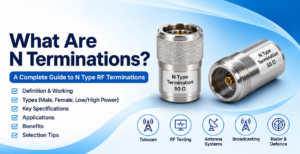
Applications of N Type Terminations
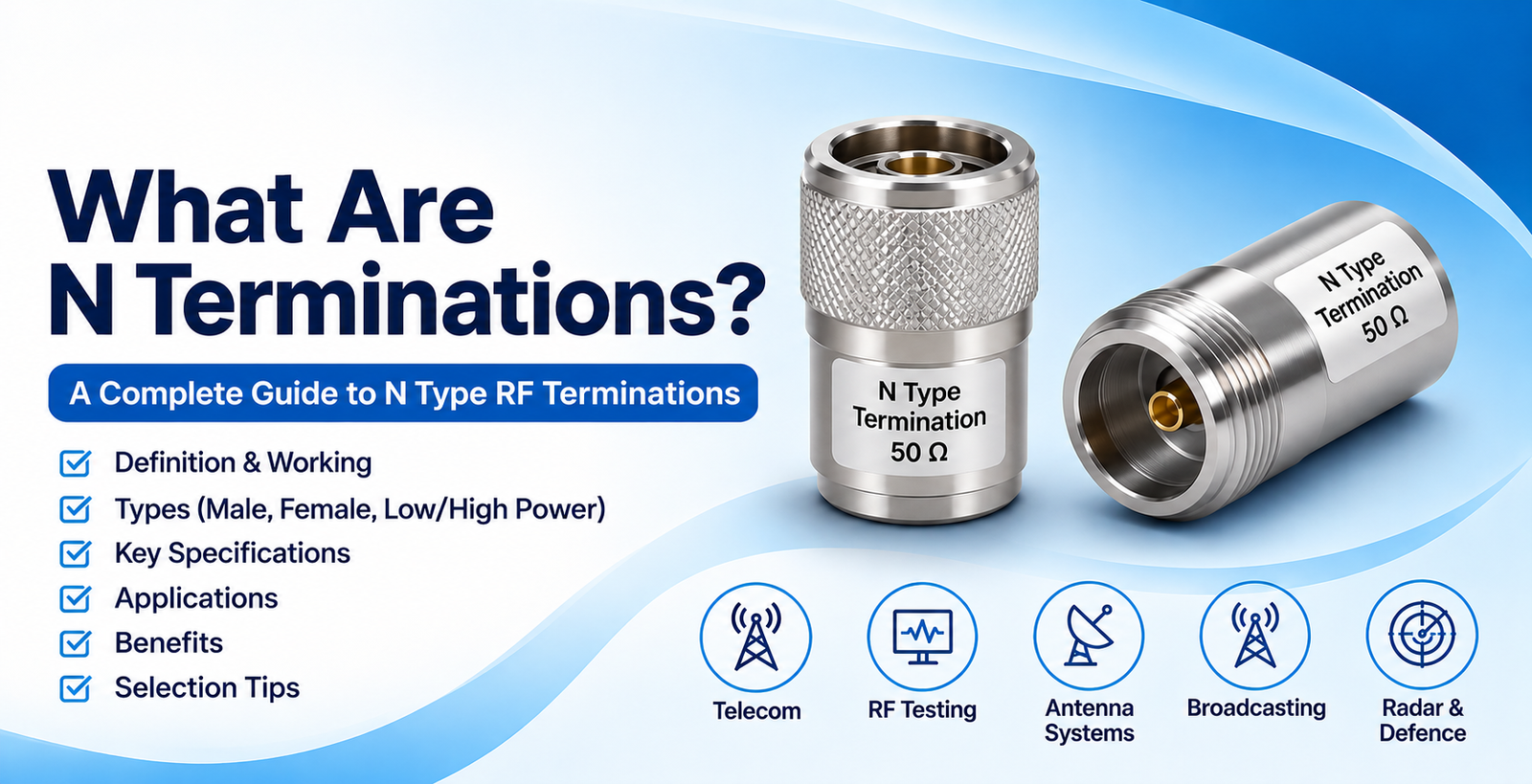
N Type RF Terminations are used across several industries because they provide reliable impedance matching and help minimise unwanted signal reflections.
1. Telecommunications Infrastructure
N Type Terminations are widely used in telecommunications infrastructure, including base station equipment, RF distribution networks, and wireless communication systems.
They help terminate unused RF ports and maintain stable signal conditions within the system.
2. RF Testing and Measurement
Testing laboratories use N Type Terminations with RF signal generators, spectrum analysers, network analysers, and other measurement instruments.
Proper termination helps reduce measurement errors caused by impedance mismatches.
3. Antenna Systems
Antenna systems may include unused RF ports, test connections, and distribution interfaces that require proper termination.
N Type Terminations provide a matched load for compatible 50-ohm N Type interfaces.
4. RF Power Dividers and Splitters
RF power dividers and splitters distribute signals across multiple output ports.
When one or more output ports remain unused, connecting suitable N Type Terminations helps maintain impedance matching and minimise unwanted reflections.
5. Broadcasting Systems
Broadcasting infrastructure uses RF components to transmit and distribute radio frequency signals.
N Type Terminations are used in compatible RF equipment to provide matched loads and support stable signal distribution.
6. Radar and Defence Communication Systems
Radar and defence communication equipment often requires reliable RF connections and controlled impedance conditions.
N Type Terminations can be used in testing setups, RF distribution networks, and compatible communication equipment.
7. Wireless Communication Networks
Wireless communication systems depend on properly matched RF components to maintain signal integrity.
N Type Terminations help manage unused RF ports in antennas, combiners, splitters, and other compatible equipment.
8. RF Amplifier Systems
RF amplifiers require suitable load conditions for reliable operation.
N Type Terminations can be used in testing and other approved configurations to provide the specified impedance at compatible RF ports.
Benefits of Using N Type RF Terminations
N Type Terminations offer several advantages in RF and microwave systems.
1. Reduced Signal Reflections
A properly matched 50-ohm termination absorbs incoming RF energy and minimises reflections.
2. Improved Signal Integrity
By reducing impedance mismatch, these components help maintain stable signal transmission.
3. Reliable Mechanical Connection
The threaded N Type connector provides a secure connection and helps prevent accidental disconnection.
4. Wide Application Compatibility
N Type Terminations are suitable for many RF applications involving compatible N Type interfaces.
5. Multiple Power Options
Different power ratings allow users to select suitable solutions for low-power testing and higher-power RF applications.
6. Durable Construction
Quality materials and suitable mechanical designs support reliable operation in demanding environments.
7. Support for Accurate RF Measurements
Proper impedance matching helps reduce measurement uncertainties caused by reflections in RF testing configurations.
N Male vs N Female Terminations: What Is the Difference?
N Male and N Female Terminations perform the same basic electrical function but have different connector interfaces.
| Feature | N Male Termination | N Female Termination |
|---|---|---|
| Connector Interface | Male | Female |
| Connection | Female N Port | Male N Port |
| Main Function | Provides matched load | Provides matched load |
| Impedance | Typically 50 Ohms | Typically 50 Ohms |
| Common Applications | RF equipment and splitters | RF cables and test equipment |
| Selection Factor | Compatible port gender | Compatible port gender |
Both configurations are available in different frequency ranges and power ratings.
The correct connector gender should be selected according to the port that needs to be terminated.
N Type Terminations vs Other RF Terminations
Different RF connector families require corresponding termination interfaces. Although their primary function is similar, their mechanical dimensions, frequency capabilities, and electrical performance may vary.
| Parameter | N Type Termination | SMA Termination | BNC Termination | TNC Termination |
|---|---|---|---|---|
| Connector Mechanism | Threaded | Threaded | Bayonet | Threaded |
| Typical Impedance | 50 Ohms | 50 Ohms | 50 Ohms or 75 Ohms | 50 Ohms |
| Common Applications | Telecom and RF systems | RF testing and microwave systems | Instrumentation and communication | Wireless and RF equipment |
| Mechanical Design | Medium-sized | Compact | Quick-connect | Medium-sized |
| Frequency Capability | Depends on design | Depends on design | Depends on design | Depends on design |
Choosing the correct termination requires considering the connector interface, frequency range, impedance, and power rating rather than connector size alone.
How to Select the Right N Type Termination?
Selecting the correct N Type RF Termination is important for maintaining electrical performance and preventing equipment damage.
Consider the following factors before purchasing.
1. Check the Connector Gender
Identify whether the equipment port requires an N Male or N Female termination.
The connector must match the interface of the RF equipment.
2. Verify the Impedance
Confirm that the termination impedance matches the transmission system.
For standard RF coaxial applications, 50-ohm N Type Terminations are commonly used.
3. Determine the Operating Frequency
Check the maximum frequency supported by the termination.
The selected product should cover the complete operating frequency range of the connected system.
4. Select the Appropriate Power Rating
Determine the maximum RF power that the termination will absorb.
Choose a power rating suitable for the application, taking into account frequency-dependent derating, ambient temperature, and cooling requirements.
5. Check VSWR and Return Loss
For sensitive RF applications, compare the VSWR and return loss specifications.
Lower VSWR and higher return loss generally indicate better impedance matching.
6. Consider Environmental Conditions
For outdoor installations, consider operating temperature, humidity, corrosion resistance, and mechanical durability.
7. Verify Product Quality
Choose terminations manufactured according to appropriate mechanical and electrical specifications.
Reliable connector construction and consistent impedance performance are important for long-term operation.
Common Mistakes to Avoid When Using N Type Terminations
Even a high-quality RF termination may not deliver the expected performance if it is selected or installed incorrectly.
Some common mistakes include:
- Using a 50-ohm termination in a 75-ohm system without verifying compatibility.
- Selecting the wrong connector gender.
- Ignoring the maximum frequency specification.
- Exceeding the rated RF power.
- Using damaged or contaminated connector interfaces.
- Applying excessive tightening force during installation.
- Ignoring the VSWR and return loss specifications.
- Using a termination in environmental conditions outside its rated limits.
- Assuming that all N Type Terminations support the same frequency range.
Following the manufacturer’s specifications helps ensure proper operation and reduces the risk of component failure.
Why Are 50 Ohm N Type Terminations Important in RF Systems?
The 50-ohm impedance standard is widely used in RF communication and measurement systems because it provides a practical balance between power-handling capability and signal transmission performance.
In a coaxial transmission system, the characteristic impedance depends on the geometry of the inner and outer conductors and the dielectric material between them.
When an RF signal encounters a load with a different impedance, part of the signal energy may be reflected.
These reflections can affect:
- Signal transmission efficiency
- VSWR performance
- RF measurement accuracy
- Amplifier stability
- Overall system reliability
A properly specified 50-ohm N Type Termination helps maintain impedance continuity and absorbs unwanted RF energy at unused ports.
Maintenance and Handling Tips for N Type Terminations
Proper handling and maintenance help extend the service life of RF terminations.
- Keep connector interfaces clean and free from dust.
- Avoid damaging the centre contact during installation.
- Inspect the connector threads before use.
- Use appropriate connector tightening practices.
- Avoid exceeding the specified power rating.
- Protect unused components from moisture and contamination.
- Store terminations in suitable protective packaging.
- Inspect electrical performance periodically in critical RF systems.
For precision applications, regular VSWR and return loss testing can help identify performance degradation.
N Type RF Terminations from SRFS Teleinfra
SRFS Teleinfra provides RF and microwave connectivity solutions for telecommunications, wireless communication, testing, and other demanding RF applications.
N Type RF Terminations are important components in maintaining impedance matching and controlling unwanted signal reflections across compatible RF systems.
When selecting an N Type Termination, it is essential to consider connector gender, operating frequency, impedance, power-handling capacity, and electrical performance.
SRFS Teleinfra focuses on RF connectivity products and solutions designed to support reliable communication infrastructure, RF testing environments, and industrial applications.
For product selection and technical specifications, visit SRFS Teleinfra.
Frequently Asked Questions (FAQs) About N Type Terminations
1. What is an N Type Termination?
An N Type Termination is a passive RF component used to terminate unused RF ports and provide a matched electrical load. It typically offers 50-ohm impedance to minimise signal reflections in coaxial transmission systems.
2. What is the impedance of an N Type Termination?
Most standard N Type RF Terminations are designed with 50-ohm impedance. However, the impedance should always be verified before connecting the component to an RF system.
3. What is the main purpose of an N Termination?
The primary purpose is to absorb incoming RF energy and minimise signal reflections caused by impedance mismatches. It helps maintain stable operating conditions in RF systems.
4. What is the difference between N Male and N Female Terminations?
An N Male Termination has a male connector interface and connects to a female N Type port. An N Female Termination has a female interface and connects to a male N Type port.
5. Can N Type Terminations reduce VSWR?
Yes. A properly matched N Type Termination can reduce reflections and help maintain a lower VSWR when connected to a compatible 50-ohm RF system.
6. What frequency range do N Type Terminations support?
The frequency range depends on the connector design, internal resistive element, and manufacturing specifications. Always check the product datasheet for the specified operating frequency.
7. What power ratings are available for N Type Terminations?
N Type Terminations are available in different power ratings, ranging from low-power versions for testing applications to higher-power versions for demanding RF systems. The actual rating depends on the product design and operating conditions.
8. Where are N Type Terminations commonly used?
They are commonly used in telecommunications, RF testing laboratories, antenna systems, power dividers, broadcasting equipment, radar systems, and wireless communication infrastructure.
9. Are N Type Terminations suitable for outdoor applications?
Some N Type Terminations are suitable for outdoor applications, depending on their environmental protection, material construction, and operating temperature specifications. Check the manufacturer’s datasheet before installation.
10. Can I use an N Type Termination on an SMA connector?
Not directly. N Type and SMA connectors have different mechanical interfaces. A suitable RF adapter may be required, provided it meets the frequency, impedance, and power requirements.
11. What happens if an RF port is left unterminated?
An unused RF port may cause signal reflections due to impedance mismatch. These reflections can affect VSWR, measurement accuracy, and the performance of connected RF equipment.
12. How do I choose the right N Type RF Termination?
Consider connector gender, impedance, frequency range, power rating, VSWR, return loss, and environmental requirements. Select a termination that meets the electrical and mechanical specifications of your RF system.
13. What is the difference between an RF termination and an RF attenuator?
An RF termination provides a matched load to absorb incoming RF energy, whereas an RF attenuator reduces the power level of a signal by a specified amount, generally measured in decibels (dB).
14. Why is a 50-ohm termination used in RF testing?
A 50-ohm termination provides a matched load for standard 50-ohm RF equipment. It helps minimise unwanted reflections and supports more accurate and repeatable measurements.
15. Do N Type Terminations require regular maintenance?
Yes. Periodic inspection of connector threads, contact surfaces, cleanliness, and electrical performance is recommended, particularly in critical RF testing and communication installations.