RG316 cable is a small-diameter, flexible coaxial cable widely used for transmitting radio frequency (RF) signals in telecommunications, wireless communication, test and measurement equipment, aerospace, defense, GPS, Wi-Fi, medical electronics, and other high-frequency applications. Its compact size and flexibility make it particularly useful where installation space is limited and the cable must be routed through tight areas.
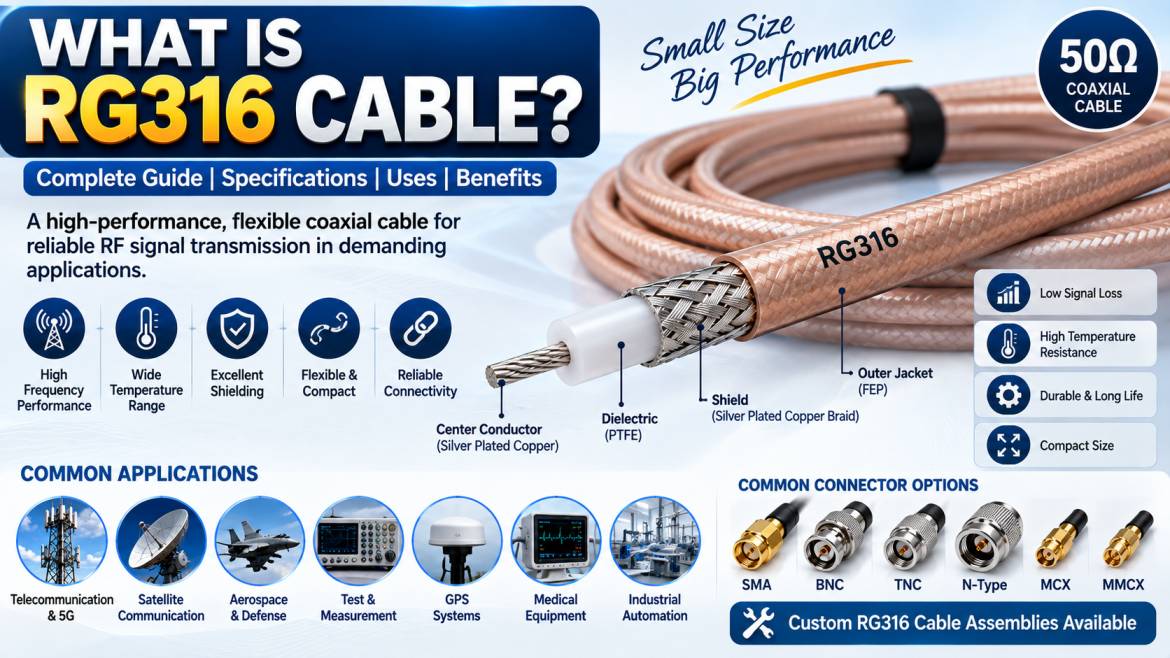
RG316 is generally manufactured with a stranded center conductor, a PTFE dielectric, a braided metallic shield, and a fluoropolymer outer jacket. This construction provides a useful combination of flexibility, temperature resistance, electrical performance, and mechanical durability.
One of the most important characteristics of RG316 cable is its ability to operate across a broad RF frequency range. Depending on the exact construction and manufacturer, RG316 cables are commonly specified for applications extending into the multi-gigahertz range. However, attenuation increases with frequency, so cable length and operating frequency should always be considered when selecting an RG316 cable assembly.
RG316 is also frequently supplied as a complete RF cable assembly with connectors such as SMA, BNC, TNC, N-Type, MMCX, MCX, and other miniature RF connectors. Custom cable assemblies can be manufactured in different lengths and connector combinations to meet specific equipment requirements.
What Is RG316 Cable?
RG316 is a miniature 50 Ohm coaxial RF cable designed primarily for high-frequency signal transmission. The cable is commonly associated with military-style RG cable designations and is widely used in commercial and industrial RF applications.
The compact construction of RG316 makes it smaller and more flexible than many larger coaxial cables. This makes it suitable for equipment where conventional low-loss coaxial cables may be physically difficult to install.
A typical RG316 cable consists of four primary layers:
- Center conductor
- Dielectric insulation
- Metallic shield
- Protective outer jacket
Together, these layers create a controlled transmission path for RF signals while reducing electromagnetic interference and signal leakage.
How Does RG316 Cable Work?
RG316 cable operates according to the principles of coaxial transmission. The RF signal travels through the center conductor, while the surrounding dielectric maintains a controlled distance between the center conductor and metallic shield.
The outer shield performs two important functions. It helps prevent external electromagnetic interference from entering the transmission path and reduces the amount of RF energy escaping from the cable.
The geometry and materials of the cable are selected to provide a characteristic impedance of approximately 50 Ohms in standard RG316 constructions. Maintaining this impedance is important because RF equipment such as antennas, transmitters, receivers, amplifiers, and test instruments is commonly designed around 50 Ohm transmission systems.
When the cable, connectors, and connected equipment have compatible impedance, signal reflections can be minimized and RF system performance can be improved.
RG316 Cable Construction
Center Conductor
The center conductor is responsible for carrying the RF signal. RG316 is commonly constructed with a stranded conductor, which provides greater flexibility than a solid conductor.
Silver-plated copper is commonly used in RG316 constructions because silver provides excellent electrical conductivity and performs well at high frequencies. The exact conductor construction can vary according to manufacturer and specification.
Dielectric
The dielectric is the insulating material positioned between the center conductor and the outer shield.
RG316 commonly uses PTFE, also known as polytetrafluoroethylene, as its dielectric material.
PTFE provides:
- Low dielectric loss
- High temperature resistance
- Good chemical resistance
- Excellent electrical insulation
- Long-term dimensional stability
These properties make PTFE particularly useful for demanding RF applications.
Shield
The metallic shield surrounds the dielectric and provides electromagnetic protection.
RG316 commonly uses a braided silver-plated copper shield. The shield provides a combination of electrical shielding and mechanical flexibility.
Shield construction can vary between manufacturers, so shielding effectiveness should be checked against the actual product datasheet when EMI performance is critical.
Outer Jacket
The outer jacket protects the internal cable structure against abrasion, moisture, chemicals, and environmental exposure.
Fluoropolymer materials such as FEP are commonly used for RG316 cable jackets because of their temperature and chemical resistance.
RG316 Cable Specifications
The exact specifications of RG316 cable vary between manufacturers, but a typical construction may have characteristics similar to those shown below.
| Specification | Typical RG316 Value |
|---|---|
| Cable Type | Miniature Coaxial RF Cable |
| Characteristic Impedance | 50 Ohms |
| Center Conductor | Stranded Silver-Plated Copper |
| Dielectric | PTFE |
| Shield | Silver-Plated Copper Braid |
| Outer Jacket | FEP / Fluoropolymer |
| Outside Diameter | Approximately 2.5 mm |
| Frequency Range | Commonly used into the GHz range |
| Operating Temperature | Often approximately -55°C to +200°C |
| Cable Type | Flexible |
| Applications | RF, Microwave, Telecom, Aerospace, Test Equipment |
These values are representative rather than universal. RF cable specifications should always be confirmed from the manufacturer’s datasheet for the specific RG316 construction.
RG316 Frequency Range
RG316 cable is designed for high-frequency applications and is commonly used from low frequencies through several gigahertz. Many RG316 products are specified for operation up to approximately 3 GHz, while some constructions may be suitable for higher frequencies depending on cable design, connector configuration, and performance requirements.
At higher frequencies, attenuation becomes increasingly important. Therefore, engineers should not select RG316 solely based on its maximum frequency rating.
When selecting RG316 for high-frequency applications, check:
- Maximum operating frequency
- Insertion loss
- Attenuation per meter
- VSWR
- Return loss
- Connector performance
- Cable length
- Temperature conditions
RG316 Cable Attenuation
Attenuation refers to the reduction in RF signal power as the signal travels through the cable.
Like other coaxial cables, RG316 experiences greater attenuation as frequency increases. The relatively small diameter that makes RG316 compact and flexible also means that it generally has higher attenuation than larger low-loss coaxial cables.
For short internal connections, equipment interconnects, and RF modules, this may not be a major concern. For long-distance transmission, however, a larger low-loss cable may provide better overall performance.
A simple way to understand cable loss is:
Total Cable Loss = Cable Attenuation per Unit Length × Cable Length
For example, if a cable has an attenuation of 1 dB/m at a particular frequency and the cable length is 2 meters, the approximate cable attenuation would be 2 dB, excluding connector losses.
Actual attenuation should always be taken from the manufacturer’s frequency-specific specifications.
RG316 Cable Impedance
Standard RG316 cable is generally designed with a 50 Ohm characteristic impedance.
50 Ohm RF systems are widely used in:
- Wireless communication
- Cellular infrastructure
- RF test equipment
- Antenna systems
- GPS
- Satellite communication
- Radar
- Aerospace electronics
- Defense electronics
Using a 50 Ohm cable in a 50 Ohm system helps minimize impedance mismatch and signal reflection.
RG316 Cable Temperature Rating
One of the major benefits of PTFE and fluoropolymer-based RG316 construction is its ability to operate over a wide temperature range.
Many RG316 products are rated for approximately -55°C to +200°C, although the actual temperature rating depends on the specific cable construction and manufacturer.
This makes RG316 attractive for applications where ordinary PVC-jacketed cables may not provide sufficient temperature resistance.
Typical high-temperature applications include:
- Aerospace equipment
- Military electronics
- Engine instrumentation
- Industrial equipment
- Test systems
- RF modules
Always verify the manufacturer’s specified temperature range before using the cable in extreme environments.
Common RG316 Cable Connector Types
RG316 cable is commonly terminated with miniature and standard RF connectors.
Popular options include:
- SMA Male
- SMA Female
- BNC Male
- BNC Female
- TNC Male
- TNC Female
- N-Type
- MMCX
- MCX
- SMB
- SMC
- RP-SMA
- 2.92 mm connectors
The correct connector should be selected according to the equipment interface, operating frequency, mechanical requirements, and environmental conditions.
RG316 Cable Assemblies
An RG316 cable assembly consists of an RG316 coaxial cable terminated with one or two RF connectors.
Common configurations include:
- SMA Male to SMA Male
- SMA Male to SMA Female
- SMA Female to SMA Female
- SMA Male to BNC Male
- SMA Male to N-Type Male
- SMA Male to TNC Male
- MMCX Male to SMA Male
- MCX Male to SMA Male
Cable assemblies can also be manufactured in customized lengths, connector orientations, and jacket configurations.
Applications of RG316 Cable
RF Communication
RG316 is widely used for short RF connections between antennas, radios, transmitters, receivers, and RF modules.
GPS Systems
GPS equipment often uses compact RF cable assemblies for connecting antennas to receivers.
Wireless Communication
RG316 can be used inside wireless communication equipment, RF modules, routers, gateways, and antenna systems.
Test and Measurement
Laboratories use RG316 assemblies for connections between RF test equipment and devices under test.
Typical equipment includes:
- Signal generators
- Spectrum analyzers
- Network analyzers
- RF power meters
- Oscilloscopes with RF interfaces
- Antenna test equipment
Aerospace and Defense
The cable’s compact size, flexibility, and temperature-resistant construction make it useful in aerospace and defense electronics.
Applications can include:
- Avionics
- Radar equipment
- Navigation systems
- Communication systems
- Military electronics
- Instrumentation
Medical Electronics
RG316 can be used in certain medical and laboratory electronic systems where compact RF connections and temperature resistance are required.
Industrial Equipment
Industrial communication and instrumentation equipment may use RG316 for internal RF signal connections.
Satellite Communication
RG316 cable assemblies can be used for short RF interconnections within satellite communication equipment and ground-based RF systems.
Advantages of RG316 Cable
Compact Size
RG316 has a small outside diameter, making it ideal for compact electronic equipment.
High Flexibility
The stranded center conductor and small cable diameter provide good flexibility for equipment interconnections.
High Temperature Resistance
PTFE and fluoropolymer construction enables many RG316 products to operate across a wide temperature range.
Good RF Performance
RG316 provides reliable RF signal transmission across a broad frequency range when used within its specified operating limits.
Excellent Chemical Resistance
Fluoropolymer materials generally provide strong resistance to many chemicals and environmental contaminants.
Easy Installation
Its small diameter allows RG316 to be routed through confined spaces.
Wide Connector Compatibility
RG316 is available with a large selection of RF connectors and custom termination options.
Reliable Performance
Properly manufactured RG316 cable assemblies provide stable electrical and mechanical performance for demanding RF applications.
Limitations of RG316 Cable
RG316 is not the best choice for every RF application.
Its main limitations include:
- Higher attenuation than larger low-loss coaxial cables
- Limited power handling compared with larger RF cables
- Increased signal loss at higher frequencies
- Not ideal for very long transmission distances
- Performance depends strongly on connector quality
- Repeated sharp bending can damage the cable
For long-distance or high-power RF transmission, engineers may choose larger low-loss coaxial cables instead.
RG316 vs RG174 Cable
RG316 and RG174 are both miniature flexible coaxial cables, but their construction and performance can differ.
| Feature | RG316 | RG174 |
|---|---|---|
| Impedance | 50 Ohms | 50 Ohms |
| Typical Conductor | Stranded, often silver-plated copper | Commonly stranded copper-based conductor |
| Dielectric | PTFE | Typically polyethylene |
| Jacket | Often FEP/fluoropolymer | Commonly PVC or similar |
| Temperature Capability | Generally higher | Generally lower |
| Flexibility | Excellent | Excellent |
| High-Temperature Applications | Better suited | More limited |
| Common Applications | RF, aerospace, defense, test | RF, GPS, electronics, telecom |
The exact specifications can vary, so individual manufacturer datasheets should be used for final product selection.
RG316 vs RG58 Cable
RG58 is considerably larger than RG316.
| Feature | RG316 | RG58 |
|---|---|---|
| Cable Diameter | Smaller | Larger |
| Flexibility | Very high | High |
| Attenuation | Generally higher | Generally lower |
| Power Handling | Lower | Higher |
| Installation Space | Excellent for compact systems | Requires more space |
| Temperature Resistance | Often high | Depends on construction |
| Typical Use | Internal RF connections | Antenna and communication systems |
RG316 is generally preferred when compact size and flexibility are more important than minimizing cable loss.
How to Choose the Right RG316 Cable
Selecting the right RG316 cable requires more than simply choosing the cable type.
Check the Frequency
Determine the highest frequency at which the cable will operate.
Check Attenuation
Review attenuation at the actual operating frequency and cable length.
Confirm Impedance
For standard RG316 applications, confirm that the system requires 50 Ohms.
Select the Correct Connector
Choose connectors that match the equipment interface.
Consider Cable Length
Shorter cables generally produce less total signal loss.
Check Temperature
Make sure the cable’s temperature rating matches the installation environment.
Evaluate Shielding
For electrically noisy environments, review the cable’s shielding construction and effectiveness.
Consider Mechanical Requirements
Determine whether the cable needs to withstand vibration, repeated movement, or tight routing.
RG316 Cable Installation Best Practices
Proper installation is essential for maintaining RF performance.
Avoid excessive pulling force.
Do not exceed the recommended bend radius.
Avoid sharp bends near connectors.
Do not twist the cable during installation.
Use appropriate RF connector torque.
Keep connectors clean.
Protect connections from moisture where required.
Avoid crushing the cable.
Use the correct cable length to minimize unnecessary signal loss.
Why RG316 Is Popular in RF Applications
RG316 has become popular because it provides a practical balance between size, flexibility, temperature resistance, and RF performance.
A larger RF cable may offer lower attenuation and higher power handling, but it may be difficult to install inside compact equipment. RG316 solves this problem by providing a miniature RF transmission solution that can be routed through limited spaces.
This makes it particularly useful for internal equipment connections, antenna pigtails, RF modules, laboratory equipment, and aerospace electronics.
Future of RG316 Cable Applications
The continuing development of wireless communication, satellite systems, IoT, GPS, aerospace electronics, defense technology, and RF measurement equipment will maintain demand for compact RF cable assemblies.
While newer technologies may use increasingly integrated RF interconnects, flexible miniature coaxial cables such as RG316 remain useful wherever engineers need a physical RF connection between separate components.
Future cable assemblies are expected to focus on improved shielding, lower attenuation, higher-frequency performance, enhanced connector reliability, smaller form factors, and customized configurations for specialized RF systems.
Conclusion
RG316 cable is a compact, flexible, 50 Ohm coaxial RF cable designed for reliable high-frequency signal transmission. Its PTFE dielectric, flexible conductor, metallic braid, and temperature-resistant outer jacket make it suitable for a wide variety of demanding applications.
RG316 is particularly valuable where space is limited and flexibility, temperature resistance, and dependable RF performance are required. It is commonly used in wireless communication, GPS, aerospace, defense, satellite communication, medical electronics, industrial equipment, and RF test and measurement systems.
When selecting an RG316 cable, engineers should consider operating frequency, attenuation, cable length, impedance, connector type, temperature rating, shielding, and mechanical requirements. Choosing the correct cable and connector combination ensures reliable signal transmission and long-term system performance.
Frequently Asked Questions About RG316 Cable
1. What is RG316 cable?
RG316 is a miniature 50 Ohm flexible coaxial cable designed for RF and microwave signal transmission. It is commonly used in communication, aerospace, defense, GPS, test equipment, and electronic systems.
2. What is the impedance of RG316 cable?
Standard RG316 cable has a characteristic impedance of 50 Ohms, making it suitable for many RF communication and test applications.
3. What is RG316 cable used for?
RG316 is used for RF interconnections, GPS systems, wireless communication, antennas, laboratory equipment, aerospace electronics, defense equipment, medical electronics, and industrial systems.
4. Is RG316 cable flexible?
Yes. RG316 is a highly flexible miniature coaxial cable. Its small diameter and commonly stranded center conductor allow it to be routed through compact electronic equipment.
5. What material is used for RG316 dielectric?
RG316 commonly uses PTFE as the dielectric material. PTFE provides excellent electrical insulation, low dielectric loss, and high temperature resistance.
6. What temperature can RG316 cable withstand?
Many RG316 constructions are designed for approximately -55°C to +200°C, but the actual rating depends on the manufacturer and specific construction.
7. What connectors can be used with RG316 cable?
RG316 can be terminated with SMA, BNC, TNC, N-Type, MMCX, MCX, SMB, SMC, and other RF connectors depending on the application.
8. Is RG316 suitable for high-frequency applications?
Yes. RG316 is widely used for high-frequency RF applications, but its attenuation increases with frequency. The manufacturer’s frequency and attenuation specifications should be checked for the intended application.
9. Is RG316 a low-loss cable?
RG316 is not generally considered a very-low-loss cable. Its small diameter provides excellent flexibility and compactness but typically results in higher attenuation than larger low-loss coaxial cables.
10. What is the difference between RG316 and RG58?
RG316 is smaller, lighter, and more flexible, while RG58 is larger and generally offers lower attenuation and greater power handling. RG316 is often better for compact equipment and short RF connections.
11. Can RG316 cable be used for GPS?
Yes. RG316 cable assemblies are commonly used for GPS antenna and receiver interconnections, particularly where a compact and flexible RF cable is required.
12. Can RG316 cable be used outdoors?
RG316 can be used in suitable outdoor applications when the cable jacket, connector termination, sealing, and environmental ratings are appropriate. Outdoor installations should use products specifically rated for the expected conditions.
13. Can RG316 cable handle high RF power?
RG316 has limited power handling compared with larger coaxial cables. The allowable power depends on frequency, temperature, cable construction, and manufacturer specifications.
14. What is the typical diameter of RG316 cable?
A typical RG316 cable has an outside diameter of approximately 2.5 mm, although the exact dimension can vary by manufacturer and construction.
15. How do I select the correct RG316 cable assembly?
Consider the required frequency, impedance, cable length, attenuation, connector type, temperature range, shielding requirements, mechanical environment, and power level before selecting an RG316 cable assembly.