What Is a DIN Connector?
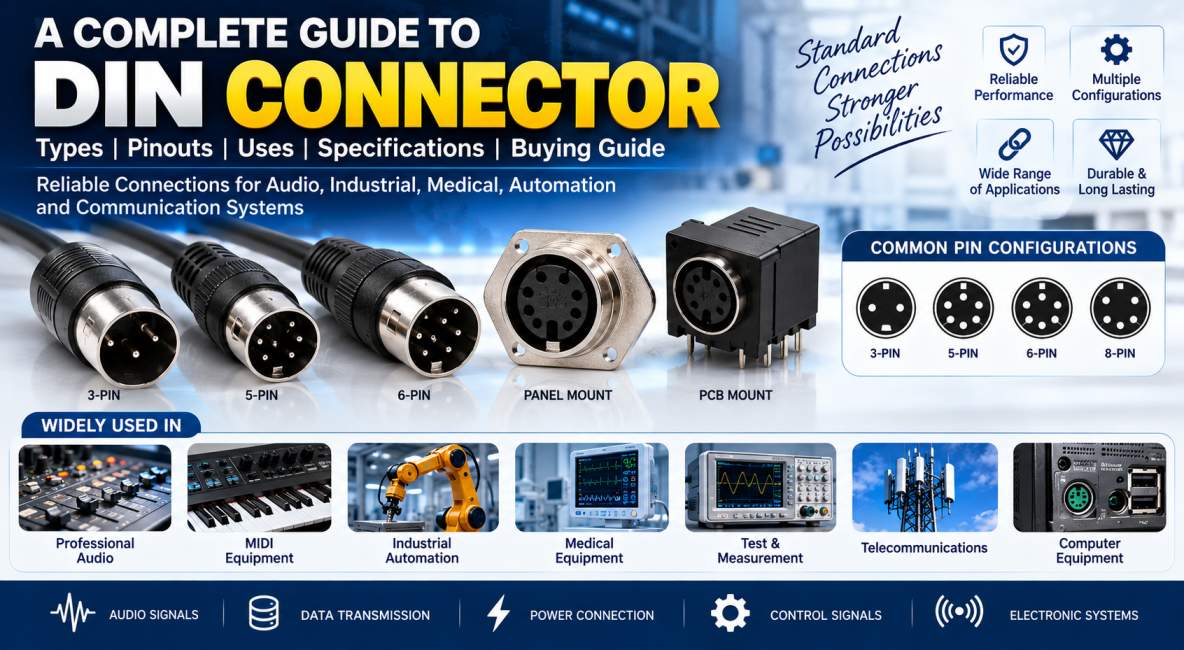
A DIN connector is a standardized electrical connector designed for transmitting electrical signals, audio, video, control signals, and power between electronic devices. The term DIN comes from the German organization Deutsches Institut für Normung, which developed standards for various mechanical and electrical components.
DIN connectors typically feature a circular metal or plastic housing containing multiple pins arranged in a defined configuration. Their standardized construction provides reliable electrical connections while allowing equipment manufacturers to use compatible connector interfaces.
DIN connectors have been used extensively in audio equipment, industrial automation, telecommunications, computers, measurement instruments, control systems, and electronic equipment. Although many consumer applications have transitioned to newer interfaces such as USB, HDMI, and USB-C, DIN connectors continue to be important in industrial, professional audio, automation, and specialized electronic applications.
The wide range of DIN connector configurations makes them suitable for applications requiring multiple electrical connections within a single compact connector.
History of DIN Connectors
DIN connector standards originated in Germany and became widely adopted throughout Europe and other parts of the world. The connectors were initially developed to create standardized and reliable interfaces between electronic devices.
Traditional DIN connectors became particularly popular in audio equipment, where 3-pin, 5-pin, and other configurations were used for microphones, amplifiers, mixers, and recording equipment.
Over time, DIN connector designs expanded into industrial automation, control systems, computer peripherals, medical equipment, and telecommunications.
Mini DIN connectors were later introduced as a smaller alternative for applications where installation space was limited.
How Does a DIN Connector Work?
A DIN connector establishes an electrical connection between a male plug and a corresponding female socket.
The male connector contains pins that fit into matching contacts inside the female connector. Each pin can carry a separate electrical function depending on the connector design and application.
For example, different pins may be assigned to:
- Signal transmission
- Ground
- Power
- Audio channels
- Control signals
- Data communication
- Sensor signals
- Video signals
The circular housing helps maintain proper alignment, while the keyed design prevents the connector from being inserted incorrectly.
When properly mated, the contacts establish a low-resistance electrical connection, allowing signals or power to pass between connected equipment.
DIN Connector Construction
A typical DIN connector consists of several important components.
Connector Housing
The housing protects the internal contacts from mechanical damage and provides structural support.
Depending on the application, the housing may be manufactured from:
- Metal
- Aluminum
- Stainless steel
- Nickel-plated brass
- Engineering plastic
- Thermoplastic materials
Industrial DIN connectors generally use ruggedized materials to withstand vibration, temperature variations, and repeated mating.
Electrical Contacts
The contacts carry electrical signals between the connected devices.
Common contact materials include:
- Brass
- Copper alloy
- Phosphor bronze
- Nickel-plated materials
- Gold-plated materials
Gold-plated contacts are often used where low contact resistance and corrosion resistance are important.
Insulator
The insulator separates individual contacts and prevents electrical short circuits.
High-quality thermoplastic materials are commonly used because they provide good insulation and mechanical stability.
Cable Strain Relief
Cable-mounted DIN connectors may include strain relief to prevent excessive mechanical stress from being transferred to the electrical contacts.
Locking Mechanism
Depending on the design, DIN connectors can use friction fitting, locking rings, latches, or threaded mechanisms to maintain a secure connection.
DIN Connector Types
DIN connectors are available in several configurations based on pin count, application, mounting method, and physical design.
3-Pin DIN Connector
The 3-pin DIN connector is commonly associated with audio applications and basic signal connections.
Typical applications include:
- Audio equipment
- Microphones
- Amplifiers
- Control systems
- Electronic instruments
4-Pin DIN Connector
4-pin DIN connectors are used in applications requiring four electrical connections.
They may be found in:
- Industrial equipment
- Audio systems
- Control equipment
- Electronic instruments
5-Pin DIN Connector
The 5-pin DIN connector is one of the most recognizable DIN connector configurations.
It has historically been used for:
- MIDI equipment
- Professional audio
- Amplifiers
- Audio mixers
- Control systems
- Legacy computer equipment
6-Pin DIN Connector
6-pin DIN connectors provide additional contacts for applications requiring more signal connections.
They are used in:
- Industrial equipment
- Control systems
- Specialized electronic equipment
- Legacy communication systems
7-Pin DIN Connector
7-pin DIN connectors are used when more signal contacts are required within a compact circular housing.
Typical applications include:
- Industrial control
- Measurement equipment
- Medical electronics
- Specialized communication equipment
8-Pin DIN Connector
8-pin DIN connectors can accommodate multiple signal and power connections.
They are commonly found in:
- Industrial automation
- Communication equipment
- Control systems
- Electronic instruments
9-Pin DIN Connector
9-pin DIN connectors are suitable for applications requiring multiple signal connections.
They can be used in:
- Industrial electronics
- Medical systems
- Instrumentation
- Control equipment
DIN Connector Pin Configuration
DIN connector pin assignments are application-specific. The physical number of pins alone does not determine what each contact carries.
For example, a 5-pin DIN connector used for MIDI has a different pin assignment from a 5-pin DIN connector used for another application.
Therefore, engineers should always refer to the equipment manufacturer’s wiring diagram or connector datasheet before connecting a DIN connector.
DIN Connector Pinout Chart
| DIN Connector | Number of Pins | Typical Applications |
|---|---|---|
| 3-Pin DIN | 3 | Audio and signal connections |
| 4-Pin DIN | 4 | Industrial and electronic equipment |
| 5-Pin DIN | 5 | MIDI, audio and control |
| 6-Pin DIN | 6 | Industrial and specialized equipment |
| 7-Pin DIN | 7 | Control and instrumentation |
| 8-Pin DIN | 8 | Communication and automation |
| 9-Pin DIN | 9 | Industrial and electronic systems |
DIN Connector Mounting Types
DIN connectors are available in different mounting configurations.
Cable Mount DIN Connector
Cable mount connectors are attached directly to cables.
They are commonly used for:
- Audio cables
- Control cables
- Instrument cables
- Communication equipment
Panel Mount DIN Connector
Panel mount connectors are installed into equipment enclosures.
They are ideal for:
- Control panels
- Industrial machines
- Test equipment
- Medical devices
- Communication equipment
PCB Mount DIN Connector
PCB-mounted DIN connectors are directly attached to printed circuit boards.
They are used in:
- Electronic control units
- Industrial equipment
- Communication devices
- Instrumentation systems
Right-Angle DIN Connector
Right-angle versions allow cables to exit perpendicular to the connector interface.
They are particularly useful where installation space is limited.
DIN Connector Applications
DIN connectors are used across a wide range of industries.
Professional Audio
DIN connectors have historically played an important role in professional and consumer audio equipment.
Applications include:
- Audio mixers
- Amplifiers
- Microphones
- Recording equipment
- Musical instruments
MIDI Equipment
5-pin DIN connectors have been widely associated with MIDI interfaces used to exchange musical performance and control information between electronic instruments.
Industrial Automation
DIN connectors are used for connecting:
- Sensors
- Controllers
- PLC equipment
- Industrial instruments
- Actuators
- Control panels
Telecommunications
Specialized DIN connector configurations can be used in communication equipment for power, control, and signal interfaces.
Medical Equipment
DIN connectors can be found in specialized medical and laboratory equipment where reliable electrical connections are required.
Test and Measurement
Test instruments may use DIN connectors for signal, control, and power connections.
Applications include:
- Signal generators
- Measurement instruments
- Laboratory equipment
- Industrial testing systems
Computer Equipment
DIN and Mini DIN connectors were historically used extensively in computer peripherals and communication interfaces.
DIN Connector Specifications
The specifications of a DIN connector depend on its design and manufacturer.
Important parameters include:
| Specification | Description |
|---|---|
| Pin Count | Number of electrical contacts |
| Contact Resistance | Electrical resistance at the mating contacts |
| Insulation Resistance | Resistance between electrically isolated contacts |
| Voltage Rating | Maximum rated operating voltage |
| Current Rating | Maximum rated current |
| Operating Temperature | Permitted temperature range |
| Mating Cycles | Number of connection and disconnection cycles |
| Contact Material | Material used for electrical contacts |
| Housing Material | Material used for the connector body |
| Mounting Type | Cable, panel, PCB or right-angle mounting |
Electrical Performance of DIN Connectors
Electrical performance is determined by several factors.
Contact Resistance
Low contact resistance helps reduce voltage drops and signal losses.
Insulation Resistance
High insulation resistance prevents unwanted current leakage between contacts.
Dielectric Strength
Dielectric strength indicates the ability of the insulation system to withstand electrical voltage without breakdown.
Current Capacity
The current rating determines how much electrical current can safely pass through the connector.
Signal Integrity
For high-speed or sensitive applications, contact geometry, shielding, impedance, and connector construction can influence signal integrity.
DIN Connector Materials
Different materials are selected based on the application’s electrical and mechanical requirements.
Copper alloys are commonly used for contacts because they provide good conductivity and mechanical strength.
Gold plating is often selected for demanding applications because of its corrosion resistance and stable contact performance.
Nickel plating can provide additional protection against corrosion and mechanical wear.
Plastic or thermoplastic materials are generally used for insulation and connector housings because they provide electrical isolation and mechanical protection.
Advantages of DIN Connectors
DIN connectors offer several important benefits.
- Standardized connector design
- Multiple pin configurations
- Compact circular construction
- Reliable electrical connections
- Easy installation
- Secure mating
- Good mechanical durability
- Available in different mounting styles
- Suitable for signal and control applications
- Cost-effective
- Wide industry adoption
- Multiple housing and contact materials
Limitations of DIN Connectors
Despite their advantages, conventional DIN connectors also have some limitations.
- Standard versions may not provide high environmental sealing
- Pin contacts can be damaged by excessive mechanical force
- Some designs have limited high-frequency performance
- Connector specifications vary between applications
- Older DIN interfaces may have limited compatibility with modern digital systems
For demanding outdoor or industrial environments, ruggedized or IP-rated DIN connector designs may be more appropriate.
DIN Connector vs Mini DIN Connector
DIN and Mini DIN connectors share similar circular concepts but differ in physical size and typical applications.
| Feature | DIN Connector | Mini DIN Connector |
|---|---|---|
| Size | Larger | More compact |
| Pin Configurations | Multiple | Commonly 3–9 pins |
| Applications | Audio, industrial, control | Computers, industrial, medical |
| Space Requirement | Moderate | Low |
| Mechanical Design | Robust | Compact |
| Common Legacy Use | Audio and equipment | PS/2, S-Video and peripherals |
DIN Connector vs Other Modern Connectors
Modern electronic systems use a wide variety of interfaces, including USB, HDMI, Ethernet, circular connectors, and specialized industrial connectors.
DIN connectors remain useful when a system requires a compact multi-contact circular interface, particularly for legacy equipment, industrial control, professional audio, and specialized instrumentation.
The correct connector should always be selected based on the electrical requirements and mechanical environment rather than simply choosing the newest connector technology.
How to Choose the Right DIN Connector
Selecting the correct DIN connector requires careful consideration of several factors.
Determine the Number of Pins
Identify how many electrical circuits need to be connected.
Check the Pin Configuration
Confirm the exact pinout before ordering or wiring the connector.
Check Voltage and Current Ratings
Ensure that the connector can safely handle the electrical load.
Select the Correct Mounting Style
Choose between cable mount, panel mount, PCB mount, or right-angle versions depending on installation requirements.
Consider Environmental Conditions
For industrial or outdoor applications, consider:
- Temperature
- Humidity
- Dust
- Vibration
- Chemical exposure
- Water resistance
Consider Contact Material
Gold-plated contacts may be preferable for applications requiring corrosion resistance and stable low-resistance connections.
Check Mating Durability
For equipment requiring frequent connection and disconnection, select a connector designed for the required mating cycle count.
DIN Connector Installation Best Practices
Proper installation helps ensure reliable long-term performance.
Always verify the pinout before installation.
Avoid forcing the connector into the mating socket.
Do not bend connector pins.
Use appropriate cable stripping and termination techniques.
Provide adequate cable strain relief.
Avoid excessive cable pulling.
Keep contacts clean and free from contamination.
For panel-mounted connectors, ensure that mounting hardware is properly secured.
Maintenance of DIN Connectors
DIN connectors generally require minimal maintenance, but regular inspection can prevent connection problems.
Inspect contacts for corrosion or physical damage.
Check cable strain relief.
Clean contaminated contacts using an appropriate contact-cleaning method.
Inspect the connector housing for cracks.
Check that the connector locks or mates correctly.
Replace damaged connectors rather than continuing to operate with unreliable contacts.
DIN Connectors in Industrial Automation
Industrial automation systems require dependable connections between controllers, sensors, actuators, and instruments.
DIN connectors can provide compact multi-contact interfaces for control and signal connections. Their circular design can simplify equipment wiring and maintenance while allowing multiple circuits to be carried through a single connector.
For harsh industrial environments, ruggedized connector versions with enhanced sealing and mechanical protection can provide improved reliability.
DIN Connectors in Professional Audio
Professional audio is one of the most historically important applications for DIN connectors.
Different DIN configurations have been used for:
- Microphones
- Amplifiers
- Audio equipment
- Recording systems
- Musical instruments
- MIDI communication
Their multi-pin configuration allows several electrical connections to be integrated into one compact interface.
DIN Connector Quality and Reliability
Connector quality can significantly influence system reliability.
A high-quality DIN connector should provide:
- Consistent contact pressure
- Low contact resistance
- Strong mechanical construction
- Accurate pin alignment
- Reliable insulation
- Corrosion-resistant contacts
- Durable housing
- Consistent manufacturing tolerances
For mission-critical applications, connectors should be selected according to applicable industry standards and the manufacturer’s technical specifications.
Future of DIN Connectors
DIN connectors continue to have relevance in specialized applications despite the widespread adoption of USB, USB-C, Ethernet, HDMI, and other modern interfaces.
Industrial automation, professional audio, medical electronics, instrumentation, and legacy equipment continue to require dependable circular multi-pin interfaces.
Future developments are likely to focus on improved environmental protection, higher durability, better contact materials, enhanced shielding, smaller form factors, and application-specific ruggedized designs.
Conclusion
DIN connectors are versatile circular electrical connectors that have been used for decades in audio, industrial automation, telecommunications, instrumentation, computers, medical equipment, and specialized electronic systems. Their multiple pin configurations, compact circular construction, reliable electrical contacts, and availability in different mounting styles make them suitable for a wide range of applications.
When selecting a DIN connector, it is important to consider pin count, pinout, voltage rating, current rating, mounting configuration, contact material, environmental conditions, and mating durability. For demanding applications, choosing a connector from a reliable manufacturer and verifying its technical specifications can significantly improve system reliability.
Although newer interfaces have replaced DIN connectors in many consumer applications, DIN connectors remain an important connectivity solution for industrial, professional, legacy, and specialized electronic systems.
Frequently Asked Questions About DIN Connectors
1. What is a DIN connector?
A DIN connector is a circular multi-pin electrical connector used to transmit power, audio, video, control signals, and data between electronic devices.
2. What does DIN stand for?
DIN stands for Deutsches Institut für Normung, the German Institute for Standardization.
3. How many pins does a DIN connector have?
DIN connectors are available in various configurations, including 3-pin, 4-pin, 5-pin, 6-pin, 7-pin, 8-pin, and 9-pin versions. Other specialized configurations are also available.
4. What is a 5-pin DIN connector used for?
5-pin DIN connectors have been widely used for audio equipment, MIDI interfaces, amplifiers, control systems, and other electronic applications.
5. What is the difference between DIN and Mini DIN connectors?
Mini DIN connectors are smaller versions of circular DIN-style connectors and are commonly used where installation space is limited.
6. Are DIN connectors still used?
Yes. DIN connectors continue to be used in professional audio, industrial automation, instrumentation, medical equipment, legacy systems, and specialized electronics.
7. Are all 5-pin DIN connectors wired the same way?
No. The pin assignment depends on the application. Always verify the equipment-specific wiring diagram before making a connection.
8. Are DIN connectors suitable for industrial applications?
Yes. DIN connectors can be used in industrial applications, particularly when the selected connector has suitable electrical ratings and mechanical or environmental protection.
9. Can DIN connectors carry power?
Yes. Certain DIN connectors are designed to carry electrical power, but the allowable voltage and current depend on the specific connector design.
10. What materials are used to manufacture DIN connector contacts?
DIN connector contacts are commonly manufactured from copper alloys, brass, or phosphor bronze and may be plated with nickel or gold.
11. What factors should be considered when buying a DIN connector?
Important factors include pin count, pinout, voltage rating, current rating, contact material, mounting type, operating temperature, environmental protection, cable size, and mating cycles.
12. What are the main applications of DIN connectors?
DIN connectors are used in professional audio, MIDI equipment, industrial automation, telecommunications, computers, medical electronics, instrumentation, control systems, and specialized electronic equipment.
For top-notch RF & 5G components solutions, choose SRFS TELEINFRA. Get in touch: Call Us: 7838349349 Or Email Us: info@srfsteleinfra.in