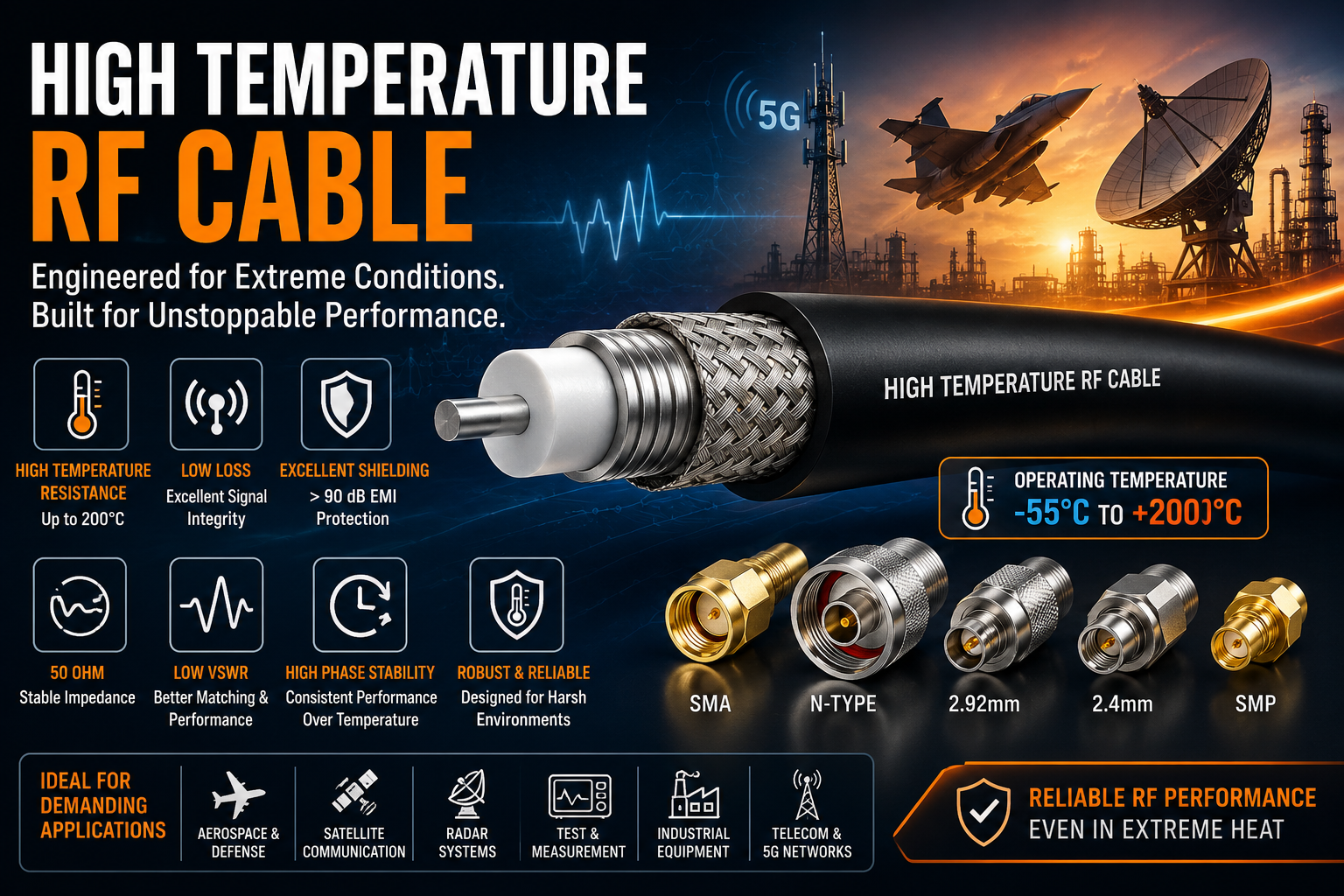
High Temperature RF Cable is a specialized radio frequency cable designed to transmit high-frequency signals reliably in environments where conventional coaxial cables may experience insulation breakdown, signal degradation, mechanical failure, or excessive phase variation due to elevated temperatures. These cables are engineered using heat-resistant dielectric materials, high-temperature insulation, robust conductors, and protective jackets to maintain electrical and mechanical performance under demanding operating conditions.
High temperature RF cables are widely used in aerospace, defense, telecommunications, satellite systems, test and measurement, industrial electronics, semiconductor manufacturing, radar, wireless infrastructure, and other applications where RF signals must remain stable despite significant temperature exposure.
As RF systems continue to operate at higher frequencies and in increasingly demanding environments, cable selection becomes critical. A cable that performs well at room temperature may not provide the same insertion loss, impedance stability, phase stability, or mechanical reliability when exposed to elevated temperatures. High Temperature RF Cable addresses these challenges by combining RF performance with thermal resistance.
What Is a High Temperature RF Cable?
A High Temperature RF Cable is a coaxial RF transmission cable specifically designed to operate continuously or intermittently at temperatures above the normal range of standard RF cables.
A typical RF cable consists of a center conductor, dielectric material, outer conductor or shielding, and protective jacket. In high-temperature designs, each component is selected according to the expected temperature, frequency, power level, mechanical environment, and required electrical stability.
Depending on construction and application, high temperature RF cables may use materials such as PTFE, FEP, PFA, fluoropolymer insulation, silicone-based materials, mineral insulation, or other specialized high-temperature materials.
The main purpose is not simply to withstand heat. A high-quality high-temperature RF cable should also maintain controlled impedance, low signal loss, effective shielding, acceptable VSWR, and stable phase characteristics throughout its operating temperature range.
Why High Temperature RF Cables Are Important
Temperature can significantly affect RF cable performance. When a conventional cable is exposed to excessive heat, its dielectric properties can change, insulation can soften or deteriorate, shielding can become mechanically unstable, and dimensional changes can affect impedance.
These changes can result in:
- Increased insertion loss
- Higher VSWR
- Return loss degradation
- Phase instability
- Impedance variation
- Dielectric deterioration
- Jacket cracking or deformation
- Reduced cable service life
- Connector reliability problems
- Signal transmission errors
High Temperature RF Cable is engineered to minimize these effects and provide reliable RF transmission in thermally demanding environments.
Construction of High Temperature RF Cable
The construction of a high-temperature RF cable is similar to conventional coaxial cable architecture, but the materials and manufacturing processes are optimized for thermal stability.
Center Conductor
The center conductor carries the RF signal. Depending on the application, it may be manufactured from copper, silver-plated copper, tin-plated copper, copper alloy, or other conductive materials.
Silver-plated conductors are often used in high-performance RF cables because silver provides excellent electrical conductivity and can support high-frequency performance.
The conductor design can be solid, stranded, or specialized for flexible applications.
Dielectric Insulation
The dielectric separates the center conductor from the outer conductor while controlling the cable’s characteristic impedance.
High-temperature RF cables commonly use thermally stable dielectric materials such as PTFE and other fluoropolymers. The dielectric must maintain its electrical properties across the intended temperature range.
Important dielectric characteristics include:
- Low dielectric loss
- Stable dielectric constant
- High temperature resistance
- Low moisture absorption
- Mechanical stability
- Low dissipation factor
Outer Conductor and Shielding
The outer conductor provides the return path for the RF signal and protects the transmitted signal from electromagnetic interference.
Depending on the cable design, shielding may include:
- Copper braid
- Silver-plated copper braid
- Tinned copper braid
- Metal foil
- Double shielding
- Triple shielding
- Corrugated metal construction
- Semi-rigid metal outer conductor
High shielding effectiveness is particularly important in sensitive RF measurement, defense, aerospace, and communication systems.
Protective Jacket
The outer jacket protects the cable against environmental conditions, abrasion, chemicals, moisture, and mechanical damage.
For high-temperature applications, specialized fluoropolymers, silicone, fiberglass, or other heat-resistant materials may be used.
The jacket material should be selected according to the actual temperature, flexibility requirements, chemical exposure, and installation environment.
Key Features of High Temperature RF Cable
High Temperature RF Cables are designed around both electrical and environmental performance.
High Temperature Resistance
The most important characteristic is the ability to operate reliably at elevated temperatures. The actual temperature rating depends on the cable construction and materials.
Different cable designs may support different continuous and intermittent temperature ranges, so the manufacturer’s datasheet should always be consulted before selecting a cable.
Low Insertion Loss
Insertion loss represents the signal power lost as the RF signal travels through the cable. A high-performance high-temperature cable is designed to minimize attenuation while maintaining stable performance over its specified frequency and temperature range.
Stable Impedance
Most RF systems use a controlled characteristic impedance, commonly 50 Ohms. Maintaining impedance stability is essential for minimizing signal reflections.
Low VSWR
Low Voltage Standing Wave Ratio indicates better impedance matching between the cable and connected RF components.
A stable VSWR across temperature and frequency helps improve overall system performance.
Excellent Shielding
High-temperature RF cables can be constructed with multiple shielding layers to reduce electromagnetic interference and prevent unwanted RF leakage.
Phase Stability
Phase stability becomes especially important in precision RF systems, phased-array antennas, radar, satellite communication, and measurement equipment.
Temperature changes can cause physical expansion and dielectric-property changes, which may alter signal phase. Specialized cables are designed to minimize these effects.
Mechanical Durability
High-temperature cables may need to withstand vibration, bending, thermal cycling, abrasion, and repeated installation.
A suitable construction helps maintain cable integrity under mechanical stress.
Types of High Temperature RF Cable
High Temperature RF Cable is available in several constructions depending on application requirements.
Flexible High Temperature RF Cable
Flexible versions are designed for applications requiring repeated movement, bending, or routing through compact equipment.
They are commonly used in:
- RF test systems
- Laboratory equipment
- Aerospace electronics
- Industrial equipment
- Antenna connections
- Semiconductor equipment
Semi-Flexible High Temperature RF Cable
Semi-flexible cables provide greater mechanical stability than highly flexible cables while still allowing controlled routing.
They are useful where signal integrity and phase stability are important.
Semi-Rigid High Temperature RF Cable
Semi-rigid RF cables use a solid metal outer conductor and provide excellent shielding and controlled impedance.
They are widely used in microwave systems, aerospace electronics, test equipment, instrumentation, and high-frequency assemblies.
High Temperature Coaxial Cable
High-temperature coaxial cables are available in different sizes and electrical configurations for general RF transmission, microwave systems, instrumentation, and specialized equipment.
High Temperature Low-Loss RF Cable
These cables are optimized to reduce attenuation, making them suitable for applications where signal power must travel through longer cable paths.
Electrical Parameters to Consider
Selecting the correct high-temperature RF cable requires consideration of several electrical parameters.
Frequency Range
The cable must support the complete operating frequency range of the RF system.
Applications may range from relatively low RF frequencies to microwave and millimeter-wave frequencies.
Characteristic Impedance
The most common RF impedance is 50 Ohms. Some systems may use 75 Ohms.
The cable impedance should match the system and connected components to minimize reflections.
Insertion Loss
Insertion loss indicates the attenuation introduced by the cable.
Lower loss is generally preferred, especially in high-frequency and long-distance RF transmission.
Return Loss
Return loss measures the amount of signal reflected back toward the source.
Higher return loss generally indicates better impedance matching.
VSWR
VSWR is another important indicator of impedance matching. Lower VSWR generally means lower reflection and improved RF transmission performance.
Power Handling
Power capability depends on frequency, conductor size, dielectric construction, ambient temperature, cooling conditions, and cable design.
Power ratings should therefore be evaluated at the actual operating temperature rather than relying only on room-temperature specifications.
Phase Stability
For precision RF applications, temperature-dependent phase variation can be a major selection criterion.
Phase-stable high-temperature cables are particularly useful in systems where timing and phase accuracy are critical.
Temperature Rating and Derating
One of the most important considerations when selecting a High Temperature RF Cable is the difference between maximum temperature rating and actual continuous operating temperature.
A cable may be capable of surviving a particular temperature for a limited period but may not be suitable for continuous operation at that temperature.
Engineers should evaluate:
- Continuous operating temperature
- Maximum intermittent temperature
- Thermal cycling
- Heating rate
- Cooling rate
- Ambient temperature
- RF power
- Installation conditions
- Connector temperature rating
Temperature can also affect power-handling capability. As temperature increases, heat dissipation becomes more difficult, potentially requiring power derating.
Materials Used in High Temperature RF Cable
Material selection directly influences thermal and electrical performance.
PTFE
PTFE is widely used as an RF dielectric because it offers excellent electrical insulation, low dielectric loss, chemical resistance, and strong temperature performance.
FEP
FEP is another fluoropolymer used in cable insulation and jacketing applications where temperature resistance, flexibility, and chemical resistance are required.
PFA
PFA provides high temperature and chemical resistance and can be used in specialized cable constructions.
Silicone
Silicone-based materials can provide excellent flexibility and temperature resistance in specialized cable applications.
Fiberglass
Fiberglass may be used as a protective thermal layer or mechanical reinforcement in cables designed for particularly demanding environments.
High Temperature RF Cable vs Standard RF Cable
The primary difference between a standard RF cable and a high-temperature RF cable is the ability to maintain performance under elevated thermal conditions.
A standard RF cable may be optimized primarily for electrical performance at normal operating temperatures. A high-temperature cable must balance electrical performance with thermal stability.
High-temperature construction can provide:
- Better thermal endurance
- Improved insulation stability
- Greater environmental reliability
- More stable RF characteristics
- Improved service life in hot environments
However, high-temperature capability may involve trade-offs in flexibility, cost, cable diameter, or mechanical construction depending on the design.
Applications of High Temperature RF Cable
Aerospace
Aerospace systems can experience extreme temperature variation, vibration, and limited maintenance access. High-temperature RF cables are used in communication, navigation, radar, avionics, and instrumentation systems.
Defense
Military electronics require reliable signal transmission under demanding environmental conditions. High-temperature cables can be used in radar, electronic warfare, communications, surveillance, and test systems.
Satellite Communication
Satellite systems require cables capable of maintaining RF performance across thermal extremes.
High-temperature and phase-stable cable assemblies can support RF links, payload electronics, antenna systems, and test equipment.
Radar Systems
Radar systems depend on accurate RF transmission and phase relationships. Temperature-stable cables can help maintain consistent signal characteristics.
RF Test and Measurement
Test laboratories use specialized RF cables for network analyzers, spectrum analyzers, signal generators, power meters, and calibration systems.
High-temperature versions can be used when test fixtures or equipment operate in heated environments.
Semiconductor Manufacturing
Semiconductor processing equipment may expose RF cables to elevated temperatures, chemicals, vacuum environments, and repeated thermal cycles.
Industrial Electronics
Industrial machinery, heating equipment, sensors, RF generators, and process-control systems can benefit from thermally resistant RF cable assemblies.
Telecommunications
Telecommunication equipment installed in high-temperature environments may require RF cables with enhanced thermal reliability.
High Temperature RF Cable for RF Test Systems
RF test environments demand consistent and repeatable measurements.
Cable temperature variation can affect:
- Phase
- Insertion loss
- Return loss
- Amplitude
- Measurement repeatability
For this reason, high-temperature and temperature-stable RF cables can be valuable in calibration systems and precision measurement applications.
When used with connectors and test equipment, the cable assembly should be evaluated as a complete RF path rather than considering the cable alone.
Importance of Connectors in High Temperature RF Cable Assemblies
A high-temperature cable cannot provide reliable performance if the connected RF connectors are not rated for the same environment.
Common RF connector interfaces include:
- SMA
- N Type
- TNC
- BNC
- 2.92mm
- 2.4mm
- 1.85mm
- SMP
- SMPM
- MCX
- MMCX
Connector selection should consider frequency, temperature rating, impedance, mating cycles, mechanical requirements, and environmental exposure.
The cable, connector, termination method, and assembly process should be treated as one complete RF transmission system.
How to Select the Right High Temperature RF Cable
Choosing the correct cable requires evaluating the complete application.
Step 1: Determine Frequency
Identify the minimum and maximum operating frequency.
Step 2: Determine Temperature
Specify both normal operating temperature and worst-case temperature.
Step 3: Select Impedance
Determine whether the system requires 50 Ohm or 75 Ohm impedance.
Step 4: Evaluate Cable Length
Longer cables generally introduce greater attenuation, particularly at higher frequencies.
Step 5: Check Flexibility
Determine whether the installation requires flexible, semi-flexible, or semi-rigid construction.
Step 6: Evaluate Power
Consider RF power, frequency, ambient temperature, and cooling conditions.
Step 7: Consider Phase Stability
For radar, aerospace, test, and phased-array applications, temperature-dependent phase variation may need to be tightly controlled.
Step 8: Select Suitable Connectors
The connectors must support the required frequency, temperature, mechanical environment, and impedance.
Step 9: Consider Environmental Conditions
Evaluate exposure to:
- Moisture
- Chemicals
- Vacuum
- Vibration
- Radiation
- Abrasion
- Thermal cycling
Step 10: Review Manufacturer Specifications
Always compare the manufacturer’s electrical, mechanical, environmental, and temperature specifications before final selection.
Advantages of High Temperature RF Cable
High Temperature RF Cable offers several important advantages for demanding RF systems.
- Reliable operation at elevated temperatures
- Improved thermal endurance
- Stable RF signal transmission
- Controlled impedance
- Low signal attenuation
- Effective electromagnetic shielding
- Improved mechanical reliability
- Better performance during thermal cycling
- Suitability for aerospace and defense environments
- Availability in flexible and rigid constructions
- Compatibility with a wide range of RF connectors
- Improved system reliability in demanding applications
Limitations and Design Considerations
High-temperature cables are not automatically the best choice for every RF installation.
Some specialized high-temperature constructions may have:
- Higher cost
- Larger diameter
- Reduced flexibility
- More complex termination requirements
- Higher minimum bend radius
- Specialized connector requirements
The correct cable should therefore be selected based on the complete electrical, mechanical, thermal, and environmental requirements.
High Temperature RF Cable Manufacturing
Quality manufacturing is critical because RF performance depends on precise control of conductor dimensions, dielectric geometry, shielding, termination, and connector installation.
Important manufacturing processes may include:
- Precision conductor preparation
- Controlled dielectric extrusion
- Shielding application
- Jacket extrusion
- Controlled stripping
- Precision connector termination
- RF testing
- VSWR testing
- Return-loss testing
- Insertion-loss testing
- Dimensional inspection
- Environmental verification
For critical applications, cable assemblies may also undergo thermal cycling and environmental qualification.
Testing of High Temperature RF Cable
A high-quality cable assembly may be evaluated using several RF and environmental tests.
Insertion Loss Test
Measures the amount of RF power lost through the cable.
Return Loss Test
Evaluates reflected RF energy and impedance matching.
VSWR Test
Determines the standing-wave ratio resulting from impedance mismatch.
Phase Stability Test
Measures changes in signal phase under temperature variation.
Temperature Cycling
The assembly can be exposed to repeated heating and cooling cycles to evaluate thermal reliability.
Mechanical Testing
Depending on application, cables may undergo bending, vibration, tensile, or flex testing.
High Temperature RF Cable in 5G and Advanced Wireless Systems
Modern wireless systems increasingly operate at higher frequencies, where cable losses and phase changes become more significant.
High-temperature RF cables can support applications involving:
- 5G infrastructure
- RF laboratories
- Massive MIMO testing
- Antenna measurement
- Microwave links
- mmWave testing
- RF semiconductor testing
- Base-station equipment
- Wireless communication research
At higher frequencies, cable construction becomes increasingly important because even small dimensional variations can affect impedance and RF performance.
High Temperature RF Cable for Microwave and Millimeter-Wave Applications
At microwave and millimeter-wave frequencies, cable performance becomes highly sensitive to construction tolerances and material characteristics.
Important factors include:
- Connector interface precision
- Dielectric consistency
- Conductor geometry
- Shielding
- Surface finish
- Cable bending
- Phase stability
- Temperature coefficient
For these applications, selecting a cable solely according to temperature rating is not sufficient. Frequency performance and mechanical stability must also be considered.
Future of High Temperature RF Cable Technology
The demand for high-temperature RF cables is expected to increase as RF systems move into more demanding environments and higher frequencies.
Future developments are likely to focus on:
- Improved thermal stability
- Lower insertion loss
- Higher-frequency operation
- Better phase stability
- Advanced fluoropolymer materials
- Improved shielding
- Smaller cable diameters
- Higher power handling
- Better thermal cycling performance
- More reliable high-frequency connectors
The combination of advanced materials and precision RF manufacturing will continue to improve cable performance for aerospace, defense, telecommunications, industrial, and scientific applications.
High Temperature RF Cable from SRFS Teleinfra
SRFS Teleinfra provides RF cable and cable assembly solutions for demanding telecommunications, RF, microwave, test and measurement, aerospace, defense, and industrial applications.
High-temperature RF cable assemblies can be specified according to application requirements such as frequency range, impedance, cable length, connector interface, flexibility, environmental conditions, and temperature requirements.
For critical applications, the complete cable assembly should be engineered according to the required RF and environmental specifications rather than selecting the cable based only on temperature rating.
Conclusion
High Temperature RF Cable is an important component for RF systems operating in thermally demanding environments. Its purpose extends beyond simply surviving high temperatures. A properly engineered cable must maintain reliable signal transmission, controlled impedance, low insertion loss, effective shielding, mechanical integrity, and acceptable phase stability throughout its specified operating conditions.
From aerospace and defense to RF laboratories, satellite communication, radar, semiconductor equipment, telecommunications, and industrial electronics, high-temperature RF cables provide a practical solution where conventional coaxial cables may not offer sufficient thermal reliability.
The best cable selection depends on frequency, impedance, temperature, power, cable length, flexibility, phase stability, connector type, shielding, and environmental requirements. By evaluating these parameters together, engineers can select a high-temperature RF cable assembly that delivers dependable performance throughout the required operating range.
Frequently Asked Questions About High Temperature RF Cable
What is a High Temperature RF Cable?
A High Temperature RF Cable is a specialized coaxial cable designed to transmit RF signals reliably in elevated-temperature environments while maintaining electrical and mechanical performance.
What materials are used in high-temperature RF cables?
High-temperature RF cables may use PTFE, FEP, PFA, silicone, fiberglass, silver-plated copper, copper alloys, and other thermally stable materials depending on the application.
Are high-temperature RF cables available in 50 Ohm?
Yes. 50 Ohm is one of the most common impedance configurations for high-temperature RF cables used in telecommunications, aerospace, defense, microwave, and test applications.
What frequencies can high-temperature RF cables support?
The supported frequency range depends on the cable construction, dielectric, conductor geometry, and connectors. Specialized cables are available for RF, microwave, and millimeter-wave applications.
Can high-temperature RF cables be used for 5G applications?
Yes. They can be used in 5G testing, antenna measurement, RF laboratories, base-station equipment, and other wireless applications when their frequency and electrical specifications meet system requirements.
Are high-temperature RF cables flexible?
Some are highly flexible, while others are semi-flexible or semi-rigid. The appropriate construction depends on bending requirements, installation space, frequency, and phase stability requirements.
Why is phase stability important in high-temperature RF cables?
Temperature can change cable dimensions and dielectric characteristics, which can alter signal phase. Phase-stable cables minimize these changes and are important in radar, aerospace, satellite, phased-array, and precision test applications.
Can high-temperature RF cables handle high RF power?
Some high-temperature RF cables are designed for high-power applications. However, power handling depends on frequency, cable construction, temperature, cooling conditions, and cable diameter. Manufacturer derating data should always be checked.
Which RF connectors can be used with high-temperature cables?
Depending on the application, high-temperature cable assemblies can be terminated with SMA, N Type, TNC, BNC, 2.92mm, 2.4mm, 1.85mm, SMP, SMPM, and other RF connector interfaces.
How do I select the right high-temperature RF cable?
Consider operating frequency, impedance, temperature, RF power, cable length, insertion loss, VSWR, phase stability, flexibility, shielding, environmental conditions, connector type, and required service life.
Meta Title
High Temperature RF Cable | Types, Features & Applications
Meta Description
Explore High Temperature RF Cable types, materials, features, applications, temperature ratings, RF performance, and selection guidelines for demanding systems.