Radio Frequency (RF) Cable is one of the most important components in modern communication systems. Whether it is a 5G network, satellite communication, radar, aerospace, broadcasting, Wi-Fi, military equipment, or laboratory testing, RF cables ensure that high-frequency signals are transmitted efficiently with minimal loss.
Selecting the right RF cable is essential for achieving excellent signal integrity, reducing attenuation, minimizing interference, and ensuring long-term system reliability. With numerous cable types, connector options, and performance characteristics available, engineers often face challenges in choosing the most suitable cable for their application.
This comprehensive guide explains everything you need to know about RF Cable, including its construction, working principle, different types, connectors, applications, selection criteria, and maintenance tips.
What Is RF Cable?
RF Cable, also known as Radio Frequency Cable or RF Coaxial Cable, is a specially designed transmission line that carries high-frequency electrical signals with minimal signal degradation. Unlike ordinary electrical wires, RF cables are engineered to maintain a constant impedance while protecting transmitted signals from electromagnetic interference (EMI) and radio frequency interference (RFI).
Most RF cables operate with a characteristic impedance of either 50 Ohms or 75 Ohms depending on the intended application.
RF cables are widely used in:
- Wireless Communication
- Cellular Networks
- Satellite Systems
- Aerospace
- Military Communications
- Radar Systems
- GPS Equipment
- Broadcast Networks
- Medical Equipment
- RF Test Laboratories
How Does an RF Cable Work?
An RF cable transfers electromagnetic energy from one device to another while maintaining signal quality. Its coaxial structure ensures that the electric and magnetic fields remain confined inside the cable, reducing radiation losses and external interference.
The center conductor carries the RF signal, while the outer shield acts as the return path and blocks external electromagnetic noise. The dielectric material maintains the spacing between the conductors and ensures consistent impedance.
This design minimizes signal reflections, insertion loss, and voltage standing wave ratio (VSWR), making RF cables suitable for high-frequency applications.
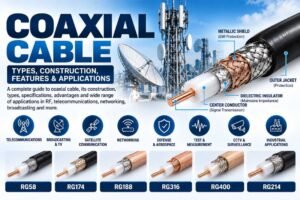
Construction of an RF Cable
An RF cable consists of several precision-engineered layers.
Center Conductor
The center conductor carries the RF signal and is typically made from copper, silver-plated copper, or copper-clad steel.
Dielectric Insulation
The dielectric surrounds the center conductor and maintains uniform spacing between conductors. Common dielectric materials include PTFE, Foam PE, Solid PE, and Air-Spaced PTFE.
Shield
The shield protects the signal from electromagnetic interference and may consist of braided copper, aluminum foil, or multiple shielding layers.
Outer Jacket
The outer jacket protects the cable from mechanical damage, moisture, chemicals, UV exposure, and environmental conditions.
Major Types of RF Cable
Flexible RF Cable
Flexible RF cables are easy to install and ideal for applications requiring repeated bending and movement.
Features include:
- Easy routing
- Excellent flexibility
- Lightweight construction
- Suitable for indoor and outdoor use
Applications:
- Telecom equipment
- Wi-Fi systems
- Laboratory testing
- Industrial automation
Semi-Rigid RF Cable
Semi-rigid cables use a solid metal outer conductor, providing excellent shielding and low signal loss.
Advantages:
- Outstanding electrical performance
- High shielding effectiveness
- Low insertion loss
- Excellent phase stability
Applications:
- Radar systems
- Aerospace
- Satellite communication
- Microwave systems
Semi-Flexible RF Cable
Semi-flexible cables offer a balance between flexibility and performance.
Applications include:
- RF assemblies
- Communication equipment
- Military electronics
Low Loss RF Cable
Low loss cables minimize attenuation over long distances.
Benefits:
- Reduced signal degradation
- Better power handling
- Improved transmission efficiency
Applications:
- Cellular towers
- Distributed antenna systems
- Long-distance communication
Corrugated RF Cable
Corrugated cables are commonly used in telecom infrastructure due to their excellent flexibility and durability.
Applications:
- Base stations
- Outdoor communication systems
- 5G infrastructure
Common RF Cable Impedances
50 Ohm RF Cable
Most widely used for RF transmission systems.
Applications:
- Test equipment
- Cellular networks
- Military communication
- RF amplifiers
- Microwave systems
75 Ohm RF Cable
Designed primarily for video and broadcast applications.
Applications:
- Television
- CCTV
- Satellite TV
- Broadcasting
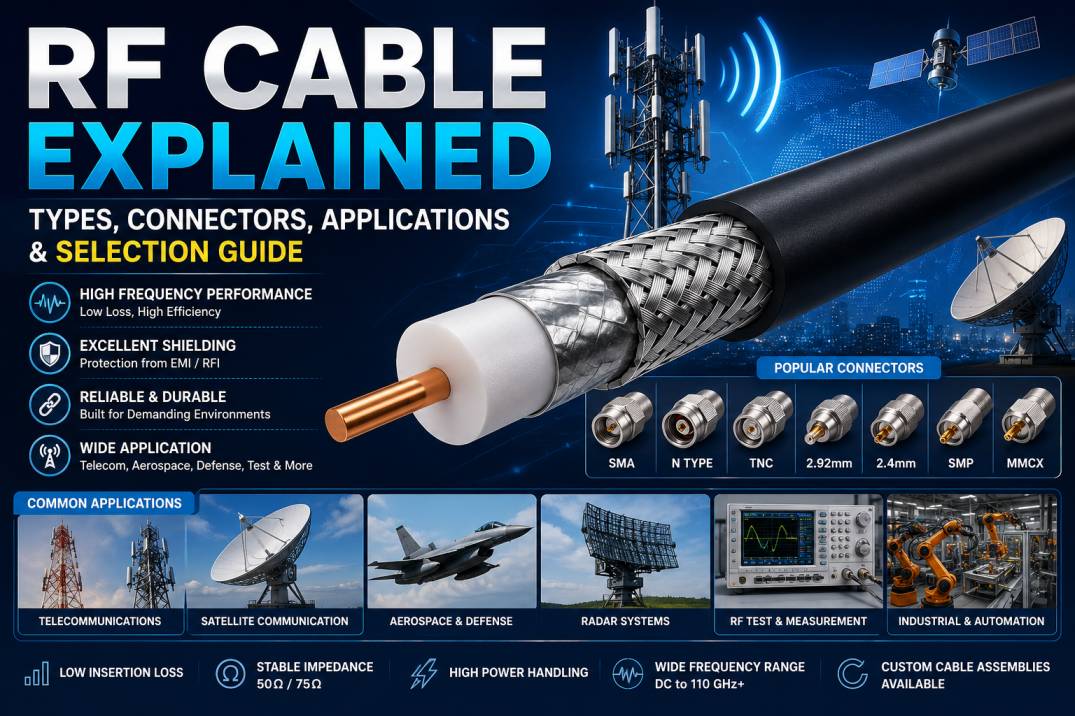
Common RF Cable Connectors
The connector selection is as important as the cable itself. A poor-quality connector can significantly reduce system performance.
SMA Connector
Used up to 18 GHz, 26.5 GHz, and higher depending on design.
Applications:
- Wi-Fi
- GPS
- RF modules
- Microwave systems
N Type Connector
Known for durability and weather resistance.
Applications:
- Base stations
- Outdoor antennas
- High-power RF systems
TNC Connector
Provides improved vibration resistance.
Applications:
- Military equipment
- Mobile communication
- Navigation systems
BNC Connector
Popular in lower-frequency RF applications.
Applications:
- Laboratory equipment
- CCTV
- Video transmission
2.92mm Connector
Supports frequencies up to 40 GHz.
Applications:
- Microwave communication
- High-frequency testing
- Aerospace
2.4mm Connector
Designed for precision microwave applications.
Applications:
- High-frequency instrumentation
- Research laboratories
SMP Connector
Miniature push-on connector for compact RF systems.
Applications:
- Defense
- Aerospace
- High-density electronic assemblies
MMCX Connector
Small snap-on connector suitable for compact electronic devices.
Applications:
- GPS
- IoT
- Wireless communication
RF Cable Frequency Range
Depending on cable construction, RF cables can support frequencies ranging from a few MHz to more than 110 GHz.
Typical operating ranges include:
- DC to 3 GHz
- DC to 6 GHz
- DC to 18 GHz
- DC to 26.5 GHz
- DC to 40 GHz
- DC to 50 GHz
- DC to 67 GHz
- DC to 110 GHz
Key Performance Parameters
Insertion Loss
Represents signal power lost during transmission. Lower insertion loss indicates better cable performance.
VSWR
Voltage Standing Wave Ratio measures impedance matching. Lower VSWR means reduced signal reflection.
Return Loss
Return loss indicates how much signal is reflected back toward the source. Higher return loss values are desirable.
Shielding Effectiveness
Measures protection against external interference. High-quality RF cables often provide shielding effectiveness exceeding 90 dB.
Power Handling
Specifies the maximum RF power that the cable can safely transmit.
Phase Stability
Critical in radar, aerospace, and measurement systems where signal timing accuracy is essential.
Applications of RF Cable
RF cables are used across numerous industries.
Telecommunications
- 4G Networks
- 5G Infrastructure
- Cellular Base Stations
- Distributed Antenna Systems
Aerospace
- Aircraft communication
- Avionics
- Flight testing
Defense
- Military communication
- Electronic warfare
- Missile systems
- Secure communication
Satellite Communication
- Earth stations
- Satellite terminals
- VSAT systems
Broadcasting
- Television
- Radio transmission
- Studio equipment
Medical Industry
- MRI systems
- Diagnostic equipment
- Imaging systems
Industrial Automation
- Wireless sensors
- Factory communication
- Robotics
Research Laboratories
- Spectrum analyzers
- Vector Network Analyzers
- Signal generators
- RF calibration systems
How to Select the Right RF Cable
Selecting the correct RF cable requires evaluating several technical parameters.
Frequency Range
Ensure the cable supports the highest operating frequency.
Cable Loss
Lower attenuation is essential for long cable runs.
Power Rating
Choose a cable that can safely handle the transmitted RF power.
Flexibility
Flexible cables are preferred where frequent movement occurs.
Environmental Conditions
Consider UV resistance, moisture protection, temperature range, and chemical resistance.
Connector Compatibility
Ensure connectors match both the equipment and the cable specifications.
Shielding Performance
High shielding is recommended for electrically noisy environments.
Budget
Balance performance, durability, and overall project cost.
Advantages of RF Cable
High-frequency signal transmission
Excellent shielding against EMI and RFI
Low insertion loss
Reliable impedance control
Long operational life
Available in numerous sizes and configurations
Suitable for indoor and outdoor installations
Compatible with various RF connectors
High mechanical durability
Excellent electrical performance
Common Mistakes to Avoid
Selecting incorrect impedance
Using poor-quality connectors
Ignoring frequency limitations
Exceeding the minimum bend radius
Improper connector installation
Using cables with excessive insertion loss
Ignoring environmental conditions
Not verifying VSWR specifications
Maintenance Tips
Inspect connectors regularly.
Avoid sharp bends during installation.
Keep connectors clean and dry.
Use protective caps when connectors are not in use.
Replace damaged cables immediately.
Perform periodic RF performance testing.
Store cables in dry and dust-free environments.
Why Choose SRFS Teleinfra for RF Cables?
SRFS Teleinfra manufactures and supplies high-quality RF Cables designed for superior electrical performance, reliability, and long service life. Our product range includes flexible RF cables, semi-rigid cables, semi-flexible cables, low-loss cables, cable assemblies, and precision RF connectors suitable for frequencies extending into the microwave range.
Every RF cable is manufactured using premium materials and undergoes rigorous quality testing to ensure low insertion loss, excellent return loss, stable impedance, and reliable performance in telecom, defense, aerospace, satellite communication, industrial, and laboratory applications.
Frequently Asked Questions
What is an RF Cable?
An RF Cable is a specialized coaxial cable designed to transmit high-frequency radio frequency signals with minimal loss and excellent shielding.
What impedance is most common for RF Cables?
The most common impedance is 50 Ohms for RF communication systems and 75 Ohms for broadcasting and video applications.
What connector is commonly used with RF Cables?
Popular connectors include SMA, N Type, BNC, TNC, 2.92mm, 2.4mm, SMP, MMCX, MCX, and QMA connectors.
What industries use RF Cables?
Telecommunications, aerospace, defense, satellite communication, medical, industrial automation, broadcasting, and research laboratories all rely on RF cables.
What factors should be considered when selecting an RF Cable?
Frequency range, insertion loss, impedance, connector type, shielding effectiveness, flexibility, environmental conditions, and power handling should all be considered.
Conclusion
RF Cable is the foundation of modern high-frequency communication systems, enabling reliable signal transmission across telecom networks, defense platforms, aerospace equipment, satellite communication, medical devices, and industrial applications. Choosing the correct cable requires careful consideration of impedance, frequency range, insertion loss, shielding, connector compatibility, and environmental conditions. By selecting a high-quality RF Cable from a trusted manufacturer such as SRFS Teleinfra, engineers and system integrators can achieve superior performance, long-term reliability, and consistent signal integrity in even the most demanding RF and microwave applications.