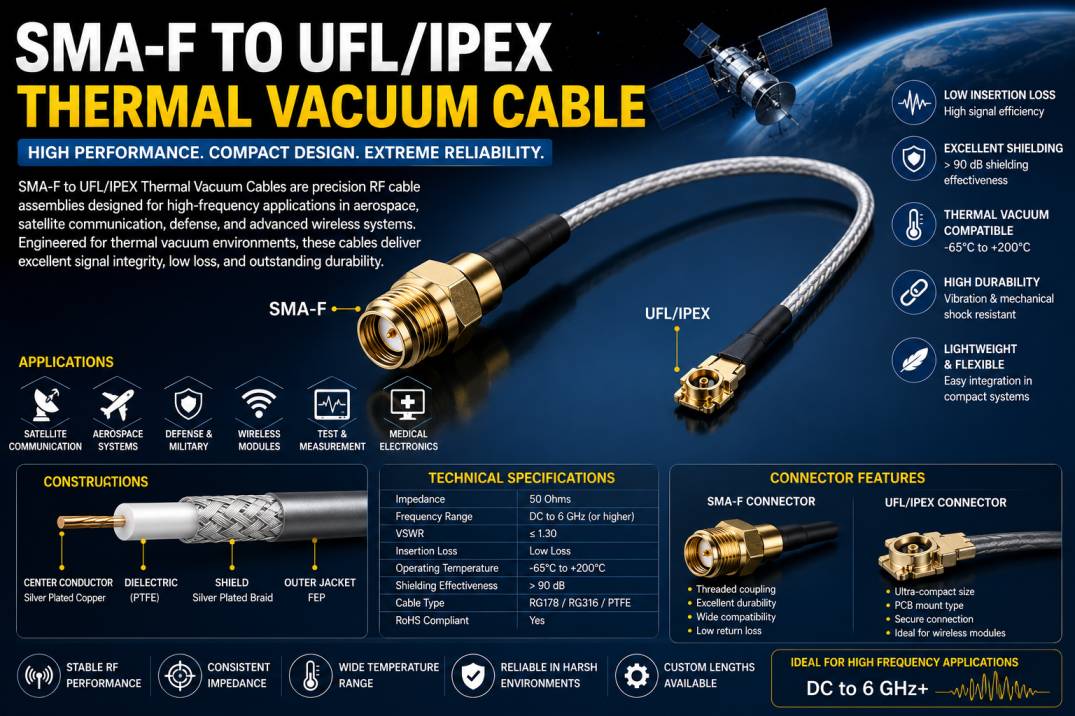
The UFL IPEX Receptacle PCB Mount Connector is one of the smallest and most widely used RF connectors in modern wireless electronic devices. Designed for compact printed circuit boards (PCBs), these miniature RF connectors provide a reliable interface between the PCB and an external antenna using ultra-miniature coaxial cable assemblies. Their compact size, excellent electrical performance, and ease of integration make them an ideal solution for today’s space-constrained electronic products.
As wireless communication technologies continue to evolve, devices such as smartphones, IoT modules, GPS receivers, Wi-Fi routers, Bluetooth devices, drones, LTE modules, and 5G communication systems require increasingly smaller RF connectors without compromising signal quality. UFL IPEX connectors have become an industry-standard solution because they deliver low insertion loss, consistent impedance, and dependable performance in high-frequency applications.
These connectors are available in several compatible series such as U.FL, IPEX MHF, AMC, and equivalent miniature RF interfaces, supporting frequencies up to several gigahertz while maintaining excellent signal integrity.
This comprehensive guide explains everything about UFL IPEX Receptacle PCB Mount Connectors, including their construction, working principle, specifications, applications, advantages, and selection criteria.
What Is a UFL IPEX Receptacle PCB Mount Connector?
A UFL IPEX Receptacle PCB Mount Connector is an ultra-miniature surface-mount RF connector designed to be mounted directly onto a printed circuit board. It serves as the mating receptacle for a compatible UFL or IPEX plug connected to a miniature coaxial cable.
Its primary purpose is to establish a reliable RF connection between the PCB circuitry and an external antenna while occupying minimal board space.
These connectors are commonly used in devices where compact size, lightweight construction, and high-frequency performance are essential.
How Does a UFL IPEX PCB Mount Connector Work?
The connector works by providing a precision RF interface between a PCB-mounted receptacle and a mating miniature coaxial cable plug.
When the cable assembly is snapped onto the PCB receptacle, the center contact transmits the RF signal while the outer shield maintains grounding and electromagnetic shielding.
The connector maintains a constant characteristic impedance throughout the connection, minimizing signal reflections and insertion loss.
Because of their snap-on coupling mechanism, UFL IPEX connectors allow easy assembly and replacement without soldering the antenna cable directly to the PCB.
Construction of UFL IPEX Receptacle PCB Mount Connector
Center Contact
The center contact carries the RF signal.
Common materials include:
- Beryllium Copper
- Phosphor Bronze
- Copper Alloy
Gold plating improves conductivity and corrosion resistance.
Outer Shell
The outer shell provides mechanical strength and grounding.
Typical materials include:
- Stainless Steel
- Brass
- Nickel-Plated Steel
Insulator
The dielectric insulator electrically separates the center conductor from the outer shell.
Common materials include:
- PTFE
- LCP (Liquid Crystal Polymer)
- High-performance engineering plastics
Mounting Pads
The connector uses precision surface-mount solder pads for secure PCB attachment.
Key Features of UFL IPEX Receptacle PCB Mount Connector
- Ultra-miniature design
- Surface mount installation
- 50 Ohm impedance
- Low insertion loss
- Excellent return loss
- High-frequency capability
- Reliable snap-on connection
- Lightweight construction
- Gold-plated contacts
- Compact PCB footprint
- Easy antenna replacement
- High mechanical reliability
Technical Specifications
| Specification | Typical Value |
| Impedance | 50 Ohms |
| Frequency Range | DC to 6 GHz |
| Connector Type | UFL / IPEX Receptacle |
| Mounting Style | Surface Mount (SMT) |
| Contact Material | Beryllium Copper |
| Contact Plating | Gold |
| Insulator | PTFE / LCP |
| Operating Temperature | -40°C to +90°C |
| Mating Cycles | Up to 30 Cycles |
| VSWR | ≤1.30 |
Types of UFL IPEX Connectors
Several connector families are available depending on the application.
Standard UFL Connector
Used in Wi-Fi modules, Bluetooth devices, and GPS systems.
IPEX Connector
Compatible with many wireless communication modules.
MHF Connector
Used in compact communication modules requiring higher performance.
PCB Receptacle
Directly mounted on the printed circuit board.
Cable Plug
Attached to miniature coaxial cable assemblies.
Common Applications
Wi-Fi Modules
Wireless routers
Access points
Wi-Fi adapters
Embedded wireless systems
Bluetooth Devices
Bluetooth speakers
Wearable electronics
Wireless accessories
IoT products
GPS Systems
Navigation devices
Vehicle tracking
Survey equipment
Drone navigation
Cellular Communication
4G LTE modules
5G communication modules
NB-IoT devices
Industrial gateways
Consumer Electronics
Smartphones
Tablets
Laptops
Smart TVs
Wireless cameras
Industrial Automation
Wireless sensors
Remote monitoring
Machine communication
Industrial IoT
Medical Equipment
Portable medical devices
Wireless diagnostic systems
Patient monitoring
Healthcare electronics
Advantages of UFL IPEX Receptacle PCB Mount Connector
- Extremely compact size
- Excellent RF performance
- Low insertion loss
- Stable impedance
- Easy installation
- Quick antenna replacement
- Lightweight
- High reliability
- Space-saving PCB design
- Cost-effective
- Excellent EMI performance
- Suitable for mass production
Limitations
- Limited mating cycles
- Designed for low-power RF applications
- Requires careful handling due to small size
- Not intended for frequent reconnections
- Limited mechanical strength compared to larger RF connectors
How to Choose the Right UFL IPEX PCB Connector
Before selecting a connector, consider:
- Operating frequency
- PCB layout
- Connector height
- Antenna compatibility
- Cable type
- Operating environment
- Mechanical durability
- Mating cycle requirements
- Temperature rating
- Manufacturer quality
UFL IPEX Connector vs SMA Connector
| Feature | UFL IPEX Connector | SMA Connector |
| Size | Ultra Miniature | Larger |
| Mounting | PCB Surface Mount | Panel/Cable Mount |
| Frequency | Up to 6 GHz | Up to 18 GHz+ |
| Power Handling | Low | Higher |
| Mating Cycles | Approximately 30 | 500+ |
| Applications | Embedded Devices | RF Equipment |
Industries Using UFL IPEX Connectors
These connectors are widely used in:
- Telecommunications
- IoT Devices
- Wireless Networking
- Medical Electronics
- Consumer Electronics
- Automotive Electronics
- Aerospace
- Industrial Automation
- Robotics
- Smart Home Devices
Maintenance Tips
For longer service life:
- Avoid repeated reconnections
- Keep contacts clean
- Prevent excessive cable stress
- Store in dust-free environments
- Handle connectors with precision tools
- Inspect solder joints periodically
Future Trends
As electronic devices become smaller and wireless communication technologies continue advancing, demand for miniature RF connectors will continue to grow. Future UFL IPEX connectors are expected to offer higher frequency support, improved durability, lower insertion loss, enhanced shielding, and compatibility with emerging technologies such as Wi-Fi 7, 6G, IoT, autonomous vehicles, wearable electronics, and advanced medical devices.
Conclusion
The UFL IPEX Receptacle PCB Mount Connector has become an industry-standard RF connector for compact wireless electronics. Its miniature size, reliable RF performance, low insertion loss, and easy PCB integration make it ideal for modern communication devices including Wi-Fi modules, GPS receivers, Bluetooth systems, IoT products, medical electronics, and industrial automation. By selecting the appropriate connector based on frequency, PCB layout, mechanical durability, and antenna compatibility, engineers can ensure reliable long-term RF performance even in the most space-constrained electronic designs.
Frequently Asked Questions (FAQs)
1. What is a UFL IPEX Receptacle PCB Mount Connector?
A UFL IPEX Receptacle PCB Mount Connector is a miniature RF connector mounted directly on a PCB to connect an external antenna using a compatible coaxial cable assembly.
2. What is the impedance of a UFL IPEX connector?
Most UFL IPEX connectors have a standard 50 Ohm impedance.
3. What frequency range do UFL IPEX connectors support?
Most standard UFL IPEX connectors support frequencies from DC up to 6 GHz, depending on the model.
4. Where are UFL IPEX PCB connectors used?
They are widely used in Wi-Fi modules, Bluetooth devices, GPS receivers, IoT devices, LTE modules, 5G equipment, medical electronics, and industrial wireless systems.
5. What is the difference between UFL and SMA connectors?
UFL connectors are much smaller and designed for PCB mounting, while SMA connectors are larger, more durable, and capable of handling higher RF power and more mating cycles.
6. Are UFL and IPEX connectors compatible?
Many UFL and IPEX connectors are mechanically compatible, but compatibility should always be confirmed based on the manufacturer’s specifications.
7. How many mating cycles does a UFL IPEX connector support?
Most connectors are rated for approximately 30 mating cycles, making them suitable for installations that do not require frequent reconnection.
8. Can UFL IPEX connectors be used for 5G applications?
Yes. They are commonly used in compact 4G and sub-6 GHz 5G wireless modules, depending on the frequency requirements.
9. Why are gold-plated contacts used?
Gold plating reduces contact resistance, improves conductivity, and protects the connector from corrosion.
10. How do I choose the right UFL IPEX PCB connector?
Select a connector based on operating frequency, PCB layout, antenna type, connector height, cable compatibility, mechanical durability, and environmental requirements.