High Performance Test Cables are precision-engineered RF and microwave cable assemblies designed to deliver highly accurate, repeatable, and low-loss signal transmission during testing, measurement, and calibration applications. These specialized cables are essential in modern laboratories, telecommunications, aerospace, defense, satellite communication, semiconductor manufacturing, and research facilities where maintaining signal integrity is critical.
Unlike standard RF coaxial cables, High Performance Test Cables are specifically developed to provide exceptional phase stability, low insertion loss, excellent return loss, high shielding effectiveness, and superior mechanical durability. They are capable of operating at extremely high frequencies while maintaining consistent electrical performance even after repeated bending and movement.
As technologies such as 5G, 6G, millimeter-wave communication, satellite internet, radar systems, and autonomous vehicles continue to evolve, precision testing has become increasingly important. High Performance Test Cables ensure accurate measurements by minimizing signal degradation, reducing phase variations, and maintaining stable impedance throughout the testing process.
This comprehensive guide explains everything you need to know about High Performance Test Cables, including their construction, working principle, technical specifications, applications, advantages, and selection criteria.
What Is a High Performance Test Cable?
A High Performance Test Cable is a precision RF cable assembly specifically designed for laboratory testing, microwave measurements, production testing, and calibration of high-frequency electronic equipment. It provides extremely low insertion loss, excellent phase stability, minimal signal reflection, and high mechanical reliability.
These cables are commonly used with:
Network analyzers
Spectrum analyzers
Signal generators
Oscilloscopes
Power meters
RF calibration kits
Microwave test systems
Unlike conventional coaxial cables, High Performance Test Cables are manufactured using premium dielectric materials, precision connectors, low-loss conductors, and advanced shielding technologies to ensure highly accurate measurement results.
How Does a High Performance Test Cable Work?
A High Performance Test Cable transmits radio frequency or microwave signals between test equipment and the device under test (DUT) while preserving signal integrity.
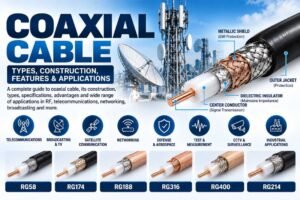
The cable consists of a precision center conductor surrounded by a low-loss dielectric, multiple shielding layers, and a protective outer jacket. These components work together to reduce attenuation, prevent electromagnetic interference (EMI), and maintain constant impedance throughout the signal path.
Because these cables are often flexed repeatedly during testing, they are engineered to minimize phase and amplitude changes caused by cable movement, ensuring consistent measurement accuracy.
Construction of High Performance Test Cable
Center Conductor
The center conductor carries the RF signal with minimal resistance.
Common materials include:
- Silver-plated copper
- Oxygen-free copper
- Copper alloy
Silver plating reduces high-frequency losses and improves conductivity.
Dielectric
The dielectric insulates the center conductor while maintaining precise impedance.
Typical dielectric materials include:
- Expanded PTFE (ePTFE)
- PTFE
- Low-density PTFE
These materials provide excellent electrical stability and low dielectric loss.
Shielding
Multiple shielding layers protect the signal from external interference.
Common shielding includes:
- Silver-plated copper braid
- Aluminum foil
- Double braid
- Triple shielding
Superior shielding minimizes EMI and signal leakage.
Outer Jacket
The outer jacket protects the cable from abrasion, chemicals, moisture, and mechanical stress.
Common jacket materials include:
- FEP
- PVC
- Polyurethane
- TPE
Key Features of High Performance Test Cable
- Ultra-low insertion loss
- Excellent phase stability
- Superior return loss
- Low VSWR
- High shielding effectiveness
- Wide frequency range
- Flexible construction
- Excellent durability
- High repeatability
- Precision impedance control
- Long service life
- High mechanical reliability
Technical Specifications
| Specification | Typical Value |
| Characteristic Impedance | 50 Ohms |
| Frequency Range | DC to 67 GHz (depending on model) |
| VSWR | ≤ 1.20 |
| Insertion Loss | Extremely Low |
| Return Loss | Excellent |
| Shielding Effectiveness | >90 dB |
| Phase Stability | Excellent |
| Velocity Factor | Approximately 70% |
| Operating Temperature | -55°C to +125°C |
| Cable Flex Life | Thousands of Flex Cycles |
Common Connector Types
High Performance Test Cables are available with numerous RF connector options.
Popular connector interfaces include:
- SMA
- N-Type
- 3.5 mm
- 2.92 mm (K Connector)
- 2.4 mm
- 1.85 mm (V Connector)
- BNC
- TNC
- SMP
- SMPM
- 7/16 DIN
- 4.3-10
Frequency Range
Modern High Performance Test Cables support wide operating frequencies.
Typical frequency options include:
- DC to 6 GHz
- DC to 12 GHz
- DC to 18 GHz
- DC to 26.5 GHz
- DC to 40 GHz
- DC to 50 GHz
- DC to 67 GHz
- DC to 110 GHz (specialized versions)
Applications of High Performance Test Cable
RF Testing Laboratories
High Performance Test Cables are widely used for precision RF measurements in research and development laboratories.
Network Analyzer Measurements
They provide highly accurate measurements for insertion loss, return loss, impedance, and S-parameter testing.
Spectrum Analysis
Used to connect spectrum analyzers to antennas, amplifiers, and RF devices while minimizing measurement uncertainty.
Telecommunications
Essential for testing:
- Cellular base stations
- 4G systems
- 5G infrastructure
- Small cells
- Massive MIMO antennas
Aerospace
Used in:
- Avionics
- Radar testing
- Satellite payload verification
- Flight communication systems
Defense
Military applications include:
- Electronic warfare
- Radar systems
- Secure communication
- Missile guidance testing
Semiconductor Industry
Used for wafer-level testing, IC characterization, and microwave device validation.
Satellite Communication
Supports testing of:
- VSAT terminals
- Satellite transceivers
- Ground stations
- RF payloads
Medical Equipment
Used in MRI systems, RF imaging equipment, and advanced diagnostic instruments.
Advantages of High Performance Test Cable
- Exceptional signal integrity
- Low attenuation
- Stable electrical performance
- High phase stability
- Excellent shielding
- Long operational life
- High mechanical flexibility
- Low measurement uncertainty
- Superior connector durability
- Repeatable measurement results
- Wide frequency compatibility
- Reduced calibration errors
Limitations of High Performance Test Cable
- Higher cost than standard RF cables
- Requires careful handling
- Premium connectors increase overall cost
- Needs periodic calibration in critical applications
- Improper bending can affect long-term performance
How to Choose the Right High Performance Test Cable
Consider the following factors before selecting a High Performance Test Cable:
- Maximum operating frequency
- Connector compatibility
- Phase stability requirements
- Flexibility
- Insertion loss
- Return loss
- VSWR
- Cable length
- Environmental conditions
- Calibration requirements
High Performance Test Cable vs Standard RF Cable
| Feature | High Performance Test Cable | Standard RF Cable |
| Accuracy | Very High | Standard |
| Insertion Loss | Ultra Low | Moderate |
| Phase Stability | Excellent | Moderate |
| Flex Life | High | Standard |
| Shielding | Superior | Good |
| Return Loss | Excellent | Standard |
| Cost | Higher | Lower |
| Laboratory Use | Ideal | Limited |
Industries Using High Performance Test Cable
These cables are widely used in:
- Telecommunications
- Aerospace
- Defense
- Satellite Communication
- Semiconductor Manufacturing
- Medical Electronics
- Industrial Automation
- Universities
- Research Laboratories
- RF Component Manufacturing
Maintenance Tips
To maximize cable life and measurement accuracy:
- Avoid sharp bends.
- Use proper connector torque tools.
- Keep connectors clean.
- Store cables properly.
- Perform periodic calibration.
- Avoid excessive cable twisting.
- Protect connectors with dust caps.
- Inspect cables before critical measurements.
Future Trends of High Performance Test Cable
The rapid deployment of 5G Advanced, 6G, satellite broadband, autonomous systems, quantum communication, and millimeter-wave technologies is increasing the demand for ultra-low-loss and highly stable RF test cables. Manufacturers are developing next-generation cables with improved phase stability, enhanced flexibility, lower attenuation, ruggedized designs, and support for frequencies exceeding 110 GHz. These advancements will enable more accurate testing of next-generation wireless devices, aerospace systems, semiconductor components, and high-speed communication networks.
Conclusion
High Performance Test Cables are indispensable components in precision RF and microwave measurement systems. Their advanced construction, exceptional phase stability, low insertion loss, excellent shielding, and repeatable performance make them the preferred choice for laboratories, aerospace, defense, telecommunications, medical technology, and semiconductor testing. Selecting the appropriate cable based on operating frequency, connector type, insertion loss, flexibility, and environmental conditions ensures reliable measurements and long-term performance in demanding RF applications.
Frequently Asked Questions (FAQs)
1. What is a High Performance Test Cable?
A High Performance Test Cable is a precision RF cable assembly designed for accurate signal transmission during RF, microwave, and laboratory testing applications.
2. What are High Performance Test Cables used for?
They are used with network analyzers, spectrum analyzers, signal generators, oscilloscopes, power meters, calibration kits, and RF test systems.
3. What is the typical impedance of a High Performance Test Cable?
Most High Performance Test Cables are designed with a 50 Ohm characteristic impedance for RF and microwave applications.
4. What frequency range do High Performance Test Cables support?
Depending on the model, they support frequencies from DC up to 67 GHz, while specialized versions can operate beyond 110 GHz.
5. Why are High Performance Test Cables better than standard RF cables?
They provide lower insertion loss, superior phase stability, excellent return loss, higher shielding effectiveness, and more repeatable measurement results.
6. Which connectors are commonly available?
Common connector options include SMA, N-Type, 3.5 mm, 2.92 mm, 2.4 mm, 1.85 mm, BNC, TNC, SMP, and SMPM.
7. Can these cables be used for 5G testing?
Yes. High Performance Test Cables are widely used in 4G, 5G, 5G Advanced, and millimeter-wave communication testing.
8. How should High Performance Test Cables be maintained?
Keep connectors clean, avoid excessive bending, use proper torque tools, store cables carefully, and perform periodic calibration for the best performance.
9. What industries use High Performance Test Cables?
They are widely used in telecommunications, aerospace, defense, satellite communication, semiconductor manufacturing, medical electronics, industrial automation, and research laboratories.
10. How do I choose the right High Performance Test Cable?
Choose based on operating frequency, connector type, insertion loss, phase stability, cable length, shielding performance, flexibility, and calibration requirements.