
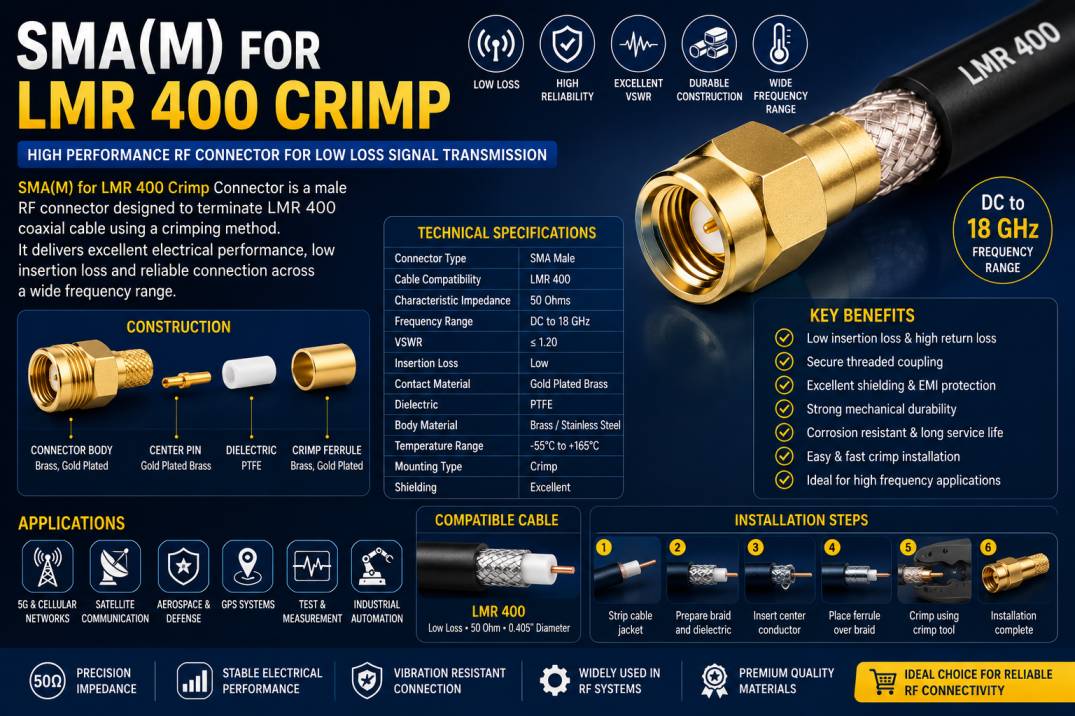
The SMA(M) for LMR 400 Crimp Connector is a high-performance RF coaxial connector designed specifically for terminating LMR 400 coaxial cables in radio frequency and microwave communication systems. It provides a secure mechanical connection and excellent electrical performance, ensuring low signal loss, high reliability, and stable impedance across a wide frequency range.
As modern communication systems continue to evolve with technologies such as 5G, Wi-Fi 6, IoT, satellite communication, military electronics, aerospace systems, GPS, and RF test equipment, the need for high-quality RF connectors has become increasingly important. The SMA(M) for LMR 400 Crimp connector offers a dependable solution for connecting LMR 400 low-loss coaxial cables to RF devices while maintaining excellent signal integrity.
Manufactured using precision machining techniques and premium materials such as brass, stainless steel, and gold-plated contacts, these connectors are engineered to deliver outstanding durability and electrical performance. Their crimp-style design allows for quick installation while providing a strong mechanical bond suitable for demanding environments.
This guide covers everything you need to know about SMA(M) for LMR 400 Crimp connectors, including their construction, working principle, specifications, advantages, applications, installation methods, and selection tips.
What Is an SMA(M) for LMR 400 Crimp Connector?
An SMA(M) for LMR 400 Crimp Connector is a male SubMiniature Version A (SMA) RF connector designed to terminate LMR 400 coaxial cables using a crimping process. It provides a precision 50 Ohm RF interface capable of transmitting microwave signals with minimal insertion loss and excellent return loss.
The connector consists of a male threaded coupling nut, precision center pin, dielectric insulator, connector body, and crimp ferrule. Once properly installed using a suitable crimping tool, it forms a durable and electrically stable connection capable of operating across a wide frequency spectrum.
SMA(M) connectors are among the most commonly used RF connectors in wireless communication equipment due to their compact size, excellent electrical characteristics, and threaded coupling mechanism that prevents accidental disconnection.
How Does an SMA(M) for LMR 400 Crimp Connector Work?
The SMA(M) connector transfers RF signals from the LMR 400 cable to RF equipment through precision electrical contacts.
The center conductor of the LMR 400 cable is crimped or soldered to the connector pin, while the cable braid is secured beneath the crimp ferrule. The connector body maintains the cable’s characteristic impedance and minimizes reflections.
The threaded coupling nut securely mates with an SMA female connector, providing a vibration-resistant connection while maintaining constant electrical contact.
Proper installation ensures:
- Low insertion loss
- Excellent impedance matching
- Minimal signal reflection
- High mechanical stability
- Reliable long-term performance
Construction of SMA(M) for LMR 400 Crimp Connector
Center Pin
The center pin carries the RF signal.
Common materials include:
- Gold-plated brass
- Beryllium copper
- Phosphor bronze
Gold plating improves conductivity while resisting corrosion.
Connector Body
The connector body provides mechanical strength and electrical shielding.
Typical materials include:
- Brass
- Stainless steel
- Nickel-plated brass
Dielectric
The dielectric maintains precise spacing between conductors.
Common materials:
- PTFE (Teflon)
- High-temperature PTFE
Crimp Ferrule
The ferrule secures the cable braid using a crimping tool.
Materials include:
- Copper
- Brass
- Nickel-plated copper
Threaded Coupling Nut
The threaded coupling mechanism ensures secure mating and vibration resistance.
Key Features
- Designed specifically for LMR 400 cable
- Precision 50 Ohm impedance
- Low insertion loss
- High return loss
- Excellent VSWR
- Gold-plated contacts
- Crimp-style installation
- Excellent shielding effectiveness
- High-frequency compatibility
- Rugged construction
- Corrosion-resistant finish
- Long service life
Technical Specifications
| Specification | Typical Value |
| Connector Type | SMA Male |
| Cable Compatibility | LMR 400 |
| Characteristic Impedance | 50 Ohms |
| Frequency Range | DC to 18 GHz (Typical) |
| Contact Material | Gold-Plated Brass |
| Dielectric | PTFE |
| Connector Body | Brass / Stainless Steel |
| Mounting Style | Crimp |
| VSWR | ≤1.20 |
| Operating Temperature | -55°C to +165°C |
Compatible Cables
This connector is specifically designed for:
- LMR 400
- Equivalent 0.405-inch low-loss RF cables
- Other compatible 50 Ohm coaxial cables with similar dimensions
Applications
Wireless Communication
- Cellular base stations
- Wi-Fi systems
- RF repeaters
- DAS networks
5G Infrastructure
- Small cells
- Massive MIMO
- Distributed antenna systems
Satellite Communication
- VSAT terminals
- Satellite antennas
- Ground stations
GPS Systems
- GPS antennas
- Navigation equipment
Aerospace & Defense
- Military communication
- Radar systems
- Electronic warfare
- Avionics
Test & Measurement
- Spectrum analyzers
- Network analyzers
- Signal generators
- RF laboratories
Industrial Automation
- Wireless sensors
- Industrial IoT
- Automation equipment
Advantages of SMA(M) for LMR 400 Crimp
- Excellent signal integrity
- Low insertion loss
- High return loss
- Secure threaded connection
- Fast crimp installation
- Reliable mechanical strength
- Excellent EMI shielding
- Compact size
- Long operational life
- Suitable for outdoor installations with proper sealing
Installation Process
Installing an SMA(M) for LMR 400 Crimp connector involves:
- Cutting the cable to the required length
- Stripping the cable jacket
- Preparing the dielectric
- Inserting the center conductor into the contact pin
- Positioning the ferrule over the cable braid
- Crimping the ferrule with the correct die
- Inspecting the finished assembly
- Testing continuity and VSWR
Using the correct crimping tool is essential for reliable performance.
Common RF Systems Using SMA(M) for LMR 400 Crimp
- Cellular communication
- Wireless LAN
- GPS systems
- RF amplifiers
- RF attenuators
- RF switches
- Microwave equipment
- Satellite communication
- Laboratory instruments
- RF test benches
How to Choose the Right SMA(M) for LMR 400 Crimp Connector
When selecting an SMA(M) connector, consider:
- Cable compatibility
- Frequency range
- Impedance
- Contact plating
- Connector material
- Environmental conditions
- Crimp tool compatibility
- Operating temperature
- Mechanical durability
- Manufacturer quality certifications
SMA(M) Crimp vs Clamp Connector
| Feature | SMA(M) Crimp | SMA(M) Clamp |
| Installation | Fast | Moderate |
| Mechanical Strength | Excellent | Good |
| Tool Required | Crimp Tool | Hand Tools |
| Vibration Resistance | Excellent | Good |
| Production Speed | High | Medium |
| Reliability | Very High | High |
Maintenance Tips
To maximize connector performance:
- Keep connectors clean
- Avoid overtightening
- Use torque wrenches for precision installations
- Inspect connectors regularly
- Replace damaged ferrules
- Protect outdoor connectors with weatherproof sealing
- Prevent contamination during installation
Future Trends
As RF systems continue to operate at higher frequencies, connector manufacturers are developing SMA connectors with lower insertion loss, higher durability, improved corrosion resistance, and better performance for 5G, satellite communication, aerospace, defense, and microwave applications. Enhanced materials, precision machining, and advanced plating technologies continue to improve the performance and reliability of SMA(M) connectors for demanding RF environments.
Conclusion
The SMA(M) for LMR 400 Crimp Connector is an industry-standard RF connector that combines excellent electrical performance with durable mechanical construction. Its compatibility with LMR 400 low-loss coaxial cable, secure threaded coupling, low insertion loss, and high-frequency capability make it an ideal choice for telecommunications, aerospace, defense, laboratory testing, industrial automation, and wireless infrastructure. Proper connector selection and professional installation ensure long-term reliability and superior RF system performance.
Frequently Asked Questions (FAQs)
1. What is an SMA(M) for LMR 400 Crimp connector?
An SMA(M) for LMR 400 Crimp connector is a male RF connector designed to terminate LMR 400 coaxial cables using a crimping method for reliable signal transmission.
2. What cable is compatible with this connector?
It is specifically designed for LMR 400 and equivalent 0.405-inch 50 Ohm low-loss coaxial cables.
3. What is the impedance of an SMA(M) connector?
The standard impedance is 50 Ohms, making it suitable for RF and microwave applications.
4. What frequency range does it support?
Most SMA(M) for LMR 400 Crimp connectors support frequencies from DC to 18 GHz, depending on the design and manufacturer.
5. Why is a crimp connector preferred?
Crimp connectors provide a secure mechanical connection, excellent electrical performance, fast installation, and high reliability in demanding environments.
6. What applications use SMA(M) for LMR 400 Crimp connectors?
They are used in wireless communication, 5G networks, GPS systems, satellite communication, aerospace, defense, RF testing, and industrial automation.
7. Can this connector be used outdoors?
Yes. When properly installed and weather-sealed, it is suitable for outdoor RF installations.
8. What material is commonly used for the center contact?
The center contact is typically made from gold-plated brass or beryllium copper for excellent conductivity and corrosion resistance.
9. What tools are required for installation?
A cable stripping tool, the correct crimp die, and an RF connector crimping tool are required for proper installation.
10. How do I choose the right SMA(M) for LMR 400 Crimp connector?
Select a connector based on cable compatibility, impedance, frequency range, connector material, plating quality, environmental conditions, and installation requirements.