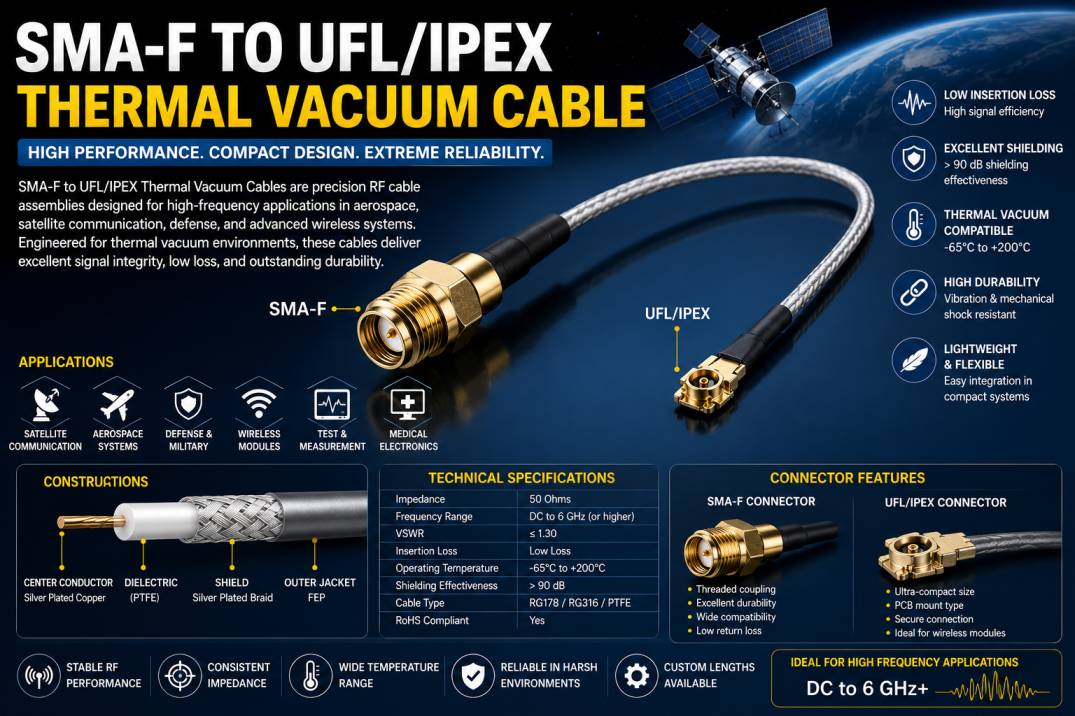
SMA-F to UFL/IPEX Thermal Vacuum Cables are specialized RF cable assemblies engineered for applications that demand reliable signal transmission under extreme environmental conditions. These cable assemblies combine the robust performance of an SMA Female connector with the miniature UFL/IPEX connector, making them ideal for compact electronic devices, aerospace systems, satellite communication, defense electronics, laboratory testing, and thermal vacuum environments.
Unlike conventional RF cable assemblies, thermal vacuum cables are manufactured using high-performance materials capable of withstanding rapid temperature variations, vacuum conditions, mechanical vibration, and radiation exposure. They are widely used in satellites, spacecraft, avionics, military communication systems, scientific research, and high-frequency RF testing where signal integrity is critical.
The combination of a standard SMA Female interface and a miniature UFL/IPEX connector enables engineers to connect external RF equipment to compact PCB-mounted wireless modules while maintaining low insertion loss, stable impedance, and excellent shielding.
As communication technologies continue to evolve toward higher frequencies and space-grade applications, SMA-F to UFL/IPEX Thermal Vacuum Cables have become an essential component in advanced RF and microwave systems.
What Is an SMA-F to UFL/IPEX Thermal Vacuum Cable?
An SMA-F to UFL/IPEX Thermal Vacuum Cable is a precision RF cable assembly that features an SMA Female connector on one end and a miniature UFL/IPEX connector on the other. The cable is designed using high-performance coaxial cable capable of operating in thermal vacuum environments while maintaining excellent electrical performance.
The SMA Female connector provides a durable threaded interface for external RF equipment, whereas the UFL/IPEX connector is designed for direct PCB mounting in compact wireless devices.
These assemblies are manufactured with precision impedance control, typically 50 Ohms, ensuring efficient RF signal transmission across a wide frequency range.
How Does an SMA-F to UFL/IPEX Thermal Vacuum Cable Work?
The cable transfers high-frequency RF signals between external communication equipment and miniature RF modules.
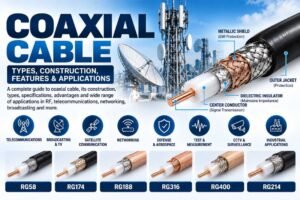
The SMA Female connector securely interfaces with RF instruments, antennas, or communication devices. The signal travels through a low-loss coaxial cable where the center conductor carries the RF energy while the dielectric maintains constant impedance. The outer shield prevents electromagnetic interference and minimizes signal leakage before the signal reaches the UFL/IPEX connector mounted on the printed circuit board.
Because thermal vacuum cables use premium dielectric materials and precision manufacturing, signal quality remains stable even under severe environmental conditions.
Construction of an SMA-F to UFL/IPEX Thermal Vacuum Cable
SMA Female Connector
The SMA Female connector provides a threaded interface with excellent mechanical stability.
Common materials include:
- Stainless Steel
- Passivated Stainless Steel
- Gold-Plated Brass
- Beryllium Copper Contacts
Gold-plated contacts improve conductivity and corrosion resistance.
Coaxial Cable
High-performance coaxial cables are selected based on frequency and environmental requirements.
Common cable types include:
- RG178
- RG316
- RG196
- Low Loss PTFE Cable
- Semi-Rigid Cable
- Semi-Flexible Cable
Dielectric Material
Premium dielectric materials ensure excellent thermal stability.
Common materials include:
- PTFE
- Expanded PTFE
- Low-Density PTFE
Shielding
Multiple shielding layers reduce electromagnetic interference.
Shielding options include:
- Silver-Plated Copper Braid
- Double Shield
- Triple Shield
- Aluminum Foil Shield
UFL/IPEX Connector
The miniature UFL/IPEX connector provides secure PCB mounting while supporting high-frequency RF transmission.
Key Features of SMA-F to UFL/IPEX Thermal Vacuum Cable
- Excellent RF performance
- Low insertion loss
- Stable 50 Ohm impedance
- High shielding effectiveness
- Lightweight construction
- Compact connector design
- Excellent mechanical durability
- High vibration resistance
- Thermal vacuum compatible
- Wide operating temperature range
- Corrosion-resistant materials
- High-frequency capability
Technical Specifications
| Specification | Typical Value |
| Characteristic Impedance | 50 Ohms |
| Frequency Range | DC to 6 GHz (Higher frequencies available) |
| Connector A | SMA Female |
| Connector B | UFL/IPEX |
| Cable Type | RG178 / RG316 / PTFE |
| VSWR | ≤ 1.30 |
| Insertion Loss | Low |
| Shielding Effectiveness | >90 dB |
| Operating Temperature | -65°C to +200°C |
| RoHS Compliance | Yes |
Common Cable Options
| Cable Type | Flexibility | Typical Applications |
| RG178 | High | Wireless Modules |
| RG316 | Medium | RF Testing |
| RG196 | Medium | Communication Systems |
| Semi-Rigid | Low | Aerospace |
| Semi-Flexible | Medium | Defense Electronics |
Connector Specifications
SMA Female Connector
- Threaded RF connector
- Excellent durability
- High-frequency performance
- Secure locking mechanism
- Suitable for repeated mating cycles
UFL/IPEX Connector
- Ultra-miniature connector
- PCB-mounted
- Lightweight
- Compact design
- Ideal for embedded wireless devices
Applications of SMA-F to UFL/IPEX Thermal Vacuum Cable
Aerospace
- Satellite payloads
- Spacecraft communication
- Flight instrumentation
- Navigation systems
Defense
- Military radios
- Radar equipment
- Electronic warfare
- Tactical communication
Satellite Communication
- RF modules
- Ground stations
- Satellite terminals
- Antenna systems
Wireless Communication
- Wi-Fi modules
- Bluetooth modules
- LTE devices
- 5G modules
Laboratory Testing
- Spectrum analyzers
- Network analyzers
- RF signal generators
- Test fixtures
Medical Electronics
- Wireless diagnostic systems
- Medical imaging
- Monitoring devices
Industrial Automation
- Industrial IoT
- Wireless sensors
- Embedded communication
- Robotics
Advantages of SMA-F to UFL/IPEX Thermal Vacuum Cable
- Reliable RF transmission
- Low signal attenuation
- Excellent EMI protection
- Compact connector size
- Stable electrical performance
- Lightweight construction
- High durability
- Easy integration with PCB modules
- Suitable for harsh environments
- Long operational life
- Excellent mechanical strength
- High-frequency compatibility
Limitations
- UFL connectors have limited mating cycles
- Requires careful PCB installation
- Not intended for frequent connector replacement
- Higher cost compared to standard cable assemblies
How to Choose the Right SMA-F to UFL/IPEX Thermal Vacuum Cable
Before selecting a cable assembly, consider:
- Operating frequency
- Cable length
- Connector orientation
- Cable flexibility
- Temperature range
- Shielding requirements
- Environmental conditions
- Mechanical durability
- RF performance
- Application requirements
SMA-F to UFL/IPEX Thermal Vacuum Cable vs Standard RF Cable Assembly
| Feature | Thermal Vacuum Cable | Standard RF Cable |
| Temperature Resistance | Excellent | Moderate |
| Vacuum Compatibility | Yes | No |
| Shielding | Superior | Standard |
| RF Stability | Excellent | Good |
| Aerospace Use | Yes | Limited |
| Mechanical Reliability | High | Moderate |
| Signal Integrity | Outstanding | Good |
Industries Using SMA-F to UFL/IPEX Thermal Vacuum Cable
These cable assemblies are widely used in:
- Aerospace
- Space Research
- Satellite Communication
- Military Electronics
- Defense Systems
- RF Laboratories
- Medical Electronics
- Industrial Automation
- Wireless Devices
- Telecommunications
Maintenance Tips
To maximize cable performance:
- Avoid excessive cable bending
- Keep connectors clean
- Prevent repeated UFL connector removal
- Inspect connectors regularly
- Use proper torque for SMA connectors
- Store cables in clean, dry environments
Future Trends
As RF communication continues advancing into higher frequencies, compact wireless modules, satellite internet, aerospace systems, and 6G communication, the demand for precision thermal vacuum cable assemblies will continue growing. Future developments include lighter cable materials, improved shielding, higher frequency capability beyond 40 GHz, enhanced radiation resistance, and lower insertion loss for next-generation RF applications.
Conclusion
SMA-F to UFL/IPEX Thermal Vacuum Cables provide reliable high-frequency signal transmission in demanding environments where conventional RF cable assemblies cannot perform efficiently. Their precision construction, excellent shielding, stable impedance, and thermal vacuum compatibility make them the preferred choice for aerospace, defense, satellite communication, laboratory testing, and advanced wireless applications. Choosing the appropriate cable type, connector configuration, and operating specifications ensures long-term reliability and superior RF performance.
Frequently Asked Questions (FAQs)
1. What is an SMA-F to UFL/IPEX Thermal Vacuum Cable?
An SMA-F to UFL/IPEX Thermal Vacuum Cable is a high-performance RF cable assembly with an SMA Female connector on one end and a UFL/IPEX connector on the other, designed for thermal vacuum and high-frequency applications.
2. What is this cable used for?
It is used in aerospace, satellites, military electronics, wireless communication, laboratory testing, embedded RF modules, and medical equipment.
3. What is the impedance of an SMA-F to UFL/IPEX cable?
Most assemblies are manufactured with a 50 Ohm characteristic impedance for optimum RF performance.
4. Which cable types are commonly used?
Common cable options include RG178, RG316, RG196, PTFE low-loss cables, semi-rigid, and semi-flexible cables.
5. What frequency range does it support?
Depending on the cable and connector combination, these assemblies typically support DC to 6 GHz, with specialized versions supporting higher frequencies.
6. Why is a thermal vacuum cable different from a standard RF cable?
Thermal vacuum cables are built using high-performance materials designed to withstand extreme temperatures, vacuum conditions, vibration, and demanding aerospace environments.
7. What are the advantages of the UFL/IPEX connector?
The UFL/IPEX connector is compact, lightweight, PCB-mounted, and ideal for wireless modules where space is limited.
8. Is the SMA Female connector suitable for repeated use?
Yes. SMA Female connectors are highly durable and support many mating cycles when handled correctly.
9. Which industries commonly use these cable assemblies?
They are widely used in aerospace, defense, satellite communication, wireless networking, industrial automation, medical electronics, and RF laboratories.
10. How do I choose the right SMA-F to UFL/IPEX Thermal Vacuum Cable?
Choose the cable based on operating frequency, cable length, connector type, cable flexibility, shielding, temperature range, impedance, and the environmental conditions of your application.