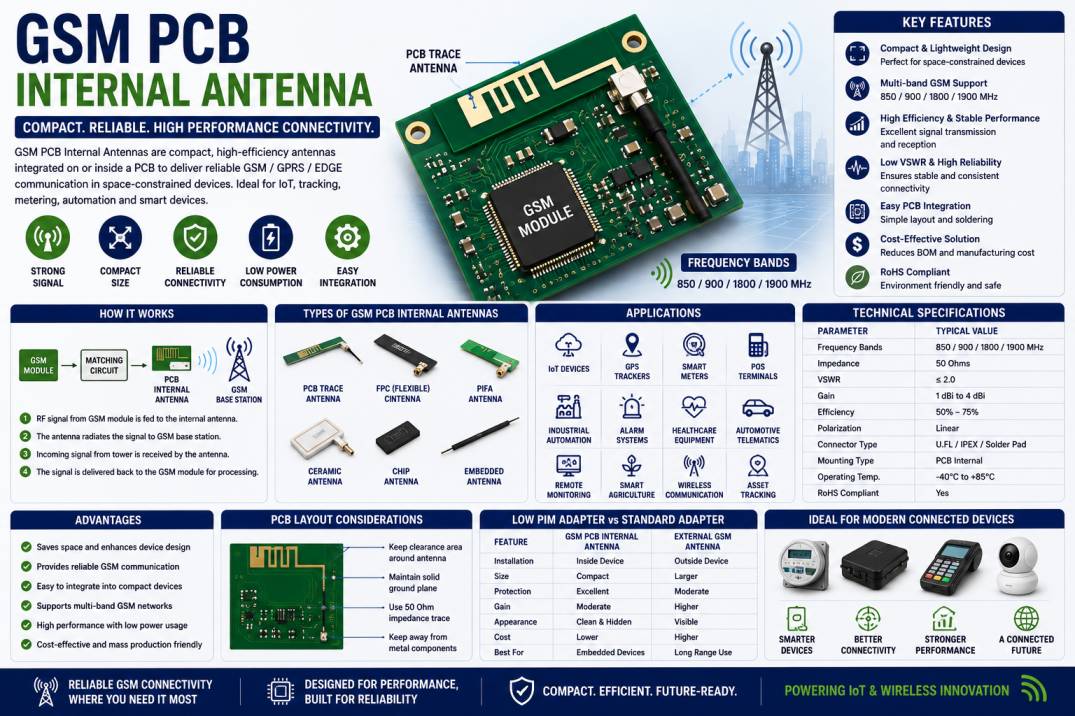
A GSM PCB Internal Antenna is a compact, high-performance antenna integrated directly onto or connected to a Printed Circuit Board (PCB) for GSM wireless communication. Designed for space-constrained electronic devices, these antennas provide reliable connectivity for GSM, GPRS, EDGE, and multi-band cellular applications without requiring bulky external antennas.
As the demand for smaller, smarter, and more connected devices continues to grow, GSM PCB Internal Antennas have become an essential component in IoT devices, GPS trackers, smart meters, POS terminals, industrial controllers, alarm systems, telematics, healthcare equipment, and wireless communication modules. Their compact size, lightweight design, and excellent RF performance make them ideal for embedded communication systems.
Modern GSM PCB Internal Antennas are engineered to support multiple frequency bands while maintaining high radiation efficiency, stable impedance, and low return loss. They enable seamless voice and data communication in challenging environments while minimizing device size and manufacturing costs.
This comprehensive guide explains everything you need to know about GSM PCB Internal Antennas, including their construction, working principle, specifications, applications, advantages, and selection criteria.
What Is a GSM PCB Internal Antenna?
A GSM PCB Internal Antenna is a miniature RF antenna designed to be mounted inside an electronic device on or near the printed circuit board. It transmits and receives GSM radio signals between the cellular network and the wireless communication module.
Unlike external antennas, PCB internal antennas remain enclosed within the device housing, providing a clean product appearance while protecting the antenna from environmental damage.
These antennas are optimized for GSM frequency bands and can also support multi-band cellular technologies depending on the design.
How Does a GSM PCB Internal Antenna Work?
A GSM PCB Internal Antenna converts electrical RF signals into electromagnetic waves for wireless transmission and receives incoming cellular signals from nearby base stations.
The working process includes:
- The GSM module generates an RF signal.
- The signal travels through a matched transmission line.
- The PCB antenna radiates electromagnetic energy.
- Nearby GSM base stations receive the transmitted signal.
- Incoming RF signals are captured by the antenna.
- The antenna delivers the received signal back to the GSM modem.
Proper impedance matching and PCB layout help maximize antenna efficiency and communication reliability.
Construction of a GSM PCB Internal Antenna
Radiating Element
The radiating element generates and receives RF signals.
Common designs include:
- Meandered Trace
- Inverted-F Antenna (IFA)
- Planar Inverted-F Antenna (PIFA)
- Monopole Design
PCB Substrate
The antenna is fabricated on high-quality PCB material.
Common substrates include:
- FR4
- Rogers PCB
- Ceramic PCB
Feed Point
The feed point connects the antenna to the GSM module through a controlled impedance RF trace.
Ground Plane
The ground plane forms part of the antenna system and significantly affects antenna performance.
Proper ground design improves efficiency and bandwidth.
Matching Circuit
Some GSM PCB Internal Antennas include matching components such as:
- Capacitors
- Inductors
- Matching Networks
These components optimize impedance and reduce return loss.
Working Principle of GSM PCB Internal Antenna
The GSM PCB Internal Antenna operates by radiating RF energy generated by the GSM modem.
The communication sequence includes:
- GSM modem generates RF signal.
- RF signal reaches the antenna feed point.
- Radiating element transmits electromagnetic waves.
- Cellular tower receives the signal.
- Tower transmits response.
- Internal antenna captures incoming signal.
- Modem processes voice and data communication.
Efficient antenna design ensures maximum radiation with minimal signal loss.
Technical Specifications
| Specification | Typical Value |
| Frequency Bands | 850 / 900 / 1800 / 1900 MHz |
| Impedance | 50 Ohms |
| VSWR | ≤ 2.0 |
| Gain | 1 dBi to 4 dBi |
| Polarization | Linear |
| Efficiency | 50%–75% |
| Connector Type | U.FL / IPEX / Solder Pad |
| Mounting Type | PCB Internal |
| Operating Temperature | -40°C to +85°C |
| RoHS Compliance | Yes |
Key Features of GSM PCB Internal Antennas
- Compact design
- Lightweight construction
- Multi-band GSM support
- Stable RF performance
- High radiation efficiency
- Low VSWR
- Excellent impedance matching
- Easy PCB integration
- Cost-effective solution
- Reliable wireless communication
- Long operational life
- Suitable for embedded applications
Types of GSM PCB Internal Antennas
PCB Trace Antenna
The antenna is etched directly onto the PCB.
It is commonly used in compact IoT devices.
Flexible PCB (FPC) Antenna
Manufactured on flexible circuits for installation in compact enclosures.
Ceramic GSM Antenna
Provides stable performance in miniature electronic devices.
PIFA Antenna
Offers improved efficiency and multi-band operation.
Chip Antenna
Ultra-small antenna designed for highly compact wireless products.
Embedded GSM Antenna
Integrated into the device enclosure while maintaining high communication performance.
Applications of GSM PCB Internal Antennas
IoT Devices
Supports smart sensors, gateways, and connected devices.
GPS Trackers
Provides GSM communication for location reporting.
Smart Energy Meters
Enables wireless data transmission for utility monitoring.
POS Terminals
Supports secure payment communication.
Industrial Automation
Provides wireless connectivity for industrial controllers.
Alarm Systems
Enables GSM communication for remote security monitoring.
Healthcare Equipment
Supports patient monitoring devices and portable medical systems.
Automotive Telematics
Used in vehicle tracking and fleet management.
Smart Agriculture
Provides wireless communication for environmental monitoring systems.
Remote Monitoring Systems
Supports wireless data transmission in industrial and commercial applications.
Advantages of GSM PCB Internal Antennas
- Small form factor
- Easy device integration
- No external antenna required
- Reduced manufacturing cost
- Reliable GSM communication
- Lightweight design
- Good radiation efficiency
- Low maintenance
- Better product aesthetics
- Suitable for compact electronics
- Multi-band compatibility
- High reliability
Limitations of GSM PCB Internal Antennas
- Lower gain than external antennas
- Performance depends on PCB layout
- Device enclosure may affect efficiency
- Ground plane size influences radiation
- Requires proper RF tuning
How to Choose the Right GSM PCB Internal Antenna
When selecting a GSM PCB Internal Antenna, consider:
- Supported GSM frequency bands
- Antenna dimensions
- Available PCB space
- Ground plane size
- Connector type
- Radiation efficiency
- Gain
- VSWR
- Device enclosure material
- Environmental conditions
GSM PCB Internal Antenna vs External GSM Antenna
| Feature | GSM PCB Internal Antenna | External GSM Antenna |
| Installation | Inside Device | Outside Device |
| Size | Compact | Larger |
| Protection | Excellent | Moderate |
| Gain | Moderate | Higher |
| Product Appearance | Cleaner | Visible |
| Installation Cost | Lower | Higher |
| Best Application | Embedded Devices | Long-Range Communication |
Industries Using GSM PCB Internal Antennas
GSM PCB Internal Antennas are widely used in:
- Telecommunications
- Internet of Things (IoT)
- Smart Metering
- Industrial Automation
- Healthcare
- Transportation
- Agriculture
- Consumer Electronics
- Security Systems
- Automotive Electronics
Maintenance Tips
To maximize antenna performance:
- Maintain proper PCB ground clearance.
- Avoid placing metal components near the antenna.
- Keep RF traces short.
- Ensure correct impedance matching.
- Protect connectors from mechanical stress.
- Verify antenna tuning during product testing.
- Inspect solder joints regularly.
Future Trends of GSM PCB Internal Antennas
As IoT, smart cities, industrial automation, and connected devices continue to expand, GSM PCB Internal Antennas are evolving toward smaller footprints, higher efficiency, and broader multi-band compatibility. Manufacturers are developing advanced embedded antenna designs that support GSM, LTE, NB-IoT, Cat-M1, and emerging LPWAN technologies within a single compact structure. Improved PCB materials, AI-assisted antenna optimization, and enhanced RF simulation tools are enabling better performance, lower power consumption, and greater integration into next-generation electronic devices.
Conclusion
GSM PCB Internal Antennas provide a compact, reliable, and cost-effective solution for embedded GSM communication in modern electronic devices. Their small size, stable RF performance, multi-band capability, and easy PCB integration make them ideal for IoT devices, GPS trackers, smart meters, industrial automation systems, healthcare equipment, automotive electronics, and wireless communication modules. By selecting the appropriate antenna design, frequency band, impedance, and PCB layout, manufacturers can achieve excellent wireless performance while maintaining compact product dimensions.
Frequently Asked Questions (FAQs)
1. What is a GSM PCB Internal Antenna?
A GSM PCB Internal Antenna is a compact embedded antenna mounted inside an electronic device to transmit and receive GSM cellular signals.
2. What is a GSM PCB Internal Antenna used for?
It is used in IoT devices, GPS trackers, smart meters, POS terminals, industrial controllers, healthcare equipment, alarm systems, and automotive telematics.
3. Which GSM frequency bands does a GSM PCB Internal Antenna support?
Most GSM PCB Internal Antennas support 850 MHz, 900 MHz, 1800 MHz, and 1900 MHz frequency bands.
4. What is the typical impedance of a GSM PCB Internal Antenna?
Most GSM PCB Internal Antennas are designed with a 50 Ohm characteristic impedance.
5. What are the advantages of using a GSM PCB Internal Antenna?
They offer compact size, easy integration, reliable GSM communication, low manufacturing cost, good radiation efficiency, and improved product aesthetics.
6. What types of GSM PCB Internal Antennas are available?
Common types include PCB Trace Antennas, Flexible PCB (FPC) Antennas, Ceramic Antennas, PIFA Antennas, Chip Antennas, and Embedded GSM Antennas.
7. Can GSM PCB Internal Antennas support IoT applications?
Yes. They are widely used in IoT devices, smart sensors, remote monitoring systems, and industrial automation equipment.
8. What factors affect GSM PCB Internal Antenna performance?
Performance depends on PCB layout, ground plane design, antenna placement, impedance matching, nearby metal objects, and enclosure materials.
9. What is the difference between an internal and external GSM antenna?
Internal GSM antennas are compact and integrated inside the device, while external antennas typically provide higher gain and longer communication range.
10. How do I choose the right GSM PCB Internal Antenna?
Choose the antenna based on supported frequency bands, PCB size, antenna dimensions, gain, efficiency, impedance, connector type, installation space, and the wireless communication requirements of your device.