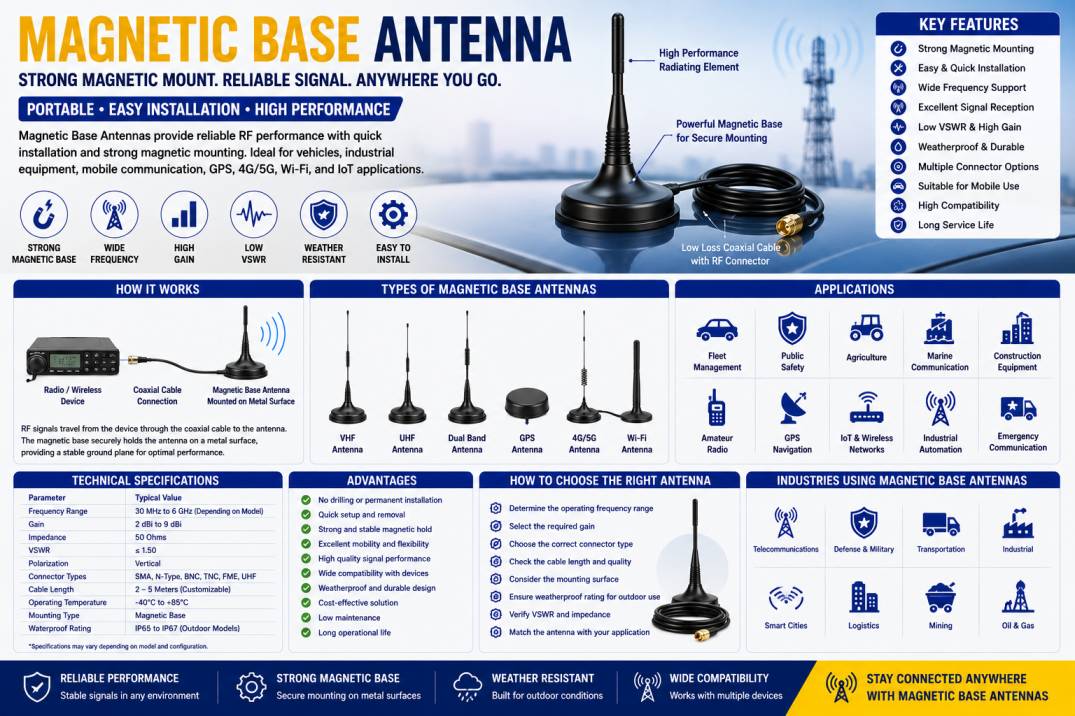
A Magnetic Base Antenna is a portable radio frequency (RF) antenna designed with a powerful magnetic base that securely attaches to metal surfaces without requiring permanent mounting. It is widely used in mobile communication systems where quick installation, flexibility, and reliable signal transmission are essential. Unlike fixed antennas that require drilling or brackets, magnetic mount antennas can be installed and removed within seconds, making them ideal for temporary and mobile applications.
Magnetic Base Antennas are commonly used in vehicles, emergency response systems, fleet management, amateur radio, public safety networks, GPS systems, cellular communication, Wi-Fi applications, industrial monitoring, and IoT devices. Their compact design, strong magnetic mounting system, and excellent RF performance make them one of the most popular antenna solutions for mobile communication.
These antennas operate across multiple frequency bands, including VHF, UHF, GSM, LTE, 4G, 5G, GPS, Wi-Fi, and other wireless communication systems. Their ability to provide stable signal reception while allowing easy repositioning makes them suitable for both commercial and industrial applications.
This comprehensive guide explains everything you need to know about Magnetic Base Antennas, including their construction, working principle, specifications, applications, advantages, and selection criteria.
What Is a Magnetic Base Antenna?
A Magnetic Base Antenna is a mobile antenna equipped with a high-strength magnetic mounting base that allows it to attach securely to metallic surfaces such as vehicle roofs, machinery, cabinets, containers, or communication equipment.
The antenna receives and transmits RF signals through a coaxial cable connected to radios, wireless modems, routers, GPS receivers, or communication devices.
Its magnetic base eliminates the need for permanent installation while maintaining excellent grounding and mechanical stability.
How Does a Magnetic Base Antenna Work?
A Magnetic Base Antenna converts electrical RF signals into electromagnetic waves and vice versa.
The operating process includes:
- RF signals travel from the communication device through the coaxial cable.
- The antenna radiates electromagnetic waves into free space.
- Incoming RF signals are captured by the antenna element.
- The signals travel back through the coaxial cable.
- The connected device processes the transmitted or received information.
The magnetic base securely holds the antenna on a conductive metal surface while providing an effective ground plane, which improves antenna efficiency and radiation performance.
Construction of a Magnetic Base Antenna
Radiating Element
The radiating element transmits and receives radio frequency signals.
Common antenna designs include:
- Whip antenna
- Helical antenna
- Collinear antenna
Magnetic Base
The base contains a powerful permanent magnet that securely attaches to metal surfaces.
High-quality rubber coatings protect vehicle paint from scratches while improving grip.
Coaxial Cable
The RF cable connects the antenna to communication equipment.
Common cable types include:
- RG58
- RG174
- LMR195
- LMR240
RF Connector
Different connector options are available depending on the application.
Common connector types include:
- SMA
- N-Type
- BNC
- TNC
- FME
- UHF (PL-259)
- RP-SMA
Protective Housing
Weather-resistant materials protect the antenna against:
- Rain
- UV radiation
- Dust
- Corrosion
- Extreme temperatures
Working Principle of a Magnetic Base Antenna
The antenna uses the conductive metal surface beneath the magnetic base as a ground plane.
The process includes:
- The communication device generates RF signals.
- Signals travel through the coaxial cable.
- The antenna radiates electromagnetic energy.
- The magnetic base stabilizes the antenna.
- The metal surface improves radiation efficiency.
- Incoming RF signals are received and delivered back to the communication device.
Proper placement on a large metallic surface significantly improves antenna performance.
Technical Specifications
| Specification | Typical Value |
| Frequency Range | 30 MHz to 6 GHz (Depending on Model) |
| Gain | 2 dBi to 9 dBi |
| Impedance | 50 Ohms |
| VSWR | ≤ 1.50 |
| Polarization | Vertical |
| Connector Types | SMA, N-Type, BNC, TNC, FME |
| Cable Length | 2–5 Meters |
| Operating Temperature | -40°C to +85°C |
| Mounting Type | Magnetic Base |
| Waterproof Rating | IP65 to IP67 (Outdoor Models) |
Key Features of Magnetic Base Antennas
- Strong magnetic mounting
- Easy installation
- No drilling required
- Portable design
- Excellent signal reception
- Wide frequency support
- Durable construction
- Weather-resistant materials
- Flexible installation
- High compatibility
- Low maintenance
- Long service life
Types of Magnetic Base Antennas
VHF Magnetic Base Antenna
Designed for VHF communication systems including marine radio and public safety.
UHF Magnetic Base Antenna
Suitable for industrial communication, security systems, and two-way radios.
Dual-Band Magnetic Base Antenna
Supports both VHF and UHF frequency bands.
Cellular Magnetic Base Antenna
Optimized for GSM, LTE, 4G, and 5G communication.
GPS Magnetic Base Antenna
Provides reliable satellite signal reception for navigation systems.
Wi-Fi Magnetic Base Antenna
Used for wireless networking and industrial IoT devices.
Multi-Band Magnetic Base Antenna
Supports multiple wireless communication frequencies simultaneously.
Applications of Magnetic Base Antennas
Fleet Management
Used in commercial vehicles for GPS tracking and communication.
Public Safety
Supports police, fire, ambulance, and emergency communication systems.
Amateur Radio
Provides portable antenna solutions for HAM radio operators.
Transportation
Used in trucks, buses, taxis, trains, and logistics vehicles.
Cellular Communication
Improves LTE and 5G signal reception in mobile applications.
Industrial Automation
Supports wireless monitoring and machine communication.
Agriculture
Used in GPS-guided farming equipment and precision agriculture.
Marine Communication
Supports VHF marine radios and navigation systems.
Construction Equipment
Provides wireless communication for heavy machinery and field operations.
Temporary Communication Systems
Ideal for event management, disaster recovery, and mobile command centers.
Advantages of Magnetic Base Antennas
- Fast installation
- No permanent mounting required
- Portable and reusable
- Excellent mobility
- Cost-effective
- Reliable RF performance
- Suitable for temporary installations
- Compatible with multiple communication systems
- Easy maintenance
- Strong magnetic holding force
- Weather-resistant construction
- Long operational life
Limitations of Magnetic Base Antennas
- Requires a metal mounting surface
- May detach at very high vehicle speeds if installed improperly
- Performance depends on ground plane quality
- Cable routing must be carefully managed
- Not suitable for non-metallic mounting surfaces
How to Choose the Right Magnetic Base Antenna
When selecting a Magnetic Base Antenna, consider:
- Operating frequency
- Gain requirements
- Connector type
- Cable length
- Mounting surface
- Environmental conditions
- VSWR
- Antenna height
- Waterproof rating
- Application type
Magnetic Base Antenna vs Fixed Mount Antenna
| Feature | Magnetic Base Antenna | Fixed Mount Antenna |
| Installation | No Drilling | Permanent Mount |
| Portability | Excellent | Limited |
| Maintenance | Easy | Moderate |
| Ground Plane | Vehicle Body | Dedicated Mount |
| Flexibility | High | Low |
| Typical Applications | Mobile Communication | Permanent Installations |
Industries Using Magnetic Base Antennas
Magnetic Base Antennas are widely used in:
- Telecommunications
- Transportation
- Logistics
- Public Safety
- Agriculture
- Construction
- Industrial Automation
- Fleet Management
- Marine Communication
- Defense
Maintenance Tips
To maximize antenna performance:
- Clean the magnetic base regularly.
- Keep the mounting surface free from dirt.
- Inspect the coaxial cable for damage.
- Protect connectors from moisture.
- Remove the antenna before automatic car washing.
- Avoid sharp cable bends.
- Verify connector tightness periodically.
Future Trends of Magnetic Base Antennas
As connected vehicles, smart transportation, IoT, autonomous systems, and 5G networks continue to expand, Magnetic Base Antennas are becoming more advanced. Manufacturers are introducing multi-band antennas capable of supporting LTE, 5G, Wi-Fi, GPS, and GNSS within a single compact unit. Improvements in magnetic strength, weatherproof materials, low-loss coaxial cables, and aerodynamic designs are enhancing performance, durability, and ease of installation. Future magnetic mount antennas will play a significant role in connected mobility, fleet management, smart agriculture, and industrial wireless communication.
Conclusion
Magnetic Base Antennas provide a practical, flexible, and efficient solution for mobile RF communication. Their easy installation, strong magnetic mounting, reliable signal performance, and compatibility with multiple wireless technologies make them an excellent choice for vehicles, industrial equipment, GPS systems, public safety, fleet management, and temporary communication networks. By selecting the correct frequency range, gain, connector type, and mounting location, users can achieve reliable wireless connectivity and long-term communication performance.
Frequently Asked Questions (FAQs)
1. What is a Magnetic Base Antenna?
A Magnetic Base Antenna is a portable RF antenna that uses a powerful magnetic mount to attach securely to metal surfaces without requiring permanent installation.
2. What is a Magnetic Base Antenna used for?
It is used in vehicles, fleet management, public safety, amateur radio, GPS systems, LTE and 5G communication, industrial automation, and wireless networking.
3. How does a Magnetic Base Antenna work?
The antenna transmits and receives RF signals through a coaxial cable while the magnetic base secures it to a metal surface that acts as a ground plane for improved performance.
4. What frequency bands do Magnetic Base Antennas support?
Depending on the model, they support VHF, UHF, GPS, GSM, LTE, 4G, 5G, Wi-Fi, and GNSS frequency bands.
5. What are the advantages of a Magnetic Base Antenna?
They offer quick installation, portability, strong magnetic mounting, excellent RF performance, weather resistance, and compatibility with various wireless systems.
6. Can a Magnetic Base Antenna be used outdoors?
Yes. Many Magnetic Base Antennas are designed with IP-rated weatherproof construction for reliable outdoor use.
7. Do Magnetic Base Antennas require drilling?
No. Their magnetic mounting system eliminates the need for drilling or permanent installation.
8. Which connector types are available?
Common connector types include SMA, N-Type, BNC, TNC, FME, RP-SMA, and UHF (PL-259).
9. What industries commonly use Magnetic Base Antennas?
They are widely used in telecommunications, transportation, logistics, public safety, agriculture, industrial automation, construction, marine communication, and defense.
10. How do I choose the right Magnetic Base Antenna?
Choose a Magnetic Base Antenna based on operating frequency, antenna gain, connector type, cable length, mounting surface, waterproof rating, environmental conditions, and the communication system you intend to use.