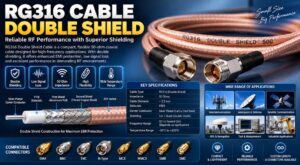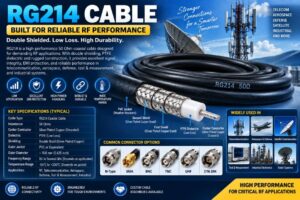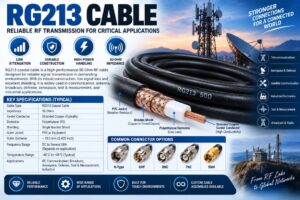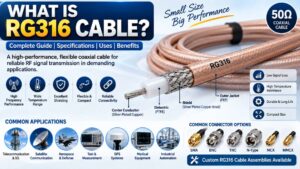
RF cables and Ethernet cables are both essential in modern communication and networking systems, but they are designed for very different purposes. While RF cables primarily transport radio-frequency signals between antennas, transmitters, receivers, and other RF equipment, Ethernet cables are mainly used to carry digital data between network devices such as computers, switches, routers, servers, access points, and IP-based equipment.
Understanding the difference between RF cable and Ethernet cable is important when designing telecom networks, wireless communication systems, 4G and 5G infrastructure, data centers, surveillance systems, industrial networks, and RF testing environments.
Choosing the wrong cable can result in signal loss, electromagnetic interference, poor network performance, impedance mismatch, or unreliable communication. This guide explains RF cable vs Ethernet cable in detail, including construction, signal type, frequency, impedance, shielding, connectors, applications, advantages, limitations, and selection criteria.
What Is an RF Cable?
An RF cable, or Radio Frequency cable, is a specialized cable designed to transmit high-frequency electrical signals with controlled impedance and minimum signal loss.
RF cables are widely used in telecommunications, wireless communication, broadcasting, radar, satellite communication, aerospace, defense, laboratory testing, antennas, and 4G/5G infrastructure.
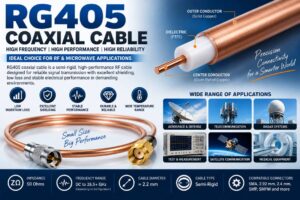
A typical RF coaxial cable consists of four primary elements:
- Center conductor
- Dielectric insulator
- Outer conductor or shield
- Protective outer jacket
The coaxial construction keeps the electromagnetic field concentrated between the center conductor and outer conductor. This provides controlled impedance and helps protect the signal from external electromagnetic interference.
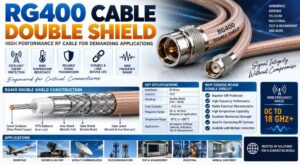
Common RF cable types include coaxial cables, low-loss cables, semi-rigid cables, semi-flexible cables, flexible RF cables, phase-stable cables, thermal-vacuum cables, and high-frequency microwave cables.
What Is an Ethernet Cable?
An Ethernet cable is a networking cable designed primarily for transmitting digital data between Ethernet-compatible devices.
Ethernet cables are commonly used in Local Area Networks (LANs), data centers, offices, industrial automation systems, IP surveillance networks, VoIP systems, servers, computers, routers, switches, and wireless access points.
Common Ethernet cable categories include:
- Cat5e
- Cat6
- Cat6A
- Cat7
- Cat8
Traditional Ethernet cables generally contain four twisted pairs of copper conductors. Each pair is twisted at a specific rate to reduce crosstalk and electromagnetic interference.
Ethernet cables may be unshielded or shielded depending on their construction and application.
RF Cable vs Ethernet Cable: Basic Difference
The biggest difference between RF cable and Ethernet cable is the type of communication they are designed to support.
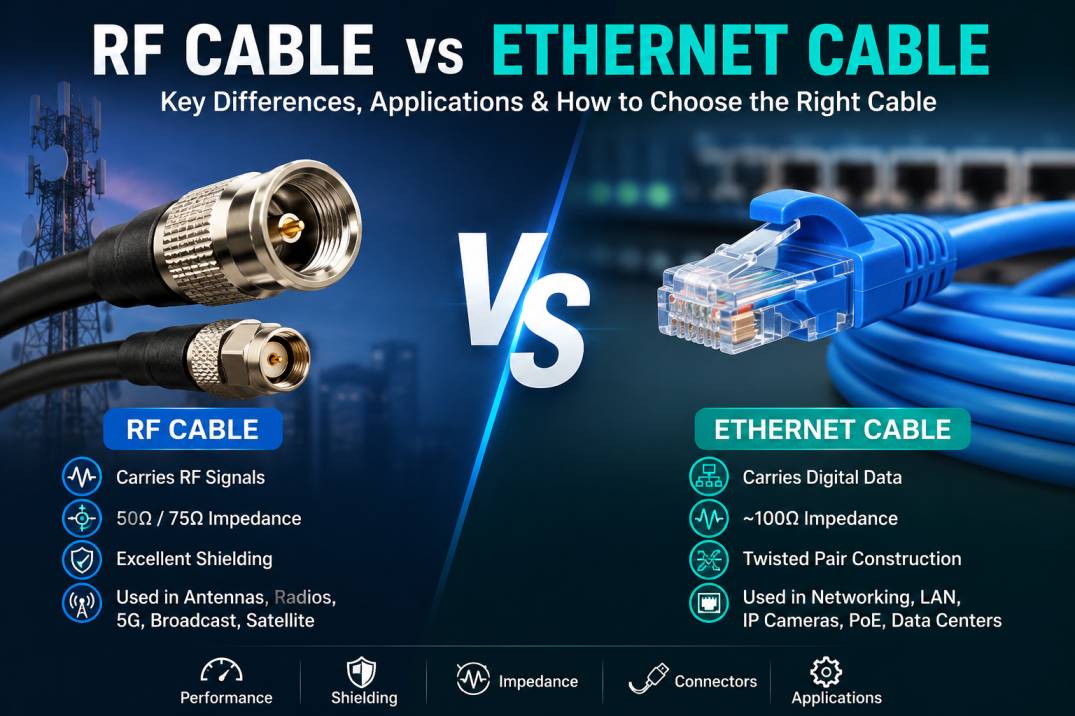
An RF cable primarily carries analog or digitally modulated RF signals at radio and microwave frequencies. An Ethernet cable carries digital network data according to Ethernet communication standards.
RF cables are optimized for characteristics such as impedance, insertion loss, return loss, VSWR, shielding effectiveness, phase stability, and power handling.
Ethernet cables are optimized for characteristics such as data transmission rate, bandwidth, crosstalk, attenuation, channel length, electromagnetic compatibility, and network protocol performance.
RF Cable vs Ethernet Cable Comparison
1. Signal Type
RF cables are designed to carry radio-frequency signals between RF devices.
Typical applications include:
- Antenna to radio connection
- Radio to amplifier connection
- RF test equipment
- Wireless communication systems
- Satellite communication
- Radar systems
- Broadcast equipment
Ethernet cables carry digital data packets between network devices.
Typical applications include:
- Computer networking
- IP cameras
- Servers
- Network switches
- Routers
- Wireless access points
- Industrial Ethernet systems
2. Cable Construction
RF cables typically use a coaxial structure. The center conductor is surrounded by a dielectric material, followed by a conductive shield and an outer protective jacket.
Ethernet cables generally use twisted-pair construction. Four pairs of insulated copper conductors are twisted together to reduce interference and crosstalk.
The difference in construction is one of the main reasons the two cables are not interchangeable for most applications.
3. Impedance
Impedance is a critical specification for RF cables.
Most RF systems use:
- 50 Ohm impedance for wireless communication, RF testing, cellular infrastructure, radar, and many microwave applications
- 75 Ohm impedance for many video, broadcast, and cable television applications
Ethernet twisted-pair cabling is generally designed around approximately 100 Ohm balanced characteristic impedance.
Therefore, directly substituting an Ethernet cable for a 50 Ohm RF coaxial cable can cause serious signal-integrity problems.
4. Frequency Range
RF cables are designed for specific frequency ranges. Depending on cable construction, RF cables can support frequencies ranging from low RF frequencies to several GHz or even tens of GHz.
High-frequency RF cables are used in:
- 5G systems
- Microwave links
- Radar
- Satellite communication
- RF laboratories
- Aerospace systems
- High-frequency test equipment
Ethernet cable performance is specified according to the relevant Ethernet category and cabling standard. For example, higher-category twisted-pair cables support higher signaling bandwidths.
The frequency rating alone, however, does not make an Ethernet cable equivalent to an RF coaxial cable because cable geometry, impedance, balance, connectorization, and transmission method are different.
5. Shielding
RF cables typically have a conductive outer shield designed to contain the RF electromagnetic field and protect the signal from external interference.
Depending on the cable, shielding may include:
- Braided shield
- Foil shield
- Double braid
- Foil plus braid
- Corrugated copper
- Tubular conductor
High-performance RF cables can provide excellent shielding effectiveness, which is particularly important in high-frequency and high-power environments.
Ethernet cables may be:
- UTP: Unshielded Twisted Pair
- FTP: Foiled Twisted Pair
- STP: Shielded Twisted Pair
- S/FTP: Shielded and individually foiled pairs
Ethernet shielding is primarily used to reduce electromagnetic interference and crosstalk in networking environments.
6. Connector Types
RF cables use many specialized coaxial connectors.
Common RF connectors include:
- SMA
- N Type
- BNC
- TNC
- SMB
- SMC
- MCX
- MMCX
- QMA
- 2.92mm
- 2.4mm
- 1.85mm
- SMP
- SMPM
- 7/16 DIN
- Mini DIN
- FME
- U.FL/IPEX
Connector selection depends on frequency, impedance, mechanical requirements, environmental conditions, and application.
Ethernet cables commonly use RJ45-style modular connectors for conventional twisted-pair Ethernet installations.
Specialized industrial Ethernet systems may use other connector systems designed for harsh environments.
7. Data Transmission
RF cables physically transport an RF electrical waveform. The information carried by the RF signal may represent voice, video, telemetry, sensor information, or digital data after modulation.
Ethernet cables directly support packet-based digital networking.
Ethernet communication involves:
- Data packets
- Frames
- Network addressing
- Error detection
- Switching
- Routing
- Network protocols
Therefore, an Ethernet cable is part of a complete data-networking system, while an RF cable is generally part of the RF signal path.
8. Maximum Cable Length
RF cable length is strongly influenced by attenuation and operating frequency.
As frequency increases, cable loss generally increases. A long RF cable run can therefore significantly reduce the power reaching the receiver or antenna.
For example, in a cellular installation, choosing a low-loss RF cable can be important when the distance between the radio equipment and antenna is substantial.
Ethernet also has defined distance limitations based on cable category, network architecture, data rate, and channel design. Conventional copper Ethernet channels are commonly designed around a maximum permanent-link/channel distance of approximately 90/100 meters depending on the specific standard and installation configuration.
For longer Ethernet distances, fiber optic cabling or appropriate network equipment may be used.
RF Cable vs Ethernet Cable: Performance Parameters
RF Cable Parameters
Important RF cable specifications include:
- Characteristic impedance
- Frequency range
- Insertion loss
- Return loss
- VSWR
- Shielding effectiveness
- Power handling
- Phase stability
- Velocity factor
- Capacitance
- Attenuation
- Temperature range
- Bend radius
Ethernet Cable Parameters
Important Ethernet specifications include:
- Cable category
- Data rate
- Bandwidth
- Insertion loss
- Return loss
- NEXT
- FEXT
- Crosstalk
- DC resistance
- Conductor size
- Shielding
- Maximum channel length
- Temperature rating
Why Impedance Matters in RF Systems
Impedance matching is one of the most important considerations when selecting an RF cable.
A typical RF signal path may contain:
Transmitter → RF Cable → Connector → Filter → Connector → RF Cable → Antenna
If the components are designed for 50 Ohm impedance, the cable should also maintain 50 Ohm characteristic impedance.
A significant impedance discontinuity can produce reflections. These reflections can increase VSWR and reduce the amount of useful power delivered to the load.
This is why RF engineers pay close attention to cable impedance, connector impedance, return loss, and VSWR.
Why Twisted Pair Is Used in Ethernet
Ethernet cables use twisted pairs because twisting helps reduce electromagnetic interference and crosstalk.
Each pair carries differential signals. The receiving device detects the voltage difference between the conductors rather than relying solely on the voltage of one conductor relative to ground.
This balanced transmission technique improves resistance to external interference and allows multiple pairs to operate within the same cable.
RF Cable vs Ethernet Cable for 4G and 5G
4G and 5G networks may use both RF cables and Ethernet cables, but they perform different functions.
RF cables can connect:
- Antennas
- Radios
- Remote Radio Units
- RF distribution systems
- Passive RF components
- Filters
- Splitters
- Combiners
Ethernet-based connections can support:
- Network management
- Transport networks
- IP communication
- Baseband networking
- Backhaul and fronthaul architectures
- Network switches
- Data communication between equipment
In modern telecom infrastructure, both technologies can exist within the same installation.
RF Cable vs Ethernet Cable in CCTV Systems
Traditional analog CCTV systems commonly use coaxial cables to transport video signals.
Modern IP surveillance systems generally use Ethernet cables.
For an IP camera installation, Ethernet can provide:
- Data transmission
- Network communication
- Remote management
- Power delivery through PoE when supported
RF coaxial cable is generally not the preferred choice for standard IP camera networking.
RF Cable vs Ethernet Cable in Wi-Fi Systems
Wi-Fi infrastructure can use both cable technologies.
An Ethernet cable may connect a network switch to a wireless access point and carry data and, where supported, Power over Ethernet.
An RF coaxial cable may be used internally or externally in specialized wireless equipment to connect radio circuitry to an antenna.
This distinction is particularly important in enterprise Wi-Fi, telecom, DAS, small-cell, and outdoor wireless infrastructure.
Can Ethernet Cable Be Used as an RF Cable?
In general, standard Ethernet cable should not be used as a direct replacement for a coaxial RF cable in conventional RF systems.
The reasons include:
- Different characteristic impedance
- Different cable geometry
- Balanced versus unbalanced transmission
- Different connector systems
- Different shielding structures
- Different loss characteristics
- Different RF performance specifications
Some specialized RF-over-twisted-pair systems do exist, but these require equipment specifically designed to transmit RF signals over twisted-pair infrastructure.
Therefore, Ethernet cable should not be substituted for RF coaxial cable simply because both are electrical cables.
Can RF Cable Be Used for Ethernet?
A conventional coaxial RF cable cannot normally replace an Ethernet twisted-pair cable for standard Ethernet networking.
Ethernet communication requires compatible physical-layer transceivers and network interfaces.
Specialized systems can transmit Ethernet over coaxial infrastructure using technologies designed for that purpose, but this is different from directly connecting an ordinary RF coaxial cable to an Ethernet RJ45 interface.
RF Cable Advantages
RF cables provide several advantages for high-frequency signal transmission.
Excellent RF Performance
Properly designed RF cables provide controlled impedance and predictable transmission characteristics across their specified frequency range.
High Shielding Effectiveness
Coaxial construction provides strong protection against electromagnetic interference and reduces unwanted radiation.
Wide Frequency Capability
Specialized RF cables can operate from low frequencies to microwave and millimeter-wave frequencies.
High Power Handling
Certain RF cables can handle substantial RF power, making them suitable for transmitters, base stations, broadcasting, and industrial applications.
Precision Connectivity
RF cables are available with precision connectors for laboratory, aerospace, defense, telecom, and microwave applications.
Ethernet Cable Advantages
Ethernet cables also offer several important benefits.
High-Speed Digital Communication
Modern Ethernet standards support high-speed networking suitable for data centers, enterprise networks, industrial systems, and IP devices.
Simple Network Connectivity
Ethernet provides a standardized method of connecting network devices.
PoE Support
Compatible Ethernet infrastructure can deliver power and data through the same cable.
Cost-Effective Installation
Twisted-pair Ethernet cabling can be economical for building and LAN deployments.
Easy Network Expansion
Ethernet networks can be expanded using switches, routers, access points, and other network infrastructure.
Limitations of RF Cable
RF cables have some limitations.
- Higher attenuation at higher frequencies
- Cable loss increases with length
- Specialized RF connectors can be more expensive
- Improper bending can affect performance
- Installation requires attention to connector quality and torque
- Different RF applications require different impedance and cable types
Limitations of Ethernet Cable
Ethernet cables also have limitations.
- Copper Ethernet has distance limitations
- Performance depends on category and installation quality
- Crosstalk can affect high-speed performance
- Poor termination can degrade network performance
- Electromagnetic interference can affect poorly designed installations
- Standard Ethernet cabling is not a substitute for conventional coaxial RF transmission
RF Cable vs Ethernet Cable: Which Is Better?
Neither cable is universally better.
The correct choice depends on the application.
Choose an RF cable when the system requires:
- RF signal transmission
- Antenna connections
- Microwave communication
- Cellular RF connections
- Radar systems
- Satellite communication
- RF testing
- Broadcast RF transmission
- Controlled 50 Ohm or 75 Ohm transmission
Choose Ethernet cable when the system requires:
- Computer networking
- IP communication
- Network switches
- Routers
- Servers
- IP cameras
- Wireless access points
- PoE devices
- Industrial Ethernet
How to Select the Right RF Cable
When selecting an RF cable, consider the following specifications.
Frequency Range
Choose a cable rated for the complete operating frequency range of the system.
Impedance
Verify whether the system requires 50 Ohm, 75 Ohm, or another specified impedance.
Cable Length
Calculate the expected insertion loss over the complete cable length.
Connector Type
Select connectors that match the equipment and required frequency range.
Power Rating
Verify average and peak RF power requirements.
Environmental Conditions
Consider:
- Temperature
- Humidity
- UV exposure
- Water ingress
- Chemical exposure
- Outdoor installation
- Vibration
- Mechanical stress
Flexibility
Select flexible, semi-flexible, or semi-rigid construction according to installation requirements.
Phase Stability
For precision measurement, phased-array, radar, and test applications, phase-stable RF cables may be required.
How to Select the Right Ethernet Cable
When selecting Ethernet cable, consider:
Ethernet Category
Select the appropriate Cat5e, Cat6, Cat6A, Cat7, or Cat8 solution based on the required network performance.
Data Rate
Determine the required network speed before selecting the cable.
Installation Environment
Consider whether the cable will be installed:
- Indoors
- Outdoors
- In cable trays
- In industrial environments
- In data centers
- In high-temperature areas
Shielding
Select UTP or shielded construction based on the electromagnetic environment.
Conductor Type
Solid copper is commonly preferred for permanent structured cabling, while stranded constructions are often used for patch cables.
RF Cable and Ethernet Cable in Telecom Infrastructure
Modern telecom infrastructure often combines both cable technologies.
A simplified telecom installation can include:
Antenna → RF Cable → Radio Equipment → Ethernet/Fiber Network → Core Network
The RF cable handles the radio-frequency path, while Ethernet or fiber-based infrastructure handles digital transport and networking functions.
This combination is especially important in modern 4G, 5G, small-cell, DAS, enterprise wireless, and private-network deployments.
Common RF Cable Types
Coaxial RF Cable
The most widely recognized RF cable construction for radio-frequency transmission.
Low-Loss RF Cable
Designed to minimize attenuation over longer RF transmission paths.
Semi-Rigid RF Cable
Uses a rigid metallic outer conductor and provides excellent shielding and predictable electrical performance.
Semi-Flexible RF Cable
Provides better flexibility than semi-rigid cable while maintaining strong RF performance.
Phase-Stable Cable
Designed to minimize changes in electrical phase caused by movement or temperature variation.
High-Frequency Microwave Cable
Designed for demanding applications operating at microwave and millimeter-wave frequencies.
Common Ethernet Cable Types
Cat5e
Commonly used for standard Gigabit Ethernet installations.
Cat6
Designed for higher-performance networking and improved crosstalk performance compared with older categories.
Cat6A
Designed for higher bandwidth and demanding enterprise installations.
Cat7
Provides advanced shielding and high-frequency performance according to its applicable cabling specification.
Cat8
Designed for very high-speed data-center networking over relatively short copper links.
Common Applications of RF Cables
RF cables are widely used in:
- 4G networks
- 5G networks
- Base stations
- DAS systems
- Small cells
- Antenna systems
- RF laboratories
- Test and measurement
- Radar
- Satellite communication
- Aerospace
- Defense
- Broadcasting
- Wireless infrastructure
- IoT communication systems
- Industrial RF systems
Common Applications of Ethernet Cables
Ethernet cables are commonly used in:
- Office networks
- Data centers
- CCTV networks
- IP telephony
- Industrial automation
- Building automation
- Servers
- Computers
- Network switches
- Routers
- Wireless access points
- Smart buildings
- IoT networks
- Enterprise networks
RF Cable vs Ethernet Cable: Key Takeaway
RF cable and Ethernet cable are designed for different transmission environments.
RF cables use controlled coaxial construction to efficiently transport RF signals while maintaining impedance, shielding, insertion loss, and return-loss performance.
Ethernet cables use twisted-pair construction to support balanced digital communication and high-speed networking.
The correct cable should always be selected according to the electrical interface, transmission technology, frequency, impedance, distance, environment, and required performance.
For telecom, RF, 4G, 5G, antenna, and wireless infrastructure projects, selecting the appropriate RF cable and connector combination is essential for maintaining reliable signal performance.
Why Choose SRFS Teleinfra for RF Cable Solutions?
SRFS Teleinfra provides RF, telecom, 4G/5G, cable assembly, connector, and network infrastructure solutions for professional communication applications.
Its RF product portfolio can support applications involving RF cables, cable assemblies, connectors, adapters, telecom infrastructure, antenna systems, grounding accessories, weatherproofing solutions, and related RF components.
For demanding RF applications, cable selection should be based on technical specifications rather than appearance or basic cable compatibility. Frequency range, impedance, attenuation, VSWR, shielding, connector type, power handling, and environmental requirements should all be evaluated before procurement.
Frequently Asked Questions About RF Cable vs Ethernet Cable
1. What is the main difference between RF cable and Ethernet cable?
RF cable is primarily designed to carry radio-frequency signals, while Ethernet cable is designed to carry digital network data between Ethernet-compatible devices.
2. Is RF cable better than Ethernet cable?
Neither is universally better. RF cable is better suited for RF signal paths, while Ethernet cable is better suited for digital networking applications.
3. Can Ethernet cable carry RF signals?
Specialized systems can transmit RF-related signals over twisted-pair infrastructure, but standard Ethernet cable should not automatically be treated as a replacement for coaxial RF cable.
4. Can RF cable be used for Ethernet?
A conventional RF coaxial cable cannot directly replace standard Ethernet twisted-pair cabling. Specialized Ethernet-over-coax technologies require compatible equipment.
5. What impedance is commonly used for RF cables?
50 Ohm is widely used in wireless, telecom, RF testing, radar, and microwave systems. 75 Ohm is also common in video, broadcast, and certain cable distribution applications.
6. What impedance is used by Ethernet cables?
Ethernet twisted-pair cabling is generally designed around approximately 100 Ohm balanced characteristic impedance.
7. Which cable is used between an antenna and radio?
A suitable RF coaxial cable or RF cable assembly is normally used between an antenna and radio when the equipment interface requires a coaxial RF connection.
8. Which Ethernet cable is best for high-speed networking?
The appropriate category depends on the required Ethernet standard, data rate, channel length, installation environment, and equipment. Higher categories can support more demanding applications.
9. Why is RF cable shielding important?
Shielding helps reduce electromagnetic interference, limits unwanted RF radiation, and protects signal integrity.
10. What should be checked before buying an RF cable?
Check frequency range, impedance, attenuation, VSWR, return loss, shielding, power handling, connector type, cable length, bend radius, temperature rating, and environmental requirements.
11. Can RF cable and Ethernet cable be used in the same telecom installation?
Yes. Modern telecom systems frequently use RF cables for radio-frequency paths and Ethernet or fiber-based networking for digital communication and transport.
12. Which cable is used for 5G networks?
5G infrastructure can use several cable technologies. RF coaxial cables are used for appropriate RF paths, while Ethernet and fiber-based connections may be used for data, transport, management, fronthaul, or backhaul depending on the architecture.
Conclusion
The comparison of RF cable vs Ethernet cable is ultimately a comparison between two different transmission technologies. RF cables are engineered for controlled radio-frequency transmission, while Ethernet cables are engineered for high-speed digital networking.
RF cables are essential for antennas, radios, RF testing, microwave systems, radar, satellite communication, and wireless infrastructure. Ethernet cables are essential for LANs, servers, switches, routers, IP cameras, access points, and digital communication networks.
Selecting the correct cable requires a clear understanding of the system’s frequency, impedance, signal type, distance, bandwidth, shielding requirements, connectors, environmental conditions, and performance targets. Using the correct cable technology helps improve reliability, signal integrity, network performance, and overall system efficiency.