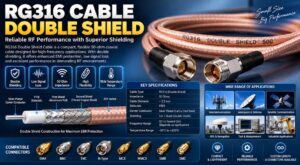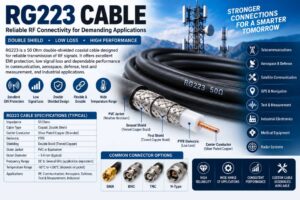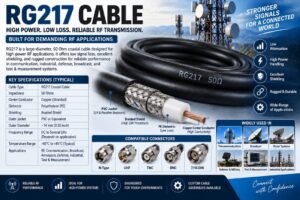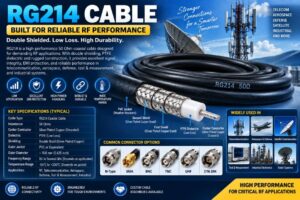
RF cables are essential components in modern wireless communication, telecommunications, test and measurement, aerospace, defense, radar, satellite communication, broadcasting, and 4G/5G network infrastructure. They are designed to transmit radio-frequency signals from one point to another while maintaining signal integrity, minimizing losses, and controlling unwanted electromagnetic interference.
One of the most important specifications when selecting an RF cable is its frequency range. The frequency range determines the spectrum over which a cable can transmit RF signals while maintaining acceptable electrical performance.
Understanding RF cable frequency range is important because a cable that works effectively at lower frequencies may experience significant insertion loss, impedance variation, phase instability, or signal reflections when used at higher frequencies.
This guide explains RF cable frequency range, how frequency affects cable performance, common RF cable frequency ranges, important specifications, cable selection criteria, and applications across modern RF and wireless systems.
What Is RF Cable Frequency Range?
RF cable frequency range refers to the range of frequencies over which an RF cable is designed to operate while meeting specified electrical performance characteristics.
It is normally expressed in units such as:
- MHz
- GHz
For example, an RF cable may be specified as:
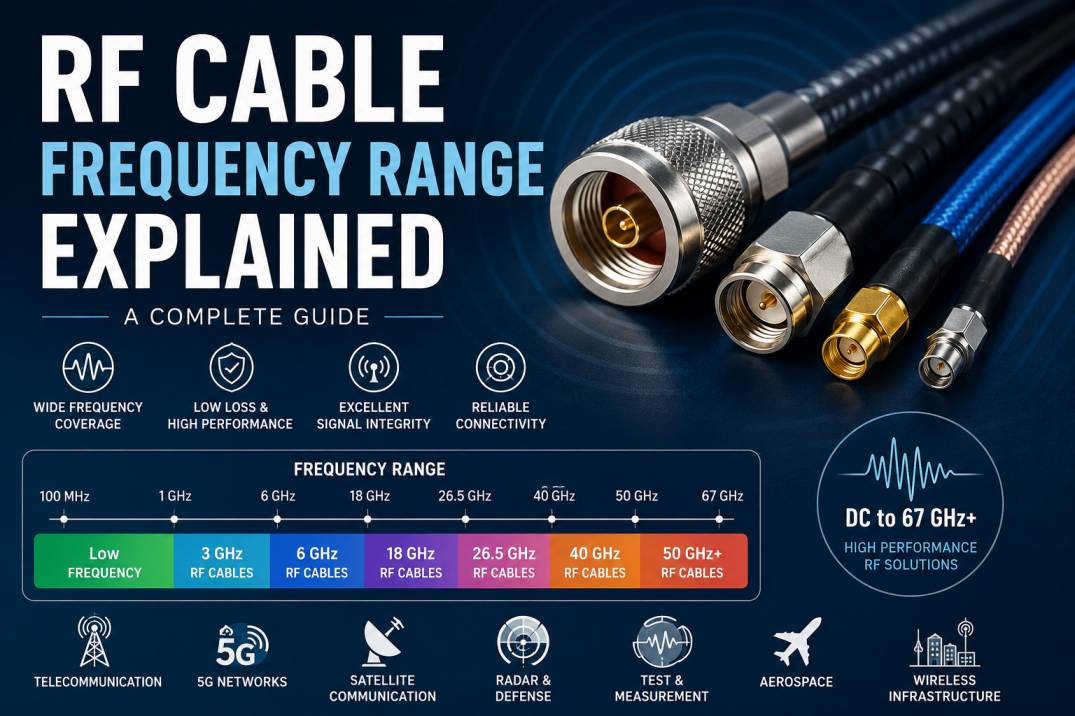
- DC to 3 GHz
- DC to 6 GHz
- DC to 18 GHz
- DC to 26.5 GHz
- DC to 40 GHz
- DC to 50 GHz
- DC to 67 GHz
The frequency rating does not simply indicate whether a signal can physically pass through the cable. Instead, it indicates the frequency range within which important parameters such as insertion loss, return loss, VSWR, impedance, shielding effectiveness, and phase stability are expected to remain within defined limits.
Why RF Cable Frequency Range Matters
RF signals behave differently as frequency increases. At higher frequencies, even small imperfections in the cable, connector, dielectric material, shielding, or termination can significantly affect system performance.
Selecting a cable with the correct frequency rating helps ensure:
- Lower insertion loss
- Better return loss
- Lower VSWR
- Stable impedance
- Improved shielding
- Reduced signal reflection
- Better phase stability
- Reliable signal transmission
- Improved measurement accuracy
- Consistent RF system performance
For example, a cable designed for applications below 6 GHz may not be suitable for a 40 GHz test system even if the connector physically fits.
Understanding Frequency in RF Systems
Frequency represents the number of electromagnetic wave cycles occurring per second.
Frequency is commonly measured in:
- Hz – Hertz
- kHz – Kilohertz
- MHz – Megahertz
- GHz – Gigahertz
RF and microwave systems commonly operate from hundreds of MHz into the tens or hundreds of GHz.
As frequency increases, wavelength decreases. This makes RF systems increasingly sensitive to cable dimensions, connector geometry, dielectric properties, conductor surface condition, and mechanical construction.
genui{“physics_waves_optics_oscillations_earth_learning_block”:{“type_id”:”WAVE_SPEED”,”locale_override”:”en-US”}}
Common RF Cable Frequency Ranges
Different RF cables are designed for different frequency ranges depending on their construction, materials, diameter, shielding, dielectric, and intended application.
Low-Frequency RF Cables
Low-frequency RF cables may operate from DC through several hundred MHz or a few GHz.
Typical applications include:
- General RF equipment
- Radio communication
- Industrial electronics
- Control systems
- Older wireless systems
- General laboratory equipment
These cables generally have less demanding high-frequency requirements compared with microwave test cables.
3 GHz RF Cables
RF cables rated up to approximately 3 GHz are commonly used in:
- Wi-Fi systems
- Cellular communication
- General RF equipment
- Wireless networking
- GPS systems
- Radio communication
They can provide reliable performance for many conventional RF applications.
6 GHz RF Cables
6 GHz RF cables are widely used in modern wireless and networking systems.
Typical applications include:
- Wi-Fi 5
- Wi-Fi 6
- Wi-Fi 6E
- LTE systems
- RF testing
- Wireless communication
- Laboratory equipment
- Antenna systems
For systems operating around the 5 GHz and 6 GHz bands, cable loss and connector quality become increasingly important.
10 GHz RF Cables
10 GHz RF cables are frequently used for higher-performance microwave applications.
Applications include:
- Microwave communication
- Radar
- RF testing
- Instrumentation
- Satellite communication
- Antenna measurements
- Defense electronics
At this frequency, cable construction and connector quality become significantly more important.
18 GHz RF Cables
18 GHz cables are common in professional RF test and measurement systems.
Applications include:
- Spectrum analyzers
- Signal generators
- Vector network analyzers
- Microwave testing
- Aerospace systems
- Defense systems
- Communication equipment
High-quality connectors such as SMA and specialized microwave connectors are commonly used with these cable assemblies.
26.5 GHz RF Cables
26.5 GHz is an important range for high-frequency laboratory and microwave applications.
These cables are commonly used for:
- High-frequency VNA testing
- Microwave components
- Aerospace testing
- Defense electronics
- Radar systems
- High-speed communication equipment
Cable assemblies operating to 26.5 GHz require accurate connector geometry and controlled manufacturing tolerances.
40 GHz RF Cables
40 GHz RF cables are designed for demanding microwave and millimeter-wave applications.
Typical applications include:
- Advanced RF testing
- 5G research
- Radar
- Aerospace
- Defense
- Satellite communication
- High-frequency semiconductor testing
- Microwave instrumentation
Common connector technologies for these systems include 2.92 mm connectors.
50 GHz and Above
RF cables operating above 50 GHz are specialized microwave and millimeter-wave products.
They may be used for:
- Advanced semiconductor testing
- Millimeter-wave research
- Aerospace
- Defense
- Radar
- High-frequency communications
- 5G/6G research
- Precision laboratory measurements
At these frequencies, cable design becomes extremely sensitive to mechanical tolerances, connector interface dimensions, dielectric properties, and phase stability.
RF Cable Frequency Range and Insertion Loss
Insertion loss is one of the most important RF cable characteristics.
It represents the amount of signal power lost as the RF signal travels through the cable.
Insertion loss is normally expressed in dB.
As frequency increases, insertion loss generally increases because of conductor losses and dielectric losses.
A longer cable also normally produces greater insertion loss.
For example, a short high-quality microwave cable may have significantly lower loss than a longer cable made from the same cable family.
Therefore, RF cable selection should consider both:
- Frequency
- Cable length
RF Cable Frequency and Skin Effect
At higher frequencies, RF current tends to concentrate toward the surface of the conductor. This phenomenon is known as the skin effect.
The effective conducting area decreases as frequency increases, which increases conductor resistance and contributes to higher attenuation.
This is one reason why RF cable loss generally increases with frequency.
Cable manufacturers use specialized conductor materials, plating, geometry, and construction methods to control these losses.
Effect of Frequency on VSWR
VSWR stands for Voltage Standing Wave Ratio.
It indicates how effectively RF power is transferred between connected components.
An impedance mismatch causes part of the RF signal to be reflected toward the source.
Higher-frequency systems are generally more sensitive to impedance discontinuities.
Poor cable construction or connectors can cause:
- Increased reflections
- Higher VSWR
- Lower return loss
- Reduced transmitted power
- Measurement errors
For precision RF applications, maintaining a controlled 50-ohm impedance throughout the cable assembly is essential.
RF Cable Frequency Range and Return Loss
Return loss describes the amount of signal reflected back toward the source due to impedance mismatch.
Higher return loss generally indicates better impedance matching.
A high-quality RF cable assembly should maintain good return loss across its specified operating frequency range.
The cable itself is only one part of the system. Connector interfaces, transitions, adapters, solder joints, crimp connections, and termination quality can all affect return loss.
Frequency Range and RF Cable Shielding
Shielding effectiveness becomes increasingly important as frequency increases.
RF cables may use:
- Braided shields
- Foil shields
- Dual shields
- Triple shields
- Corrugated conductors
- Tubular outer conductors
Effective shielding helps prevent:
- RF leakage
- External interference
- Crosstalk
- Electromagnetic interference
- Signal coupling between adjacent cables
For sensitive communication and test systems, high shielding effectiveness can be critical.
RF Cable Frequency Range and Phase Stability
Phase stability is particularly important in precision RF systems.
When cable temperature, movement, bending, or mechanical stress changes, the electrical length of the cable can change.
This may result in phase variation.
Phase-stable RF cables are commonly used in:
- Vector network analyzers
- Antenna measurement systems
- Radar
- Satellite communication
- Aerospace testing
- Defense systems
- Microwave instrumentation
For these applications, selecting a cable based only on frequency range is not sufficient. Phase stability and environmental performance must also be considered.
Common RF Cable Types and Their Frequency Applications
Coaxial RF Cable
Coaxial cable is one of the most widely used RF cable technologies.
It consists of:
- Center conductor
- Dielectric
- Shield or outer conductor
- Protective jacket
Coaxial RF cables are available in flexible, semi-flexible, semi-rigid, low-loss, phase-stable, and high-performance configurations.
Flexible RF Cable
Flexible RF cables are designed for applications where the cable needs to bend during installation or operation.
Applications include:
- RF equipment
- Antenna systems
- Test equipment
- Telecom systems
- Wireless infrastructure
Semi-Rigid RF Cable
Semi-rigid cables use a rigid metallic outer conductor and provide excellent shielding and predictable electrical performance.
They are widely used in:
- Microwave equipment
- Aerospace
- Defense
- Laboratory instrumentation
- High-frequency electronics
Semi-Flexible RF Cable
Semi-flexible cables provide a balance between the shielding characteristics of semi-rigid cables and easier installation.
They are useful where controlled bending is required.
Low-Loss RF Cable
Low-loss RF cables are designed to reduce attenuation over longer cable lengths.
They are commonly used in:
- Base stations
- Antenna feeders
- Wireless networks
- Telecom infrastructure
- Distributed antenna systems
Phase-Stable RF Cable
Phase-stable cables are designed to minimize changes in electrical phase caused by temperature, bending, and mechanical movement.
They are important for precision measurement and high-frequency applications.
RF Cable Frequency Range by Connector Type
The connector also influences the maximum usable frequency of an RF cable assembly.
SMA Connector
SMA connectors are widely used in RF systems and are available in cable assemblies supporting several GHz and, depending on design, much higher microwave frequencies.
Applications include:
- Wireless communication
- RF testing
- GPS
- Antenna systems
- Microwave equipment
N-Type Connector
N-Type connectors are widely used for robust RF and microwave applications.
They are common in:
- Telecom
- Antenna systems
- Base stations
- RF infrastructure
- Outdoor wireless systems
BNC Connector
BNC connectors are widely used for general RF and test applications, particularly at lower and moderate RF frequencies.
TNC Connector
TNC connectors provide a threaded interface and are used in applications requiring improved mechanical stability compared with bayonet-style interfaces.
2.92 mm Connector
2.92 mm connectors, commonly known as K connectors, are designed for high-frequency microwave applications and are commonly associated with systems operating up to approximately 40 GHz.
2.4 mm Connector
2.4 mm connectors are designed for higher-frequency microwave applications and can support frequencies substantially above conventional SMA applications.
1.85 mm Connector
1.85 mm connectors, commonly associated with V-band and high-frequency microwave test systems, are used for very high-frequency applications.
Why Connector Frequency Rating Is Important
An RF cable may use a high-performance cable, but the complete assembly is limited by its weakest component.
The overall frequency performance depends on:
- Cable
- Connector
- Termination
- Adapter
- Manufacturing process
- Assembly quality
For example, installing a lower-frequency connector onto a high-frequency cable does not automatically create a high-frequency cable assembly.
The complete assembly must be engineered and tested for the intended frequency range.
RF Cable Frequency Range and Cable Length
Cable length has a major influence on RF performance.
Longer cables generally introduce more attenuation.
Shorter cables are often preferred in high-frequency test systems because they can reduce:
- Insertion loss
- Phase variation
- Signal attenuation
- Measurement uncertainty
However, the shortest possible cable is not always the best option. Mechanical routing, minimum bend radius, equipment layout, connector orientation, and installation requirements must also be considered.
RF Cable Frequency Range for 4G and 5G
Modern cellular networks require RF cables capable of supporting multiple frequency bands.
4G LTE systems commonly operate across a wide range of frequency bands, depending on the deployment and region.
5G introduces additional frequency ranges, including sub-6 GHz and higher-frequency spectrum.
RF cables used in 5G infrastructure should therefore be selected according to:
- Operating frequency
- Insertion loss
- PIM performance
- VSWR
- Shielding
- Power handling
- Cable length
- Environmental conditions
- Connector type
For high-frequency 5G research and advanced wireless systems, specialized microwave cable assemblies may be required.
RF Cable Frequency Range for Test and Measurement
Test and measurement applications require highly controlled RF cables.
They may connect:
- Vector network analyzers
- Spectrum analyzers
- Signal generators
- Power meters
- Oscilloscopes
- RF probes
- Antennas
- Calibration equipment
In these applications, cable specifications such as phase stability, amplitude stability, connector repeatability, VSWR, and insertion loss can be more important than simply selecting the highest possible frequency rating.
RF Cable Frequency Range for Aerospace and Defense
Aerospace and defense systems often require high-performance RF cables capable of operating across demanding frequency ranges and environmental conditions.
Typical applications include:
- Radar
- Electronic warfare
- Satellite communication
- Aircraft communication
- Navigation
- Missile systems
- Antenna systems
- Avionics
- RF test equipment
These systems may require cables with:
- High shielding effectiveness
- Low insertion loss
- Phase stability
- Temperature resistance
- Vibration resistance
- High mechanical reliability
- Controlled impedance
How to Select the Correct RF Cable Frequency Range
Selecting an RF cable should begin with the actual system requirements.
Step 1: Determine Operating Frequency
Identify the lowest and highest frequencies used by the system.
For example, if the equipment operates from 1 GHz to 18 GHz, select a cable assembly with a frequency rating that comfortably covers the entire range.
Step 2: Check Insertion Loss
Determine the maximum acceptable signal loss.
For long cable runs, low-loss RF cable may be necessary.
Step 3: Check Impedance
Most RF communication systems use 50-ohm impedance.
Ensure that the cable, connector, adapter, and equipment all use compatible impedance.
Step 4: Check VSWR and Return Loss
For high-frequency systems, verify that VSWR and return loss meet the equipment requirements.
Step 5: Select the Correct Connector
The connector must support the required frequency and mechanical interface.
Step 6: Consider Cable Length
Use the shortest practical cable while maintaining proper routing and mechanical requirements.
Step 7: Consider Environmental Conditions
For outdoor telecom, aerospace, defense, and industrial applications, evaluate:
- Temperature
- Moisture
- UV exposure
- Vibration
- Mechanical movement
- Chemical exposure
Step 8: Consider Phase Stability
For precision measurement, radar, and advanced microwave systems, phase stability may be a critical selection parameter.
RF Cable Frequency Range vs Bandwidth
Frequency range and bandwidth are related but should not be treated as identical terms.
Frequency range describes the frequencies over which the cable is designed to operate.
Bandwidth generally refers to the width of the frequency spectrum being utilized.
For example, a cable specified from DC to 18 GHz has a broad operating frequency range of up to 18 GHz.
The actual application may use only a small portion of that range.
Does a Higher Frequency Rating Mean a Better RF Cable?
Not necessarily.
A 40 GHz cable is not automatically better for every application than a 6 GHz cable.
Using a higher-frequency cable can increase cost without providing meaningful benefits if the application operates at much lower frequencies.
Cable selection should be based on:
- Required frequency
- Loss requirements
- Cable length
- Connector requirements
- Phase stability
- Power handling
- Mechanical flexibility
- Environmental conditions
- Budget
The best RF cable is the one that meets the complete system requirements.
RF Cable Frequency Range and Power Handling
Frequency capability and power handling are separate specifications.
An RF cable may support a very high frequency but may not be designed to carry high RF power under all operating conditions.
Power handling can depend on:
- Frequency
- Cable diameter
- Conductor material
- Dielectric
- Temperature
- VSWR
- Cooling conditions
- Cable construction
Therefore, both frequency and power ratings should be checked before selecting a cable.
RF Cable Frequency Range and PIM Performance
Passive Intermodulation, commonly called PIM, is especially important in cellular and telecom infrastructure.
Poor-quality connectors, materials, contact surfaces, or mechanical connections can generate unwanted intermodulation products.
Low-PIM RF cables and assemblies are therefore used in applications such as:
- 4G networks
- 5G networks
- Distributed antenna systems
- Base stations
- Indoor coverage systems
- Repeater systems
Frequency range alone does not determine PIM performance. Mechanical construction and material quality are also important.
Importance of RF Cable Manufacturing Quality
At higher frequencies, manufacturing tolerances become increasingly important.
Small dimensional variations can affect:
- Impedance
- VSWR
- Return loss
- Insertion loss
- Phase
- Connector performance
Precision manufacturing and controlled assembly processes are therefore essential for high-frequency RF cable assemblies.
RF Cable Testing
Professional RF cable assemblies may undergo electrical and mechanical testing.
Common electrical tests include:
- Insertion loss
- Return loss
- VSWR
- Phase
- Isolation
- Shielding effectiveness
- PIM, where applicable
Mechanical inspections may include:
- Connector dimensions
- Cable length
- Connector torque
- Pull strength
- Bend radius
- Visual inspection
Testing helps confirm that the finished cable assembly meets its specified frequency and performance requirements.
RF Cable Frequency Range: Practical Examples
A Wi-Fi system operating around 5 GHz may require a cable rated comfortably above its operating frequency.
A microwave laboratory system operating at 18 GHz may require an 18 GHz or higher precision cable assembly.
A 40 GHz measurement system should use a cable and connector combination specifically designed and tested for 40 GHz operation.
A millimeter-wave research system operating above 50 GHz requires specialized high-frequency cable assemblies and connectors.
These examples demonstrate why the frequency rating must always be considered together with the complete RF system requirements.
RF Cable Frequency Range for SRFS Teleinfra
SRFS Teleinfra provides RF cable and cable assembly solutions for telecommunications, RF testing, wireless infrastructure, microwave systems, and advanced RF applications.
The product selection can include different cable constructions, connector configurations, frequency capabilities, and application-specific designs.
Depending on the application, RF cable assemblies can be configured with connectors such as SMA, N-Type, BNC, TNC, 2.92 mm, 2.4 mm, 1.85 mm, SMP, SMPM, MMCX, MCX, U.FL/IPEX, and other RF interfaces.
For demanding applications, cable selection can be optimized for electrical performance, mechanical flexibility, low loss, phase stability, shielding, environmental conditions, and frequency requirements.
Key Factors Affecting RF Cable Frequency Performance
The main factors affecting RF cable frequency performance include:
- Cable construction
- Conductor material
- Dielectric material
- Shielding design
- Cable diameter
- Connector type
- Connector quality
- Cable length
- Manufacturing tolerances
- Operating temperature
- Mechanical movement
- Bending
- Impedance matching
- Installation quality
All these factors should be evaluated when selecting an RF cable.
RF Cable Frequency Range: Quick Selection Guide
For general RF applications, select a cable based on the required operating band and acceptable loss.
For telecom infrastructure, prioritize low loss, environmental durability, PIM performance, and connector reliability.
For laboratory testing, prioritize low VSWR, excellent return loss, phase stability, connector repeatability, and calibration compatibility.
For microwave applications, select cables and connectors specifically designed for the required frequency.
For millimeter-wave applications, use precision cable assemblies engineered and tested for the target frequency range.
Conclusion
RF cable frequency range is one of the most important specifications when selecting a cable for wireless, telecom, microwave, test and measurement, aerospace, defense, radar, and satellite applications.
The frequency rating determines the range in which the cable is designed to provide acceptable electrical performance. However, frequency should never be considered alone.
Insertion loss, VSWR, return loss, impedance, shielding effectiveness, phase stability, cable length, connector type, power handling, PIM performance, and environmental requirements can all influence the suitability of an RF cable.
As operating frequencies increase from a few GHz to 20 GHz, 40 GHz, 50 GHz, and beyond, precision cable construction and connector engineering become increasingly important.
Choosing the correct RF cable frequency range helps minimize signal loss and reflections while improving reliability and overall RF system performance.
For telecom, RF testing, microwave, 4G/5G, aerospace, defense, and high-frequency applications, selecting the right RF cable assembly should always be based on the complete electrical and mechanical requirements of the system.
Frequently Asked Questions
What is RF cable frequency range?
RF cable frequency range is the spectrum of frequencies over which an RF cable is designed to operate while meeting specified electrical performance requirements such as insertion loss, VSWR, return loss, and impedance.
What frequency range do RF cables support?
RF cables can support frequencies ranging from DC and low-frequency RF applications to several GHz, tens of GHz, and specialized millimeter-wave frequencies above 50 GHz.
Does RF cable loss increase with frequency?
Yes. In general, insertion loss increases as frequency increases because conductor and dielectric losses become more significant at higher frequencies.
Is a 50-ohm RF cable suitable for all RF applications?
50-ohm RF cables are widely used in communication, microwave, test, aerospace, and defense systems, but the complete system should always be checked for impedance compatibility.
What RF cable is suitable for 5G?
The appropriate 5G RF cable depends on the operating frequency, cable length, insertion loss, PIM requirement, connector type, power level, and installation environment.
What RF cable is suitable for 40 GHz?
For 40 GHz applications, use a precision RF cable assembly specifically rated and tested for 40 GHz operation, together with compatible high-frequency connectors such as 2.92 mm where appropriate.
Does cable length affect RF frequency performance?
Cable length directly affects signal attenuation and phase characteristics. Longer cables generally introduce greater insertion loss, especially at higher frequencies.
Why is VSWR important in RF cables?
VSWR indicates the degree of impedance mismatch and signal reflection. Lower VSWR generally means better RF power transfer and reduced signal reflection.
What is the difference between RF frequency range and bandwidth?
Frequency range describes the overall frequencies over which a cable is designed to operate. Bandwidth generally describes the span of frequencies utilized or available for a particular application.
Are high-frequency RF cables better than low-frequency cables?
Not necessarily. A high-frequency cable may provide capabilities that are unnecessary for a low-frequency application. The correct cable should match the application’s frequency, loss, mechanical, environmental, and connector requirements.
What connector is best for high-frequency RF cables?
The appropriate connector depends on the target frequency and application. SMA, 2.92 mm, 2.4 mm, 1.85 mm, SMP, and SMPM are examples of connectors used across different high-frequency applications.
Why is phase stability important in RF cable assemblies?
Phase stability minimizes changes in electrical phase caused by temperature, movement, and bending. It is particularly important for VNA testing, radar, antenna measurements, aerospace, and precision microwave applications.