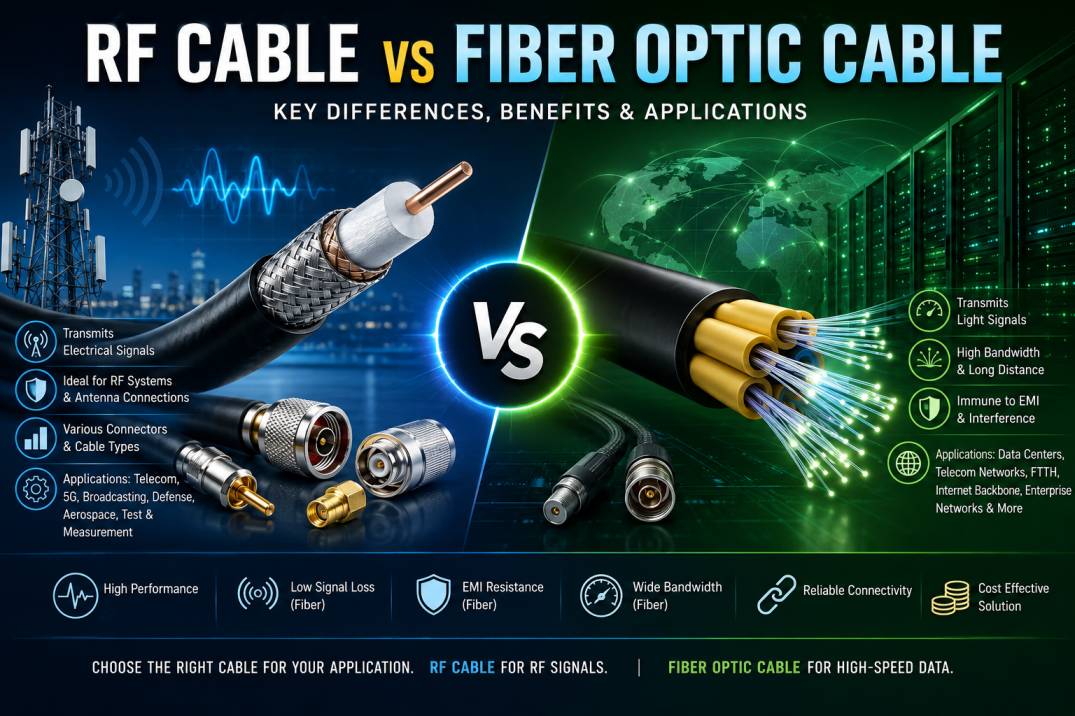
RF cables and fiber optic cables are two of the most important transmission media used in modern communication, networking, wireless infrastructure, telecom systems, broadcasting, data centers, defense, aerospace, and industrial applications. Although both are designed to transport information from one point to another, they use fundamentally different technologies.
RF cables transmit electrical signals through a conductive medium, while fiber optic cables transmit information as pulses of light through optical fibers. Choosing between RF cable and fiber optic cable depends on factors such as frequency, distance, bandwidth, signal loss, electromagnetic interference, installation environment, cost, and application requirements.
Understanding the difference between RF cable vs fiber optic cable is especially important when designing telecom networks, RF systems, 4G/5G infrastructure, antenna systems, DAS networks, test and measurement setups, and high-speed communication networks.
What Is an RF Cable?
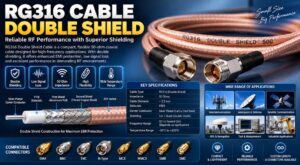
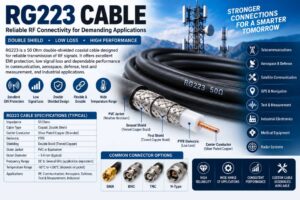
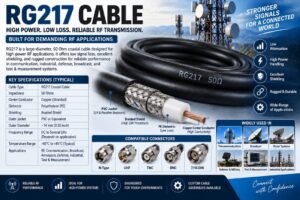
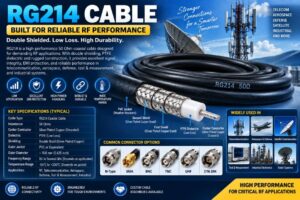
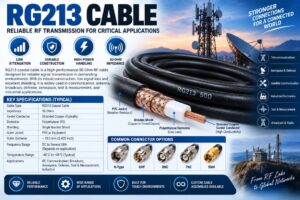
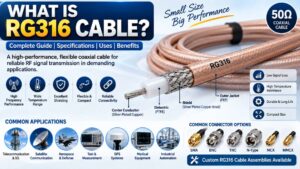
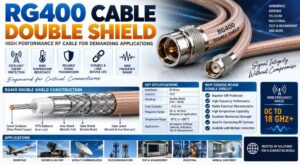
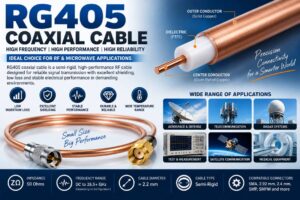
An RF cable, or Radio Frequency cable, is a coaxial cable designed to carry high-frequency electrical signals between RF components. A typical RF cable consists of a center conductor, dielectric insulation, shielding layer, and protective outer jacket.
RF cables are widely used for connecting antennas, radios, transmitters, receivers, amplifiers, filters, splitters, combiners, RF test equipment, and other high-frequency devices.
Common RF cable types include coaxial cables, flexible RF cables, semi-rigid cables, semi-flexible cables, low-loss cables, phase-stable cables, and high-performance test cables.
Popular RF connectors include SMA, N-Type, BNC, TNC, SMB, MCX, MMCX, QMA, 2.92 mm, 2.4 mm, 1.85 mm, SMP, and UFL/IPEX.
What Is a Fiber Optic Cable?
A fiber optic cable is a communication cable that transmits information using pulses of light through extremely thin strands of glass or plastic.
Unlike RF cables, fiber optic cables do not depend on electrical conductivity for signal transmission. This makes fiber optic technology highly resistant to electromagnetic interference and suitable for high-bandwidth, long-distance communication.
Fiber optic cables are commonly used in telecommunications, internet backbone networks, data centers, FTTH networks, cloud infrastructure, enterprise networks, cable television, industrial communication, and long-distance networking.
The two major types of fiber optic cable are single-mode fiber and multimode fiber.
How Does an RF Cable Work?
RF cable transmission is based on the movement of electrical signals through a controlled transmission line.
The center conductor carries the RF signal, while the surrounding dielectric maintains the required spacing and electrical characteristics. The outer conductor or shield provides electromagnetic isolation and helps prevent signal leakage and interference.
The cable’s impedance is an important characteristic. Most RF systems use 50-ohm impedance, while some video and broadcast applications commonly use 75-ohm systems.
RF cable performance depends on parameters such as:
- Frequency range
- Characteristic impedance
- Insertion loss
- Return loss
- VSWR
- Shielding effectiveness
- Power handling
- Phase stability
- Connector quality
- Operating temperature
- Cable length
How Does a Fiber Optic Cable Work?
Fiber optic communication converts electrical data into optical signals.
A transmitter, typically using a laser or LED-based optical source, converts the information into light. The light travels through the fiber core by the principle of total internal reflection. At the receiving end, a photodetector converts the optical signal back into an electrical signal.
Fiber optic transmission generally provides extremely high bandwidth and very low attenuation over long distances.
The main components of a fiber optic cable include:
- Optical fiber core
- Cladding
- Coating
- Strength members
- Outer protective jacket
RF Cable vs Fiber Optic Cable: Key Difference
The biggest difference between RF cable and fiber optic cable is the method used to carry information.
RF cables transmit electrical signals, whereas fiber optic cables transmit optical signals.
RF cables are particularly suitable for direct RF connections between antennas and radio equipment. Fiber optic cables are generally better suited for long-distance, high-bandwidth data transmission and environments with significant electromagnetic interference.
RF Cable vs Fiber Optic Cable Comparison
| Parameter | RF Cable | Fiber Optic Cable |
|---|---|---|
| Signal Type | Electrical/RF | Optical |
| Transmission Medium | Copper or conductive material | Glass or optical fiber |
| Typical Impedance | 50 Ohm or 75 Ohm | Not applicable |
| EMI Immunity | Moderate to high depending on shielding | Excellent |
| Bandwidth | Application dependent | Extremely high |
| Long-Distance Performance | Higher loss over long distances | Excellent |
| Signal Attenuation | Increases with frequency and length | Generally very low over suitable distances |
| RF Signal Transmission | Excellent | Requires optical conversion |
| Electrical Isolation | No | Yes |
| Weight | Generally higher | Generally lower for long links |
| Connector Types | SMA, N, BNC, TNC, SMP, etc. | LC, SC, ST, MPO/MTP, etc. |
| Installation | Relatively straightforward | Requires fiber handling and specialized tools |
| Bending Sensitivity | Depends on cable construction | Fiber has bending limitations |
| EMI Resistance | Depends on shielding | Immune to electromagnetic interference |
| Typical Applications | Antennas, RF equipment, telecom, test systems | Data networks, telecom backbones, FTTH, data centers |
Bandwidth Comparison
Bandwidth is one of the strongest advantages of fiber optic communication.
RF cables can support very high frequencies, particularly when specialized coaxial cables are used. However, cable attenuation generally increases as frequency and transmission distance increase.
Fiber optic systems can support extremely high data rates and are therefore widely used for backbone communication, data centers, cloud infrastructure, and long-distance networks.
For applications involving very high data capacity over long distances, fiber optic technology generally provides a significant advantage.
Signal Loss and Attenuation
Signal attenuation is an important consideration when selecting a transmission medium.
RF cables experience insertion loss as signals travel through the cable. The loss generally increases with cable length and operating frequency. This is why low-loss RF cables are often selected for antenna feeder systems and telecom installations.
Fiber optic cables also experience attenuation, but optical fiber can maintain low loss over much longer distances compared with conventional RF coaxial cable.
For long-distance communication, fiber optic cable is therefore usually more efficient.
Electromagnetic Interference
RF cables carry electrical signals and can be affected by electromagnetic interference if the cable shielding and installation are inadequate.
High-quality RF cables use shielding structures such as braided shields, foil shields, tubular conductors, or multiple shielding layers to reduce interference.
Fiber optic cables transmit light rather than electrical signals. As a result, they are inherently immune to electromagnetic interference.
This makes fiber particularly useful in environments containing high-power electrical equipment, industrial machinery, radio transmitters, and other sources of electromagnetic noise.
Power Handling Capability
One major advantage of RF cable is that it can carry both RF signals and, depending on the system design, significant RF power.
RF feeder cables are commonly used between radio equipment and antennas where signal power must physically travel through the cable.
Fiber optic cable does not carry RF power. It carries information in optical form.
Therefore, if the application requires direct RF power transmission to an antenna, an RF cable is generally required.
RF Cable Applications
RF cables are widely used in:
Telecom Networks
RF cables connect radio equipment, antennas, filters, combiners, splitters, and other telecom components.
4G and 5G Infrastructure
RF cable assemblies are used in base stations, remote radio units, antennas, distributed antenna systems, and RF equipment.
Antenna Systems
Coaxial RF cables connect antennas to transmitters and receivers while maintaining controlled impedance and minimizing signal loss.
RF Testing and Measurement
High-performance RF cables are used with vector network analyzers, spectrum analyzers, signal generators, power meters, and other laboratory equipment.
Defense and Aerospace
RF cables are used in radar, satellite communication, avionics, electronic warfare systems, and other high-frequency applications.
Broadcasting
RF cables are used for radio, television, wireless communication, and broadcast infrastructure.
Fiber Optic Cable Applications
Fiber optic cables are commonly used in:
- Internet backbone networks
- FTTH networks
- Data centers
- Cloud infrastructure
- Enterprise networking
- Long-distance telecommunications
- Cable television
- Industrial networking
- High-speed computing
- 5G transport networks
- Metro networks
- Inter-building communication
Advantages of RF Cable
RF cables offer several important benefits.
Direct RF Transmission
RF cables can directly carry RF signals without requiring electrical-to-optical conversion.
Excellent Compatibility
They can connect directly to antennas, radios, filters, amplifiers, splitters, and other RF components.
Wide Connector Availability
RF systems support a large range of connector types for different frequencies, power levels, mechanical requirements, and applications.
Easy Installation
Many standard RF cable assemblies are straightforward to install and terminate.
High Power Capability
Appropriately designed RF cables can handle substantial RF power, making them suitable for transmitter-to-antenna applications.
Advantages of Fiber Optic Cable
Very High Bandwidth
Fiber optic technology supports extremely high data rates.
Long Transmission Distance
Fiber is highly suitable for long-distance communication with relatively low attenuation.
EMI Immunity
Fiber does not conduct electricity and is immune to electromagnetic interference.
Electrical Isolation
Fiber provides electrical isolation between connected systems.
Lightweight Infrastructure
Fiber can reduce cable weight, especially in large-scale communication networks.
Limitations of RF Cable
RF cables also have certain limitations.
Signal loss increases with cable length and frequency. Long RF cable runs can therefore require low-loss cable, larger cable diameter, amplification, or other signal-management techniques.
RF cables can also be affected by electromagnetic interference if the shielding design is insufficient.
Mechanical characteristics such as bend radius, connector quality, cable routing, and installation torque can significantly influence RF performance.
Limitations of Fiber Optic Cable
Fiber optic cable requires optical transceivers or other conversion equipment when communicating with electrical RF equipment.
Fiber installation and maintenance can also require specialized tools and greater attention to cleanliness, connector inspection, splicing, and bend radius.
Fiber optic systems do not directly transmit RF power, so they cannot simply replace coaxial feeder cable in every antenna application.
RF Cable vs Fiber Optic Cable for 5G
5G networks commonly use both technologies.
RF cables are used for RF signal paths between radios, antennas, filters, and related equipment.
Fiber optic cables are commonly used in transport and backhaul networks to carry large quantities of digital data between network nodes.
In modern 5G infrastructure, the two technologies are therefore complementary rather than direct substitutes.
A typical architecture may use fiber for high-speed transport and RF coaxial cable for the final RF connection between radio equipment and antenna systems.
RF Cable vs Fiber Optic Cable for Data Centers
Fiber optic cable is generally preferred for high-speed data center networking because of its bandwidth, distance capability, low weight, and immunity to electromagnetic interference.
RF cable can still be used in data centers for specialized RF, wireless, timing, testing, monitoring, and antenna-related applications.
The correct choice depends on whether the system is transporting digital network data or RF signals.
RF Cable vs Fiber Optic Cable for Telecom
Telecom networks frequently use both.
Fiber optic cable is widely used for backhaul, fronthaul, transport, and high-speed network connectivity.
RF cable is used where an actual RF signal must travel between radio equipment and antennas or between RF components.
Therefore, telecom infrastructure should not be viewed as an RF-versus-fiber environment. Modern networks commonly integrate both technologies.
RF Cable vs Fiber Optic Cable for Long-Distance Transmission
Fiber optic cable is generally the preferred choice for long-distance communication.
RF coaxial cables become increasingly lossy as distance and frequency increase. Long cable runs can therefore require additional amplification or specially engineered low-loss cables.
Fiber optic systems can transmit data across significantly longer distances while maintaining excellent signal integrity.
RF Cable vs Fiber Optic Cable: Which One Is Better?
There is no universal winner.
The correct cable depends on the application.
Choose an RF cable when:
- You need to transmit an RF signal directly.
- The cable connects an antenna to radio equipment.
- RF power transmission is required.
- The system uses coaxial RF components.
- Controlled impedance is essential.
- The application involves RF testing or measurement.
Choose fiber optic cable when:
- Extremely high data bandwidth is required.
- Transmission distances are long.
- Electromagnetic interference is a major concern.
- Electrical isolation is required.
- The application involves data networking.
- The system requires high-capacity telecom transport.
Factors to Consider Before Selecting a Cable
Before choosing between RF cable and fiber optic cable, evaluate:
1. Signal Type
Determine whether the system transmits RF/electrical signals or digital/optical information.
2. Frequency
For RF applications, check the required operating frequency and cable frequency rating.
3. Distance
Long-distance applications often favor fiber optic technology.
4. Signal Loss
Compare insertion loss or optical attenuation for the required cable length.
5. Bandwidth
Determine the required data rate or RF frequency range.
6. EMI Environment
For high-noise environments, fiber provides a major advantage.
7. Power Requirements
If RF power must travel through the cable, coaxial RF cable is generally necessary.
8. Installation Requirements
Consider connectorization, bending radius, termination, maintenance, and available installation tools.
9. Environmental Conditions
Temperature, moisture, vibration, outdoor exposure, chemicals, UV radiation, and mechanical stress can affect cable selection.
10. Total Cost
Consider not only the cable price but also connectors, installation tools, transceivers, termination, maintenance, and replacement costs.
Role of RF Cable Assemblies
An RF cable assembly combines an RF cable with suitable connectors installed at one or both ends.
Common RF cable assemblies include:
- SMA cable assemblies
- N-Type cable assemblies
- BNC cable assemblies
- TNC cable assemblies
- QMA cable assemblies
- 2.92 mm cable assemblies
- 2.4 mm cable assemblies
- SMP cable assemblies
- MCX cable assemblies
- MMCX cable assemblies
- UFL/IPEX cable assemblies
The cable assembly must be engineered according to the required frequency, impedance, insertion loss, VSWR, power handling, connector type, and mechanical configuration.
Importance of Connector Selection
The connector is a critical part of any high-frequency cable system.
A high-quality RF cable can still experience poor performance if an unsuitable or incorrectly installed connector is used.
Important connector parameters include:
- Frequency rating
- Impedance
- VSWR
- Insertion loss
- Return loss
- Power handling
- Mating cycles
- Environmental rating
- Interface type
- Mounting configuration
Future of RF and Fiber Optic Technologies
The growth of 5G, private wireless networks, cloud computing, data centers, IoT, satellite communication, defense electronics, and high-speed networking will continue to increase demand for both RF and fiber technologies.
RF technology will remain essential wherever wireless signals must be generated, transmitted, received, tested, filtered, amplified, or connected to antennas.
Fiber optics will continue to dominate high-capacity transport and networking applications where long-distance, high-bandwidth, and EMI-resistant communication are required.
The future will increasingly involve hybrid architectures in which fiber and RF technologies work together.
RF Cable vs Fiber Optic Cable: Final Verdict
RF cable and fiber optic cable serve different but complementary purposes.
RF cable is the preferred solution for transmitting RF signals directly between antennas, radios, amplifiers, filters, splitters, combiners, and test equipment.
Fiber optic cable is the preferred solution for high-speed digital communication, long-distance transmission, data centers, telecom transport, and environments requiring electromagnetic immunity.
For modern telecom and wireless infrastructure, the best solution is often not choosing one over the other but using each technology where it provides the greatest technical advantage.
SRFS Teleinfra provides RF and telecom infrastructure solutions including RF cables, cable assemblies, RF connectors, telecom accessories, mounting solutions, grounding products, and other RF infrastructure components for demanding wireless and communication applications.
Frequently Asked Questions
What is the main difference between RF cable and fiber optic cable?
RF cable transmits electrical radio-frequency signals through a conductive medium, while fiber optic cable transmits information using light through optical fiber.
Is fiber optic cable better than RF cable?
Neither is universally better. Fiber is generally better for high-bandwidth and long-distance data transmission, while RF cable is better when direct RF signal or RF power transmission is required.
Can fiber optic cable replace RF cable?
Fiber can replace some RF transmission paths when RF signals are converted to optical signals, but it cannot directly replace coaxial RF cable where RF power must be delivered to an antenna.
Which cable has higher bandwidth?
Fiber optic cable generally provides much higher bandwidth potential than conventional coaxial RF cable, especially for long-distance digital communication.
Which cable is better for 5G?
Both are important. Fiber is widely used for transport and backhaul, while RF cable is used for connecting RF equipment and antennas.
Which cable has lower signal loss?
For long-distance communication, fiber optic cable generally provides lower transmission loss. RF cable loss depends strongly on cable type, frequency, and length.
Is RF cable affected by electromagnetic interference?
RF cable can be affected by electromagnetic interference depending on its shielding and installation. Properly shielded RF cables provide strong protection against interference.
Is fiber optic cable affected by EMI?
No. Fiber optic cable is inherently immune to electromagnetic interference because it transmits optical signals rather than electrical signals.
Can RF cable carry data?
Yes. RF cables can carry modulated information and high-frequency communication signals. However, their performance depends on frequency, bandwidth, cable construction, and transmission distance.
What type of cable should I use for an antenna?
For a conventional antenna-to-radio RF connection, a suitable coaxial RF cable is generally required. Selection should consider frequency, cable length, insertion loss, impedance, power, connector type, and environmental conditions.
Why are low-loss RF cables used in telecom systems?
Low-loss RF cables reduce signal attenuation between radio equipment and antennas, helping maintain signal strength and overall system performance.
What is 50-ohm RF cable?
A 50-ohm RF cable is a coaxial transmission line designed with a characteristic impedance of 50 ohms. It is widely used in wireless communication, RF testing, telecom, radar, and defense systems.
What is the difference between single-mode and multimode fiber?
Single-mode fiber is designed for long-distance, high-bandwidth transmission using a small core, while multimode fiber is generally used for shorter-distance communication and has a larger core.
Which cable is better for data centers?
Fiber optic cable is generally preferred for high-speed data center networking because of its high bandwidth, long-distance capability, low weight, and immunity to EMI.
Why are both RF and fiber cables used in modern telecom networks?
Fiber provides high-capacity digital transport, while RF cable provides direct RF connectivity between radios, antennas, and RF components. They perform different functions within the same network.
Conclusion
The comparison between RF cable vs fiber optic cable is ultimately a comparison between two different transmission technologies designed for different requirements. RF cables remain essential for wireless and high-frequency signal paths, while fiber optic cables provide outstanding bandwidth, distance, and electromagnetic immunity for modern communication networks.
Understanding frequency, bandwidth, attenuation, impedance, power handling, distance, EMI, environmental conditions, and installation requirements is essential for selecting the correct cable.
For telecom, 4G, 5G, RF testing, antenna systems, defense, aerospace, data centers, and network infrastructure, selecting the right transmission medium can have a significant impact on system reliability and performance.m