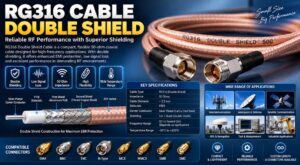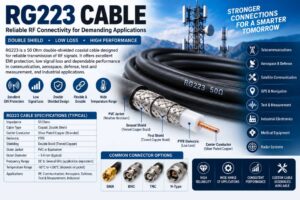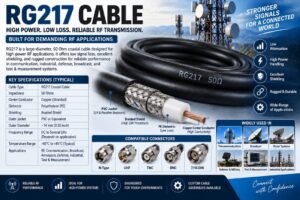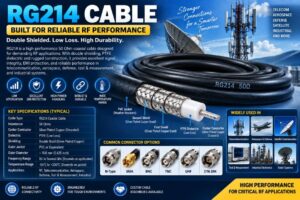
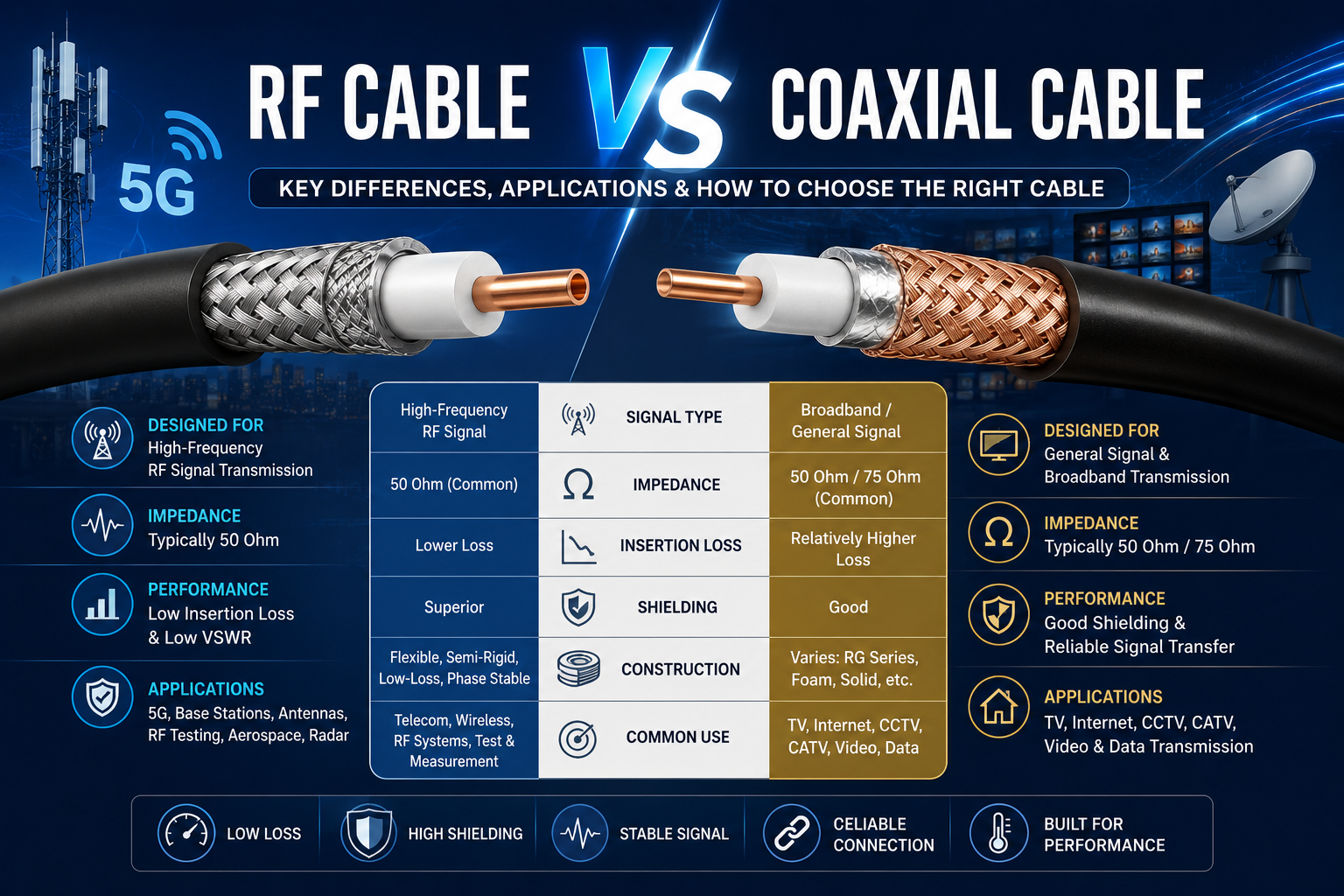
RF cable and coaxial cable are terms that are often used interchangeably in the telecommunications, wireless communication, electronics, and networking industries. Although the two terms are closely related, they do not always describe exactly the same thing.
A coaxial cable is a specific type of cable construction consisting of a central conductor, dielectric insulation, outer conductor or shield, and protective jacket. An RF cable refers more broadly to a cable designed to transmit radio-frequency signals. In practice, most RF cables used in modern wireless and telecom systems are coaxial cables.
Understanding the difference between RF cable and coaxial cable is important when selecting cables for 4G, 5G, Wi-Fi, RF testing, antennas, base stations, distributed antenna systems, radar, satellite communication, and other high-frequency applications.
The correct cable should be selected according to frequency, impedance, insertion loss, shielding, power handling, flexibility, environmental conditions, connector type, and application requirements.
What Is an RF Cable?
An RF cable is a transmission cable specifically engineered to carry radio-frequency signals from one RF component to another.
RF cables are used to connect:
- Antennas
- RF modules
- Radios
- Base stations
- Remote radio units
- Filters
- Amplifiers
- Combiners
- Splitters
- Test equipment
- Signal generators
- Spectrum analyzers
- Vector network analyzers
- Microwave equipment
RF cables are available in different constructions, including flexible coaxial cables, low-loss coaxial cables, semi-flexible cables, semi-rigid cables, phase-stable cables, high-frequency test cables, and specialized cable assemblies.
Depending on the design, RF cables can operate from relatively low radio frequencies to microwave and millimeter-wave frequencies.
What Is a Coaxial Cable?
A coaxial cable is a cable construction in which the center conductor and outer conductor share the same axis.
A typical coaxial cable consists of four primary layers:
- Center conductor
- Dielectric insulator
- Outer conductor or shield
- Protective outer jacket
The center conductor carries the RF or electrical signal. The dielectric maintains the required spacing between the center conductor and shield. The outer conductor provides electrical return and electromagnetic shielding, while the jacket protects the cable from physical and environmental damage.
Coaxial cables are used for many applications, including RF communication, television, broadband, instrumentation, CCTV, radio systems, antennas, and data transmission.
Is RF Cable the Same as Coaxial Cable?
Not exactly.
RF cable describes a cable according to its intended function: transmitting radio-frequency signals.
Coaxial cable describes a cable according to its physical construction.
Most RF cables used for telecommunications and wireless communication are coaxial cables because coaxial construction provides controlled impedance, shielding, and predictable high-frequency transmission characteristics.
Therefore, a coaxial cable can be used as an RF cable if it is designed and specified for the required RF frequency and application.
RF Cable vs Coaxial Cable: Key Difference
The simplest distinction is that RF cable is an application-oriented term, while coaxial cable is a construction-oriented term.
An RF cable is selected based on its ability to transmit RF signals effectively.
A coaxial cable is identified by its concentric conductor and shielding structure.
For example, a 50 Ohm low-loss coaxial cable can be an RF cable for a 5G base station. Similarly, a precision coaxial cable can be used as an RF test cable in a laboratory.
Construction of RF and Coaxial Cables
Center Conductor
The center conductor carries the signal.
Common materials include:
- Copper
- Copper alloys
- Silver-plated copper
- Tin-plated copper
- Copper-clad materials
The conductor material and geometry influence conductivity, attenuation, flexibility, and frequency performance.
Dielectric
The dielectric separates the center conductor from the outer conductor.
Common dielectric materials include:
- PTFE
- PE
- FEP
- Foam polyethylene
- Low-loss specialized dielectric materials
The dielectric affects impedance, velocity factor, attenuation, and phase characteristics.
Shield or Outer Conductor
The outer conductor provides shielding and serves as the signal return path.
Depending on cable construction, shielding can include:
- Copper braid
- Aluminum foil
- Double shielding
- Triple shielding
- Tubular metal conductors
- Corrugated copper
- Corrugated aluminum
Higher-quality shielding can improve electromagnetic isolation and reduce interference.
Outer Jacket
The outer jacket protects the cable against mechanical and environmental conditions.
Depending on the application, jacket materials may be designed for:
- UV resistance
- Moisture resistance
- Chemical resistance
- Temperature resistance
- Flame resistance
- Abrasion resistance
RF Cable vs Coaxial Cable: Impedance
Impedance is one of the most important specifications when selecting RF and coaxial cables.
Common impedance values include:
- 50 Ohm
- 75 Ohm
- 93 Ohm in certain specialized systems
50 Ohm cables are widely used in RF, wireless, cellular, microwave, aerospace, defense, and test applications.
75 Ohm coaxial cables are commonly associated with television, video, broadband, and certain communication applications.
Using a cable with the wrong impedance can create signal reflections and transmission losses.
RF Cable vs Coaxial Cable: Frequency Range
Frequency capability is another major difference between cable types.
A general-purpose coaxial cable may be designed for relatively low-frequency or broadband applications, while a specialized RF cable can be engineered for microwave or millimeter-wave frequencies.
RF cable specifications should therefore always be checked against the actual operating frequency.
A cable that works well at lower frequencies may have excessive attenuation or inadequate electrical performance at higher frequencies.
RF Cable vs Coaxial Cable: Insertion Loss
Insertion loss represents the amount of signal power lost as the signal travels through a cable.
Lower insertion loss is generally desirable in RF applications.
Cable loss depends on factors such as:
- Frequency
- Cable length
- Conductor material
- Dielectric material
- Cable diameter
- Shield construction
- Temperature
- Connector performance
For long RF transmission paths, low-loss coaxial cable is often preferred.
RF Cable vs Coaxial Cable: Shielding
Shielding protects RF signals from external electromagnetic interference and helps prevent unwanted radiation from the cable.
Coaxial cable inherently provides shielding because its outer conductor surrounds the center conductor.
However, shielding effectiveness varies significantly between different cable constructions.
A simple braided cable may provide different shielding performance from a double-shielded or corrugated cable.
For high-performance RF applications, shielding effectiveness should be considered alongside insertion loss and impedance.
RF Cable vs Coaxial Cable: Flexibility
RF cables can be designed for different mechanical requirements.
Flexible RF Cable
Flexible RF cables are suitable for applications requiring frequent routing, bending, or movement.
Typical applications include:
- Test equipment
- Internal equipment connections
- Small cells
- Antenna connections
- Wireless devices
Semi-Flexible Cable
Semi-flexible cables provide a compromise between flexibility and electrical stability.
Semi-Rigid Cable
Semi-rigid cables provide excellent shielding and controlled electrical performance but are intended for applications where the cable is routed into a fixed position.
RF Cable vs Coaxial Cable for 5G
Modern 5G networks require RF interconnects with controlled impedance, low attenuation, reliable shielding, and suitable connector performance.
Common 5G cable requirements include:
- 50 Ohm impedance
- Low insertion loss
- Low VSWR
- High return loss
- Low PIM where required
- High shielding effectiveness
- Suitable power handling
- Environmental durability
- Appropriate frequency capability
Low-loss coaxial RF cables are commonly used for connections between radios and antennas.
Flexible RF cable assemblies can be useful for compact equipment connections, while specialized high-frequency cables may be required for advanced 5G testing and millimeter-wave applications.
RF Cable vs Coaxial Cable for RF Testing
RF testing requires highly controlled and repeatable cable performance.
Test cables may require:
- Excellent phase stability
- Low insertion loss
- Low VSWR
- High return loss
- High shielding effectiveness
- Mechanical repeatability
- Precision connectors
Applications include:
- Vector network analyzers
- Spectrum analyzers
- Signal generators
- RF power meters
- Antenna measurement systems
- Microwave test systems
For these applications, a standard general-purpose coaxial cable may not provide the required measurement accuracy.
RF Cable vs Coaxial Cable for Telecom
Telecommunications infrastructure uses several types of RF and coaxial cable depending on the network architecture.
Applications include:
- 4G networks
- 5G networks
- Base stations
- Distributed antenna systems
- Small cells
- RF repeaters
- Antenna systems
- Indoor coverage systems
Low-loss and low-PIM cable assemblies are especially important in cellular infrastructure where multiple high-power carriers may operate simultaneously.
RF Cable vs Coaxial Cable for Antenna Systems
Antenna feeder cables carry RF signals between radios and antennas.
For outdoor antenna systems, the cable must provide:
- Low attenuation
- High shielding
- Weather resistance
- Suitable power handling
- Mechanical durability
- Reliable connectors
- Appropriate impedance
Large-diameter low-loss coaxial cables are often used where long transmission distances require minimized signal attenuation.
Low-PIM RF Cable and Coaxial Cable
Passive intermodulation, commonly called PIM, is an important consideration in cellular networks.
PIM occurs when multiple RF signals interact through nonlinear passive components and connections, generating unwanted frequencies.
Cable assemblies intended for cellular infrastructure may therefore be designed for low-PIM performance.
PIM performance depends on the complete assembly, including:
- Cable
- Connectors
- Plating
- Contact surfaces
- Assembly quality
- Mechanical installation
Therefore, simply selecting a cable with a low-PIM specification does not guarantee low-PIM performance if the connectors or installation practices are poor.
RF Cable vs Coaxial Cable: Connector Compatibility
Cable performance depends heavily on connector selection.
Common RF connectors include:
- SMA
- N Type
- BNC
- TNC
- 4.3-10
- 7/16 DIN
- 2.92 mm
- 2.4 mm
- 1.85 mm
- SMP
- SMPM
- MCX
- MMCX
- QMA
- FME
The connector should match the cable, impedance, frequency, mechanical requirements, and equipment interface.
A high-performance cable connected with an unsuitable or poorly installed connector can significantly reduce overall RF performance.
RF Cable vs Coaxial Cable: Advantages
Advantages of RF Cable
RF cables offer application-specific designs for high-frequency signal transmission.
Benefits may include:
- Wide frequency coverage
- Low insertion loss
- Controlled impedance
- High shielding
- Low VSWR
- Phase stability
- Low PIM
- High power handling
- Specialized connector options
Advantages of Coaxial Cable
Coaxial cables offer a standardized and proven transmission structure.
Advantages include:
- Excellent shielding
- Controlled impedance
- Reliable RF transmission
- Wide range of sizes
- Flexible and rigid constructions
- Easy connectorization
- Cost-effective options
- Availability across many industries
RF Cable vs Coaxial Cable: Which Is Better?
Neither is universally better.
The correct choice depends on the application.
If the primary requirement is reliable RF signal transmission, a properly specified RF cable is essential.
If the requirement is a particular cable construction with controlled impedance and shielding, coaxial cable may be the appropriate choice.
In many telecommunications applications, the terms overlap because the RF cable itself is a coaxial cable.
How to Choose Between RF Cable and Coaxial Cable
1. Identify the Frequency
Determine the lowest and highest operating frequencies.
2. Select the Correct Impedance
Most RF systems use 50 Ohm impedance, while many video and broadcast systems use 75 Ohm.
3. Calculate Cable Length
Longer cable runs generally require lower-loss cable designs.
4. Check Insertion Loss
Compare attenuation at the actual operating frequency.
5. Evaluate VSWR and Return Loss
These parameters indicate how effectively the cable maintains impedance matching.
6. Check Shielding
Select shielding appropriate for the electromagnetic environment.
7. Evaluate Flexibility
Determine whether the cable will be stationary, routed once, or repeatedly moved.
8. Consider PIM
Cellular and multi-carrier applications may require low-PIM cable assemblies.
9. Select the Connector
Ensure that the connector supports the required frequency, impedance, power, and environmental conditions.
10. Consider the Environment
For outdoor installations, consider moisture, UV exposure, temperature, corrosion, and mechanical stress.
Common Types of RF Coaxial Cables
RG Series Coaxial Cables
RG cables are available in numerous configurations and are widely used in RF, communication, instrumentation, and electronic applications.
LMR-Type Low-Loss Cables
Low-loss flexible coaxial cables are often selected where better attenuation performance is required without using extremely rigid cable constructions.
Semi-Rigid Coaxial Cables
These cables use a rigid metallic outer conductor and provide excellent shielding and predictable high-frequency characteristics.
Semi-Flexible Coaxial Cables
Semi-flexible cables provide controlled electrical performance while allowing more practical routing than fully rigid cable.
Phase-Stable Cables
These cables are designed for applications where phase variation caused by temperature and mechanical movement must be minimized.
High-Frequency Test Cables
Precision test cables are designed for demanding measurement environments and may support microwave and millimeter-wave frequencies.
RF Cable vs Coaxial Cable for Different Applications
5G Base Stations
Low-loss, low-PIM coaxial RF cables are commonly appropriate.
Small Cells
Flexible and compact RF cable assemblies are often useful.
DAS Systems
Low-PIM and low-loss cable assemblies can be important for multi-carrier indoor systems.
Aerospace and Defense
Phase-stable, low-loss, lightweight, and high-frequency cables may be required depending on the platform.
Laboratory Testing
Precision RF test cables with stable phase and low VSWR are preferred.
Satellite Communication
Low-loss, high-frequency coaxial cables with reliable environmental performance may be required.
Wi-Fi and Wireless Equipment
Smaller flexible coaxial cables are commonly used for antenna and module connections.
Common Mistakes When Selecting RF or Coaxial Cable
Choosing Cable Only by Appearance
Two cables may look similar but have very different electrical characteristics.
Ignoring Frequency
A cable should always be evaluated at the actual operating frequency.
Ignoring Cable Length
Long cable runs can create significant attenuation.
Using the Wrong Impedance
Mixing 50 Ohm and 75 Ohm components can create impedance mismatch.
Ignoring Connector Quality
Poor connectorization can compromise an otherwise high-quality cable.
Ignoring Environmental Conditions
Outdoor cables require suitable protection against moisture, UV radiation, temperature, and mechanical stress.
Overlooking PIM
PIM can become a significant issue in cellular and multi-carrier networks.
RF Cable vs Coaxial Cable: Quick Comparison
RF cable is primarily classified by its intended RF transmission application, while coaxial cable is classified by its physical construction.
A coaxial cable may be used as an RF cable when it meets the required RF specifications.
For professional applications, engineers should evaluate the complete cable assembly rather than selecting a cable based only on terminology.
Why Choose SRFS Teleinfra for RF Cables?
SRFS Teleinfra provides RF and telecom components, RF cables, cable assemblies, connectors, adapters, grounding products, weatherproofing solutions, and other network infrastructure products.
The appropriate RF cable can be selected according to application requirements such as frequency, impedance, cable length, connector type, insertion loss, shielding, flexibility, PIM performance, and environmental conditions.
For 4G, 5G, RF testing, antenna systems, telecom infrastructure, and wireless communication applications, selecting the correct cable assembly can help maintain reliable RF performance and signal integrity.
Conclusion
RF cable and coaxial cable are closely related terms, but they describe different aspects of a cable.
RF cable generally refers to a cable designed to transmit radio-frequency signals, while coaxial cable refers to a specific construction consisting of a central conductor surrounded by dielectric and an outer conductor.
Most modern RF cables used in telecommunications are coaxial because coaxial construction provides controlled impedance, shielding, and reliable high-frequency transmission.
The best cable depends on frequency, impedance, insertion loss, VSWR, shielding, flexibility, PIM requirements, environmental conditions, cable length, and connector selection.
For 5G, telecom, antenna, microwave, RF testing, and other high-frequency applications, selecting the correct RF coaxial cable and properly engineered cable assembly is essential for achieving reliable signal transmission and long-term system performance.
Frequently Asked Questions
Is RF cable the same as coaxial cable?
No. RF cable describes a cable intended for radio-frequency signal transmission, while coaxial cable describes a specific physical cable construction. Many RF cables are coaxial cables.
Which is better, RF cable or coaxial cable?
Neither is universally better. The correct cable depends on frequency, impedance, insertion loss, shielding, flexibility, power handling, PIM requirements, and application.
Are all coaxial cables RF cables?
No. Coaxial cables are used for many applications, including RF, television, broadband, video, and instrumentation. A coaxial cable must have suitable specifications to function effectively in a particular RF application.
Is 50 Ohm coaxial cable used for RF?
Yes. 50 Ohm coaxial cable is widely used for RF, wireless communication, cellular networks, microwave systems, antennas, aerospace, defense, and RF testing.
What is the difference between 50 Ohm and 75 Ohm coaxial cable?
The primary difference is their characteristic impedance. 50 Ohm cables are widely used in RF and wireless systems, while 75 Ohm cables are common in video, television, and broadband applications.
Can coaxial cable be used for 5G?
Yes. Properly specified low-loss coaxial RF cables are widely suitable for many 5G applications. The cable must support the required frequency, impedance, attenuation, power, shielding, and environmental conditions.
What is low-loss RF coaxial cable?
Low-loss RF coaxial cable is designed to minimize signal attenuation during RF transmission. It is particularly useful for longer cable runs and applications where preserving signal power is important.
Why is shielding important in RF cable?
Shielding helps protect the RF signal from external electromagnetic interference and reduces unwanted radiation from the cable.
What is low-PIM RF cable?
Low-PIM RF cable is designed to minimize passive intermodulation products that can occur when multiple RF signals interact through nonlinear passive components and connections.
Which RF cable is best for 5G?
The best RF cable for 5G depends on the application. Low-loss and low-PIM coaxial cables are commonly used in cellular infrastructure, while flexible, phase-stable, and high-frequency cables may be preferred for specialized applications.