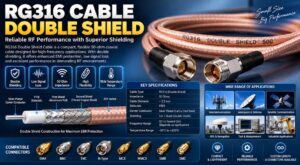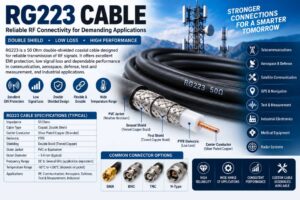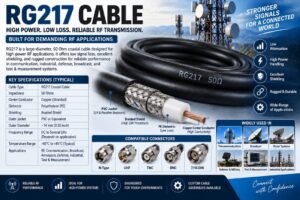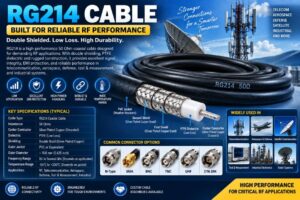
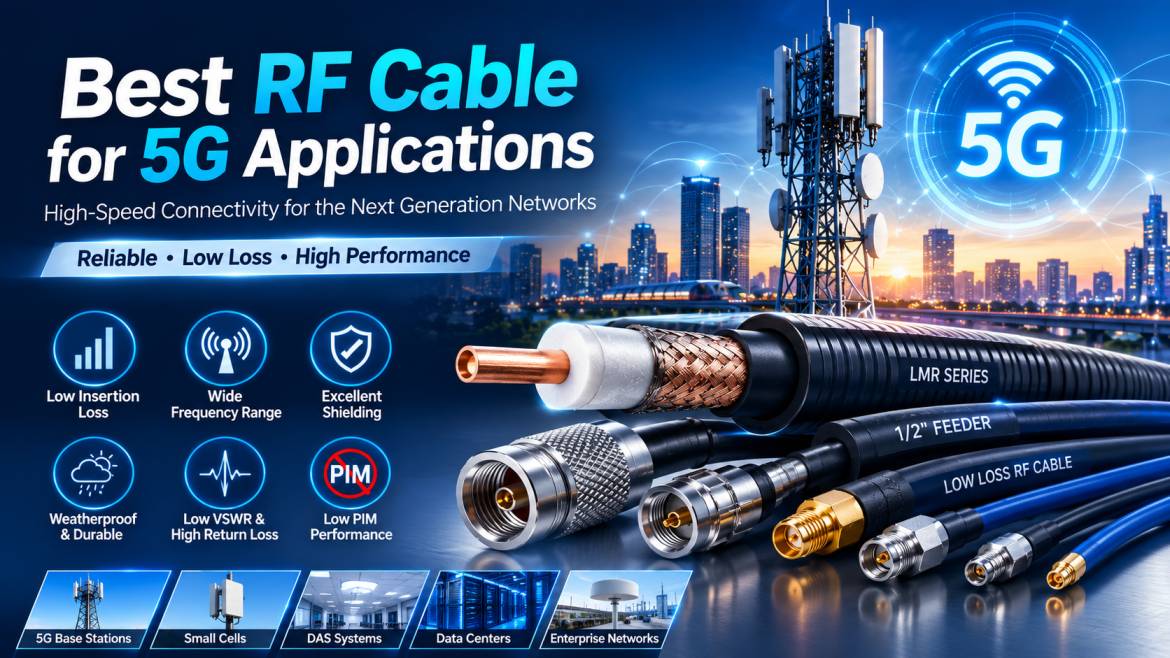
The rapid expansion of 5G networks has created new requirements for RF cables used in telecommunications, wireless infrastructure, testing, private networks, data centers, and industrial communication systems. Unlike traditional wireless networks, 5G operates across a wider range of frequencies and requires higher bandwidth, lower latency, better signal integrity, and greater network density. As a result, selecting the best RF cable for 5G applications is critical for maintaining reliable RF performance.
RF cables provide the physical connection between antennas, radios, base stations, remote radio units, distributed antenna systems, filters, combiners, amplifiers, test equipment, and other RF components. A poorly selected cable can introduce excessive insertion loss, impedance mismatch, phase instability, shielding problems, passive intermodulation, and signal degradation.
The best RF cable for a particular 5G application depends on frequency range, cable length, installation environment, flexibility requirements, insertion loss, shielding effectiveness, phase stability, power handling, connector type, bending requirements, and PIM performance.
For modern 5G infrastructure, common RF cable technologies include flexible coaxial cables, low-loss coaxial cables, semi-flexible cables, semi-rigid cables, phase-stable cables, high-frequency test cables, and specialized low-PIM cable assemblies.
What Is an RF Cable?
An RF cable, or radio frequency cable, is a coaxial transmission line designed to carry high-frequency electrical signals between RF devices. A typical coaxial RF cable consists of a center conductor, dielectric material, outer conductor or shield, and protective outer jacket.
The center conductor carries the RF signal, while the dielectric maintains the spacing between the conductor and shield. The outer conductor provides shielding and serves as the return path for the RF signal. The external jacket protects the cable from mechanical damage, moisture, chemicals, temperature variations, and environmental exposure.
In 5G systems, RF cables must maintain controlled impedance and minimize signal losses across increasingly high operating frequencies.
Why RF Cable Selection Matters in 5G Networks
5G networks can operate across sub-1 GHz, mid-band, and millimeter-wave frequency ranges. Each frequency range presents different transmission challenges.
As frequency increases, attenuation generally becomes more significant and cable losses can become a major factor in overall link performance. Cable selection therefore directly influences RF coverage, system efficiency, antenna performance, and signal quality.
Important factors include:
- Low insertion loss
- Stable 50 Ohm impedance
- High shielding effectiveness
- Low VSWR
- Low return loss
- Excellent phase stability
- Low passive intermodulation
- Appropriate power handling
- Mechanical flexibility
- Environmental durability
- Reliable connector performance
- Suitable frequency coverage
What Is the Best RF Cable for 5G Applications?
There is no single RF cable that is ideal for every 5G installation. The best cable depends on the specific application.
For outdoor 5G base stations and antenna systems, low-loss coaxial cables and low-PIM cable assemblies are commonly preferred.
For applications requiring repeated movement or tight routing, flexible RF cables are generally more appropriate.
For high-frequency laboratory testing, calibration, and measurement systems, phase-stable and high-performance test cables are often preferred.
For extremely high-frequency applications, semi-rigid, semi-flexible, or specialized microwave cables may provide better electrical stability and mechanical performance.
Types of RF Cables Used in 5G Applications
1. Low-Loss RF Cable
Low-loss RF cables are designed to minimize attenuation over relatively long transmission paths. They are widely used in telecommunications infrastructure where RF signals must travel from radios or amplifiers to antennas.
Their low attenuation characteristics make them suitable for:
- 5G base stations
- Macro cell sites
- Small cells
- Distributed antenna systems
- Remote radio units
- Antenna feeder systems
- Wireless infrastructure
For longer cable runs, selecting a cable with low attenuation can significantly improve overall system efficiency.
2. Flexible RF Cable
Flexible RF cables are designed for applications requiring repeated bending and easier installation.
They are particularly useful for:
- Indoor 5G systems
- Small cells
- Equipment interconnections
- Rack-mounted RF systems
- Antenna connections
- Radio units
- Test equipment
Flexible cables are easier to route than rigid cable constructions and can simplify installation where space is limited.
3. Semi-Flexible RF Cable
Semi-flexible RF cables provide a balance between flexibility and electrical performance. They are commonly used where controlled routing and stable RF characteristics are required.
Typical applications include:
- RF modules
- 5G radio equipment
- Microwave equipment
- Instrumentation
- Antenna systems
- High-frequency interconnects
4. Semi-Rigid RF Cable
Semi-rigid cables use a rigid metallic outer conductor that provides excellent shielding and predictable electrical characteristics.
They are particularly suitable for high-frequency applications where mechanical movement is limited.
Advantages include:
- Excellent shielding
- Low radiation
- Stable impedance
- High-frequency performance
- Low signal leakage
- Excellent repeatability
Semi-rigid cables are commonly found inside RF equipment, microwave systems, laboratory instruments, aerospace electronics, and high-frequency communication equipment.
5. Phase-Stable RF Cable
Phase stability becomes increasingly important in advanced 5G testing, beamforming, MIMO, phased-array antennas, and measurement applications.
Phase-stable cables are designed to minimize changes in electrical phase when the cable experiences mechanical movement or temperature variation.
They are suitable for:
- 5G testing
- Vector network analyzers
- Phased-array systems
- MIMO testing
- Antenna measurement
- Radar
- Satellite communication
- RF calibration
6. Low-PIM RF Cable Assembly
Passive intermodulation is a major consideration in high-performance cellular infrastructure.
Low-PIM RF cable assemblies are engineered to minimize unwanted intermodulation products generated by passive components and connections.
They are particularly useful for:
- 5G macro sites
- DAS systems
- Multi-band antennas
- Cellular base stations
- Indoor coverage systems
- High-density wireless infrastructure
Low-PIM performance depends not only on the cable but also on connector design, materials, assembly quality, contact surfaces, and installation practices.
Key RF Cable Specifications for 5G
Frequency Range
The cable must support the complete operating frequency range of the application.
For example, a cable designed for lower-frequency cellular systems may not provide optimal performance at much higher microwave or millimeter-wave frequencies.
Always select a cable with a frequency rating above the highest operating frequency required by the system.
Impedance
Most commercial telecommunications RF systems use 50 Ohm impedance.
Maintaining consistent 50 Ohm impedance throughout the signal path is essential for minimizing reflections and maximizing power transfer.
Insertion Loss
Insertion loss indicates how much RF signal power is lost as the signal travels through the cable.
Lower insertion loss is generally preferred, particularly for long cable runs and high-frequency applications.
Insertion loss is affected by:
- Cable length
- Frequency
- Conductor material
- Dielectric material
- Cable construction
- Temperature
- Connector quality
VSWR
Voltage Standing Wave Ratio indicates the level of impedance mismatch within an RF transmission path.
A lower VSWR generally indicates better impedance matching.
High VSWR can result in reflected power, reduced efficiency, and degraded system performance.
Return Loss
Return loss measures the amount of signal reflected toward the source.
Higher return loss generally indicates better impedance matching.
For demanding 5G applications, good return-loss performance is important for maintaining signal integrity.
Shielding Effectiveness
5G infrastructure often operates in environments containing multiple RF systems and electronic devices.
High shielding effectiveness helps prevent unwanted electromagnetic interference from entering or leaving the cable.
Cable construction may use:
- Braided shields
- Foil shields
- Corrugated conductors
- Tubular outer conductors
- Double-shielded structures
Passive Intermodulation Performance
PIM is especially important in multi-carrier cellular networks.
A cable assembly with poor PIM characteristics can generate unwanted frequencies when multiple high-power RF signals interact through nonlinear passive junctions.
Low-PIM cables and assemblies are therefore preferred in many cellular and 5G infrastructure installations.
Best RF Cable by 5G Application
5G Base Stations
Low-loss and low-PIM coaxial cables are generally suitable for connecting radios, filters, combiners, and antennas.
The cable should provide low attenuation, strong shielding, suitable power handling, and reliable connector performance.
5G Small Cells
Compact flexible RF cables are often advantageous because small-cell equipment may have limited installation space.
The cable should provide a combination of flexibility, low loss, and dependable connectorization.
5G DAS
Distributed antenna systems require multiple RF connections throughout buildings, campuses, transportation facilities, stadiums, hospitals, and commercial properties.
Low-PIM cables and reliable cable assemblies are particularly important in DAS installations because multiple RF carriers may operate simultaneously.
5G MIMO Systems
Massive MIMO systems use multiple antennas and RF paths.
Cable-to-cable consistency becomes important because differences in insertion loss and phase can affect the overall system.
Phase-stable and tightly controlled cable assemblies may therefore be preferred for demanding MIMO applications.
5G Testing and Measurement
Laboratory and production testing requires cables with highly repeatable electrical characteristics.
Phase-stable test cables, low-loss cables, and precision connectors are commonly selected for:
- VNAs
- Spectrum analyzers
- Signal generators
- Network analyzers
- RF power meters
- Antenna test systems
5G Millimeter-Wave Applications
At higher frequencies, cable losses, connector tolerances, mechanical stability, and manufacturing precision become increasingly important.
Specialized high-frequency coaxial cables and precision connectors are generally required for demanding millimeter-wave applications.
RF Cable Materials and Construction
The materials used in an RF cable strongly influence its electrical and mechanical characteristics.
Center Conductor
Common conductor materials include copper and copper alloys, often with plating selected to improve conductivity, corrosion resistance, or connector compatibility.
Dielectric
The dielectric separates the center conductor from the outer conductor and affects propagation velocity, impedance, loss, and phase characteristics.
PTFE and other low-loss dielectric materials are commonly used in high-performance RF cables.
Outer Conductor
The outer conductor provides shielding and electrical return.
Depending on the cable type, it may consist of braid, foil, tubular metal, or corrugated metal.
Protective Jacket
The outer jacket provides mechanical and environmental protection.
For outdoor 5G infrastructure, the jacket may need resistance to UV exposure, moisture, temperature changes, and environmental contaminants.
How to Choose the Best RF Cable for 5G
Selecting an RF cable should begin with the complete RF link requirements rather than simply choosing the cable with the highest frequency rating.
Step 1: Identify the Operating Frequency
Determine the lowest and highest frequencies used by the system.
Step 2: Determine Cable Length
Longer cables generally produce greater attenuation, making low-loss cable construction more important.
Step 3: Check Impedance
For most cellular and 5G RF infrastructure, verify that the cable and connected components are designed for 50 Ohm operation.
Step 4: Compare Insertion Loss
Compare attenuation at the actual operating frequencies and required cable length.
Step 5: Evaluate PIM Requirements
For cellular infrastructure and multi-carrier systems, check the PIM specification of the complete cable assembly.
Step 6: Consider Mechanical Requirements
Determine whether the cable must be flexible, semi-flexible, or rigid.
Step 7: Select Compatible Connectors
Common RF connectors include SMA, N Type, 4.3-10, 7/16 DIN, 2.92 mm, 2.4 mm, SMP, SMPM, MCX, MMCX, and other specialized interfaces.
Step 8: Consider the Installation Environment
Outdoor installations may require UV resistance, waterproofing, corrosion resistance, and appropriate temperature performance.
Importance of RF Cable Assemblies in 5G
A high-quality cable combined with a poor connector or improper assembly can still cause significant RF performance problems.
Professional RF cable assemblies should provide:
- Accurate connector installation
- Controlled cable stripping
- Proper crimping or soldering
- Reliable electrical contact
- Low VSWR
- Low insertion loss
- Consistent impedance
- Strong mechanical retention
- Proper shielding continuity
For demanding applications, cable assemblies should be tested before deployment.
Common RF Connectors for 5G Cable Assemblies
N Type Connector
N Type connectors are widely used in outdoor RF and cellular infrastructure because of their robust construction and weather-resistant configurations.
4.3-10 Connector
4.3-10 connectors are increasingly used in modern mobile communication infrastructure because of their strong PIM performance and mechanical reliability.
7/16 DIN Connector
7/16 DIN connectors are traditionally used in high-power cellular infrastructure and antenna feeder systems.
SMA Connector
SMA connectors are widely used in RF equipment, test systems, wireless modules, and compact 5G devices.
2.92 mm Connector
2.92 mm connectors are suitable for high-frequency microwave and test applications and are commonly used where higher-frequency performance is required.
2.4 mm Connector
2.4 mm connectors are designed for even higher-frequency applications and precision microwave measurements.
SMP and SMPM Connectors
SMP and SMPM connectors are compact interfaces suited to high-density RF systems where space is limited.
Advantages of High-Quality RF Cables for 5G
Using properly specified RF cables can provide several benefits:
- Improved signal integrity
- Lower transmission losses
- Better RF efficiency
- Reduced reflections
- Improved antenna performance
- Better network reliability
- Improved measurement accuracy
- Reduced electromagnetic interference
- Better long-term installation stability
Common Mistakes When Selecting RF Cable for 5G
Choosing Only by Frequency Rating
A cable may support the required frequency but still have excessive attenuation or inadequate shielding.
Ignoring Cable Length
Even a high-performance cable can introduce significant loss if the transmission path is unnecessarily long.
Ignoring Connector Performance
Connector mismatch or poor assembly can negatively affect the entire RF link.
Overlooking PIM
PIM should be carefully evaluated for cellular infrastructure, particularly where multiple high-power carriers are present.
Using the Wrong Cable for Moving Applications
Rigid or semi-rigid cables may not be suitable where continuous movement or repeated bending occurs.
Ignoring Environmental Conditions
Outdoor cable installations should account for UV radiation, moisture, temperature, wind, and mechanical stress.
Maintenance of RF Cables in 5G Networks
Proper installation and maintenance can extend cable life and preserve RF performance.
Inspect cable assemblies regularly for:
- Damaged jackets
- Loose connectors
- Corrosion
- Excessive bending
- Water ingress
- Connector contamination
- Mechanical stress
- Improper routing
Avoid sharp bends and excessive pulling forces. Connector interfaces should also be protected from contamination and moisture.
Why Low-Loss RF Cable Is Important for 5G
Every RF transmission path has some level of loss. As 5G networks use higher frequencies and wider bandwidths, minimizing unnecessary cable loss becomes increasingly important.
For long-distance RF connections, a low-loss cable can help preserve more signal power between the radio and antenna.
However, cable selection should always balance attenuation, flexibility, diameter, cost, power handling, environmental requirements, and installation complexity.
RF Cable for 5G: Performance vs Flexibility
A major design consideration is the trade-off between electrical performance and mechanical flexibility.
Large-diameter low-loss cables can provide excellent attenuation performance but may be harder to route.
Smaller flexible cables are easier to install but may have higher attenuation.
Therefore, the optimum solution depends on the specific installation.
Future Trends in RF Cables for 5G and Beyond
The evolution of 5G toward higher frequencies, denser networks, advanced MIMO, private wireless systems, and emerging 6G technologies is increasing demand for higher-performance RF interconnects.
Future RF cable designs are likely to focus on:
- Higher-frequency operation
- Lower insertion loss
- Improved phase stability
- Better thermal performance
- Higher shielding effectiveness
- Lower PIM
- Smaller cable diameters
- Higher-density connectors
- Improved environmental durability
- Precision manufacturing
As wireless systems become more complex, RF cables will remain a critical part of the overall signal chain.
Why Choose SRFS Teleinfra for RF Cables and Cable Assemblies?
SRFS Teleinfra provides RF and telecom interconnection solutions for wireless communication, 4G, 5G, RF testing, antenna systems, and network infrastructure applications.
Its RF product range can support different application requirements, including RF cables, cable assemblies, connectors, adapters, attenuators, grounding solutions, weatherproofing products, and telecom accessories.
For 5G projects, the appropriate cable can be selected based on frequency, cable length, connector interface, insertion loss, shielding, PIM, flexibility, environmental conditions, and installation requirements.
Conclusion
Choosing the best RF cable for 5G applications requires more than selecting a cable based on frequency alone. Insertion loss, impedance, VSWR, return loss, shielding, PIM, phase stability, mechanical flexibility, connector quality, environmental resistance, and cable length all influence the performance of a 5G RF link.
Low-loss RF cables are generally suitable for longer transmission paths, flexible cables are useful for compact installations, semi-rigid and semi-flexible cables provide controlled high-frequency performance, while phase-stable and precision cable assemblies are valuable for advanced testing, MIMO, beamforming, and high-frequency applications.
The right RF cable should therefore be selected according to the complete system requirements. A properly engineered RF cable assembly can help reduce transmission losses, maintain signal integrity, improve reliability, and support the demanding performance requirements of modern 5G infrastructure.
Frequently Asked Questions
What is the best RF cable for 5G applications?
The best RF cable depends on frequency, length, insertion loss, PIM requirements, flexibility, environmental conditions, and connector type. Low-loss and low-PIM coaxial cables are commonly used for 5G infrastructure, while phase-stable and precision cables are preferred for demanding test and measurement applications.
Which RF cable is used in 5G base stations?
Low-loss coaxial cables and low-PIM cable assemblies are commonly used in 5G base stations and antenna systems. The exact cable depends on frequency, power, distance, connector interface, and installation requirements.
Is 50 Ohm RF cable suitable for 5G?
Yes. Most cellular and 5G RF systems use 50 Ohm transmission lines. The cable, connectors, antennas, and other RF components should maintain the appropriate impedance throughout the signal path.
Why is low-loss RF cable important for 5G?
Low-loss RF cable minimizes signal attenuation between the radio and antenna. This becomes particularly important for long cable runs and higher-frequency 5G applications.
What is low-PIM RF cable?
Low-PIM RF cable is designed to minimize passive intermodulation generated by nonlinear interactions within passive RF components and connections. It is particularly important in multi-carrier cellular and 5G infrastructure.
What RF connector is best for 5G?
There is no universal best connector. N Type, 4.3-10, 7/16 DIN, SMA, 2.92 mm, 2.4 mm, SMP, and SMPM connectors are used for different 5G applications depending on frequency, power, size, environmental requirements, and system design.
Are flexible RF cables suitable for 5G?
Yes. Flexible RF cables can be suitable for 5G applications where cable routing, compact installation, and mechanical flexibility are important. The cable must still meet the required frequency, attenuation, impedance, shielding, and PIM specifications.
What is phase-stable RF cable?
Phase-stable RF cable is designed to maintain relatively consistent electrical phase when exposed to mechanical movement or temperature variations. It is useful in advanced RF testing, MIMO, phased-array, radar, and measurement applications.
How does cable length affect 5G RF performance?
Longer cables generally introduce greater insertion loss. Therefore, low-loss cable construction becomes increasingly important as cable length increases.
Can RF cable be used outdoors for 5G?
Yes, but the cable should be specifically suitable for the outdoor environment. Outdoor 5G cable assemblies may require UV resistance, moisture protection, weatherproofing, corrosion resistance, and appropriate temperature performance.