
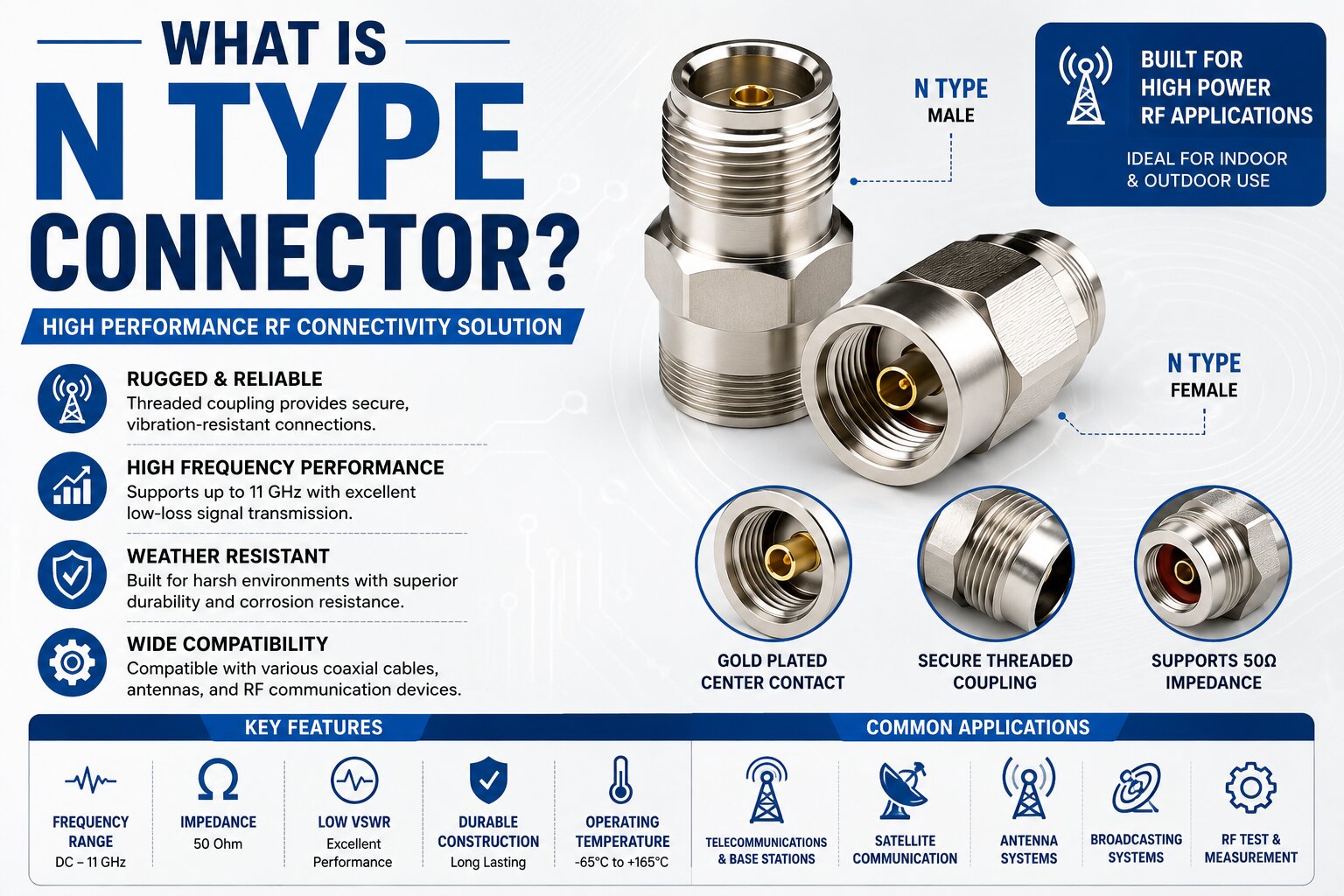
An N Type connector is a threaded RF connector widely used in radio frequency communication systems for transmitting high-frequency signals with low loss and excellent performance. These connectors are known for their durable construction, weather resistance, secure threaded coupling, and ability to handle high-power RF applications.
The N Type connector was developed by Paul Neill at Bell Labs and is designed for reliable microwave and RF communication. It is commonly used in telecommunications, wireless networking, broadcasting, military systems, satellite communication, antennas, and industrial RF equipment.
N Type connectors are capable of supporting frequencies up to 11 GHz in standard designs, while precision versions can support even higher frequencies. Their rugged design makes them highly suitable for outdoor and harsh environmental conditions.
Today, N Type connectors are widely used in telecom towers, RF communication systems, Wi-Fi infrastructure, cellular networks, radar systems, and microwave communication applications because of their stable electrical performance and reliable signal transmission.
What is an N Type Connector?
An N Type connector is a threaded coaxial RF connector designed for medium-to-high-frequency communication systems. It is used to connect coaxial cables, antennas, RF modules, and communication devices while maintaining excellent signal integrity.
The connector consists of:
- A center conductor
- Dielectric insulation
- Outer shielding body
- Threaded coupling mechanism
- Cable termination section
N Type connectors are mainly designed with:
- 50 ohm impedance
- 75 ohm impedance
These connectors are commonly used in applications requiring low signal loss, high power handling, and weatherproof RF connectivity.
Importance of N Type Connectors
Modern communication systems require stable and durable RF connections, especially in outdoor and industrial environments. N Type connectors are important because they provide strong mechanical stability and excellent microwave performance.
N Type connectors help:
- Improve signal transmission
- Reduce insertion loss
- Maintain impedance matching
- Support high-power RF systems
- Resist environmental damage
Their reliable performance makes them one of the most preferred RF connectors in telecom and wireless infrastructure.
How Does an N Type Connector Work?
An N Type connector works by creating a secure electrical connection between coaxial cables and RF communication equipment.
The center conductor transfers RF signals, while the outer metal body provides shielding and grounding protection. The threaded coupling mechanism locks the connector firmly in place, ensuring stable signal transmission and minimizing signal leakage.
The working process includes:
- RF signal transfer
- Impedance matching
- EMI shielding
- Secure mechanical locking
This design helps maintain high-frequency performance and stable communication reliability.
Components of an N Type Connector
An N Type connector contains several important components that support RF performance and durability.
Center Pin
The center conductor carries the RF signal between connected devices.
Dielectric Insulator
The dielectric material separates the center conductor from the outer body and maintains impedance consistency.
Outer Shield
The metal body provides grounding and electromagnetic shielding.
Threaded Coupling Nut
The threaded mechanism ensures secure and vibration-resistant connectivity.
Cable Attachment Section
This section connects the coaxial cable to the connector body.
Types of N Type Connectors
N Type connectors are available in different configurations depending on application requirements.
N Type Male Connector
The male connector contains a center pin and threaded coupling.
Applications
- Antenna systems
- RF communication
- Telecom equipment
N Type Female Connector
The female connector accepts the male pin and threaded interface.
Uses
- RF modules
- Communication devices
- Testing equipment
Right Angle N Type Connector
Right-angle connectors are used where installation space is limited.
Benefits
- Better cable routing
- Reduced cable stress
- Compact installation
Bulkhead N Type Connector
Bulkhead connectors are designed for panel-mount applications.
Applications
- Communication cabinets
- RF enclosures
- Telecom panels
Waterproof N Type Connector
These connectors are designed for outdoor communication systems.
Uses
- Telecom towers
- Outdoor antennas
- Wireless infrastructure
Specifications of N Type Connectors
The specifications of N Type connectors determine their communication performance and compatibility.
Frequency Range
Standard N Type connectors generally support frequencies up to:
- 11 GHz
Precision versions may support higher frequencies.
Impedance
Common impedance values include:
- 50 ohm
- 75 ohm
Proper impedance matching reduces signal reflection and loss.
VSWR
VSWR measures impedance matching efficiency.
Lower VSWR values indicate better RF performance.
Power Handling
N Type connectors can handle relatively high RF power compared to smaller connectors.
Material
These connectors are commonly made from:
- Brass
- Stainless steel
- Gold-plated contacts
- Nickel-plated bodies
Operating Temperature
Industrial-grade connectors can operate under extreme environmental conditions.
Applications of N Type Connectors
N Type connectors are widely used across multiple RF and communication industries.
Telecommunications Industry
Telecom infrastructure heavily depends on N Type RF connectivity.
Applications
- Cellular towers
- Base stations
- RF amplifiers
- Wireless communication systems
Antenna Systems
Many outdoor antennas use N Type connectors because of their durability and weather resistance.
Wi-Fi and Wireless Networking
Wireless networking systems use N Type connectors for stable RF communication.
Uses
- Wi-Fi antennas
- Wireless bridges
- Outdoor networking systems
Broadcasting Systems
Broadcast communication equipment uses N Type connectors for RF signal transmission.
Military and Aerospace
Defense communication systems require highly reliable RF connectivity.
Benefits
- Rugged construction
- Vibration resistance
- Stable microwave performance
Satellite Communication
Satellite communication systems use N Type connectors for microwave signal transmission.
RF Testing Equipment
Laboratory instruments use N Type connectors for RF measurements and testing.
Equipment
- Spectrum analyzers
- Signal generators
- Network analyzers
Advantages of N Type Connectors
N Type connectors provide several important RF communication benefits.
Excellent High-Frequency Performance
They support stable RF communication at microwave frequencies.
Strong Mechanical Stability
Threaded coupling prevents accidental disconnection.
Weather Resistance
Outdoor-rated connectors resist moisture and environmental conditions.
High Power Handling
N Type connectors support higher RF power compared to many compact connectors.
Low Signal Loss
Precision construction minimizes insertion loss and reflection.
Long Operational Life
Durable materials support repeated usage and harsh environments.
Cable Types Used with N Type Connectors
N Type connectors are compatible with multiple coaxial cable types.
RG58 Cable
Used in RF communication systems and wireless devices.
RG213 Cable
Supports higher power communication applications.
LMR Series Cable
Widely used in telecom and wireless infrastructure.
Heliax Cable
Used in high-performance telecom installations.
Installation Methods of N Type Connectors
Proper installation helps maintain RF signal quality and communication stability.
Crimp Type Installation
Crimp connectors are installed using specialized crimping tools.
Clamp Type Installation
Clamp-style connectors provide secure cable attachment.
Solder Type Installation
Soldering creates strong electrical connections for precision RF systems.
Difference Between N Type and SMA Connectors
Both connectors are used in RF systems but differ in design and application.
N Type Connector
- Larger size
- Better for outdoor use
- Higher power handling
- Strong weather resistance
SMA Connector
- Smaller size
- Compact device applications
- Higher frequency capability
- Lightweight design
N Type connectors are preferred for industrial and outdoor RF systems.
Common Problems with N Type Connectors
Improper installation or low-quality connectors may affect performance.
Signal Loss
Poor-quality connectors may increase attenuation.
Connector Damage
Over-tightening may damage threaded sections.
Corrosion
Outdoor systems may experience environmental corrosion.
Impedance Mismatch
Incorrect impedance can cause signal reflection.
Tips for Choosing the Right N Type Connector
Selecting the correct connector improves communication reliability and system performance.
Check Frequency Requirements
Ensure the connector supports the required operating frequency.
Verify Cable Compatibility
Choose connectors suitable for the selected coaxial cable type.
Consider Environmental Conditions
Outdoor installations may require waterproof connectors.
Check Impedance
Use proper impedance values for accurate signal transmission.
Select Durable Materials
High-quality materials improve performance and lifespan.
Future of N Type Connectors
Modern RF communication systems continue to require durable and high-performance connectivity solutions.
Recent developments include:
- Precision microwave N Type connectors
- Waterproof telecom connectors
- 5G communication infrastructure
- Low-loss RF connectivity systems
- Advanced wireless communication networks
As telecom infrastructure, wireless networking, and microwave communication continue to expand, N Type connectors will remain essential components in RF communication systems.
Conclusion
An N Type connector is a reliable threaded RF connector used for stable high-frequency communication in telecom, wireless networking, satellite systems, broadcasting, and industrial RF applications. Its strong mechanical stability, weather resistance, low signal loss, and high-power handling make it ideal for outdoor and professional communication systems.
From telecom towers and antenna systems to RF testing equipment and microwave communication networks, N Type connectors continue to provide dependable RF connectivity across modern communication industries.
Understanding their types, specifications, applications, and installation methods helps engineers and communication professionals select the right connector for efficient and reliable RF communication systems.