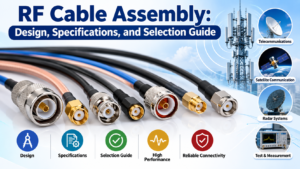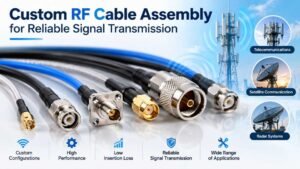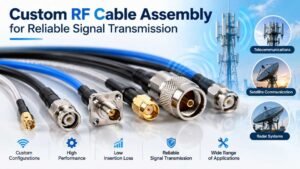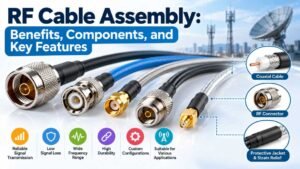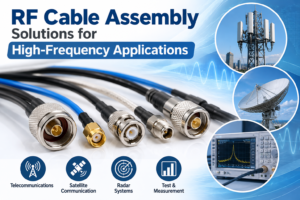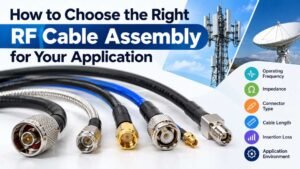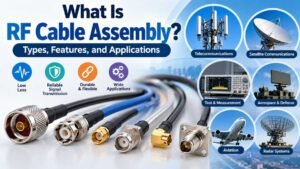
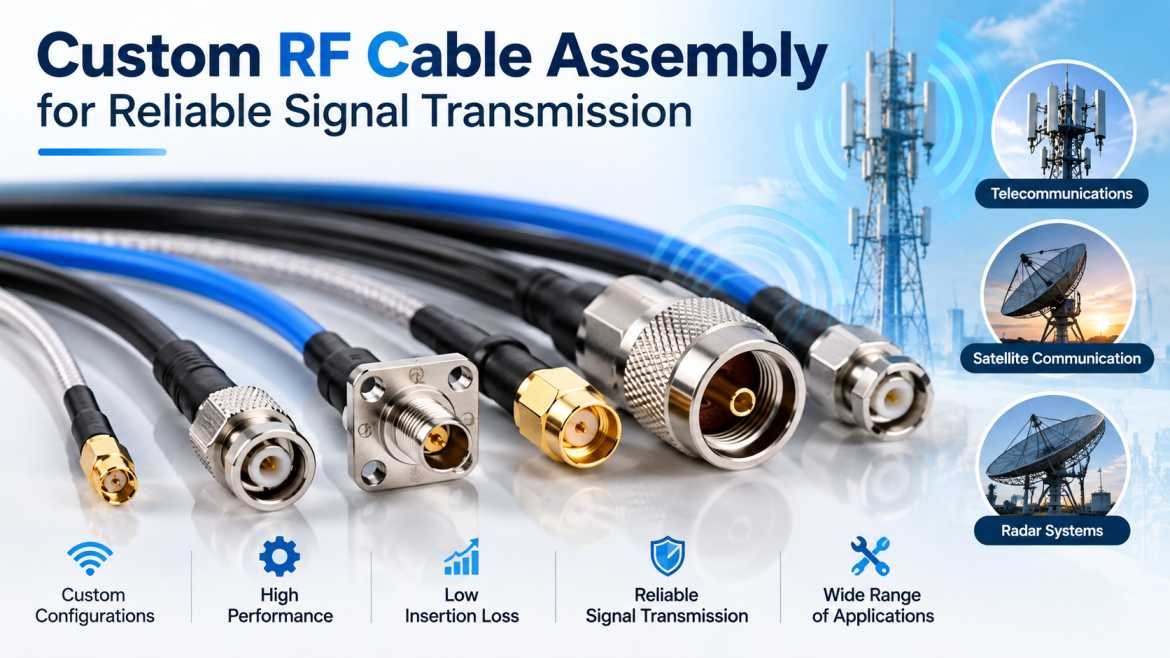
A Custom RF Cable Assembly is an essential component in modern electronic communication systems, designed to transmit radio frequency (RF) signals between electronic devices, antennas, transmitters, receivers, and other RF equipment. These assemblies are engineered according to specific application requirements to deliver reliable signal transmission, minimize signal loss, and maintain consistent electrical performance across a wide range of frequencies.
RF cable assemblies are widely used in telecommunications, wireless communication, aerospace, defense electronics, medical equipment, satellite communication, radar systems, and industrial testing applications. Unlike standard cable solutions, custom RF cable assemblies can be designed with specific cable lengths, connector types, impedance values, shielding configurations, and environmental protection features.
Choosing the right custom RF cable assembly helps improve system reliability, reduce interference, and support the performance requirements of high-frequency electronic applications.
What Is a Custom RF Cable Assembly?
A Custom RF Cable Assembly is a specially manufactured cable system consisting of an RF coaxial cable and connectors selected to meet the electrical, mechanical, and environmental requirements of a particular application. Depending on the design, it may also include protective jackets, strain reliefs, heat-shrink tubing, and other accessories.
These assemblies are designed to transmit high-frequency signals while maintaining controlled impedance and minimizing unwanted signal reflections. Customization allows engineers to select suitable materials, connector interfaces, cable dimensions, and operating specifications for their equipment.
For example, an RF cable assembly used in a wireless communication system may require low insertion loss, effective shielding, and connectors compatible with antenna ports. In a laboratory testing environment, the assembly may need precise electrical characteristics and repeatable measurement performance.
Custom RF cable assemblies are available in various configurations, including SMA, SMB, SMC, BNC, TNC, N-Type, 2.92 mm, 3.5 mm, SMP, and SMPM connector options, depending on the application’s frequency range and interface requirements.
Key Components of a Custom RF Cable Assembly
Understanding the main components of an RF cable assembly helps in selecting the right configuration for reliable signal transmission.
1. RF Coaxial Cable
The coaxial cable is the primary transmission medium. It generally consists of a central conductor, dielectric insulation, an outer conductive shield, and an external protective jacket.
The center conductor carries the RF signal, while the dielectric maintains the required spacing between conductors. The outer shield provides a return path and helps protect the signal from electromagnetic interference.
Cable selection depends on operating frequency, attenuation, flexibility, temperature resistance, and installation requirements.
2. RF Connectors
RF connectors provide secure electrical connections between the cable and electronic equipment. Common connector types include SMA, N-Type, BNC, TNC, and precision microwave connectors.
Each connector has different mechanical dimensions, coupling mechanisms, frequency capabilities, and electrical characteristics. Selecting compatible connectors is essential for maintaining impedance continuity and reducing signal reflections.
3. Shielding and Protective Layers
Shielding helps prevent external electromagnetic interference from affecting the transmitted signal. Depending on the application, cable designs may use braided shields, foil shields, or multiple shielding layers.
The outer jacket protects the cable from abrasion, moisture, chemicals, and other environmental conditions when the selected material is suitable for the intended environment.
4. Cable Termination
Cable termination refers to the process of attaching connectors to the coaxial cable. Proper termination is critical for maintaining electrical continuity, impedance matching, shielding effectiveness, and mechanical strength.
High-quality termination processes help reduce the risk of intermittent connections, excessive insertion loss, and premature assembly failure.
Benefits of Custom RF Cable Assembly for Reliable Signal Transmission
Custom RF cable assemblies offer several advantages for applications where signal quality and dependable connectivity are essential.
Improved Signal Integrity
Custom cable assemblies can be designed to meet the required impedance, frequency range, and attenuation targets. Correct cable and connector selection helps reduce signal reflections and maintain signal quality throughout the transmission path.
Reduced Signal Loss
Insertion loss is an important consideration in RF system design. Selecting a cable with suitable attenuation characteristics, minimizing unnecessary cable length, and choosing compatible connectors can help reduce transmission losses.
Low-loss configurations are particularly valuable in antenna systems, wireless infrastructure, satellite equipment, and microwave communication applications.
Enhanced Electromagnetic Compatibility
Effective shielding helps limit the effects of external electromagnetic interference and reduces unwanted signal leakage. This is particularly important in environments containing multiple electronic devices, transmitters, receivers, and high-frequency circuits.
Application-Specific Design
Custom RF cable assemblies can be manufactured to meet particular requirements for cable length, connector orientation, bend radius, flexibility, mounting space, and operating environment.
This flexibility allows engineers to integrate cable assemblies into compact devices, complex electronic systems, and specialized equipment.
Improved Mechanical Reliability
Suitable cable construction, connector selection, and strain relief can help assemblies withstand repeated movement, vibration, and installation stresses. For applications involving frequent bending or motion, selecting a cable designed for dynamic use is particularly important.
Applications of Custom RF Cable Assembly
Custom RF cable assemblies support signal transmission in numerous industries and technical environments.
Telecommunications and Wireless Communication
Telecommunications equipment uses RF cable assemblies to connect antennas, radio units, base stations, wireless access equipment, and test instruments. Reliable connections help maintain signal quality and support stable communication links.
Custom assemblies can be designed for cellular networks, wireless infrastructure, private radio systems, and other RF communication installations.
Satellite Communication
Satellite communication systems depend on RF connections between antennas, transceivers, receivers, and related equipment. These applications may require low-loss cables, stable electrical performance, and materials suitable for specific indoor or outdoor environments.
Aerospace and Defense
Aerospace and defense systems use RF cable assemblies in radar equipment, navigation systems, communication devices, electronic warfare equipment, and specialized testing platforms.
Depending on the application, assemblies may require compact dimensions, secure connector interfaces, vibration resistance, and operation across demanding temperature ranges.
Test and Measurement Equipment
RF cable assemblies connect spectrum analyzers, signal generators, network analyzers, oscilloscopes with RF interfaces, and other testing instruments. Precision applications may require controlled phase characteristics, repeatable measurements, and connectors designed for high-frequency operation.
For accurate measurements, connector condition, cable stability, and appropriate handling are important.
Medical and Industrial Electronics
RF assemblies are used in selected medical imaging systems, diagnostic equipment, industrial sensors, and specialized electronic instruments. The assembly must meet the applicable electrical, mechanical, cleanliness, and regulatory requirements of the final equipment.
Important Specifications to Consider When Choosing a Custom RF Cable Assembly
Selecting the right RF cable assembly requires evaluating several technical specifications.
Operating Frequency
The assembly must support the application’s required frequency range. Cable attenuation, connector performance, and impedance behavior vary with frequency, so all components should be suitable for the intended operating band.
Characteristic Impedance
Common RF systems use 50-ohm coaxial cables, while some video and broadcast applications use 75-ohm systems. Matching the cable assembly to the equipment’s impedance requirements helps reduce reflections and improve power transfer.
Insertion Loss
Insertion loss measures the signal power lost as it passes through the assembly. It is commonly expressed in decibels (dB) and depends on cable type, length, frequency, and connector performance.
Return Loss and VSWR
Return loss and voltage standing wave ratio (VSWR) indicate impedance matching and the extent of signal reflections. Better impedance matching generally supports more efficient signal transmission.
Cable Length and Flexibility
The cable length should accommodate the installation without creating unnecessary excess. Longer cables generally introduce more attenuation. Flexibility and minimum bend radius should also be considered to avoid damage or performance degradation.
Connector Compatibility
Connector interfaces must match the equipment ports in type, gender, coupling style, and mechanical dimensions. Precision applications also require suitable connector tolerances and careful mating procedures.
Environmental Requirements
Consider operating temperature, humidity, moisture exposure, vibration, chemical contact, and ultraviolet exposure where applicable. Select cable jackets and connectors according to the actual installation environment.
How Custom RF Cable Assemblies Are Manufactured
Manufacturing a reliable custom RF cable assembly involves several stages.
First, the application requirements are reviewed, including frequency range, impedance, cable length, connector interfaces, environmental conditions, and electrical performance targets.
Next, suitable coaxial cable and connectors are selected. The cable is cut to the required length, prepared according to the termination design, and fitted with compatible connectors using the appropriate tooling and assembly procedures.
The completed assembly is then inspected and tested according to the applicable specifications. Depending on the application, testing may include continuity, insulation integrity, insertion loss, return loss, VSWR, and other electrical or mechanical checks.
For demanding applications, documentation, traceability, and repeatable manufacturing processes can help ensure consistent product quality.
Why Choose a Reliable Custom RF Cable Assembly Manufacturer?
Choosing an experienced RF cable assembly manufacturer helps ensure that the product meets the technical requirements of the intended system.
A reliable manufacturer should be able to provide suitable cable and connector options, application-specific configurations, controlled termination processes, and relevant electrical test results. Engineering support can also help customers identify potential compatibility issues before production.
Manufacturers should be evaluated on their technical capabilities, quality-control procedures, ability to meet specifications, production consistency, and experience with the required connector interfaces.
For specialized applications, customers should clearly communicate the operating frequency, impedance, cable length, connector types, environmental conditions, and required test parameters before placing an order.
Conclusion
Custom RF Cable Assembly solutions are essential for reliable signal transmission in telecommunications, wireless communication, satellite systems, aerospace electronics, test equipment, and industrial applications. By combining suitable coaxial cables, compatible connectors, effective shielding, and precise termination, these assemblies help maintain signal integrity and dependable electrical performance.
Selecting the right assembly requires careful consideration of frequency range, impedance, insertion loss, return loss, cable flexibility, connector compatibility, and environmental requirements. Working with a qualified manufacturer and verifying the finished assembly against the required specifications can improve system reliability and reduce connection-related problems.
For businesses and engineers seeking dependable RF connectivity, custom RF cable assemblies provide a practical solution for meeting application-specific electrical and mechanical requirements.
Frequently Asked Questions (FAQs)
1. What is a Custom RF Cable Assembly?
A Custom RF Cable Assembly is a coaxial cable fitted with compatible RF connectors and configured to meet specific electrical, mechanical, and environmental requirements.
2. What are the common applications of custom RF cable assemblies?
They are used in telecommunications, wireless networks, satellite communication, radar systems, aerospace electronics, defense equipment, and RF test and measurement instruments.
3. Which connectors are available for custom RF cable assemblies?
Common options include SMA, SMB, SMC, BNC, TNC, N-Type, 2.92 mm, 3.5 mm, SMP, and SMPM connectors. The appropriate choice depends on frequency, interface compatibility, and performance requirements.
4. How does a custom RF cable assembly improve signal transmission?
A properly designed assembly supports controlled impedance, suitable shielding, and low insertion loss, helping minimize signal reflections, interference, and unnecessary transmission losses.
5. What impedance is commonly used in RF cable assemblies?
A 50-ohm impedance is widely used in RF communication and test equipment. A 75-ohm impedance is common in video and broadcast systems. The correct value depends on the connected equipment.
6. How do I choose the right custom RF cable assembly?
Evaluate the operating frequency, impedance, cable length, insertion loss, return loss, connector type, flexibility, environmental conditions, and required electrical tests.
7. Can custom RF cable assemblies be manufactured in different lengths?
Yes. Custom RF cable assemblies can be produced in specified lengths and configurations according to application requirements and manufacturing capabilities.
8. Why is testing important for RF cable assemblies?
Testing helps verify electrical continuity and relevant RF performance parameters, such as insertion loss, return loss, and VSWR, helping confirm that the assembly meets its specified requirements.