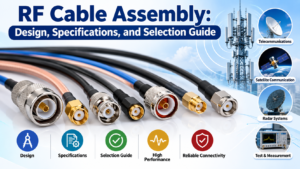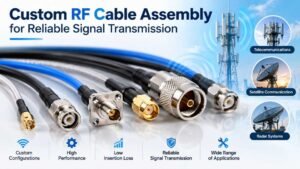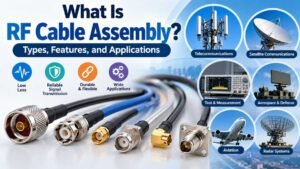
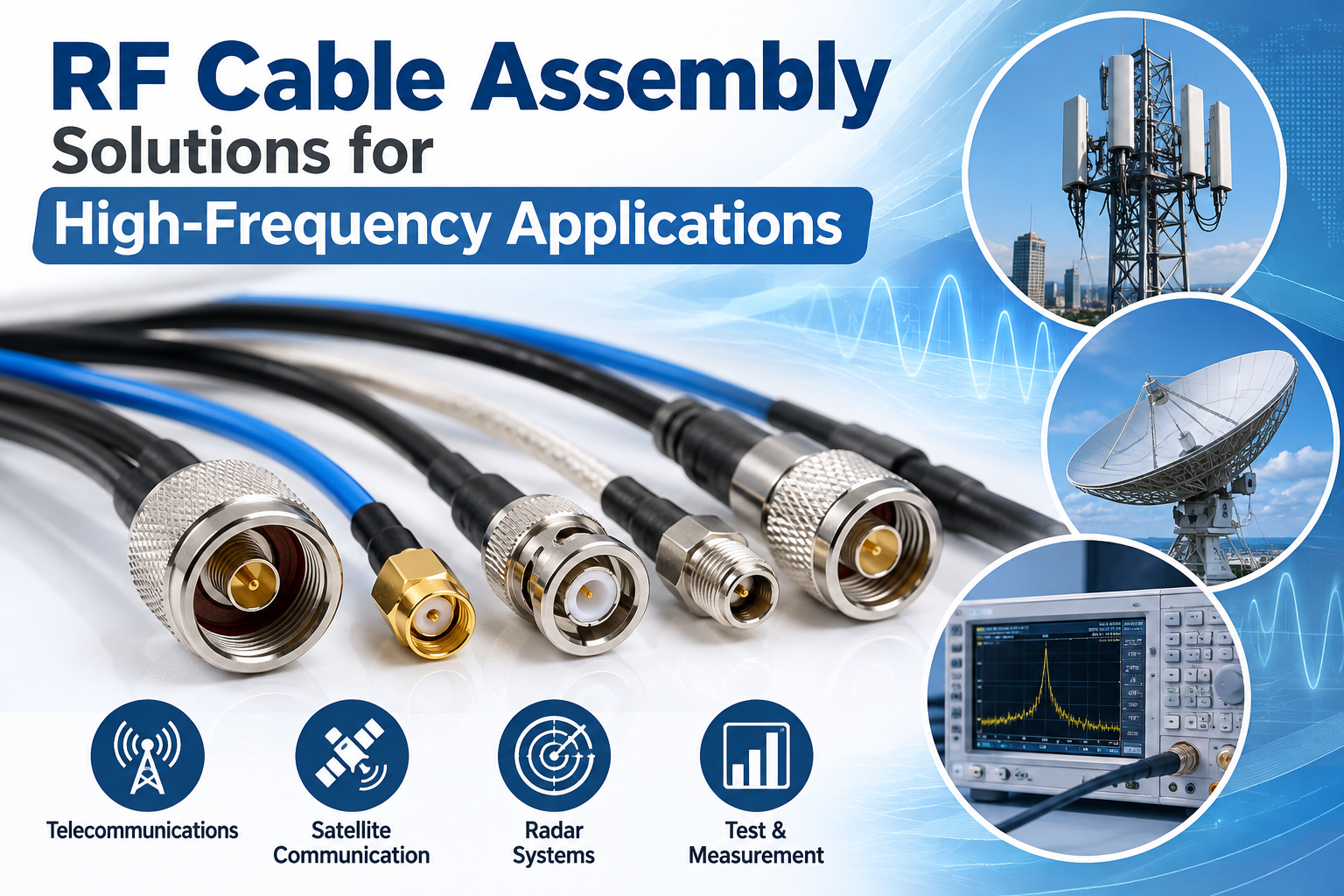
RF Cable Assembly is an essential component in modern electronic systems that require reliable radio frequency signal transmission. It connects RF devices, antennas, transmitters, receivers, testing equipment, and communication systems while maintaining signal quality across different operating frequencies. As industries increasingly depend on high-frequency technologies, the demand for precision-engineered RF cable assembly solutions continues to grow.
High-frequency applications require cable assemblies that can manage signal loss, impedance variations, electromagnetic interference, and demanding environmental conditions. A properly designed RF cable assembly helps maintain signal integrity, supports consistent system performance, and enables reliable communication between connected components.
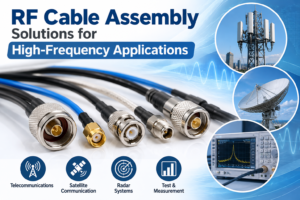
RF cable assemblies are widely used in telecommunications, wireless networks, satellite communication, aerospace, defense, radar systems, medical electronics, and RF testing laboratories. Selecting the right assembly depends on factors such as operating frequency, cable type, connector configuration, electrical specifications, and installation requirements.
What Is an RF Cable Assembly?
An RF cable assembly is a complete cable connection solution consisting of a coaxial or other suitable RF cable fitted with compatible connectors at one or both ends. It is designed to carry radio frequency signals between electronic components with controlled electrical characteristics.
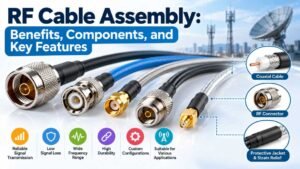
Unlike ordinary electrical cables, RF cable assemblies are engineered to preserve signal quality at high frequencies. Their construction typically includes a center conductor, dielectric insulation, conductive shielding, and an outer protective jacket. These layers work together to support signal transmission, minimize interference, and protect the cable from environmental damage.
RF cable assemblies can be manufactured in different lengths, connector configurations, impedance ratings, and performance specifications. Depending on the application, they may feature straight or right-angle connectors, flexible or semi-rigid cables, and specialized materials for high-temperature or outdoor installations.
Importance of RF Cable Assemblies in High-Frequency Applications
High-frequency signals are sensitive to small changes in electrical characteristics. Even minor variations in impedance, connector quality, or cable construction can affect signal transmission and system efficiency.
RF cable assemblies help address these challenges through controlled impedance, effective shielding, low signal attenuation, and precision connector interfaces.
1. Maintaining Signal Integrity
Signal integrity is one of the most important considerations in high-frequency communication. Poorly matched connectors, damaged cables, or unsuitable transmission lines can introduce reflections, distortion, and unwanted signal loss.
A well-designed RF cable assembly maintains consistent electrical characteristics along the transmission path. This helps transfer RF signals between devices with predictable performance and reduces the risk of communication errors.
2. Reducing Signal Loss
Signal attenuation refers to the reduction in signal strength as it travels through a cable. Cable material, conductor dimensions, operating frequency, and assembly length all influence attenuation.
Low-loss RF cable assemblies are useful in applications where signals must travel longer distances or where maintaining sufficient signal power is critical. Selecting an appropriate cable diameter, conductor material, and dielectric can help achieve the required attenuation performance.
3. Minimizing Electromagnetic Interference
Electromagnetic interference can affect the performance of sensitive electronic systems. RF cable assemblies often use conductive shielding to reduce unwanted coupling between the transmitted signal and external electrical noise.
Effective shielding also helps limit RF energy leakage, although overall performance depends on the cable construction, connector termination, and installation quality.
4. Supporting High-Frequency Performance
As operating frequencies increase, electrical discontinuities become more significant. Precision-engineered RF cable assemblies help maintain stable impedance and repeatable electrical performance across the intended frequency range.
The selected assembly should be qualified for the required frequency, insertion loss, return loss, and power-handling conditions rather than chosen solely by its connector type.
Key Components of an RF Cable Assembly
Understanding the main components of an RF cable assembly helps buyers and engineers select a suitable solution for their applications.
Center Conductor
The center conductor carries the RF signal. Copper, silver-plated copper, and other conductive materials may be used depending on the cable design. Conductor dimensions and material properties influence resistance, attenuation, and high-frequency performance.
Dielectric Insulation
The dielectric separates the center conductor from the outer conductor and helps establish the cable’s characteristic impedance. Common dielectric materials include polyethylene, expanded polyethylene, and PTFE. The appropriate material depends on electrical requirements, temperature limits, flexibility, and environmental conditions.
Shielding Layer
The outer conductor or shielding layer provides the return path for the RF signal and helps protect against electromagnetic interference. Depending on the design, shielding may use braided wire, foil, solid metal tubing, or combinations of these structures.
Outer Jacket
The outer jacket protects the cable against abrasion, moisture, chemicals, and other environmental influences. Jacket material should be selected according to installation conditions, including indoor, outdoor, industrial, or high-temperature environments.
RF Connectors
Connectors provide the interface between the cable assembly and electronic equipment. Common RF connector types include SMA, SMB, SMC, BNC, TNC, N-Type, 2.92 mm, 2.4 mm, and SMP connectors.
Each connector type has specific mechanical dimensions, coupling arrangements, frequency capabilities, and electrical characteristics. Compatibility between the connector and the mating interface is essential for reliable operation.
Types of RF Cable Assembly Solutions
Different high-frequency applications require different cable constructions and connector configurations. Understanding the available options helps engineers choose an assembly that meets their system requirements.
Flexible RF Cable Assemblies
Flexible RF cable assemblies are designed for applications that require easy routing, compact installation, or movement during operation. They are commonly used in wireless equipment, communication devices, laboratory instruments, and general RF interconnections.
Their performance depends on cable construction, bend radius, connector quality, and operating frequency. Repeated flexing should be considered when selecting an assembly for dynamic applications.
Semi-Rigid RF Cable Assemblies
Semi-rigid RF cable assemblies use a rigid metallic outer conductor that provides consistent shielding and mechanical stability. They are often selected for microwave equipment, precision test systems, aerospace electronics, and applications requiring stable electrical performance.
Because these cables retain their formed shape, they are generally suited to fixed installations rather than frequent movement.
Low-Loss RF Cable Assemblies
Low-loss RF cable assemblies are developed to reduce attenuation over the required operating frequency range. They are useful in antenna connections, wireless infrastructure, communication links, and other applications where signal strength must be preserved.
Actual performance depends on cable type, length, frequency, and connector transitions.
High-Frequency Microwave Cable Assemblies
Microwave cable assemblies are designed for applications operating at microwave frequencies. Depending on the specification, they may use precision connectors and carefully controlled cable construction to achieve the required insertion loss, return loss, phase stability, and repeatability.
They are frequently used in RF laboratories, radar equipment, satellite systems, and high-frequency measurement setups.
Custom RF Cable Assemblies
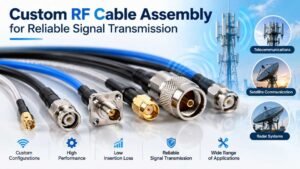
Custom RF cable assemblies are manufactured according to specific application requirements. Customers can define cable length, connector combinations, cable type, routing needs, environmental conditions, and electrical performance targets.
Customization is particularly useful when standard assemblies do not satisfy equipment dimensions, interface compatibility, or system-level performance requirements.
Applications of RF Cable Assemblies in High-Frequency Systems
Telecommunications and Wireless Networks
Telecommunications infrastructure relies on RF cable assemblies to connect antennas, radio units, communication modules, and testing equipment. These assemblies support signal transmission in cellular networks, wireless communication systems, and other RF installations.
Reliable assembly performance helps maintain signal quality and reduces connection-related problems during installation and maintenance.
Satellite Communication
Satellite communication systems require dependable RF interconnections between antennas, transmitters, receivers, and associated electronics. Cable assemblies must be selected according to frequency, attenuation, temperature range, and mechanical requirements.
For demanding installations, environmental resistance and long-term connection reliability are also important considerations.
Aerospace and Defense
Aerospace and defense electronics use RF cable assemblies in radar systems, navigation equipment, electronic communication, and specialized instrumentation. These applications may require controlled electrical performance, compact construction, vibration resistance, and operation across demanding environmental conditions.
Assemblies should be selected against the applicable engineering and qualification requirements of the intended platform.
RF Testing and Measurement
RF cable assemblies connect instruments such as spectrum analyzers, signal generators, vector network analyzers, and other test equipment. Precision assemblies can help reduce measurement uncertainty when their frequency range, connector condition, and calibration requirements are properly managed.
Phase-stable cable assemblies may be required when repeatable phase measurements are important.
Medical and Industrial Electronics
RF cable assemblies are also used in selected medical electronics, industrial sensing, scientific instruments, and specialized heating or measurement systems. The required cable construction depends on the frequency, power level, equipment design, and applicable safety or regulatory requirements.
Important Factors When Selecting an RF Cable Assembly
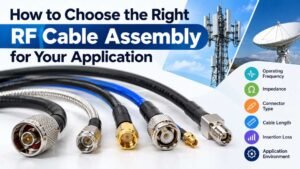
Choosing the correct RF cable assembly involves evaluating several electrical, mechanical, and environmental factors.
Operating Frequency
Confirm that the cable and connectors support the complete frequency range required by the system. A connector’s physical compatibility alone does not guarantee suitable performance at the intended frequency.
Characteristic Impedance
Common RF systems use 50-ohm impedance, while some video and broadcast systems use 75-ohm impedance. The assembly impedance should match the connected equipment and transmission line to minimize reflections.
Insertion Loss and Return Loss
Insertion loss indicates how much signal power is lost through the assembly. Return loss indicates how effectively the assembly maintains impedance matching. Both parameters should be evaluated across the intended frequency range.
Cable Length and Flexibility
Longer cables generally introduce more attenuation. The cable must also fit the installation space while respecting the manufacturer’s minimum bend radius. Excessive bending or twisting can degrade performance and damage connectors.
Connector Compatibility
Check connector type, gender, interface dimensions, coupling mechanism, and frequency rating. Precision applications may require specific connector series and tighter mechanical tolerances.
Environmental Requirements
Consider operating temperature, humidity, vibration, moisture exposure, chemical contact, and outdoor installation conditions. Suitable jacket materials and connector designs can improve durability under the expected environment.
Power Handling
The assembly must support the required RF power under actual operating conditions. Power capability can vary with frequency, ambient temperature, cable length, and heat dissipation.
Benefits of High-Quality RF Cable Assembly Solutions
High-quality RF cable assemblies provide several benefits when correctly specified and installed.
- Reliable signal transmission: Suitable electrical characteristics help preserve signal quality.
- Reduced interference: Effective shielding and sound connector termination help limit unwanted RF coupling.
- Consistent performance: Controlled manufacturing and appropriate testing improve repeatability.
- Installation flexibility: Different cable types and connector configurations support a wide range of equipment layouts.
- Improved durability: Appropriate materials and construction help withstand expected operating conditions.
- Application-specific design: Custom assemblies can address special dimensions, interfaces, and performance requirements.
The actual benefits depend on the selected design, manufacturing quality, and compatibility with the overall system.
Quality Testing and Manufacturing Considerations
Manufacturing quality plays an important role in RF cable assembly performance. A reliable production process should control cable preparation, connector installation, contact integrity, and assembly dimensions.
Depending on the application, inspection and testing may include continuity testing, insulation checks, insertion loss measurement, return loss or VSWR testing, and verification of connector dimensions. More demanding systems may require phase stability, shielding effectiveness, environmental, or mechanical qualification tests.
Testing should cover the required frequency range and follow appropriate methods and acceptance criteria. Proper handling, connector cleaning, installation torque where specified, and suitable storage also help maintain performance after delivery.
Conclusion
RF Cable Assembly solutions are essential for high-frequency applications that depend on accurate signal transmission, controlled impedance, and reliable connectivity. From telecommunications and wireless networks to satellite communication, aerospace electronics, and RF testing, the right cable assembly helps meet system-level electrical and mechanical requirements.
When selecting an RF cable assembly, consider operating frequency, impedance, insertion loss, return loss, cable length, connector type, power handling, and environmental conditions. Flexible, semi-rigid, low-loss, microwave, and custom assemblies each serve different purposes.
By matching the cable construction and connector configuration to the intended application, engineers and purchasing teams can improve compatibility, support dependable performance, and build reliable high-frequency systems.
Frequently Asked Questions (FAQs)
1. What is an RF cable assembly used for?
An RF cable assembly connects radio frequency components and transfers signals between antennas, transmitters, receivers, test instruments, and communication equipment.
2. What is the difference between an RF cable and an RF cable assembly?
An RF cable is the transmission cable itself, while an RF cable assembly includes the cable fitted with compatible connectors and prepared for installation.
3. Which impedance is commonly used in RF cable assemblies?
A 50-ohm impedance is widely used in RF communication, wireless, and test equipment. A 75-ohm impedance is common in video and certain broadcast applications. The correct choice depends on the connected system.
4. How do I choose an RF cable assembly for high-frequency applications?
Evaluate the required frequency range, impedance, insertion loss, return loss, connector compatibility, cable length, power handling, and operating environment.
5. Which connectors are used in RF cable assemblies?
Common options include SMA, SMB, SMC, BNC, TNC, N-Type, 2.92 mm, 2.4 mm, and SMP connectors. The suitable connector depends on the required frequency, interface, and application.
6. Why is shielding important in an RF cable assembly?
Shielding helps reduce electromagnetic interference and unwanted signal leakage. Its effectiveness depends on the cable design, connector termination, and installation quality.
7. Can RF cable assemblies be customized?
Yes. Custom assemblies can be specified by cable length, connector type, cable construction, routing requirements, and electrical or environmental performance targets.
8. How can RF cable assembly performance be tested?
Common tests include continuity, insertion loss, return loss, VSWR, and connector inspection. Additional testing may be required for phase stability, environmental resistance, or other application-specific needs.