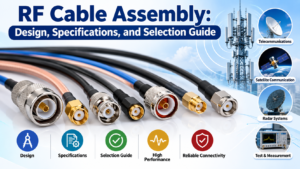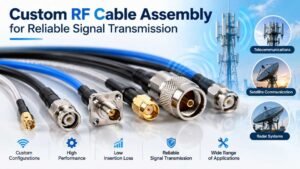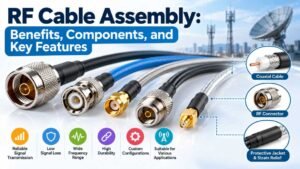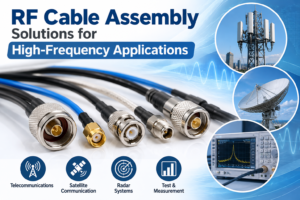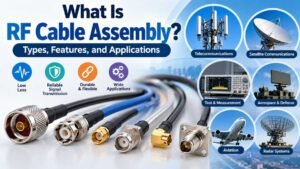
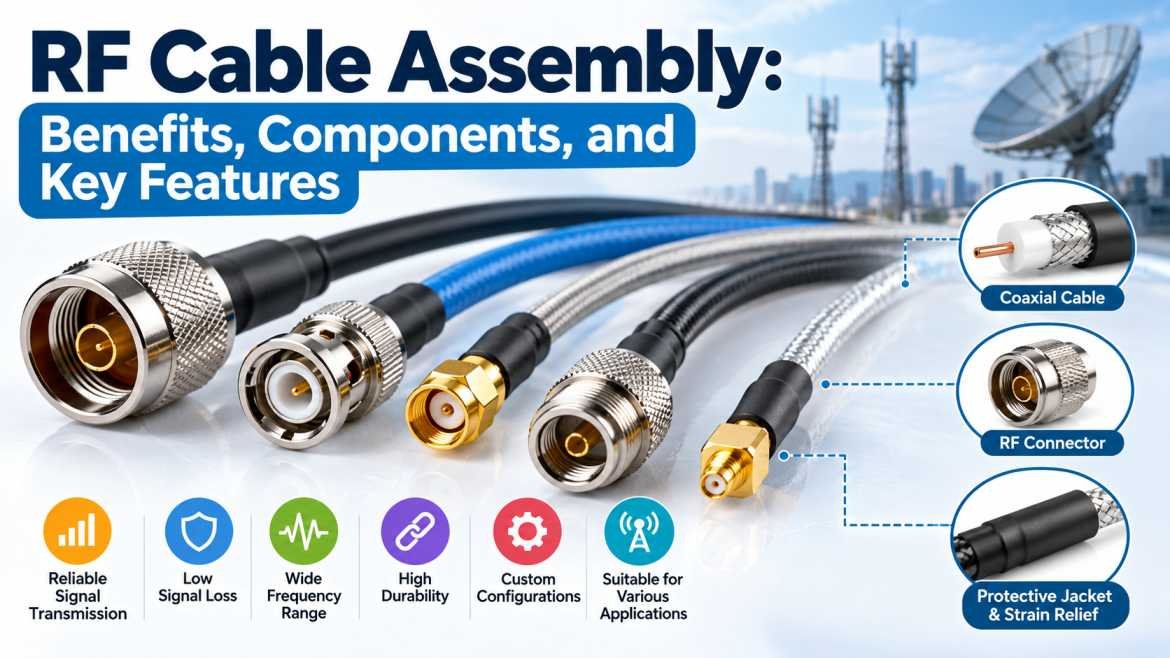
An RF Cable Assembly is an essential component in modern electronic communication systems, designed to transmit radio frequency signals between electronic devices, antennas, transmitters, receivers, and other RF equipment. RF stands for Radio Frequency, which refers to electromagnetic signals used for wireless communication, radar systems, satellite communication, broadcasting, and telecommunications.
RF Cable Assemblies combine a coaxial cable with specialized RF connectors to provide reliable signal transmission across a wide range of frequencies. They are engineered to maintain signal integrity, minimize transmission losses, reduce electromagnetic interference, and support consistent performance in demanding operating environments.
With the growing demand for high-speed wireless communication, advanced radar technology, satellite connectivity, and 5G infrastructure, RF Cable Assembly solutions have become increasingly important for industries that require accurate and dependable high-frequency signal transmission.
Understanding the benefits, components, and key features of an RF Cable Assembly helps engineers, system integrators, and purchasing professionals select the right solution for their specific applications.
What Is an RF Cable Assembly?
An RF Cable Assembly is a pre-terminated cable solution consisting of a coaxial cable fitted with RF connectors at one or both ends. It is designed to carry high-frequency electrical signals between connected components while maintaining the required electrical and mechanical performance.
Unlike ordinary electrical cables, RF Cable Assemblies are specifically designed to control impedance and minimize signal reflections. Most RF coaxial cable assemblies use a characteristic impedance of 50 ohms, particularly in wireless communication, test equipment, and RF transmission systems. Some video and broadcasting applications use 75-ohm assemblies.
The performance of an RF Cable Assembly depends on several factors, including cable construction, connector quality, operating frequency, insertion loss, shielding effectiveness, and environmental requirements.
RF Cable Assemblies are available in different lengths, connector configurations, cable types, and performance specifications. They can be manufactured as standard products or customized according to the requirements of a particular electronic system.
Key Components of an RF Cable Assembly
An RF Cable Assembly consists of several components that work together to ensure stable and efficient signal transmission.
1. Coaxial Cable
The coaxial cable forms the main body of an RF Cable Assembly. It carries RF signals between connected devices and is constructed to maintain a consistent impedance throughout its length.
Coaxial cables generally consist of a central conductor, dielectric insulation, an outer conductor or shield, and a protective outer jacket.
Different cable types offer different levels of flexibility, attenuation, shielding, and frequency capability. Common options include flexible coaxial cables, semi-rigid cables, and conformable cables.
The correct cable selection depends on operating frequency, installation space, required length, bending requirements, and environmental conditions.
2. RF Connectors
RF connectors provide the electrical and mechanical interface between the cable and connected equipment. They are designed to maintain impedance continuity and minimize reflections at the connection point.
Common RF connector types include SMA, SMB, SMC, BNC, TNC, N-Type, 2.92 mm, 2.4 mm, 3.5 mm, SMP, and SMPM connectors.
Each connector type has specific dimensions, coupling mechanisms, frequency capabilities, and performance characteristics. For example, SMA connectors are widely used in RF equipment and wireless systems, while N-Type connectors are frequently found in antenna installations and communication infrastructure.
The connector must be compatible with the equipment interface and suitable for the assembly’s intended frequency range.
3. Center Conductor
The center conductor carries the primary RF signal through the cable. It is commonly manufactured from copper, copper alloys, or other conductive materials selected for their electrical and mechanical properties.
Its dimensions, material, and surface finish influence conductor losses and high-frequency performance.
A properly designed center conductor helps maintain signal transmission efficiency and supports consistent electrical characteristics.
4. Dielectric Insulation
The dielectric is the insulating material positioned between the center conductor and the outer conductor. It prevents direct electrical contact while maintaining the required spacing between conductors.
Common dielectric materials include PTFE and polyethylene, depending on the cable design and application.
The dielectric affects characteristic impedance, signal propagation velocity, capacitance, temperature performance, and maximum operating frequency.
5. Shielding Layer
The shielding layer surrounds the dielectric and helps contain the RF signal within the cable while reducing susceptibility to external electromagnetic interference.
Depending on the design, shielding may consist of braided metal, foil, a solid metallic tube, or multiple shielding layers.
Effective shielding is particularly important in environments containing multiple electronic devices, transmitters, switching systems, and other sources of electromagnetic noise.
6. Protective Outer Jacket
The outer jacket protects the cable from abrasion, moisture, chemicals, and environmental exposure, depending on the selected material.
Common jacket materials include PVC, polyethylene, and specialized fluoropolymer compounds.
For outdoor, industrial, or aerospace applications, the jacket must be selected according to temperature, weather exposure, flexibility, and applicable safety requirements.
Major Benefits of RF Cable Assembly
RF Cable Assemblies provide several benefits for modern communication and electronic systems.
1. Reliable High-Frequency Signal Transmission
One of the primary benefits of an RF Cable Assembly is its ability to transmit high-frequency signals with controlled electrical characteristics. Proper impedance matching helps minimize signal reflections and supports reliable communication between connected devices.
This is especially important in wireless infrastructure, laboratory testing, radar equipment, and satellite communication systems.
2. Reduced Signal Loss
RF Cable Assemblies can be designed to minimize insertion loss, helping preserve signal strength between the source and destination.
Signal loss depends on cable type, length, frequency, connector performance, and installation conditions. Selecting a cable with suitable attenuation characteristics can improve overall system performance.
For applications requiring longer cable runs or higher operating frequencies, low-loss coaxial cables may be appropriate.
3. Effective Electromagnetic Shielding
RF Cable Assemblies use coaxial construction and shielding layers to reduce unwanted electromagnetic interference.
Good shielding helps prevent external noise from affecting transmitted signals and reduces the amount of RF energy radiated from the cable.
This benefit is particularly valuable in sensitive measurement systems, telecommunications equipment, and densely populated electronic installations.
4. Consistent Electrical Performance
Manufactured RF Cable Assemblies can provide repeatable electrical characteristics when production processes and testing procedures are properly controlled.
Parameters such as characteristic impedance, insertion loss, return loss, and voltage standing wave ratio can be verified against the specified requirements.
Consistent performance is essential for systems that require predictable RF behavior across multiple cable connections.
5. Flexible Design and Customization
RF Cable Assemblies are available in different cable lengths, connector combinations, and mechanical configurations.
Custom assemblies can be designed for restricted installation spaces, specific connector interfaces, specialized frequency ranges, and unique environmental requirements.
This flexibility allows engineers to integrate RF connections into communication equipment, test systems, and industrial electronics without relying exclusively on standard cable configurations.
6. Improved Installation Efficiency
Pre-terminated RF Cable Assemblies simplify installation by providing ready-to-connect cable solutions.
They can reduce the need for on-site connector termination and help minimize assembly errors when the products are manufactured and inspected according to suitable specifications.
Correct cable routing, bend-radius control, and connector installation practices remain important for achieving reliable performance.
7. Long-Term Operational Reliability
An RF Cable Assembly designed for its intended operating environment can provide dependable service over an extended period.
Durability depends on connector construction, cable materials, strain relief, temperature exposure, vibration, moisture, and the frequency of connection cycles.
Choosing appropriate components helps reduce premature wear and supports the reliability of the overall electronic system.
Key Features of RF Cable Assembly
When evaluating an RF Cable Assembly, several technical features should be considered to ensure compatibility and performance.
1. Characteristic Impedance
Characteristic impedance is one of the most important electrical specifications. Common RF systems use 50-ohm cable assemblies, while many video systems use 75-ohm assemblies.
The cable, connectors, and equipment should be designed for compatible impedance to minimize reflections and maintain signal integrity.
2. Frequency Range
The operating frequency range indicates the frequencies over which the assembly is designed to perform according to its specifications.
The usable frequency range depends on the cable construction, connector interface, assembly quality, and test conditions.
Engineers should verify the specified frequency range before selecting an RF Cable Assembly for high-frequency applications.
3. Insertion Loss
Insertion loss measures the reduction in signal power caused by inserting the cable assembly into a transmission path. It is commonly expressed in decibels (dB).
Lower insertion loss is generally desirable when preserving signal strength is important. However, acceptable loss depends on cable length, frequency, and the overall system’s power budget.
4. Return Loss and VSWR
Return loss describes the amount of signal reflected back toward the source because of impedance discontinuities. Higher return loss generally indicates better impedance matching.
Voltage Standing Wave Ratio (VSWR) is another measurement used to evaluate impedance matching. A VSWR closer to 1:1 indicates lower reflection.
Both parameters are important for RF transmitters, receivers, antennas, and precision test equipment.
5. Shielding Effectiveness
Shielding effectiveness indicates how well the cable limits electromagnetic coupling and unwanted signal radiation.
The required shielding performance depends on the electromagnetic environment, signal sensitivity, and system design.
6. Mechanical Flexibility
Cable flexibility affects how easily the assembly can be routed through equipment enclosures, cabinets, and compact electronic systems.
Flexible assemblies are suitable for many general-purpose installations, while semi-rigid and conformable options may be selected for applications requiring controlled geometry or specialized performance.
7. Environmental Resistance
Some RF Cable Assemblies are designed for outdoor exposure, vibration, temperature variation, or industrial environments.
Depending on the application, relevant requirements may include operating temperature, moisture resistance, corrosion resistance, flame performance, and mechanical durability.
These capabilities should be confirmed against the manufacturer’s specifications rather than assumed from the cable’s appearance.
Applications of RF Cable Assembly
RF Cable Assemblies are used across a wide range of industries where dependable high-frequency signal transmission is required.
Telecommunications and Wireless Communication
RF Cable Assemblies connect antennas, radio units, base stations, wireless modules, and RF equipment. They support cellular networks, private wireless systems, and other communication infrastructure.
Satellite Communication
Satellite systems use RF connections in ground stations, communication terminals, antennas, and associated electronic equipment. Assemblies must meet the required frequency, loss, and environmental specifications.
Aerospace and Defense
RF Cable Assemblies are used in radar equipment, navigation systems, communication platforms, and specialized electronic systems. Depending on the application, these assemblies may require stringent mechanical, electrical, and environmental performance.
Test and Measurement Equipment
Laboratories and electronics manufacturers use RF Cable Assemblies to connect signal generators, spectrum analyzers, network analyzers, and devices under test.
Precision assemblies are particularly useful when repeatable measurements and controlled impedance are important.
Medical and Industrial Electronics
RF connections may be found in specialized medical equipment, industrial monitoring systems, sensors, and high-frequency processing equipment. The selected assembly must satisfy the relevant technical and safety requirements of the application.
How to Choose the Right RF Cable Assembly
Selecting the correct RF Cable Assembly requires evaluating the complete electrical and mechanical requirements of the system.
First, determine the operating frequency and characteristic impedance. Next, select a cable type with suitable attenuation, shielding, and flexibility.
Choose connectors that match the equipment interfaces and verify their specified frequency capability. Determine the required cable length while considering acceptable insertion loss and routing constraints.
Environmental factors such as temperature, vibration, moisture, and chemical exposure should also be evaluated. Finally, review available test data and quality requirements, including insertion loss, return loss, VSWR, and continuity.
For demanding applications, custom RF Cable Assemblies may provide a practical solution when standard products do not meet the required configuration or performance specifications.
Conclusion
RF Cable Assembly solutions are fundamental to modern communication networks, wireless systems, radar equipment, satellite infrastructure, and electronic test environments. Their performance depends on the quality of the coaxial cable, connectors, shielding, dielectric materials, and manufacturing processes.
Key benefits include reliable signal transmission, reduced signal loss, effective electromagnetic shielding, design flexibility, and consistent electrical performance. Important selection factors include impedance, frequency range, insertion loss, return loss, VSWR, mechanical flexibility, and environmental resistance.
By understanding these benefits, components, and key features, engineers and system integrators can select RF Cable Assemblies that meet their technical requirements and support dependable system operation.
Frequently Asked Questions (FAQs)
1. What is an RF Cable Assembly?
An RF Cable Assembly is a coaxial cable fitted with RF connectors to transmit radio frequency signals between electronic devices, antennas, and communication equipment.
2. What are the main components of an RF Cable Assembly?
The main components include the center conductor, dielectric insulation, shielding layer, outer jacket, and RF connectors.
3. What are the benefits of RF Cable Assembly?
Major benefits include reliable signal transmission, controlled impedance, reduced signal loss, electromagnetic shielding, installation convenience, and customization options.
4. What types of connectors are used in RF Cable Assemblies?
Common connectors include SMA, SMB, SMC, BNC, TNC, N-Type, 2.92 mm, 2.4 mm, 3.5 mm, SMP, and SMPM, depending on the application.
5. What is the standard impedance of an RF Cable Assembly?
A 50-ohm impedance is widely used in RF and wireless communication systems. A 75-ohm impedance is common in video and certain broadcasting applications.
6. Where are RF Cable Assemblies used?
They are used in telecommunications, wireless networks, satellite communication, aerospace, defense, radar systems, test equipment, and industrial electronics.
7. How do I select the right RF Cable Assembly?
Consider the operating frequency, impedance, cable length, insertion loss, connector type, shielding, flexibility, and environmental conditions.
8. Can RF Cable Assemblies be customized?
Yes. RF Cable Assemblies can be customized according to cable length, connector combinations, routing requirements, electrical specifications, and operating conditions.
9. Why is shielding important in an RF Cable Assembly?
Shielding helps reduce electromagnetic interference, limits unwanted signal radiation, and supports reliable transmission in electrically noisy environments.
10. What is the difference between insertion loss and return loss?
Insertion loss measures the signal power lost through the assembly, while return loss measures the signal reflected back toward the source due to impedance mismatches.