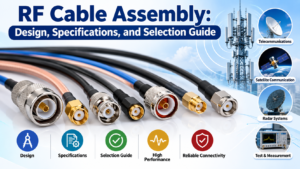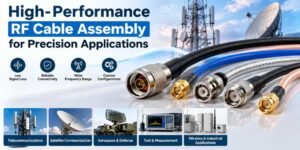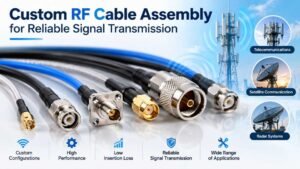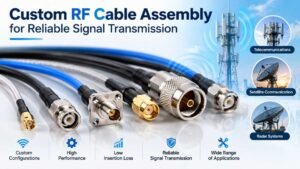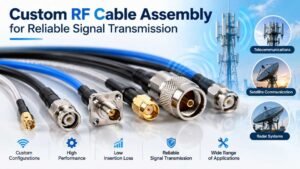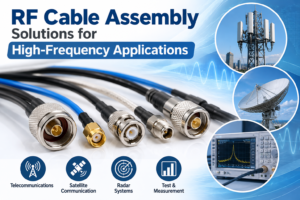
In modern telecommunications and wireless communication networks, reliable signal transmission is essential for maintaining connectivity, improving network performance, and supporting high-frequency applications. A high-performance RF Cable Assembly plays a critical role in transmitting radio frequency signals between antennas, transmitters, receivers, radio units, and other communication equipment. These assemblies are designed to deliver consistent electrical performance while minimizing signal loss, electromagnetic interference, and unwanted reflections.
As wireless technologies continue to evolve, communication infrastructure requires dependable components that can support higher frequencies, increased data traffic, and demanding operating environments. From cellular base stations and 5G networks to satellite communication systems and wireless infrastructure, RF cable assemblies help maintain stable connections between essential electronic components.
Selecting the right RF Cable Assembly involves evaluating frequency range, insertion loss, impedance, connector compatibility, shielding effectiveness, cable flexibility, and environmental requirements. Understanding these characteristics helps telecommunications engineers and equipment manufacturers select suitable solutions for their specific applications.
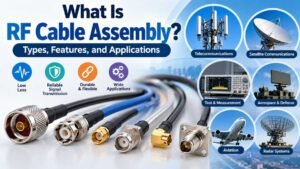
What Is an RF Cable Assembly?
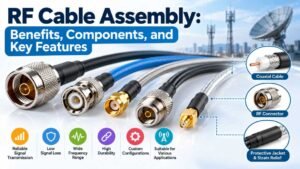
An RF Cable Assembly is a complete radio frequency cable solution consisting of a coaxial cable, connectors, and, when required, protective components or customized terminations. It is designed to carry high-frequency electrical signals between interconnected devices while maintaining signal integrity.
Unlike ordinary electrical cables, RF cable assemblies are engineered to control electrical characteristics across a specified frequency range. Their coaxial construction typically includes a central conductor, dielectric insulation, an outer conductive shield, and an external protective jacket. This structure helps contain electromagnetic energy within the cable and reduces susceptibility to external interference.
RF cable assemblies are available in various configurations, lengths, connector combinations, and cable types. Depending on the application, they may be designed for indoor equipment connections, outdoor telecommunications installations, test equipment, antenna systems, or demanding industrial environments.
High-performance assemblies are manufactured and tested to meet specified electrical and mechanical requirements. This makes them important components in communication systems where dependable signal transmission is necessary.
Importance of RF Cable Assembly in Telecommunications
Telecommunications networks depend on the efficient transfer of RF signals between multiple interconnected devices. Even when antennas, radios, and other equipment are carefully selected, an unsuitable cable assembly can introduce excessive attenuation, impedance mismatches, or interference.
A high-quality RF Cable Assembly helps maintain signal integrity throughout the transmission path. Lower insertion loss can reduce the amount of signal power lost between connected devices, while proper impedance matching helps minimize signal reflections. Effective shielding can also reduce unwanted electromagnetic coupling that may affect communication performance.
These characteristics are particularly important in cellular base stations, distributed antenna systems, wireless access points, and radio communication infrastructure. In these installations, cable assemblies connect radio equipment to antennas and support connections between different RF components.
Reliable cable assemblies can also simplify installation and maintenance when they are designed with appropriate cable lengths, connector interfaces, and environmental protection. Choosing suitable assemblies from the beginning can help reduce avoidable connection problems and support long-term network reliability.
Key Features of High-Performance RF Cable Assembly
1. Low Insertion Loss
Insertion loss refers to the reduction in signal power as a signal passes through a cable assembly. It is commonly expressed in decibels (dB) and depends on factors such as cable length, conductor properties, dielectric material, operating frequency, and connector performance.
Low-loss RF cable assemblies are valuable in telecommunications applications where maintaining adequate signal strength is important. Lower attenuation can help preserve the available link budget between transmitters, receivers, and antennas.
When comparing cable assemblies, engineers should review insertion-loss specifications across the intended operating frequency range rather than relying on a single value.
2. Controlled Impedance
Most telecommunications RF systems use a defined characteristic impedance, commonly 50 ohms. Maintaining compatibility between the cable, connectors, and connected equipment helps reduce impedance discontinuities and signal reflections.
Impedance mismatches can increase reflected power and affect the efficiency of RF transmission. Therefore, cable assemblies should be selected to match the impedance requirements of the connected devices.
Correct connector termination and consistent manufacturing quality are equally important for achieving the specified electrical performance.
3. Effective Electromagnetic Shielding
Electromagnetic interference can affect the performance of sensitive communication equipment. RF cable assemblies typically use conductive shielding to limit the coupling of unwanted signals into and out of the transmission path.
Shielding performance depends on the cable construction, connector design, termination quality, and assembly integrity. Properly installed shielding helps support reliable operation in environments containing multiple transmitters, electronic devices, and RF sources.
4. Wide Frequency Capability
Different wireless applications operate across different frequency bands. Cellular communication, satellite links, microwave radio systems, and RF test equipment may require different frequency capabilities.
A high-performance RF Cable Assembly should be specified for the complete operating frequency range of the application. Engineers should evaluate insertion loss, return loss, shielding, and power-handling requirements at the relevant frequencies.
A cable assembly suitable for one frequency band may not deliver the same performance at higher frequencies.
5. Mechanical Durability and Flexibility
Telecommunications installations often require cables to pass through equipment racks, cabinets, conduits, towers, and restricted installation spaces. Cable assemblies must provide an appropriate balance of flexibility, bend radius, durability, and electrical stability.
Flexible cables can simplify routing, while more rigid or low-loss cable constructions may be appropriate for certain fixed installations. Repeated bending, excessive pulling force, and operation below the recommended bend radius can damage the cable or affect its electrical characteristics.
Selecting the correct construction helps support installation efficiency and service life.
6. Reliable Connector Interfaces
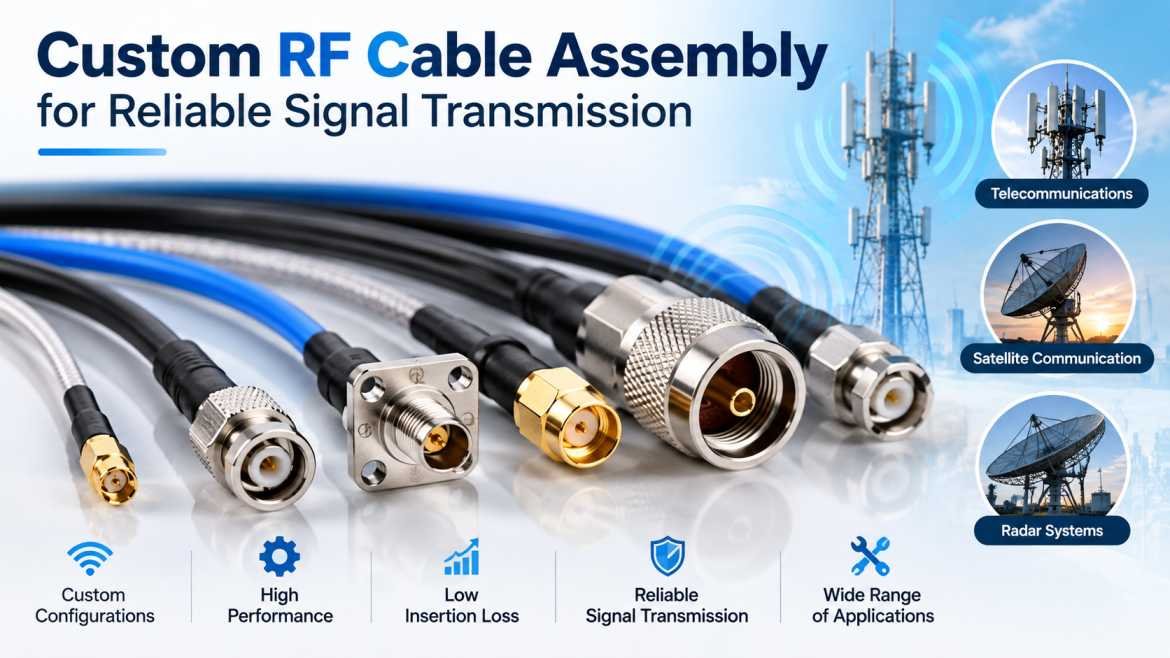
RF connectors provide the mechanical and electrical interface between the cable and connected equipment. Common connector families include SMA, N-type, TNC, BNC, and 4.3-10, depending on the frequency range, interface requirements, and application.
Connector selection should consider impedance, frequency capability, mating compatibility, environmental sealing, and mechanical durability. Correct assembly and tightening procedures are also important for maintaining consistent performance.
Applications of RF Cable Assembly in Telecommunications and Wireless Systems
Cellular Base Stations and 5G Infrastructure
RF cable assemblies are used to connect radio equipment, antennas, filters, and other RF components within cellular infrastructure. These connections must meet the electrical requirements of the deployed frequency bands and installation environment.
In 5G networks, cable performance remains important for RF connections involving antennas and radio units. The precise architecture varies by deployment, with some systems using short RF cable connections and others relying on fiber-based fronthaul or integrated radio equipment.
Distributed Antenna Systems
Distributed antenna systems (DAS) help extend wireless coverage across buildings, campuses, transportation facilities, and other large areas. RF cable assemblies can connect signal sources, repeaters, splitters, couplers, and antennas.
For these applications, cable loss, connector compatibility, installation length, and frequency coverage must be considered to maintain the required signal distribution.
Wireless Communication Equipment
Wireless access points, radio modules, communication terminals, and industrial wireless devices may use RF cable assemblies to connect internal RF components or external antennas.
Compact cable assemblies with appropriate connector configurations are particularly useful when equipment has limited installation space. Reliable connections help support the intended RF performance of the overall system.
Microwave Radio Links
Microwave communication systems use RF signals to transmit information between fixed locations. Cable assemblies may connect transceivers, antennas, test interfaces, and associated RF components.
Because performance can vary significantly with frequency, engineers should evaluate cable attenuation and connector characteristics across the intended microwave band.
Satellite Communication Systems
Satellite communication equipment uses RF cable assemblies in antenna systems, transceivers, receivers, and signal distribution networks. Depending on the system, assemblies may need to accommodate outdoor exposure, temperature variation, vibration, and demanding frequency requirements.
Suitable cable construction and connector interfaces help support reliable connections in ground stations, satellite terminals, and related communication equipment.
RF Testing and Measurement
RF cable assemblies are also used with network analyzers, signal generators, spectrum analyzers, and other test instruments. Measurement applications may require controlled impedance, repeatable electrical performance, and connectors suited to the relevant frequency range.
For precision testing, phase stability, return loss, connector repeatability, and calibration requirements may be especially important.
Types of RF Cable Assembly
Several types of RF cable assemblies are available to support different telecommunications and wireless applications.
Flexible RF Cable Assemblies: These are suitable for equipment interconnections and installations where cable routing requires flexibility. Their performance depends on the selected cable type, length, and operating frequency.
Low-Loss RF Cable Assemblies: These are designed to reduce attenuation and may be suitable for longer RF transmission paths or applications with demanding signal budgets.
Semi-Rigid RF Cable Assemblies: These use a formable, relatively rigid outer conductor and are often selected for compact equipment, controlled routing, and applications requiring stable electrical characteristics.
High-Frequency RF Cable Assemblies: These are designed for specified higher-frequency applications and require suitable cable construction and connector interfaces to achieve the intended performance.
Custom RF Cable Assemblies: Custom solutions can be manufactured with specific lengths, connector combinations, cable constructions, and termination requirements to meet equipment or installation needs.
The appropriate type depends on the electrical specifications, physical layout, operating conditions, and budget of the application.
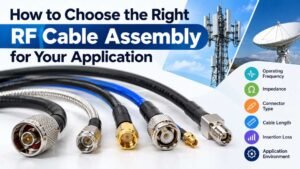
How to Choose the Right RF Cable Assembly
Selecting the right RF Cable Assembly requires a clear understanding of the system’s electrical and mechanical requirements.
First, identify the operating frequency range and impedance. These specifications establish important requirements for the cable and connectors.
Second, evaluate insertion loss and return loss. Insertion loss indicates signal attenuation, while return loss indicates the extent of reflected signal power. Both should be considered across the required frequency range.
Third, determine the appropriate cable length and construction. Longer cables generally introduce more attenuation, while cable flexibility and bend radius affect installation options.
Fourth, verify connector compatibility. Connector gender, interface type, impedance, frequency capability, and environmental requirements must match the connected equipment.
Fifth, assess environmental conditions, including temperature, moisture, vibration, UV exposure, and mechanical stress. Outdoor installations may require suitable jackets, sealing, and corrosion-resistant materials.
Finally, review manufacturer specifications and testing requirements. Depending on the application, important checks may include continuity, insertion loss, return loss or VSWR, connector integrity, and dimensional inspection.
A systematic selection process helps reduce installation issues and supports dependable RF performance.
Benefits of High-Performance RF Cable Assembly
High-performance RF cable assemblies offer several benefits for telecommunications and wireless infrastructure when correctly specified and installed.
They help preserve signal quality by controlling attenuation and impedance characteristics. Effective shielding can reduce unwanted electromagnetic interference, while suitable connectors provide dependable interfaces between RF components.
Appropriate cable construction also supports installation requirements, whether the system needs flexible routing, compact connections, or durable outdoor connections. Customized assemblies can reduce the need for on-site cable preparation and help simplify equipment integration.
Consistent manufacturing and appropriate testing can further improve product repeatability and reduce the risk of avoidable connection failures. However, overall network performance also depends on antennas, transmitters, receivers, installation practices, and other system components.
Quality Testing and Manufacturing Considerations
Manufacturing quality plays an important role in RF cable assembly performance. Poor stripping, incorrect connector installation, damaged dielectric materials, or inconsistent termination can introduce electrical discontinuities and reduce reliability.
Quality control may include visual inspection, dimensional checks, continuity testing, insertion-loss measurement, return-loss testing, and VSWR verification. Additional testing may be required for applications with demanding power, environmental, phase-stability, or mechanical requirements.
Manufacturers should follow appropriate assembly procedures and use compatible cable and connector components. For critical telecommunications installations, engineers should also review product documentation, specified operating limits, and any required compliance or qualification testing.
Proper handling, installation, connector mating, and maintenance are essential for preserving the intended performance of the completed assembly.
Conclusion
High-performance RF Cable Assembly solutions are important for telecommunications and wireless systems that depend on stable, efficient radio frequency signal transmission. From cellular infrastructure and distributed antenna systems to microwave links, satellite communication, and RF test equipment, these assemblies connect essential components while helping control signal loss, reflections, and electromagnetic interference.
Choosing the right assembly requires careful evaluation of frequency range, impedance, insertion loss, shielding, connector compatibility, cable construction, and environmental conditions. Quality manufacturing, suitable testing, and correct installation further contribute to dependable performance.
By matching RF cable assembly specifications to the requirements of the application, telecommunications engineers and equipment manufacturers can build reliable connections that support the performance and long-term operation of modern wireless communication systems.
Frequently Asked Questions (FAQs)
1. What is an RF Cable Assembly?
An RF Cable Assembly is a cable terminated with compatible RF connectors and designed to transmit radio frequency signals between electronic devices, antennas, transmitters, receivers, and communication equipment.
2. Why is RF Cable Assembly important in telecommunications?
RF cable assemblies provide connections between key communication components. Their electrical performance influences signal attenuation, impedance matching, interference susceptibility, and the reliability of RF signal transmission.
3. What impedance is commonly used for RF Cable Assembly?
A 50-ohm characteristic impedance is widely used in telecommunications and RF equipment. Other impedance values exist for specific applications, so the assembly must match the requirements of the connected system.
4. Which connectors are commonly used in RF Cable Assemblies?
Common connector types include SMA, N-type, TNC, BNC, and 4.3-10. The correct choice depends on the operating frequency, impedance, mechanical interface, power requirements, and installation environment.
5. How does insertion loss affect RF Cable Assembly performance?
Insertion loss represents the signal power lost as it travels through the assembly. Lower insertion loss can help preserve signal strength, particularly in longer transmission paths or applications with limited link budgets.
6. Can RF Cable Assemblies be customized?
Yes. Custom RF cable assemblies can be produced with specified cable lengths, connector combinations, cable types, and termination configurations to suit equipment and installation requirements.
7. Are RF Cable Assemblies suitable for 5G networks?
Yes. RF cable assemblies can be used in 5G infrastructure for appropriate RF interconnections. The required specifications depend on the network architecture, frequency band, radio equipment, and antenna configuration.
8. What tests are performed on RF Cable Assemblies?
Common tests include continuity, insertion loss, return loss, VSWR, and visual or dimensional inspection. Additional environmental and mechanical testing may be required for specialized applications.
9. How can I select the right RF Cable Assembly?
Determine the operating frequency, impedance, required cable length, insertion-loss limits, connector interfaces, environmental conditions, and mechanical requirements. Then compare these needs with the manufacturer’s specifications and test results.
10. What industries use high-performance RF Cable Assemblies?
Telecommunications, wireless networking, satellite communications, aerospace, defense, broadcasting, industrial electronics, and RF testing are among the industries that use RF cable assemblies for suitable applications.