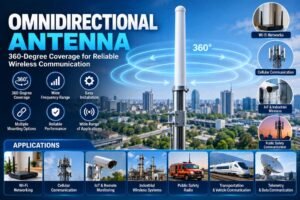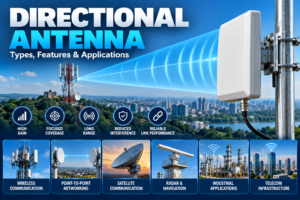
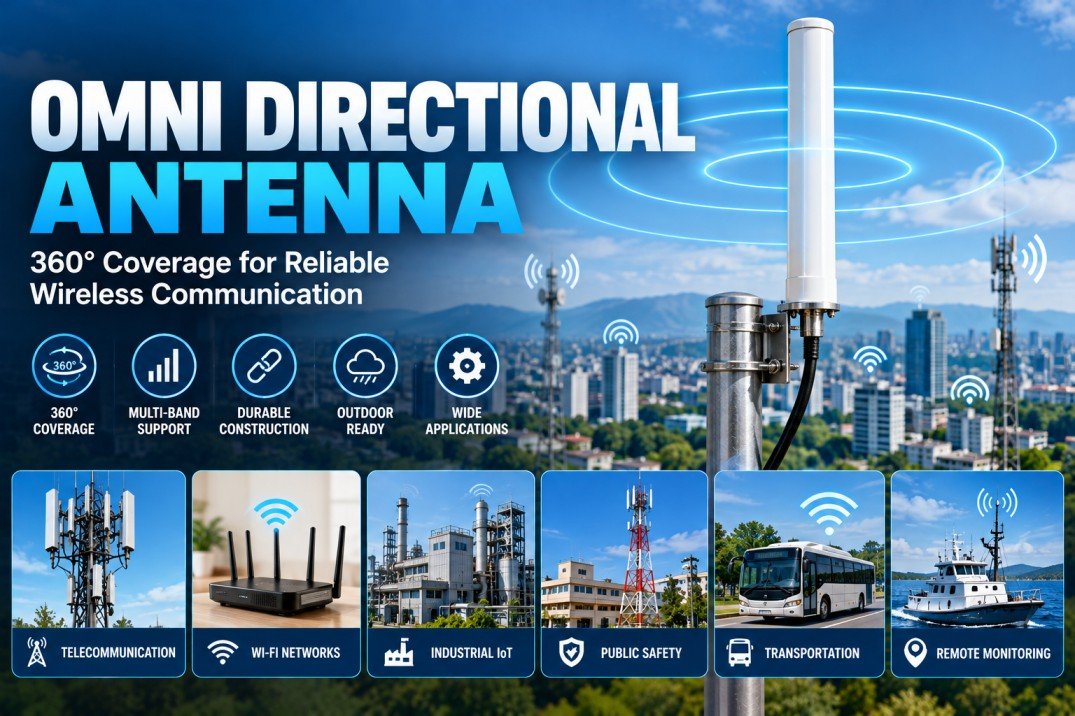
An omni directional antenna is a type of antenna designed to transmit or receive radio frequency (RF) signals in all horizontal directions. Unlike a directional antenna, which concentrates its signal toward a specific direction, an omni directional antenna provides broad horizontal coverage, making it suitable for wireless communication systems that require connectivity across multiple directions.
Omni directional antennas are widely used in telecommunications, Wi-Fi networks, radio communication, IoT devices, public safety systems, industrial wireless networks, and critical communication infrastructure. Their ability to provide 360-degree horizontal coverage makes them an effective solution for applications where users or devices are distributed around a central communication point.
What Is an Omni Directional Antenna?
An omni directional antenna is an RF antenna that radiates or receives electromagnetic energy in all directions around its vertical axis, under ideal operating conditions. Its radiation pattern typically resembles a doughnut shape, with stronger coverage across the horizontal plane and reduced radiation along the antenna’s vertical axis.
These antennas are commonly installed on buildings, communication towers, vehicles, access points, and industrial equipment. Depending on the design, they can operate across different frequency bands for cellular communication, Wi-Fi, telemetry, radio systems, and other wireless applications.
The actual coverage area depends on antenna gain, operating frequency, mounting height, surrounding obstacles, cable losses, and environmental conditions.
How Does an Omni Directional Antenna Work?
An omni directional antenna converts electrical RF signals into electromagnetic waves during transmission. During reception, it captures electromagnetic energy from nearby transmitters and converts it into electrical signals for processing by the connected communication equipment.
Its antenna elements and physical structure are designed to distribute energy broadly around the antenna’s vertical axis. This allows devices located in different horizontal directions to communicate without requiring the antenna to be mechanically repositioned.
However, 360-degree horizontal coverage does not mean that the antenna provides equal signal strength at every angle or distance. The radiation pattern, installation environment, polarization, and interference can influence actual performance.
Types of Omni Directional Antennas
1. Omni Directional Dipole Antenna
Dipole antennas are commonly used in wireless routers, communication equipment, and compact RF devices. They offer a relatively simple design and are available for different frequency bands.
2. Fiberglass Omni Directional Antenna
Fiberglass omni directional antennas are designed for outdoor installations and are often enclosed in protective radomes. They are used in wireless networks, telemetry, industrial communication, and other outdoor RF systems.
3. Collinear Omni Directional Antenna
Collinear antennas use multiple radiating elements arranged to increase gain and improve horizontal coverage. They are commonly used in base stations, radio communication networks, and fixed wireless installations.
4. Wi-Fi Omni Directional Antenna
Wi-Fi omni directional antennas provide broad horizontal coverage for wireless access points, routers, and network devices. Their performance depends on the supported Wi-Fi frequency bands and antenna specifications.
5. Cellular Omni Directional Antenna
Cellular omni directional antennas are designed for compatible cellular frequency bands and can be used in wireless communication systems, subject to network requirements and installation conditions.
6. Industrial Omni Directional Antenna
Industrial omni directional antennas support wireless connectivity for automation systems, monitoring devices, telemetry equipment, and IoT applications. Ruggedized designs may be available for challenging environments.
Key Features of an Omni Directional Antenna
Omni directional antennas offer several features that make them suitable for different communication requirements.
- 360-degree horizontal coverage: Supports communication with devices distributed around the antenna.
- Flexible installation: Available in indoor, outdoor, panel-mounted, magnetic-mount, and other configurations.
- Multiple frequency options: Models are available for different RF bands, depending on the application.
- Different gain levels: Low- and high-gain designs support different coverage and installation requirements.
- Simple network integration: Can connect to compatible radios, access points, modems, and RF equipment.
- Polarization options: Vertical and other polarization configurations are available depending on the antenna design.
- Outdoor durability: Selected models offer weather-resistant housings for external installations.
Important Technical Specifications
Selecting an omni directional antenna requires understanding its electrical and mechanical specifications.
| Specification | Description |
|---|---|
| Frequency Range | The RF band supported by the antenna |
| Antenna Gain | Directional concentration of radiated or received energy, commonly measured in dBi |
| Radiation Pattern | Describes how the antenna transmits or receives signals |
| Polarization | Orientation of the electromagnetic field |
| Impedance | Commonly 50 ohms for professional RF systems |
| VSWR | Indicates impedance matching performance |
| Connector Type | May include SMA, N-type, TNC, or other interfaces |
| Power Handling | Maximum RF input power supported by the antenna |
| Mounting Type | Determines how the antenna is installed |
| Environmental Rating | Indicates suitability for outdoor or demanding environments |
Specifications vary by model and manufacturer. Always verify the datasheet before selecting an antenna for a specific application.
Applications of Omni Directional Antennas
Telecommunications and Wireless Networks
Omni directional antennas support wireless communication systems where devices operate in different directions around a central access point or radio.
Wi-Fi and Local Area Networks
They are commonly used in routers, access points, and wireless networking equipment to provide broad horizontal coverage within offices, commercial buildings, campuses, and other facilities.
Industrial IoT and Automation
Industrial antennas enable communication between sensors, controllers, gateways, and monitoring systems. They can support remote monitoring, asset tracking, and industrial data transmission.
Public Safety and Critical Communication
Compatible omni directional antennas can support radio communication systems used by emergency services, security teams, and operational personnel. Antenna selection must match the radio frequency and system requirements.
Transportation and Fleet Communication
Omni directional antennas are used in vehicles and mobile communication systems where connectivity may be required from multiple directions.
Remote Monitoring and Telemetry
They can connect monitoring devices, telemetry units, and wireless gateways in utilities, industrial facilities, and remote installations.
Advantages of Omni Directional Antennas
The primary advantage of an omni directional antenna is its broad horizontal coverage. It can communicate with multiple devices positioned around it without requiring precise directional alignment.
Other benefits include straightforward installation, compatibility with many wireless systems, support for mobile or changing device positions, and availability across a range of frequencies and gain levels.
These antennas are particularly useful when the direction of the communicating device changes frequently or when multiple users are distributed across a coverage area.
Omni Directional Antenna vs Directional Antenna
An omni directional antenna provides broad horizontal coverage, while a directional antenna concentrates energy toward a narrower area.
| Feature | Omni Directional Antenna | Directional Antenna |
|---|---|---|
| Coverage | Broad horizontal coverage | Focused coverage |
| Alignment | Usually less demanding | Requires suitable alignment |
| Typical Uses | Wi-Fi, mobile radios, local wireless networks | Point-to-point links, remote targets |
| Signal Concentration | Spread across a wider area | Concentrated in selected directions |
| Installation | Often simpler for general coverage | Depends on target direction |
The best choice depends on whether the application prioritizes broad coverage or a stronger link in a specific direction.
How to Choose the Right Omni Directional Antenna
Consider these factors before purchasing an omni directional antenna:
- Frequency compatibility: Confirm that the antenna covers the system’s required frequency band.
- Gain requirements: Select a suitable gain based on coverage needs and installation conditions.
- Mounting location: Determine whether the antenna will be installed indoors, outdoors, on a pole, or on a vehicle.
- Connector compatibility: Match the antenna connector to the connected radio or RF cable assembly.
- Cable losses: Account for signal loss through cables, adapters, and connectors.
- Environmental protection: For outdoor use, check weather resistance, temperature limits, and corrosion protection.
- Radiation pattern: Review the manufacturer’s radiation-pattern plots to ensure suitable coverage.
- Regulatory requirements: Ensure that the antenna and connected radio comply with applicable frequency and transmission regulations.
Conclusion
An omni directional antenna is an important component in wireless communication systems that require broad horizontal RF coverage. Its versatility makes it suitable for telecommunications, Wi-Fi networks, industrial IoT, telemetry, public safety, and mobile communication applications.
Choosing the right model requires careful evaluation of frequency range, gain, radiation pattern, polarization, connector type, mounting arrangement, and environmental conditions. Reviewing the technical datasheet and matching the antenna to the communication system helps achieve reliable wireless performance.
FAQs About Omni Directional Antennas
1. What is an omni directional antenna?
It is an antenna designed to transmit or receive RF signals in all horizontal directions around its vertical axis under ideal conditions.
2. Does an omni directional antenna provide 360-degree coverage?
It typically provides broad 360-degree horizontal coverage, but signal strength may vary because of the radiation pattern, obstacles, and installation conditions.
3. What is an omni directional antenna used for?
It is used in Wi-Fi, telecommunications, industrial IoT, radio communication, telemetry, public safety, and wireless networking systems.
4. What is antenna gain?
Antenna gain, commonly measured in dBi, describes how an antenna concentrates radiated or received energy relative to an isotropic reference antenna.
5. Is a high-gain omni directional antenna always better?
No. Higher gain can narrow vertical coverage and may create weaker coverage at certain elevation angles. The correct gain depends on the deployment and required coverage.
6. What is the difference between an omni directional and a directional antenna?
An omni directional antenna provides broad horizontal coverage, whereas a directional antenna concentrates energy toward a particular direction or region.
7. Can an omni directional antenna be used outdoors?
Yes. Outdoor-rated models are available with protective housings and mounting hardware. Check the environmental specifications before installation.
8. Which connector is used with an omni directional antenna?
Connector options may include SMA, N-type, TNC, and other interfaces. The correct choice depends on the antenna model, frequency, power, and connected equipment.
9. How do I improve omni directional antenna performance?
Use a suitable mounting height, minimize cable losses, maintain compatible polarization, avoid nearby obstructions, and select an antenna with an appropriate radiation pattern.
10. How do I select an omni directional antenna for my application?
Confirm the operating frequency, gain, impedance, radiation pattern, connector, environmental rating, mounting requirements, and compatibility with the connected radio system.