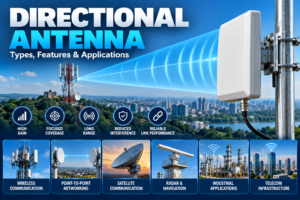
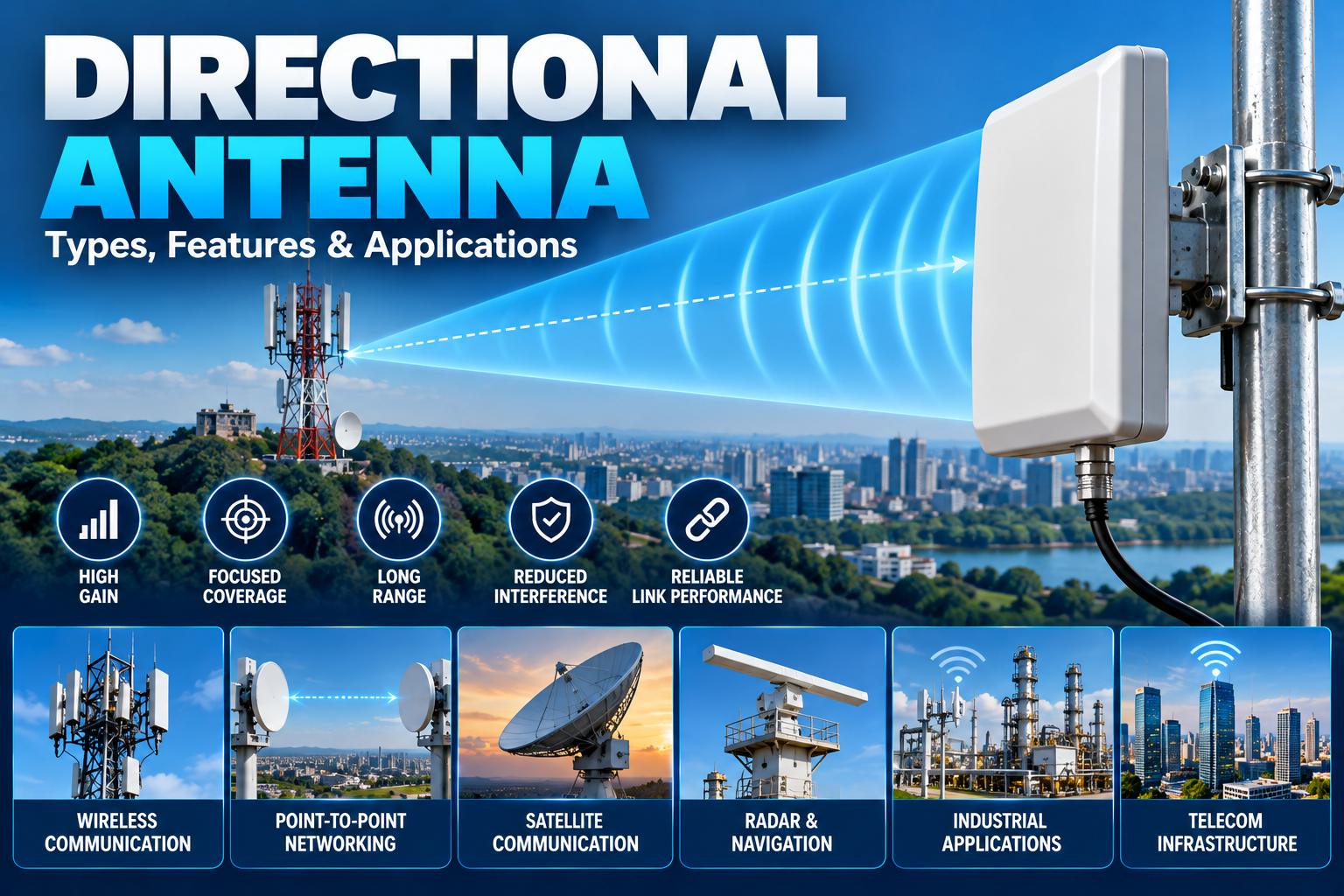
A directional antenna is a type of antenna designed to transmit or receive radio frequency (RF) signals more effectively in a specific direction rather than equally in all directions. It concentrates radio energy toward a selected area, helping improve signal strength, communication range, and wireless link reliability.
Directional antennas are widely used in wireless communication, telecom infrastructure, Wi-Fi networks, point-to-point communication, satellite systems, radar, broadcasting, and industrial wireless applications. They are particularly useful when communication must be established between specific locations or when interference from unwanted directions needs to be reduced.
Understanding directional antenna types, operating principles, specifications, and applications helps engineers and system integrators select the right antenna for their RF communication requirements.
What Is a Directional Antenna?
A Nv is an RF antenna that focuses most of its radiated or received energy toward a particular direction. Unlike an omnidirectional antenna, which generally distributes energy around the antenna in a horizontal plane, a directional antenna provides greater gain in its preferred direction.
The antenna’s design determines its radiation pattern, beamwidth, gain, polarization, and operating frequency. These characteristics influence how effectively it communicates with a distant transmitter or receiver.
Directional antennas are available in different designs, including Yagi antennas, panel antennas, parabolic dish antennas, horn antennas, and sector antennas. Each design is suitable for specific frequency ranges, coverage requirements, and installation environments.
How Does a Directional Antenna Work?
A directional antenna works by shaping electromagnetic radiation so that more energy is concentrated in a selected direction. Its physical structure and arrangement of radiating elements determine the direction and shape of the main radiation beam.
When transmitting, the antenna focuses RF energy toward the intended receiver. When receiving, it is generally more sensitive to signals arriving from its preferred direction.
The operating process involves the following steps:
- Signal generation: A radio transmitter generates an RF signal.
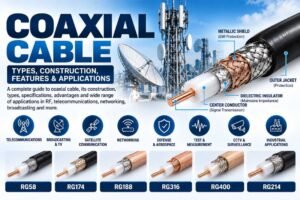
- Signal transmission: The signal travels through a coaxial cable or RF feed system to the antenna.
- Directional radiation: The antenna radiates the signal with greater energy concentrated toward the intended direction.
- Signal reception: A compatible receiving antenna captures the transmitted signal.
- Signal processing: The receiving equipment processes the captured signal.
For effective communication, the antennas must be selected for compatible frequency ranges and, where required, aligned with each other. Cable loss, obstructions, polarization mismatch, and environmental conditions can also affect performance.
Types of Directional Antennas
1. Yagi Antenna
A Yagi antenna uses a driven element along with parasitic elements, typically including a reflector and one or more directors. This structure creates a directional radiation pattern.
Yagi antennas are commonly used for television reception, telemetry, amateur radio, and selected wireless communication systems. They are useful when communication is required in a particular direction.
2. Panel Antenna
A panel antenna features a compact, flat structure designed to provide directional coverage. It is widely used in wireless networking, cellular systems, indoor coverage solutions, and outdoor communication links.
Panel antennas are available in various frequency ranges, gain levels, polarizations, and beamwidths. Their compact design makes them suitable for wall, pole, and equipment mounting.
3. Parabolic Dish Antenna
A parabolic dish antenna uses a reflector shaped like a parabola to focus RF energy. It can provide high gain and a narrow beam, making it suitable for long-distance communication.
Typical applications include satellite communication, microwave backhaul, radio astronomy, and point-to-point wireless links. Accurate alignment is important because narrow-beam antennas can be sensitive to positioning errors.
4. Horn Antenna
A horn antenna uses a flared waveguide structure to radiate or receive electromagnetic waves. It is frequently used in microwave and millimeter-wave systems, antenna testing, radar, and measurement applications.
Horn antennas offer useful directional characteristics and are often selected for laboratory testing and high-frequency RF systems.
5. Sector Antenna
A sector antenna provides directional coverage across a defined angular area, such as 60, 90, or 120 degrees, depending on the model.
Sector antennas are widely used in cellular base stations, wireless internet service provider networks, and telecom infrastructure. Multiple sector antennas can be deployed to cover different areas around a site.
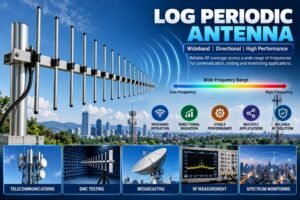
6. Log-Periodic Antenna
A log-periodic antenna is designed to operate across a relatively wide frequency range while maintaining useful directional characteristics.
It is commonly used in RF testing, electromagnetic compatibility measurements, monitoring systems, and broadband communication applications.
Key Features of Directional Antennas
Directional antennas offer several technical features that make them valuable for specialized wireless systems.
- Directional gain: Concentrates transmitted or received energy toward a preferred direction.
- Improved link performance: Can support stronger received signals when properly aligned.
- Reduced unwanted reception: May help limit signals arriving from certain unwanted directions.
- Frequency-specific designs: Available for narrowband and broadband applications.
- Different polarization options: Includes vertical, horizontal, dual, and circular polarization, depending on the antenna.
- Multiple mounting options: Available for poles, walls, towers, rooftops, and equipment enclosures.
- Different beamwidths: Supports focused point-to-point links or wider directional coverage.
Actual performance depends on the antenna’s design, installation, operating environment, and connected RF equipment.
Important Directional Antenna Specifications
Selecting a directional antenna requires evaluating its electrical and mechanical specifications.
| Specification | Description |
|---|---|
| Frequency Range | The frequencies over which the antenna is designed to operate |
| Gain | The antenna’s directional performance relative to a reference antenna |
| Beamwidth | The angular width of the main radiation beam |
| Polarization | The orientation or type of electromagnetic field |
| Impedance | Commonly 50 ohms in RF communication systems |
| VSWR | Indicates impedance matching performance |
| Return Loss | Indicates the amount of reflected RF power |
| Connector Type | The RF interface used to connect the antenna |
| Front-to-Back Ratio | Compares radiation in the forward direction with radiation behind the antenna |
| Environmental Rating | Indicates suitability for outdoor exposure, moisture, dust, or other conditions |
Specifications vary by antenna model. Engineers should review the manufacturer’s datasheet before choosing an antenna for a particular installation.
Applications of Directional Antennas
Wireless Communication
Directional antennas support wireless links between fixed locations, remote equipment, access points, and communication nodes. They are useful where signal concentration and controlled coverage are important.
Telecom Infrastructure
Telecom operators use directional and sector antennas in base stations, wireless backhaul systems, and network expansion projects. Proper antenna selection helps achieve required coverage and link performance.
Point-to-Point Networking
Directional antennas are frequently used to connect buildings, industrial facilities, campuses, and remote sites. A focused beam can help establish a reliable wireless connection over an appropriate distance.
Satellite Communication
High-gain directional antennas communicate with satellites by focusing energy toward a specific point in the sky. Dish antennas are common in satellite television, data communication, and ground station systems.
Radar and Navigation
Radar systems use directional antennas to concentrate energy and detect objects in selected directions. Directional antenna designs are also used in specialized navigation and tracking equipment.
Industrial and Remote Monitoring
Factories, utilities, transportation systems, and remote monitoring installations may use directional antennas to connect sensors, controllers, telemetry units, and wireless gateways.
Test and Measurement
Directional antennas are used in RF testing, field-strength measurements, electromagnetic compatibility testing, and antenna characterization.
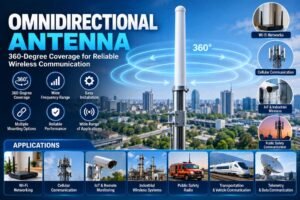
Directional Antenna vs Omnidirectional Antenna
| Feature | Directional Antenna | Omnidirectional Antenna |
|---|---|---|
| Coverage | Focused toward a selected direction | Generally covers all directions around the antenna in the horizontal plane |
| Gain | Often higher in the preferred direction | Usually lower than a comparable directional design |
| Alignment | Often requires careful positioning | Usually less critical for general surrounding coverage |
| Common Uses | Point-to-point links and focused coverage | General wireless access and broad local coverage |
| Interference Control | Can reduce reception from some unwanted directions | May receive signals from more directions |
The best choice depends on whether the system requires focused communication with a particular destination or broader coverage for multiple devices.
Advantages of Directional Antennas
Directional antennas can improve communication performance when used in suitable conditions. Their main advantages include increased gain in the preferred direction, potential improvements in link margin, better control of coverage, and reduced reception of some unwanted signals.
They can also help establish longer wireless links when sufficient antenna gain, transmitter power, receiver sensitivity, and line of sight are available. However, a directional antenna does not guarantee a particular communication distance. Actual range depends on frequency, terrain, obstructions, regulations, and the complete radio link budget.
How to Choose the Right Directional Antenna
Before purchasing a directional antenna, consider these factors:
- Operating frequency: Ensure the antenna covers the required frequency band.
- Required range: Estimate the link distance and calculate the link budget.
- Antenna gain: Select suitable gain based on the coverage and link requirements.
- Beamwidth: Choose a narrow beam for focused links or a wider beam for broader directional coverage.
- Polarization: Match the transmitting and receiving antenna polarization where possible.
- Installation environment: Consider wind loading, temperature, moisture, dust, and mounting location.
- Connector compatibility: Verify the connector type and cable interface.
- Regulatory compliance: Ensure the complete radio system complies with applicable transmission power and spectrum regulations.
Conclusion
A directional antenna is an important component in RF and wireless communication systems where focused coverage, improved directional gain, and reliable links are required. Different types, including Yagi, panel, parabolic dish, horn, sector, and log-periodic antennas, support a wide range of applications.
By evaluating frequency range, gain, beamwidth, polarization, mounting requirements, and environmental conditions, engineers can select a directional antenna suited to their system. Correct installation and alignment are essential for achieving the intended performance.
FAQs About Directional Antennas
1. What is a directional antenna?
A directional antenna is designed to transmit or receive RF signals more effectively in a particular direction rather than equally in all directions.
2. What is the main advantage of a directional antenna?
Its main advantage is increased gain in the preferred direction, which can improve wireless link performance when the antennas are correctly aligned.
3. What are the common types of directional antennas?
Common types include Yagi, panel, parabolic dish, horn, sector, and log-periodic antennas.
4. Where are directional antennas used?
They are used in telecom infrastructure, wireless networking, satellite communication, radar, point-to-point links, industrial monitoring, and RF testing.
5. What is antenna gain?
Antenna gain describes how effectively an antenna concentrates energy in a particular direction compared with a reference antenna. It is commonly expressed in dBi.
6. What is beamwidth in a directional antenna?
Beamwidth is the angular width of the antenna’s main radiation beam, often measured between the points where power drops by 3 dB from its peak.
7. Does a directional antenna increase internet speed?
It may improve wireless signal quality and link stability in suitable conditions, potentially improving network performance. Actual speed also depends on the router, network capacity, interference, and service provider.
8. Does a directional antenna need alignment?
Most directional antennas need to be aimed toward the intended communication point. Accurate alignment is particularly important for high-gain antennas with narrow beamwidths.
9. What frequency range do directional antennas support?
Directional antennas are available for many frequency bands, from lower radio frequencies through microwave and millimeter-wave ranges. The supported range depends on the specific model.
10. How do I select the right directional antenna?
Check the required frequency, gain, beamwidth, polarization, impedance, connector type, installation environment, and regulatory requirements before selecting a model.
Add an RF link-budget sectionInclude an antenna selection checklist