
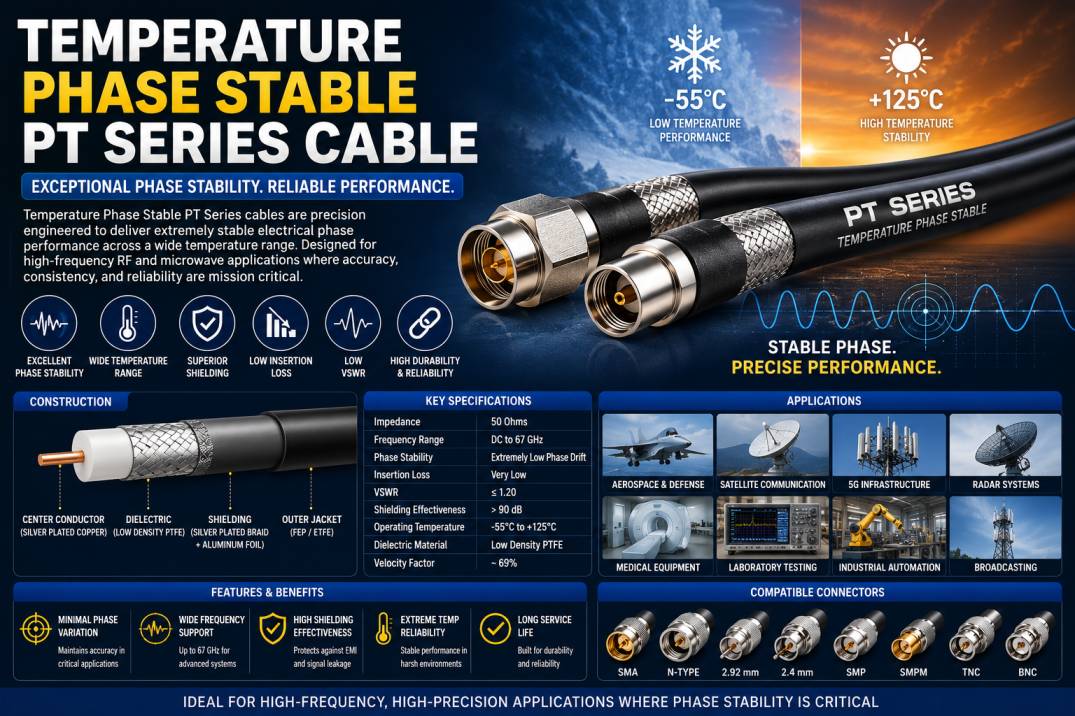
Temperature Phase Stable PT Series cables are precision-engineered RF and microwave coaxial cable assemblies specifically designed to maintain stable electrical phase performance under varying temperature conditions. In high-frequency communication systems, even minor temperature fluctuations can cause phase variations that degrade signal accuracy, synchronization, and overall system performance. PT Series cables are developed to minimize these phase changes, ensuring exceptional stability in mission-critical applications.
These cables are widely used in aerospace, defense, satellite communication, radar systems, military electronics, 5G infrastructure, laboratory testing, medical equipment, and microwave communication systems where accurate phase consistency is essential. Their advanced construction, premium dielectric materials, and low-loss conductors provide superior electrical performance across a wide frequency range.
As technologies such as 5G, 6G, autonomous vehicles, satellite internet, phased-array radar, and precision electronic warfare continue to evolve, Temperature Phase Stable PT Series cables have become indispensable components for maintaining accurate RF signal transmission.
This comprehensive guide explains everything about Temperature Phase Stable PT Series cables, including their construction, working principle, features, specifications, applications, advantages, and selection criteria.
What Is Temperature Phase Stable PT Series Cable?
Temperature Phase Stable PT Series Cable is a high-performance RF coaxial cable specifically designed to minimize electrical phase variation when exposed to changing temperatures. Unlike conventional RF cables, PT Series cables use specialized dielectric materials and precision manufacturing techniques that ensure extremely low phase drift across a broad operating temperature range.
These cables are manufactured for applications where timing accuracy, signal synchronization, and phase consistency are critical. They provide excellent electrical stability while maintaining low insertion loss, superior shielding effectiveness, and high mechanical durability.
PT Series cables are commonly available as custom cable assemblies with precision RF connectors such as SMA, N-Type, 2.92 mm, 2.4 mm, SMP, SMPM, TNC, and other high-frequency interfaces.
How Does Temperature Phase Stable PT Series Cable Work?
Temperature changes cause conventional RF cables to expand or contract, resulting in changes to the electrical length of the cable. This phenomenon creates phase drift, which can negatively affect communication systems requiring precise timing.
Temperature Phase Stable PT Series cables are designed using low-expansion dielectric materials, stable conductors, and precision shielding that significantly reduce these dimensional changes. As a result, the electrical phase remains highly stable even when operating in extremely hot or cold environments.
This phase stability is essential for radar systems, satellite communication, phased-array antennas, synchronized transmitters, and laboratory calibration equipment.
Construction of Temperature Phase Stable PT Series Cable
Center Conductor
The center conductor carries the RF signal with minimal resistance.
Common materials include:
- Silver-plated copper
- Oxygen-free copper
- Copper-clad steel
Silver plating improves conductivity while minimizing high-frequency signal loss.
Dielectric Insulation
The dielectric plays the most important role in phase stability.
Typical materials include:
- Low-density PTFE
- Expanded PTFE
- Precision fluoropolymer compounds
These materials exhibit extremely low thermal expansion.
Shielding
Multiple shielding layers protect signals from external interference.
Shield types include:
- Silver-plated copper braid
- Aluminum foil
- Double braid
- Triple shield
High shielding effectiveness minimizes EMI and signal leakage.
Outer Jacket
The outer jacket protects the cable against environmental conditions.
Common materials include:
- FEP
- ETFE
- TPE
- Polyurethane
- PVC
These jackets provide excellent resistance to abrasion, chemicals, and temperature extremes.
Key Features of Temperature Phase Stable PT Series Cable
- Excellent phase stability
- Low insertion loss
- High shielding effectiveness
- Superior mechanical flexibility
- Low VSWR
- Stable impedance
- Wide operating temperature range
- High-frequency performance
- Excellent durability
- Moisture resistance
- Long service life
- Low signal attenuation
Technical Specifications
| Specification | Typical Value |
| Characteristic Impedance | 50 Ohms |
| Frequency Range | DC to 67 GHz (depending on model) |
| Phase Stability | Extremely Low Phase Drift |
| VSWR | Less than 1.20 |
| Insertion Loss | Very Low |
| Shielding Effectiveness | Greater than 90 dB |
| Operating Temperature | -55°C to +125°C |
| Jacket Material | FEP / ETFE |
| Dielectric | Low-Density PTFE |
| Connector Types | SMA, N, 2.92 mm, SMP, TNC |
Common PT Series Cable Types
Temperature Phase Stable PT Series cables are available in multiple configurations.
Common types include:
- Flexible PT Series Cable
- Semi-Rigid PT Series Cable
- Low-Loss PT Series Cable
- High-Frequency PT Series Cable
- Phase Matched PT Series Assemblies
- Ruggedized PT Series Cable Assemblies
Frequency Range
Depending on cable construction, PT Series cables support:
- DC to 6 GHz
- DC to 12 GHz
- DC to 18 GHz
- DC to 26.5 GHz
- DC to 40 GHz
- DC to 50 GHz
- DC to 67 GHz
Advanced microwave versions can support even higher frequencies.
Common RF Connector Types
Temperature Phase Stable PT Series cables are available with:
- SMA
- N-Type
- TNC
- BNC
- 2.92 mm
- 2.4 mm
- 1.85 mm
- SMP
- SMPM
- SSMP
Applications of Temperature Phase Stable PT Series Cable
Aerospace
Aircraft communication
Navigation systems
Satellite payloads
Flight testing
Defense
Military communication
Electronic warfare
Radar systems
Missile guidance
Phased-array antennas
Satellite Communication
Ground stations
Satellite terminals
VSAT systems
Space communication
5G Infrastructure
Massive MIMO antennas
Remote radio units
Base stations
Small cells
Medical Equipment
MRI systems
RF diagnostic equipment
Imaging systems
Medical research
Industrial Automation
Precision instrumentation
Factory automation
Wireless monitoring
Industrial communication
Laboratory Testing
Network analyzers
Spectrum analyzers
Calibration laboratories
Signal generators
Oscilloscopes
Advantages of Temperature Phase Stable PT Series Cable
- Excellent temperature stability
- Minimal phase variation
- Low insertion loss
- High shielding performance
- Excellent flexibility
- Long operational life
- Superior mechanical strength
- Stable impedance
- Reliable high-frequency transmission
- High durability
- Suitable for harsh environments
- Ideal for precision RF measurements
Limitations of PT Series Cable
- Higher cost than standard RF cables
- Requires precision connectors
- Proper installation is necessary for optimal performance
- Custom assemblies may require longer lead times
How to Choose the Right Temperature Phase Stable PT Series Cable
Consider the following factors before selecting a PT Series cable:
- Operating frequency
- Required phase stability
- Connector type
- Cable flexibility
- Shielding performance
- Temperature range
- Insertion loss
- VSWR
- Installation environment
- Mechanical durability
Temperature Phase Stable PT Series vs Standard RF Cable
| Feature | PT Series Cable | Standard RF Cable |
| Phase Stability | Excellent | Moderate |
| Temperature Performance | Outstanding | Standard |
| Insertion Loss | Low | Moderate |
| Shielding | Excellent | Good |
| Frequency Capability | Very High | High |
| Signal Accuracy | Excellent | Moderate |
| Reliability | High | Good |
| Precision Applications | Ideal | Limited |
Industries Using PT Series Cable
Temperature Phase Stable PT Series cables are widely used in:
- Aerospace
- Defense
- Telecommunications
- Satellite Communication
- Medical Electronics
- Industrial Automation
- Semiconductor Manufacturing
- RF Laboratories
- Broadcasting
- Scientific Research
Maintenance Tips
To maximize cable performance:
- Avoid excessive bending
- Protect connectors from contamination
- Use recommended torque values
- Store cables in dry environments
- Perform periodic inspection
- Avoid sharp bend radii
- Clean connectors before installation
Future Trends of Temperature Phase Stable PT Series Cable
The growing demand for high-frequency communication, 5G and 6G networks, satellite internet, aerospace systems, electronic warfare, and autonomous vehicles is driving continuous innovation in Temperature Phase Stable PT Series cables. Manufacturers are introducing advanced dielectric materials, improved shielding technologies, lower insertion loss, higher frequency capabilities exceeding 100 GHz, and lighter cable constructions. These advancements enable PT Series cables to support next-generation communication systems that require exceptional phase stability, low latency, and reliable performance in challenging environments.
Conclusion
Temperature Phase Stable PT Series cables are engineered for applications where electrical phase consistency is critical. Their advanced construction, premium dielectric materials, low insertion loss, and excellent shielding performance ensure reliable signal transmission across a wide temperature range. Whether used in aerospace, defense, satellite communication, laboratory testing, or 5G infrastructure, PT Series cables provide exceptional accuracy, durability, and long-term reliability. Selecting the correct cable based on operating frequency, connector compatibility, phase stability, and environmental requirements ensures optimum performance in demanding RF and microwave systems.
Frequently Asked Questions (FAQs)
1. What is a Temperature Phase Stable PT Series cable?
A Temperature Phase Stable PT Series cable is a precision RF coaxial cable designed to maintain consistent electrical phase performance despite temperature changes.
2. Why is phase stability important in RF systems?
Phase stability ensures accurate signal timing, synchronization, and measurement, which are critical in radar, satellite communication, aerospace, and laboratory applications.
3. What industries use PT Series cables?
PT Series cables are widely used in aerospace, defense, telecommunications, satellite communication, medical equipment, industrial automation, and RF testing laboratories.
4. What frequency range do PT Series cables support?
Depending on the model, PT Series cables typically support frequencies from DC to 67 GHz, with specialized versions available for even higher frequencies.
5. What connectors are compatible with PT Series cables?
Common connector options include SMA, N-Type, TNC, BNC, 2.92 mm, 2.4 mm, 1.85 mm, SMP, SMPM, and SSMP.
6. What are the advantages of PT Series cables?
Key advantages include excellent phase stability, low insertion loss, high shielding effectiveness, wide temperature tolerance, stable impedance, and long service life.
7. Can PT Series cables be used outdoors?
Yes. With appropriate connector sealing and protective jackets, PT Series cables are suitable for outdoor and harsh environmental conditions.
8. What operating temperatures can PT Series cables withstand?
Most Temperature Phase Stable PT Series cables operate reliably from -55°C to +125°C, with some specialized versions supporting even wider ranges.
9. How do PT Series cables differ from standard RF cables?
PT Series cables are specifically designed to minimize phase drift caused by temperature changes, providing superior accuracy and stability for precision RF applications.
10. How do I choose the right Temperature Phase Stable PT Series cable?
Choose a cable based on operating frequency, required phase stability, insertion loss, connector compatibility, temperature range, shielding performance, cable flexibility, and environmental conditions.