In modern telecommunications and RF communication systems, reliable signal transmission is essential for maintaining network performance and connectivity. Coaxial cables play an important role in transmitting radio frequency signals between antennas, transmitters, receivers, communication equipment, and other RF devices.
LMR 400 Cable is a high-performance, 50-ohm coaxial cable designed for low-loss RF signal transmission. It is widely used in wireless communication systems, antenna installations, telecom infrastructure, radio frequency applications, and networking equipment.
Known for its low signal attenuation, flexible construction, excellent shielding effectiveness, and weather-resistant jacket options, LMR 400 Cable is suitable for both indoor and outdoor RF installations.
It is commonly selected for applications where better signal performance is required over longer cable runs compared with smaller-diameter coaxial cables.
Whether used in cellular communication systems, Wi-Fi networks, GPS installations, two-way radio systems, or antenna feeder assemblies, LMR 400 Cable provides a dependable solution for RF signal transmission.
What Is LMR 400 Cable?
LMR 400 Cable is a 50-ohm low-loss coaxial cable designed to transmit radio frequency signals with reduced signal attenuation.
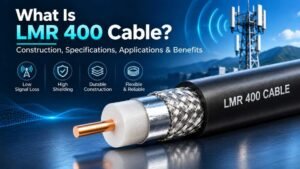
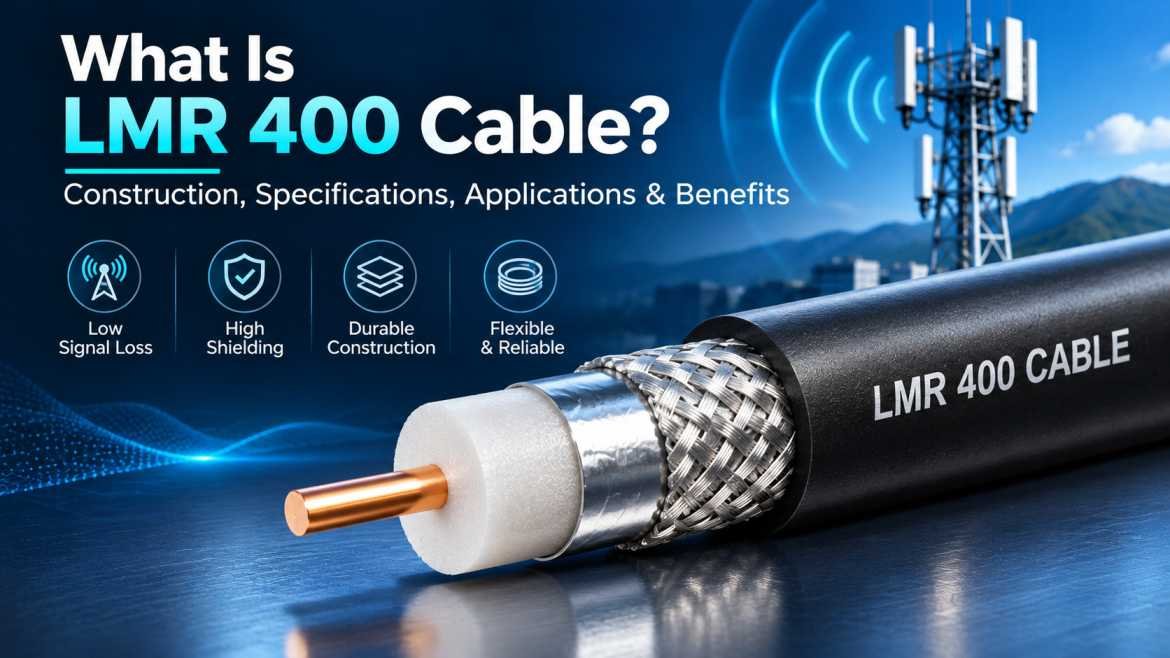
It is a type of flexible RF coaxial cable that features a solid inner conductor, foam polyethylene dielectric, aluminium foil shielding, braided shielding, and a protective outer jacket.
The cable has a nominal outer diameter of approximately 10.29 mm (0.405 inches), making it thicker than conventional RG-series coaxial cables such as RG58 and RG213.
The larger diameter and specialized construction help reduce signal loss and provide improved shielding performance.
LMR 400 Cable is commonly used for connecting antennas to radio equipment, wireless communication systems, RF transmitters, receivers, and other high-frequency devices.
The LMR® product name is associated with Times Microwave Systems. Compatible cables from other manufacturers may use similar designations, but their construction and performance specifications should be verified independently.
Construction of LMR 400 Cable
The construction of LMR 400 Cable consists of multiple layers, each designed to provide electrical performance, mechanical strength, shielding, and environmental protection.
Understanding its construction helps explain why this cable is widely used in demanding RF communication applications.
1. Inner Conductor
The inner conductor is the central component responsible for carrying RF signals through the coaxial cable.
In the standard Times Microwave LMR-400 construction, the inner conductor is solid bare copper-clad aluminium.
It provides the electrical transmission path and is designed to maintain consistent impedance throughout the cable.
2. Dielectric Insulation
The dielectric material surrounds the inner conductor and maintains the required spacing between the inner and outer conductors.
LMR 400 Cable uses foam polyethylene (Foam PE) as its dielectric material.
This low-density dielectric helps reduce electrical losses and supports efficient RF signal transmission.
3. Aluminium Foil Shielding
An aluminium tape layer provides additional shielding around the dielectric.
It helps protect the transmitted RF signal from external electromagnetic interference and contributes to the cable’s overall shielding effectiveness.
4. Tinned Copper Braided Shield
The outer braided shield is generally constructed using tinned copper.
It provides additional protection against electromagnetic interference and helps maintain electrical continuity and shielding performance.
The combination of aluminium foil and copper braid provides effective dual shielding.
5. Outer Protective Jacket
The outer jacket protects the internal cable construction from environmental conditions, mechanical damage, moisture, and abrasion.
Standard outdoor LMR-400 typically uses a black polyethylene (PE) jacket designed for UV resistance.
Other versions are available with different jacket materials for indoor, outdoor, and specialized installation requirements.
How Does LMR 400 Cable Work?
LMR 400 Cable works on the coaxial transmission principle, where RF signals travel through the inner conductor while the outer conductor acts as the return path and electromagnetic shield.
The inner conductor and outer shielding are separated by a dielectric material that maintains the required electrical characteristics.
When an RF signal enters the cable, electromagnetic energy travels along the transmission line.
The coaxial construction helps contain the electromagnetic field within the cable, reducing unwanted radiation and external interference.
The 50-ohm characteristic impedance allows the cable to operate efficiently with compatible RF equipment.
For reliable performance, the cable impedance should match the connected equipment and antenna system.
Proper impedance matching helps minimize signal reflections, reduce VSWR, and improve overall transmission efficiency.
Key Features of LMR 400 Cable
LMR 400 Cable offers several important features that make it suitable for professional RF and communication applications.
1. Low Signal Attenuation
One of the main advantages of LMR 400 Cable is its relatively low signal attenuation compared with smaller-diameter coaxial cables.
Lower attenuation helps maintain stronger RF signals over longer cable runs.
2. 50-Ohm Characteristic Impedance
LMR 400 Cable is designed with a nominal characteristic impedance of 50 ohms.
This makes it compatible with a wide range of RF communication equipment, antennas, transmitters, and receivers designed for 50-ohm systems.
3. Dual Shielding Construction
The combination of aluminium foil and tinned copper braid provides effective shielding against external electromagnetic interference.
It also helps minimize unwanted RF signal leakage.
4. Flexible Cable Design
Despite its relatively large diameter, LMR 400 Cable is designed to provide practical flexibility for antenna feeder installations and RF cable assemblies.
Its bending characteristics make it easier to route compared with some rigid coaxial cable designs.
5. UV-Resistant Outdoor Jacket
Standard outdoor versions feature a polyethylene jacket designed to withstand outdoor exposure and UV radiation.
This makes the cable suitable for antenna installations and outdoor wireless communication systems.
6. Reliable Mechanical Performance
The cable construction provides a combination of tensile strength, crush resistance, and mechanical durability for suitable installation environments.
7. Wide Application Compatibility
LMR 400 Cable can be used with various RF connectors and cable assembly configurations, depending on the connector interface and installation requirements.
Technical Specifications of LMR 400 Cable
The technical specifications of LMR 400 Cable are important for determining its suitability for different RF communication applications.
The following specifications are based on the standard Times Microwave LMR-400 cable. Specifications may vary between manufacturers and compatible alternatives.
| Specification | Details |
|---|---|
| Product Type | Low-Loss RF Coaxial Cable |
| Cable Model | LMR-400 |
| Characteristic Impedance | 50 Ohms |
| Overall Diameter | 10.29 mm (0.405 inches) |
| Inner Conductor | Solid Bare Copper-Clad Aluminium |
| Inner Conductor Diameter | 2.74 mm (0.108 inches) |
| Dielectric Material | Foam Polyethylene (Foam PE) |
| Dielectric Diameter | 7.24 mm (0.285 inches) |
| Outer Shield | Aluminium Foil |
| Overall Braid | Tinned Copper |
| Jacket Material | Polyethylene (PE) |
| Jacket Colour | Black |
| Velocity of Propagation | Approximately 84–85% |
| Capacitance | 23.9 pF/ft (78.4 pF/m) |
| Inductance | 0.060 µH/ft (0.20 µH/m) |
| Shielding Effectiveness | Greater than 90 dB |
| Weight | Approximately 0.10 kg/m |
| Minimum Installation Bend Radius | 25.4 mm |
| Operating Temperature | -40°C to +85°C |
| Voltage Withstand | 2500 V DC |
| Application | RF, Telecom, Wireless Communication and Antenna Systems |
Note: Always verify the exact manufacturer’s datasheet before using these specifications for product selection or engineering applications.
LMR 400 Cable Attenuation Characteristics
Attenuation is one of the most important parameters when selecting an RF coaxial cable.
It refers to the reduction in signal power as an RF signal travels through the cable. Attenuation is generally measured in decibels (dB) per unit length.
LMR 400 Cable is designed to provide relatively low attenuation, making it suitable for RF applications requiring longer cable runs.
However, signal attenuation increases with frequency. Higher-frequency signals generally experience greater losses than lower-frequency signals.
The following table provides typical attenuation values for standard Times Microwave LMR-400.
| Frequency | Attenuation (dB/100 ft) | Attenuation (dB/100 m) |
|---|---|---|
| 30 MHz | 0.7 | 2.2 |
| 50 MHz | 0.9 | 2.9 |
| 150 MHz | 1.5 | 5.0 |
| 220 MHz | 1.9 | 6.1 |
| 450 MHz | 2.7 | 8.9 |
| 900 MHz | 3.9 | 12.8 |
| 1500 MHz | 5.1 | 16.8 |
| 1800 MHz | 5.7 | 18.6 |
| 2000 MHz | 6.0 | 19.6 |
| 2500 MHz | 6.8 | 22.2 |
| 5800 MHz | 10.8 | 35.5 |
These values are typical manufacturer-published figures under specified test conditions. Actual cable loss can vary with frequency, cable length, temperature, manufacturing tolerances, and connector losses.
Types and Variants of LMR 400 Cable
LMR 400 Cable is available in different versions to meet the requirements of indoor, outdoor, and specialized RF installations.
1. Standard LMR 400 Cable
Standard LMR 400 Cable is designed for outdoor RF communication and antenna feeder applications.
It generally features a black polyethylene outer jacket that provides UV resistance and environmental protection.
Key Features:
- 50-ohm characteristic impedance.
- Low-loss coaxial construction.
- Foam polyethylene dielectric.
- Dual shielding construction.
- UV-resistant outdoor jacket.
- Suitable for antenna feeder assemblies.
2. LMR 400-DB Cable
LMR 400-DB is a watertight version designed for applications requiring additional moisture protection.
It is suitable for outdoor installations where water penetration and environmental exposure are important considerations.
Key Features:
- Watertight cable construction.
- Suitable for outdoor installations.
- 50-ohm impedance.
- Designed for moisture-resistant applications.
- Useful for demanding antenna feeder installations.
3. LMR 400-FR Cable
LMR 400-FR is a fire-retardant version designed for indoor and outdoor applications requiring suitable fire-performance characteristics.
It is commonly considered for building communication infrastructure and other installations where applicable fire-safety requirements must be met.
Key Features:
- Fire-retardant jacket construction.
- Suitable for specified indoor and outdoor installations.
- Low-loss RF performance.
- Designed for communication infrastructure.
4. LMR 400-PVC Cable
LMR 400-PVC uses a PVC outer jacket and is designed for general-purpose installations where PVC jacket characteristics are preferred.
Key Features:
- PVC protective jacket.
- Suitable for specified general-purpose applications.
- 50-ohm impedance.
- Flexible coaxial construction.
Note: Exact availability, jacket construction, fire ratings, and environmental performance depend on the manufacturer’s product variant.
Applications of LMR 400 Cable
LMR 400 Cable is widely used in RF and telecommunications infrastructure because of its low-loss performance, effective shielding, and mechanical construction.
1. Wireless Communication Systems
LMR 400 Cable is commonly used in wireless communication systems to connect antennas with transmitters, receivers, and radio equipment.
Its low-loss characteristics help reduce signal degradation in antenna feeder installations.
2. Cellular and Telecom Infrastructure
Telecommunication networks require reliable RF connections between antennas and communication equipment.
LMR 400 Cable is used in suitable cellular infrastructure applications, wireless base stations, and antenna distribution systems.
3. Wi-Fi and WLAN Systems
Wireless networking installations may use LMR 400 Cable to connect external antennas with wireless access points and RF equipment.
It is suitable for installations where cable length and RF signal loss need careful consideration.
4. GPS and GNSS Antenna Systems
GPS and GNSS installations use coaxial cables to connect antennas with receivers.
LMR 400 Cable can be used in compatible antenna systems where its attenuation and connector characteristics meet the application requirements.
5. Two-Way Radio Communication
Professional radio systems, mobile radio installations, and fixed communication stations use coaxial cables for antenna connections.
LMR 400 Cable provides a suitable transmission solution for compatible 50-ohm radio systems.
6. Radio Frequency Testing
RF testing laboratories use coaxial cables to connect antennas, signal generators, amplifiers, and other RF measurement equipment.
LMR 400 Cable is useful where a balance between low attenuation, shielding, and flexibility is required.
7. Public Safety and Emergency Communication
Emergency communication systems, including compatible public safety radio networks, require reliable RF transmission between antennas and communication equipment.
LMR 400 Cable can support these applications when selected according to the required frequency, power, and environmental specifications.
8. SCADA and Industrial Communication
Industrial communication systems use RF links for remote monitoring, telemetry, and control applications.
LMR 400 Cable can provide suitable RF connectivity between antennas and communication devices in compatible installations.
Benefits of Using LMR 400 Cable
LMR 400 Cable offers several advantages for RF engineers, telecom operators, system integrators, and communication infrastructure providers.
1. Reduced RF Signal Loss
Its low-loss coaxial construction helps reduce signal attenuation compared with many smaller coaxial cables.
2. Improved Shielding Performance
The combination of aluminium foil and braided shielding helps protect RF signals from external interference.
3. Suitable for Outdoor Installations
Standard PE-jacketed versions are designed for outdoor applications and provide UV-resistant protection.
4. Reliable Signal Transmission
The 50-ohm impedance supports compatibility with standard RF communication equipment designed for this impedance.
5. Mechanical Strength
The cable construction provides suitable mechanical durability for professional antenna feeder and communication installations.
6. Flexible Installation
Its flexible coaxial design supports practical routing in telecom towers, equipment rooms, antenna systems, and other RF installations.
7. Wide Connector Compatibility
LMR 400 Cable can be terminated with suitable RF connectors, including N-Type, SMA, TNC, and other compatible connector interfaces.
The exact connector must be selected according to the cable dimensions, frequency range, and termination method.
LMR 400 Cable vs RG 58 Cable
LMR 400 Cable and RG58 Cable are both 50-ohm coaxial cables, but they differ in diameter, construction, attenuation, and applications.
| Parameter | LMR 400 Cable | RG 58 Cable |
|---|---|---|
| Characteristic Impedance | 50 Ohms | 50 Ohms |
| Overall Diameter | Approximately 10.29 mm | Approximately 5 mm |
| Construction | Foam PE dielectric with dual shielding | Construction varies by manufacturer |
| Signal Attenuation | Lower | Generally higher |
| Shielding | Aluminium foil and braided shield | Typically braided shielding |
| Flexibility | Flexible but thicker | More flexible and thinner |
| Weight | Approximately 0.10 kg/m | Generally lighter |
| Applications | Antenna feeders and low-loss RF connections | Short RF connections and equipment wiring |
Which One Should You Choose?
Choose LMR 400 Cable when lower signal attenuation and improved shielding are important, particularly for longer antenna feeder connections.
RG58 is more suitable for shorter cable runs and applications where smaller diameter and greater routing flexibility are preferred.
LMR 400 Cable vs LMR 600 Cable
LMR 400 and LMR 600 are popular low-loss coaxial cables used in professional RF and telecommunications applications.
Both are designed for 50-ohm systems, but they differ in cable diameter, attenuation, weight, and installation requirements.
| Parameter | LMR 400 | LMR 600 |
|---|---|---|
| Characteristic Impedance | 50 Ohms | 50 Ohms |
| Overall Diameter | 10.29 mm | Approximately 15.0 mm |
| Signal Attenuation | Low | Generally lower |
| Cable Weight | Approximately 0.10 kg/m | Higher |
| Installation Space | Moderate | Requires more space |
| Flexibility | Easier routing than larger cable | Larger bending requirements |
| Applications | Wireless systems and antenna feeders | Longer RF feeder runs and higher-performance installations |
Which Cable Is Better?
LMR 400 is a practical choice for installations requiring a balance between signal performance, cable size, and flexibility.
LMR 600 may be more suitable for applications requiring lower signal attenuation over longer cable distances, provided the installation can accommodate its larger diameter and bending requirements.
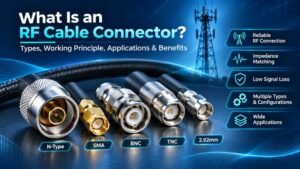
Common RF Connectors Used with LMR 400 Cable
LMR 400 Cable can be used with different RF connectors depending on the application and equipment interface.
Some commonly used connector types include:
1. N-Type Connectors
N-Type connectors are commonly used in outdoor antenna installations, wireless communication systems, and RF transmission equipment.
They are available in different configurations suitable for LMR 400 cable termination.
2. SMA Connectors
SMA connectors are widely used in RF equipment, wireless devices, test instruments, and antenna assemblies.
Compatible SMA connectors can be used for LMR 400 cable assemblies where the connector design supports the cable diameter.
3. TNC Connectors
TNC connectors feature a threaded coupling mechanism and are used in wireless communication equipment, antennas, and RF applications.
4. Reverse Polarity SMA Connectors
RP-SMA connectors are commonly used in certain Wi-Fi equipment, wireless antennas, and networking devices.
The correct RP-SMA connector should be selected according to the required gender and cable termination specifications.
What Is an LMR 400 Cable Assembly?
An LMR 400 Cable Assembly is a finished coaxial cable manufactured by terminating LMR 400 cable with suitable RF connectors at one or both ends.
These assemblies are used to establish RF connections between antennas, communication equipment, transmitters, receivers, and other RF devices.
A typical LMR 400 Cable Assembly consists of:
- LMR 400 low-loss coaxial cable.
- RF connectors such as N-Type, SMA, or TNC.
- Connector termination using a suitable crimp, clamp, or other specified method.
- Protective heat-shrink tubing, where required.
- Specified cable length.
- Electrical testing and inspection.
Cable assemblies can be manufactured in customized lengths and connector configurations depending on the application.
Important parameters such as insertion loss, VSWR, continuity, and connector termination quality should be verified during assembly testing.
Factors to Consider When Selecting LMR 400 Cable
Selecting the right LMR 400 Cable is important for achieving reliable RF signal transmission and long-term installation performance.
Consider the following factors before purchasing:
1. Operating Frequency
Check the frequency range of your RF system and confirm that the selected cable meets the required attenuation and electrical performance specifications.
2. Cable Length
Determine the required cable length carefully. Longer cable runs introduce greater signal attenuation, so calculate the expected cable loss before installation.
3. Characteristic Impedance
Ensure that the cable has a 50-ohm characteristic impedance when used with standard 50-ohm RF equipment.
4. Connector Compatibility
Select connectors compatible with the LMR 400 cable diameter and the interface requirements of your equipment.
5. Shielding Effectiveness
Check the cable shielding construction and specifications to ensure suitable protection against external electromagnetic interference.
6. Environmental Conditions
For outdoor applications, select an appropriate UV-resistant and moisture-resistant jacket configuration.
7. Power Handling Capacity
Verify the cable’s power rating at the actual operating frequency, ambient temperature, installation conditions, and VSWR.
Power-handling capacity decreases as frequency increases and depends on the cable’s thermal and electrical operating conditions.
8. Minimum Bending Radius
Follow the manufacturer’s minimum bending radius to avoid damaging the inner conductor, dielectric, or shielding layers.
9. Manufacturer and Quality
Purchase from reliable manufacturers and suppliers. Verify the datasheet, construction details, electrical performance, and quality certifications where applicable.
Installation and Maintenance Guidelines for LMR 400 Cable
Proper installation and maintenance are important for ensuring the performance and service life of LMR 400 Cable.
Follow these recommendations:
- Avoid bending the cable below its specified minimum bend radius.
- Use compatible RF connectors designed for LMR 400 cable.
- Follow the recommended connector installation procedure.
- Avoid excessive pulling, twisting, and crushing.
- Use suitable weatherproofing methods for outdoor connector joints.
- Protect exposed cable sections from mechanical damage.
- Maintain proper grounding and bonding according to the installation design.
- Inspect connectors regularly for corrosion or damage.
- Verify continuity and VSWR after installation.
- Use suitable cable supports and clamps to prevent unnecessary mechanical stress.
Following these practices helps maintain reliable RF connectivity and reduces the possibility of cable-related signal degradation.
Why Is LMR 400 Cable Important in Modern Telecom Infrastructure?
Modern telecommunications systems require dependable RF transmission between antennas and communication equipment.
With the growth of wireless broadband, cellular communication, Wi-Fi networks, industrial wireless systems, and critical communication infrastructure, selecting suitable coaxial cables has become increasingly important.
LMR 400 Cable provides an effective solution for applications requiring low attenuation, good shielding, and reliable mechanical performance.
Its combination of 50-ohm impedance, foam polyethylene dielectric, dual shielding, and protective jacket makes it a widely used option for professional RF installations.
For telecom operators, RF engineers, system integrators, and communication equipment manufacturers, LMR 400 Cable offers a practical solution for maintaining efficient signal transmission.
Conclusion
LMR 400 Cable is a high-performance, 50-ohm low-loss coaxial cable designed for reliable RF signal transmission in telecommunications, wireless communication, antenna systems, and other high-frequency applications.
Its solid inner conductor, foam polyethylene dielectric, aluminium foil shielding, tinned copper braid, and protective outer jacket provide a combination of electrical performance, shielding effectiveness, and mechanical durability.
Available in different jacket configurations and compatible with various RF connector types, LMR 400 Cable is suitable for a wide range of indoor and outdoor communication installations.
When selecting LMR 400 Cable, it is important to consider operating frequency, cable length, attenuation, connector compatibility, power handling, shielding performance, and environmental requirements.
Choosing the correct coaxial cable helps improve RF system performance, minimize signal losses, and establish reliable communication infrastructure.
Frequently Asked Questions (FAQs)
1. What is LMR 400 Cable used for?
LMR 400 Cable is used for RF signal transmission in wireless communication systems, telecom infrastructure, antenna feeder assemblies, GPS installations, Wi-Fi networks, two-way radios, and RF testing applications.
2. What is the impedance of LMR 400 Cable?
LMR 400 Cable has a nominal characteristic impedance of 50 ohms, making it suitable for standard 50-ohm RF communication equipment.
3. What is the diameter of LMR 400 Cable?
The standard Times Microwave LMR-400 cable has an overall diameter of approximately 10.29 mm or 0.405 inches.
4. Is LMR 400 Cable suitable for outdoor use?
Yes. Standard LMR-400 with a polyethylene jacket is designed for outdoor applications and provides UV-resistant protection. Other variants are available for specialized installation requirements.
5. What is the difference between LMR 400 and RG58 Cable?
LMR 400 has a larger diameter and generally lower signal attenuation than RG58. It is suitable for longer RF cable runs, while RG58 is commonly used for shorter connections and applications requiring a smaller cable diameter.
6. What is the maximum frequency of LMR 400 Cable?
The standard Times Microwave product specifications list a maximum frequency of 8 GHz. Actual suitability depends on the required attenuation, return loss, and complete system performance at the operating frequency.
7. Which connectors are compatible with LMR 400 Cable?
Compatible connector options include N-Type, SMA, TNC, and other RF connector configurations specifically designed for the cable’s dimensions and termination requirements.
8. What is the attenuation of LMR 400 Cable?
Attenuation depends on operating frequency and cable length. For standard LMR-400, typical attenuation is approximately 3.9 dB per 100 feet at 900 MHz and 6.8 dB per 100 feet at 2500 MHz.
9. What is the difference between LMR 400 and LMR 600 Cable?
LMR 600 has a larger diameter and generally lower attenuation than LMR 400. LMR 400 offers a smaller and easier-to-route design, while LMR 600 is often selected for longer cable runs requiring reduced signal loss.
10. Can LMR 400 Cable be used for 5G applications?
Yes. LMR 400 Cable can be used in suitable 5G-related RF applications where its frequency response, attenuation, power handling, and connector specifications meet the system requirements.
SEO Keywords
Primary Keyword:
- LMR 400 Cable
Secondary Keywords:
- LMR 400 Coaxial Cable
- LMR 400 RF Cable
- LMR 400 Low Loss Cable
- 50 Ohm Coaxial Cable
- LMR 400 Antenna Cable
- LMR 400 Outdoor Cable
- LMR 400 Cable Assembly
- Low Loss RF Coaxial Cable
- LMR 400 Feeder Cable
Long-Tail Keywords:
- What is LMR 400 Cable?
- LMR 400 Cable specifications
- LMR 400 Cable attenuation
- LMR 400 Cable applications
- LMR 400 Cable construction
- LMR 400 vs RG58 Cable
- LMR 400 vs LMR 600 Cable
- LMR 400 Cable for antenna installation
- LMR 400 Cable for wireless communication
- LMR 400 Cable connector types
- 50 Ohm LMR 400 Coaxial Cable
- LMR 400 Low Loss RF Cable for Telecom
Suggested Internal Linking Opportunities for SRFS Teleinfra
To improve topical relevance and strengthen internal SEO, link this article to related product categories and technical resources available on the SRFS Teleinfra website:
- RF Cable Assemblies
- LMR 200 Cable
- LMR 400 Cable Assemblies
- LMR 600 Cable
- N-Type RF Connectors
- SMA Connectors
- RF Coaxial Adapters
- Antenna Feeder Cables
- Low Loss RF Cables
- Telecom and Wireless Communication Components
Use descriptive anchor text such as “LMR 400 Cable Assembly”, “Low Loss RF Cable”, and “N-Type Connectors” when creating internal links.