
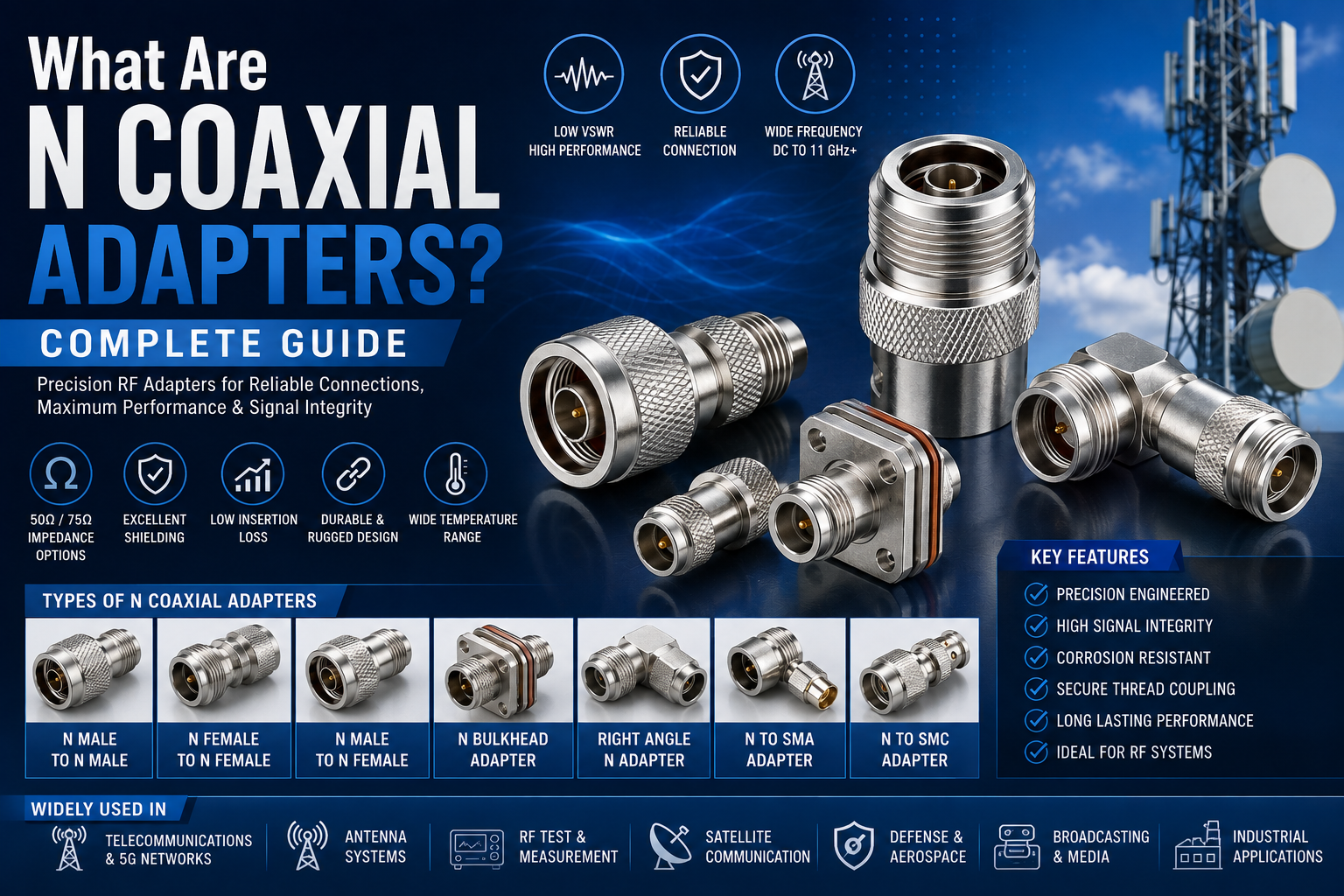
N Coaxial Adapters are precision-engineered RF components used to connect coaxial cables, connectors, antennas, and RF equipment that have different N-Type interfaces or connector configurations. They provide a reliable mechanical and electrical connection while maintaining the required impedance, signal integrity, and RF performance.
The N-Type connector is one of the most widely used coaxial connector families for telecommunications, wireless communication, antenna systems, RF testing, broadcast infrastructure, radar, and industrial applications. N Coaxial Adapters are designed to extend the flexibility of these systems by allowing two compatible or different connector interfaces to be interconnected.
Most N-Type RF systems use a 50 Ohm impedance, although 75 Ohm versions are also available for specific applications. The adapter must match the impedance and frequency requirements of the system to minimize signal reflections, insertion loss, and VSWR.
High-quality N Coaxial Adapters are manufactured using precision-machined conductive materials and high-performance dielectric materials. Depending on the application, they can be supplied with nickel-plated, gold-plated, or other protective finishes for improved durability and corrosion resistance.
Why Are N Coaxial Adapters Important?
RF systems frequently contain components from different manufacturers or equipment with different connector genders and configurations. Direct connection is not always possible.
N Coaxial Adapters solve this problem by providing an interface between two connectors.
They help:
- Connect different N-Type connector configurations
- Convert connector gender
- Connect RF cables to antennas
- Interface test equipment with coaxial cables
- Extend RF system flexibility
- Maintain impedance matching
- Reduce signal reflections
- Support reliable RF transmission
- Simplify equipment installation and maintenance
A properly designed N Coaxial Adapter provides a mechanically secure connection while maintaining the electrical characteristics required by the RF system.
How Do N Coaxial Adapters Work?
An N Coaxial Adapter creates an electrical path between two coaxial interfaces. The adapter contains a center conductor, dielectric insulator, outer conductor, and connector interface.
The center conductor carries the RF signal, while the outer conductor provides the return path and electromagnetic shielding.
When the adapter is correctly matched to the system impedance, the transition between the two connectors can be achieved with minimal electrical discontinuity.
The performance of an N Coaxial Adapter depends on:
- Connector design
- Impedance
- Operating frequency
- Materials
- Contact quality
- Manufacturing precision
- VSWR
- Insertion loss
- Return loss
- Shielding effectiveness
Main Types of N Coaxial Adapters
N Coaxial Adapters are available in several configurations to meet different RF system requirements.
N Male to N Male Adapter
An N Male to N Male adapter has male N-Type interfaces on both ends. It is commonly used when two female N-Type connectors need to be connected together.
Typical applications include RF cable interconnection, antenna systems, test setups, and telecommunications equipment.
N Female to N Female Adapter
An N Female to N Female adapter provides two female N-Type interfaces. It is useful when two male N-Type connectors need to be interconnected.
These adapters are frequently used for RF cable extensions and equipment interconnection.
N Male to N Female Adapter
An N Male to N Female adapter connects an N-Type male connector to an N-Type female connector.
This configuration is useful when equipment and cable assemblies have opposite connector genders.
N Bulkhead Adapter
N Bulkhead Adapters are designed for panel or enclosure mounting. They allow an RF connection to pass through a panel while maintaining a secure coaxial interface.
They are commonly used in:
- RF enclosures
- Communication cabinets
- Test equipment
- Antenna systems
- Outdoor equipment
- Network infrastructure
Right-Angle N Adapter
A Right-Angle N Adapter changes the direction of the RF connection by approximately 90 degrees.
These adapters are particularly useful where installation space is limited or where a straight connector would create excessive cable bending.
N Flange Adapter
N Flange Adapters are designed for mounting applications where mechanical fastening is required.
They can be used in RF equipment, antenna assemblies, test fixtures, and specialized communication systems.
N to SMA Adapter
N to SMA Adapters allow N-Type equipment to connect with SMA-based RF components.
They are commonly used in RF testing, wireless systems, antennas, modules, and laboratory equipment.
N to TNC Adapter
N to TNC Adapters provide an interface between N-Type and TNC connectors.
They are useful when integrating different RF components within communication and instrumentation systems.
N to BNC Adapter
N to BNC Adapters allow N-Type equipment to interface with BNC connectors.
They can be used in RF laboratories, test equipment, broadcast systems, and instrumentation applications where the two connector families need to be interconnected.
50 Ohm N Coaxial Adapters
50 Ohm N Coaxial Adapters are widely used in RF and microwave communication systems.
Common applications include:
- Cellular networks
- Wireless communication
- RF amplifiers
- Base stations
- Antenna systems
- Test equipment
- Radar systems
- Satellite communication
- Industrial RF systems
50 Ohm adapters are designed to maintain the impedance environment used by most N-Type RF systems.
75 Ohm N Coaxial Adapters
75 Ohm N-Type adapters are used in applications where the system requires 75 Ohm impedance.
They may be used in:
- Broadcast systems
- Video distribution
- CATV infrastructure
- Television systems
- Broadband networks
It is important to match the adapter impedance to the rest of the RF system.
Key Components of an N Coaxial Adapter
An N Coaxial Adapter consists of several precision components.
Center Contact
The center contact carries the RF signal between the two interfaces.
It is typically manufactured from a highly conductive material and may include protective plating.
Dielectric Insulator
The dielectric separates the center conductor from the outer conductor while maintaining the required electrical characteristics.
PTFE and other low-loss dielectric materials are commonly used.
Outer Conductor
The outer conductor provides electrical grounding and RF shielding.
It also contributes to the mechanical strength of the connector.
Connector Body
The connector body provides mechanical protection and supports the internal components.
Brass and stainless steel are commonly used materials.
Coupling Mechanism
The coupling mechanism secures the adapter to the mating connector and helps maintain reliable electrical contact.
Important Specifications of N Coaxial Adapters
When selecting an N Coaxial Adapter, several specifications should be evaluated.
Connector Type
Identify the required connector configuration, such as:
- N Male
- N Female
- N Male to N Female
- N Male to N Male
- N Female to N Female
- N to SMA
- N to BNC
- N to TNC
Impedance
Common impedance options include:
- 50 Ohm
- 75 Ohm
The impedance must match the RF system whenever possible.
Frequency Range
The adapter should support the operating frequency of the application.
Standard N-Type components can support frequencies into the GHz range, while specialized designs can offer higher-frequency performance.
VSWR
Voltage Standing Wave Ratio indicates how well the adapter maintains impedance matching.
Lower VSWR generally indicates better RF performance.
Insertion Loss
Insertion loss represents the amount of signal power lost when the adapter is inserted into the RF path.
A high-quality adapter should provide low insertion loss.
Return Loss
Return loss indicates the amount of signal reflected back toward the source.
Higher return loss generally represents better impedance matching.
Material
Common materials include:
- Brass
- Stainless steel
- Copper alloys
- PTFE
- Other RF-grade dielectric materials
Plating
Common surface finishes include:
- Nickel plating
- Gold plating
- Silver plating
- Passivated stainless steel
The appropriate finish depends on electrical, environmental, and mechanical requirements.
Advantages of N Coaxial Adapters
N Coaxial Adapters provide several important advantages in RF systems.
Reliable RF Connectivity
Precision manufacturing provides stable electrical contact and reliable signal transmission.
Excellent Mechanical Strength
The N-Type interface provides a robust threaded connection suitable for demanding environments.
Good Environmental Performance
Many N adapters are designed for outdoor and industrial applications where vibration, temperature variation, and moisture can be present.
Impedance Matching
Correctly specified adapters help maintain the impedance of the RF transmission system.
Easy Installation
Threaded N-Type interfaces allow secure installation without specialized locking mechanisms.
Versatile Compatibility
N adapters are available in many configurations, making it easier to connect different RF components.
Long Service Life
High-quality materials and protective plating can provide excellent resistance to mechanical wear and corrosion.
Applications of N Coaxial Adapters
N Coaxial Adapters are used across numerous industries.
Telecommunications
They are widely used in cellular infrastructure, base stations, RF distribution systems, and wireless communication networks.
Antenna Systems
N adapters are commonly used to connect coaxial cables to antennas and other RF antenna components.
4G and 5G Networks
N-Type interfaces are widely used in outdoor wireless infrastructure, including RF feeder systems, antennas, and related equipment.
RF Test and Measurement
Laboratories use N adapters to connect:
- Signal generators
- Spectrum analyzers
- Network analyzers
- Power meters
- RF amplifiers
- Test cables
Defense and Aerospace
N Coaxial Adapters can be used in RF communication, radar, electronic systems, and test equipment.
Broadcasting
They are used for RF signal distribution and communication equipment.
Satellite Communication
N-Type interfaces and adapters can be used in selected satellite and ground communication systems.
Industrial Applications
Industrial RF equipment may use N adapters for monitoring, communication, instrumentation, and wireless connectivity.
Wireless Networking
N adapters can be used with external antennas, wireless access equipment, and RF networking systems.
N Coaxial Adapters for 5G and Wireless Infrastructure
Modern wireless networks require reliable RF connectivity and low-loss signal paths.
N-Type interfaces remain useful in many outdoor wireless infrastructure applications because of their robust mechanical construction and environmental capabilities.
N Coaxial Adapters can help connect:
- Antenna feeder cables
- RF modules
- Surge protection devices
- Antenna ports
- RF test equipment
- Cable assemblies
- Wireless communication hardware
For high-frequency 5G applications, however, the adapter must be selected according to the exact frequency range and RF performance requirements of the system.
N Coaxial Adapters and Signal Integrity
Signal integrity is one of the most important considerations in RF systems.
Every connector transition can introduce a small amount of discontinuity. Poorly designed adapters may increase:
- Insertion loss
- Return loss
- VSWR
- Signal reflection
- Interference
Precision N Coaxial Adapters minimize these unwanted effects by maintaining controlled geometry and high-quality electrical contacts.
N Coaxial Adapters and VSWR
VSWR is an important RF parameter used to evaluate impedance matching.
An adapter with poor impedance matching can cause a portion of the RF signal to reflect toward the source.
This can reduce system efficiency and affect measurement accuracy.
High-quality N adapters are designed with controlled dimensions to provide low VSWR over their specified operating frequency range.
N Coaxial Adapters for Outdoor Applications
N-Type connectors are particularly popular in outdoor RF infrastructure because their threaded coupling mechanism provides a secure mechanical connection.
For outdoor applications, adapters may require:
- Weather-resistant construction
- Corrosion-resistant plating
- Robust mechanical design
- Sealing provisions
- Wide temperature capability
- UV-resistant components
- Stable RF performance
For outdoor installations, the complete connector assembly should be properly protected against moisture and environmental exposure.
How to Choose the Right N Coaxial Adapter
Selecting the right adapter requires evaluating the complete RF system.
Step 1: Identify the Connector Interfaces
Determine the connector type and gender at both ends.
Step 2: Check Impedance
Confirm whether the system requires 50 Ohm or 75 Ohm impedance.
Step 3: Check Frequency
Select an adapter rated for the complete operating frequency range.
Step 4: Evaluate VSWR
Choose a low-VSWR design when signal integrity is critical.
Step 5: Check Insertion Loss
For high-frequency and low-power systems, even small losses can matter.
Step 6: Consider the Environment
For outdoor applications, select corrosion-resistant and weather-resistant construction.
Step 7: Check Mechanical Requirements
Consider straight, right-angle, bulkhead, flange, or other configurations depending on the installation.
Common Mistakes When Selecting N Coaxial Adapters
Several mistakes can negatively affect RF performance.
Using the Wrong Impedance
A 50 Ohm adapter should not automatically be substituted for a 75 Ohm component.
Ignoring Frequency Rating
An adapter suitable for a lower-frequency application may not provide the required performance at higher frequencies.
Choosing Only by Connector Gender
Connector gender is important, but it is not the only selection factor.
Ignoring VSWR
For high-performance RF systems, VSWR should be considered alongside mechanical compatibility.
Using Poor-Quality Materials
Low-quality materials and poor plating can increase contact resistance and reduce durability.
Incorrect Installation
Over-tightening, cross-threading, contamination, or damaged mating surfaces can affect connector performance.
N Coaxial Adapter vs N Connector
An N connector is normally used as an interface on a cable, antenna, or equipment port.
An N Coaxial Adapter is used to connect two interfaces or convert between different connector configurations.
For example, an N Male to N Female adapter can connect two components that otherwise cannot be directly connected because of their connector configuration.
N Coaxial Adapter vs N Cable Assembly
An N cable assembly consists of a coaxial cable fitted with N-Type connectors.
An N Coaxial Adapter is a separate interconnection component used between connectors.
Both are important in RF systems, but they serve different purposes.
Quality Standards for N Coaxial Adapters
High-quality N adapters should be manufactured using controlled mechanical dimensions and appropriate RF materials.
Important quality considerations include:
- Dimensional accuracy
- Connector interface compatibility
- Impedance consistency
- Low VSWR
- Low insertion loss
- High return loss
- Contact reliability
- Surface finish
- Environmental durability
- Mechanical strength
For professional applications, manufacturers should provide relevant electrical and mechanical specifications.
Maintenance of N Coaxial Adapters
Proper handling can extend the service life of RF adapters.
Keep connector interfaces clean and free from dust, oil, moisture, and other contaminants.
Avoid:
- Cross-threading
- Excessive tightening
- Dropping adapters
- Touching precision contact surfaces unnecessarily
- Using damaged connectors
Inspect the connector before installation and replace components that show significant mechanical or electrical damage.
Why Choose Precision N Coaxial Adapters?
Precision N Coaxial Adapters are designed to provide reliable RF performance in demanding applications.
Their benefits include:
- Accurate connector geometry
- Reliable impedance matching
- Low VSWR
- Low insertion loss
- High mechanical strength
- Excellent shielding
- Corrosion-resistant construction
- Reliable mating performance
- Long service life
For telecommunications, antenna systems, RF laboratories, defense applications, and industrial wireless infrastructure, precision adapters can help maintain consistent system performance.
Conclusion
N Coaxial Adapters are essential RF components used to connect, convert, and extend N-Type coaxial interfaces in a wide range of communication and electronic systems. Their primary purpose is to provide a reliable mechanical and electrical transition while maintaining signal integrity.
Available in configurations such as N Male to N Male, N Female to N Female, N Male to N Female, bulkhead, right-angle, flange, and N-to-other-series adapters, they offer excellent flexibility for RF system design.
When selecting an N Coaxial Adapter, it is important to consider connector type, impedance, frequency range, VSWR, insertion loss, return loss, material, plating, environmental requirements, and mechanical configuration.
A properly selected and precision-manufactured N Coaxial Adapter can provide reliable connectivity and stable RF performance in telecommunications, 4G and 5G infrastructure, antenna systems, RF testing, broadcasting, aerospace, defense, satellite communication, and industrial applications.
Frequently Asked Questions About N Coaxial Adapters
What is an N Coaxial Adapter?
An N Coaxial Adapter is an RF component used to connect two N-Type interfaces or convert between different connector configurations while maintaining reliable electrical and mechanical performance.
What is an N-Type connector used for?
N-Type connectors are widely used in RF, microwave, telecommunications, antenna, wireless communication, test and measurement, broadcasting, and industrial applications.
Are N Coaxial Adapters available in 50 Ohm and 75 Ohm versions?
Yes. N-Type adapters are available in both 50 Ohm and 75 Ohm configurations. The correct impedance should match the RF system.
What is an N Male to N Female adapter?
An N Male to N Female adapter has an N-Type male connector on one side and an N-Type female connector on the other. It is used to connect equipment or cables with opposite connector genders.
What is an N Female to N Female adapter used for?
An N Female to N Female adapter is used to connect two N-Type male connectors together, commonly for extending or interconnecting RF cable assemblies.
Are N Coaxial Adapters suitable for 5G applications?
Yes, N-Type adapters can be used in many 5G and wireless infrastructure applications. However, the specific adapter must be rated for the required frequency range and RF performance.
What is the impedance of an N Coaxial Adapter?
N-Type adapters are commonly available in 50 Ohm configurations, with 75 Ohm versions also available for specific applications.
Why is VSWR important in an N Coaxial Adapter?
VSWR indicates how effectively the adapter maintains impedance matching. Lower VSWR generally means fewer signal reflections and better RF performance.
Can N Coaxial Adapters be used outdoors?
Yes. N-Type adapters are commonly used in outdoor RF infrastructure. Outdoor applications may require weather-resistant, corrosion-resistant, and environmentally sealed designs.
How do I choose the right N Coaxial Adapter?
Consider connector gender, connector series, impedance, frequency range, VSWR, insertion loss, return loss, material, plating, mechanical configuration, and environmental requirements before selecting an adapter.