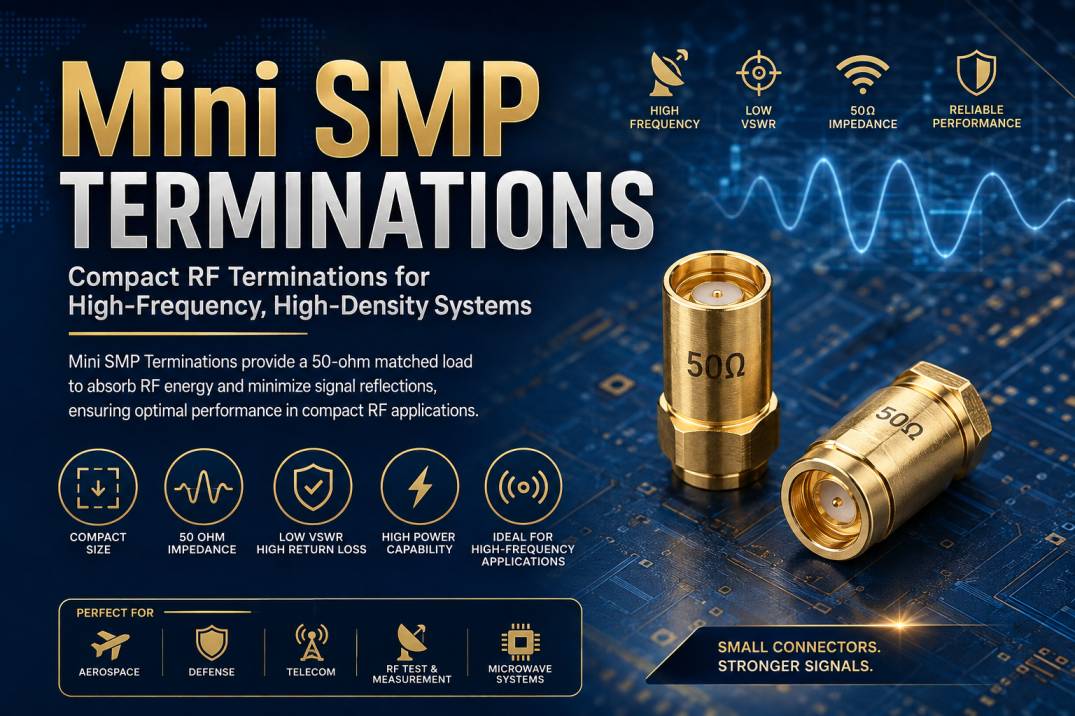
Mini SMP Terminations are compact RF components designed to terminate unused Mini SMP connector ports while maintaining a controlled 50-ohm impedance environment. They are engineered for high-frequency and high-density RF systems where space is limited and reliable signal termination is essential.
Mini SMP connectors are widely used in applications requiring miniature, lightweight, and high-performance RF interconnections. Mini SMP Terminations complement these connectors by absorbing unwanted RF energy and preventing signal reflections from unused ports.
For modern RF, microwave, aerospace, defense, telecommunications, test-and-measurement, and high-density electronic systems, Mini SMP Terminations provide an effective way to maintain signal integrity while minimizing the physical footprint of the RF interface.
What Is a Mini SMP Termination?
A Mini SMP Termination is an RF termination device specifically designed for Mini SMP interfaces. Its primary function is to absorb RF power at the end of an RF transmission path instead of allowing the signal to reflect back toward the source.
In a properly designed RF system, an unused RF port should generally be terminated with a matched load. An unterminated port can create signal reflections that increase VSWR and degrade overall system performance.
Mini SMP Terminations provide a matched impedance, typically 50 ohms, allowing the RF energy to be absorbed with minimal reflection.
Because Mini SMP connectors are significantly smaller than conventional SMP connectors, Mini SMP Terminations are particularly useful in compact and high-density RF assemblies.
Why Are Mini SMP Terminations Important?
RF signals are sensitive to impedance discontinuities. When an RF signal reaches an unmatched or open circuit, part of the energy can be reflected toward the signal source.
These reflections can cause:
- Increased VSWR
- Higher return loss variation
- Signal distortion
- Measurement inaccuracies
- Reduced power-transfer efficiency
- Unwanted resonances
- Interference between RF channels
A Mini SMP Termination provides a controlled impedance at the unused port and helps reduce these problems.
This becomes especially important in high-frequency systems where even small mechanical or electrical discontinuities can significantly affect performance.
How Does a Mini SMP Termination Work?
The operating principle is straightforward. The termination presents a resistive load that closely matches the characteristic impedance of the RF system.
For a typical 50-ohm RF system, the termination is designed to present approximately 50 ohms to the incoming signal.
When the impedance is properly matched, most of the RF energy is absorbed by the termination rather than being reflected back into the transmission line.
The quality of an RF termination is therefore strongly related to its impedance accuracy, VSWR, return loss, frequency capability, power-handling capability, and mechanical design.
Mini SMP Termination and Impedance Matching
Impedance matching is one of the most important concepts behind RF terminations.
Most Mini SMP RF systems use a 50-ohm characteristic impedance. The termination must maintain this impedance across its specified operating frequency range.
A mismatch between the transmission line and termination can generate reflections. The reflection coefficient is related to the difference between the load impedance and transmission-line impedance.
A well-designed Mini SMP Termination minimizes this mismatch and helps maintain predictable RF performance.
Key Features of Mini SMP Terminations
Compact Size
The most important advantage of Mini SMP Terminations is their miniature form factor. They are suitable for systems where PCB space and mechanical clearance are restricted.
50 Ohm Impedance
Mini SMP Terminations are commonly designed for 50-ohm RF systems, making them suitable for microwave and high-frequency applications.
High-Frequency Performance
Depending on the specific design, Mini SMP Terminations can support high-frequency applications and demanding RF test environments.
Low VSWR
A low VSWR indicates that the termination provides a good impedance match and minimizes signal reflections.
Good Return Loss
High return loss corresponds to low reflected power, helping maintain signal integrity in precision RF systems.
Compact and Lightweight Construction
Their miniature construction makes them suitable for aerospace, defense, telecommunications, instrumentation, and high-density electronics.
Reliable Mechanical Interface
Mini SMP Terminations are designed to mate securely with compatible Mini SMP interfaces, providing reliable electrical and mechanical connectivity.
Mini SMP Termination Types
Mini SMP Terminations can be categorized according to interface configuration, mounting arrangement, and application requirements.
Mini SMP Male Termination
A Mini SMP male termination is designed to connect to a compatible Mini SMP female interface. It is useful for terminating unused female RF ports in compact assemblies and test systems.
Mini SMP Female Termination
A Mini SMP female termination is designed for connection with a compatible Mini SMP male interface. It can be used for terminating unused male RF interfaces.
PCB Mini SMP Termination
PCB-compatible Mini SMP termination solutions are useful in compact RF modules, microwave circuits, and high-density electronic assemblies where PCB integration is required.
High-Frequency Mini SMP Termination
High-frequency versions are optimized for microwave and high-speed RF applications where low VSWR, stable impedance, and controlled RF performance are important.
Mini SMP Terminations vs Standard SMP Terminations
Mini SMP and SMP interfaces serve similar RF interconnection requirements but differ in physical size and packaging.
Mini SMP products are designed for applications where greater component density and reduced package size are important. Standard SMP components generally provide a larger mechanical interface.
The appropriate choice depends on available space, mating requirements, frequency range, mechanical constraints, and system architecture.
Electrical Specifications to Consider
When selecting Mini SMP Terminations, engineers should evaluate several electrical parameters.
Frequency Range
The operating frequency range determines whether the termination is suitable for the intended RF system.
Impedance
Most RF Mini SMP Terminations are designed for 50-ohm systems.
VSWR
VSWR is an important indicator of impedance matching. Lower VSWR generally means lower reflection and better termination performance.
Return Loss
Return loss indicates how much RF energy is reflected from the termination. Higher return loss generally represents better matching.
Power Rating
The termination must be capable of safely dissipating the RF power applied to it.
Insertion and Reflection Characteristics
For precision applications, engineers should review the manufacturer’s RF performance data across the complete frequency range rather than relying only on nominal specifications.
Mechanical Specifications to Consider
Electrical performance is only part of Mini SMP Termination selection.
Important mechanical considerations include:
- Interface type
- Gender
- Mounting configuration
- Overall dimensions
- Mating mechanism
- Connector material
- Plating
- Environmental protection
- Operating temperature
- Mechanical durability
- Cable or PCB compatibility
Correct mechanical compatibility is essential because an electrically suitable termination may still be unsuitable if the connector interface or mounting configuration does not match the system.
Materials Used in Mini SMP Terminations
High-quality Mini SMP Terminations typically use carefully selected conductive and dielectric materials to achieve reliable RF performance.
Common material considerations include:
- Precision-machined conductive bodies
- Gold, nickel, or other suitable plating systems
- High-performance dielectric materials
- RF-rated resistive elements
- Corrosion-resistant construction
Material selection depends on frequency, power, environmental conditions, mechanical requirements, and expected service life.
Applications of Mini SMP Terminations
Mini SMP Terminations are useful in a wide range of high-frequency applications.
Aerospace
Aerospace electronics often require compact RF components because equipment weight and available installation space are limited.
Mini SMP Terminations can be used in RF modules, avionics, communication systems, navigation equipment, and electronic instrumentation.
Defense
Defense electronics frequently require high-density RF architectures. Mini SMP Terminations can help terminate unused RF interfaces in radar, communication, electronic warfare, and RF testing systems.
Telecommunications
Miniature RF components are increasingly important in compact telecom equipment, wireless infrastructure, and high-density RF modules.
RF Test and Measurement
Test laboratories use RF terminations to prevent unused ports from producing reflections that could affect measurements.
Mini SMP Terminations can be particularly useful in compact test fixtures and multi-channel RF equipment.
Microwave Systems
Microwave circuits operate at frequencies where impedance discontinuities can have significant effects. Properly matched terminations help maintain predictable circuit behavior.
PCB-Based RF Systems
Mini SMP interfaces are useful for connecting compact RF modules, boards, and cable assemblies. Terminations can be used on unused interfaces during development, testing, or system operation.
Radar Systems
Radar equipment uses multiple RF channels and high-frequency signal paths. Proper termination of unused ports can help maintain RF performance and reduce unwanted reflections.
Mini SMP Terminations in High-Density RF Systems
Modern RF equipment increasingly requires more channels in smaller physical packages. This trend is particularly visible in aerospace electronics, phased-array systems, wireless infrastructure, instrumentation, and advanced communication equipment.
Mini SMP technology supports this requirement by enabling smaller RF interfaces.
Mini SMP Terminations complement this architecture by providing matched termination without consuming significant mechanical space.
Benefits of Using Mini SMP Terminations
The major benefits include:
- Compact physical size
- Efficient use of PCB and system space
- Controlled 50-ohm impedance
- Reduced RF reflections
- Improved signal integrity
- Low VSWR performance
- High-density connector compatibility
- Suitable for high-frequency applications
- Lightweight construction
- Reliable RF testing and measurement
- Flexible use in compact RF architectures
Mini SMP Terminations for RF Testing
During RF testing, unused ports can introduce reflections that affect measurement accuracy. A matched termination provides a controlled load and can help engineers obtain more repeatable measurements.
Mini SMP Terminations can be used with RF test fixtures, switching systems, cable assemblies, microwave modules, and other high-density RF equipment.
They are particularly valuable when a test setup contains multiple RF ports but only some of them are actively connected.
Mini SMP Terminations and Signal Integrity
Signal integrity becomes increasingly important as operating frequencies increase.
A poor termination can create reflections that travel back through the transmission line. These reflected signals can interact with incident signals and potentially create standing-wave patterns.
A properly designed Mini SMP Termination helps minimize this effect by providing a controlled load.
For high-frequency systems, engineers should consider the entire signal path, including connectors, adapters, cables, PCB transitions, and terminations.
How to Select the Right Mini SMP Termination
Selecting the correct Mini SMP Termination requires evaluating both electrical and mechanical requirements.
1. Determine the Connector Interface
Identify whether the RF port requires a Mini SMP male or female termination.
2. Confirm Impedance
For most microwave RF systems, confirm that the system and termination are designed for 50 ohms.
3. Check Frequency
Select a termination whose specified frequency range covers the complete operating range of the application.
4. Check VSWR and Return Loss
For precision RF applications, compare VSWR and return-loss specifications across the operating frequency range.
5. Verify Power Handling
Make sure the termination can safely dissipate the maximum RF power expected in the system.
6. Check Mechanical Dimensions
Miniature RF equipment often has strict dimensional requirements. Verify the termination’s overall size and mating clearance.
7. Consider Environmental Requirements
For aerospace, defense, outdoor, or industrial applications, consider temperature, vibration, humidity, corrosion, and other environmental factors.
8. Verify Manufacturer Specifications
Always use the manufacturer’s latest datasheet for final electrical, mechanical, environmental, and qualification requirements.
Common Problems Caused by Incorrect RF Termination
Using an unsuitable termination can create several problems.
High VSWR
An impedance mismatch can increase reflected energy and negatively affect system performance.
Measurement Errors
In test systems, poor termination can influence measured return loss, insertion loss, gain, and other RF parameters.
Excessive RF Heating
If the termination’s power rating is too low, excessive RF energy can generate heat and potentially damage the component.
Mechanical Mismatch
A termination with an incompatible connector interface cannot provide a reliable RF connection even if its electrical specifications are appropriate.
Frequency Limitations
A termination designed for a lower frequency range may not provide acceptable performance at higher microwave frequencies.
Mini SMP Terminations for 5G and Advanced Wireless Systems
The continued development of higher-frequency wireless technologies increases the importance of compact, high-performance RF interconnects.
5G infrastructure, advanced wireless research, phased-array antennas, RF front ends, and laboratory test equipment can require high-density RF interfaces.
Mini SMP Terminations can be useful wherever compact RF ports need reliable matched termination.
Their small size makes them particularly attractive for systems where conventional connector hardware would occupy excessive space.
Mini SMP Terminations for Aerospace and Defense Electronics
Aerospace and defense systems typically demand a combination of low weight, compact packaging, mechanical reliability, and stable RF performance.
Mini SMP Terminations can support these requirements when properly specified for the operating environment.
Applications may include:
- Radar
- RF modules
- Electronic warfare equipment
- Avionics
- Satellite payload electronics
- Military communication systems
- Phased-array systems
- RF test equipment
Manufacturing Quality of Mini SMP Terminations
Precision is essential when manufacturing high-frequency RF terminations.
Important manufacturing considerations include:
- Accurate dimensional control
- Consistent impedance
- Precision machining
- Controlled connector geometry
- High-quality plating
- Reliable dielectric materials
- Proper assembly
- RF performance testing
- Mechanical inspection
- Environmental qualification where required
Small variations in connector geometry can influence RF performance, particularly at higher frequencies.
Testing of Mini SMP Terminations
Quality Mini SMP Terminations may be evaluated using specialized RF test equipment.
Common measurements include:
- VSWR
- Return loss
- Reflection coefficient
- Power handling
- Frequency response
- Mechanical dimensions
- Connector mating performance
- Environmental performance
Vector Network Analyzers are commonly used to characterize RF reflection and impedance performance.
Mini SMP Termination Maintenance and Handling
Miniature RF connectors should be handled carefully because their small interfaces can be more susceptible to mechanical damage.
Best practices include:
- Keep connector interfaces clean.
- Avoid excessive mating force.
- Use appropriate RF torque practices where applicable.
- Protect unused components from contamination.
- Avoid bending or mechanically stressing miniature interfaces.
- Follow the manufacturer’s mating and handling instructions.
- Inspect connectors before installation.
- Store components in clean, dry packaging.
Mini SMP Terminations vs RF Loads
The terms RF termination and RF load are sometimes used interchangeably, but application context can differ.
An RF termination generally refers to a matched device used to terminate a transmission path. An RF load can refer more broadly to a component designed to absorb RF power.
Mini SMP Terminations are essentially miniature matched RF loads designed around the Mini SMP interface.
Why Choose High-Quality Mini SMP Terminations?
A high-quality termination provides more than simple physical port closure. It must maintain predictable RF characteristics across its intended frequency range.
For demanding applications, engineers should prioritize:
- Accurate impedance
- Low VSWR
- High return loss
- Appropriate power rating
- Stable RF performance
- Reliable connector construction
- Proper material selection
- Consistent manufacturing
- Suitable environmental performance
These factors directly influence system reliability and measurement accuracy.
Mini SMP Terminations for Custom RF Applications
Different RF systems may require different termination configurations. Custom Mini SMP Terminations can be developed for specific connector orientations, mounting requirements, frequency ranges, power levels, environmental conditions, or mechanical constraints.
Custom solutions are particularly useful when standard termination products do not meet the dimensions or performance requirements of a specialized RF system.
Conclusion
Mini SMP Terminations are compact matched RF components designed to terminate unused Mini SMP interfaces while maintaining controlled impedance and reducing unwanted signal reflections. Their miniature form factor makes them well suited to high-density RF architectures where space, weight, and signal integrity are important.
They can be used across aerospace, defense, telecommunications, radar, microwave electronics, RF testing, instrumentation, and advanced wireless systems.
When selecting a Mini SMP Termination, engineers should evaluate connector type, impedance, frequency range, VSWR, return loss, power rating, mechanical dimensions, materials, environmental requirements, and manufacturer testing.
For demanding high-frequency applications, selecting a properly specified and precision-manufactured Mini SMP Termination can help maintain reliable RF performance and improve overall system signal integrity.
Frequently Asked Questions About Mini SMP Terminations
What is a Mini SMP Termination?
A Mini SMP Termination is a compact RF component used to terminate a Mini SMP connector port with a matched impedance, typically 50 ohms, to minimize signal reflections.
What is the impedance of a Mini SMP Termination?
Mini SMP Terminations are commonly designed for 50-ohm RF systems. The exact impedance should always be confirmed from the manufacturer’s datasheet.
What is the purpose of a Mini SMP Termination?
Its primary purpose is to provide a matched load at an unused RF port and reduce unwanted signal reflections caused by an open or mismatched interface.
Where are Mini SMP Terminations used?
They are used in aerospace, defense, telecommunications, radar, microwave electronics, RF test equipment, instrumentation, PCB-based RF systems, and high-density communication equipment.
Are Mini SMP Terminations suitable for high-frequency applications?
Yes. Mini SMP interfaces are designed for compact high-frequency RF applications, but the exact usable frequency range depends on the specific termination design and manufacturer’s specifications.
What is the difference between Mini SMP and SMP Terminations?
The primary difference is the physical interface and size. Mini SMP components are designed for more compact and higher-density packaging than standard SMP components.
How does a Mini SMP Termination reduce RF reflections?
It provides a matched load that absorbs incoming RF energy rather than reflecting a significant portion of that energy back toward the signal source.
Can Mini SMP Terminations be used on PCBs?
Yes. Depending on the design, Mini SMP termination solutions can be used with PCB-mounted Mini SMP interfaces and compact RF modules.
How do I select a Mini SMP Termination?
Consider connector gender, 50-ohm impedance, operating frequency, VSWR, return loss, RF power rating, dimensions, environmental requirements, and mechanical compatibility.
Why is VSWR important in Mini SMP Terminations?
VSWR indicates the degree of impedance mismatch between the RF transmission line and termination. Lower VSWR generally indicates better matching and lower signal reflection.
What industries use Mini SMP Terminations?
Major applications include aerospace, defense, telecom, radar, satellite communication, wireless infrastructure, RF laboratories, semiconductor testing, instrumentation, and microwave electronics.
Can Mini SMP Terminations be customized?
Yes. Depending on the manufacturer, customized configurations may be available for specific frequency, power, mechanical, connector, environmental, or mounting requirements.