
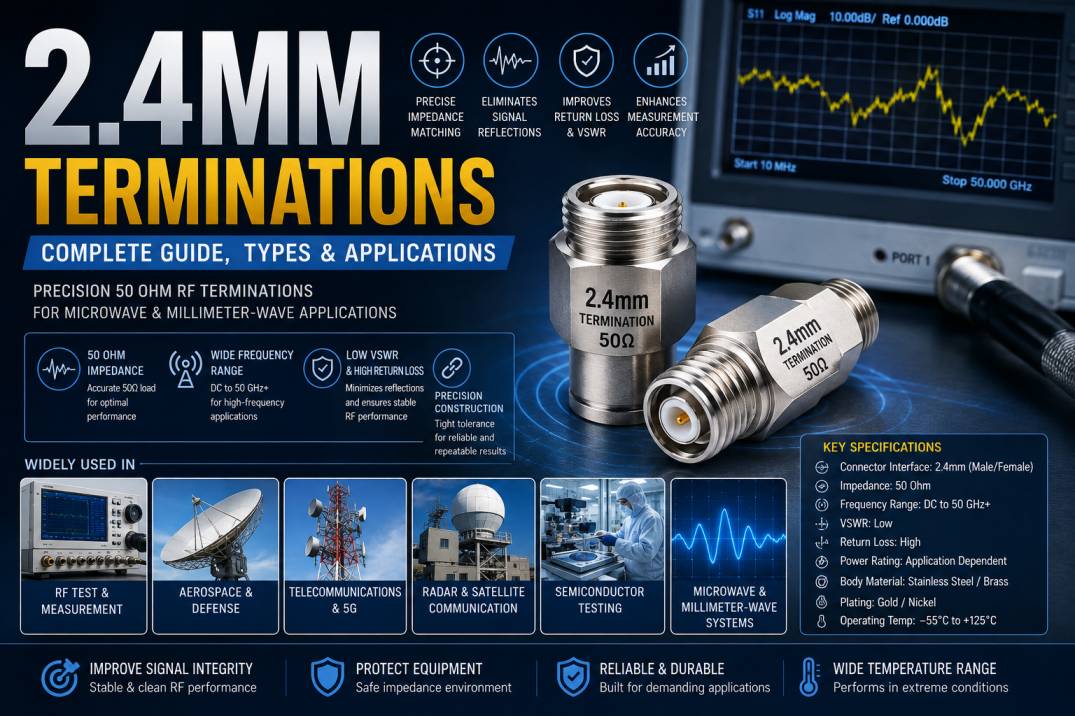
2.4mm Terminations are precision RF components designed to terminate high-frequency coaxial transmission lines and prevent unwanted signal reflections. They are commonly used in microwave, millimeter-wave, RF testing, aerospace, defense, telecommunications, and high-frequency research applications where accurate impedance matching and excellent electrical performance are essential.
The 2.4mm connector interface is a high-frequency coaxial interface designed for demanding microwave applications. A standard 2.4mm termination provides a precisely controlled 50 Ohm load to absorb RF energy at the end of a transmission line. By matching the characteristic impedance of the system, it minimizes reflections and helps maintain signal integrity.
2.4mm RF Terminations are particularly valuable in applications operating at frequencies extending into the millimeter-wave range. They are commonly used with vector network analyzers, signal generators, spectrum analyzers, RF power meters, microwave test systems, and other precision measurement equipment.
What Is a 2.4mm Termination?
A 2.4mm Termination is a precision 50 Ohm RF load equipped with a 2.4mm coaxial connector interface. Its primary function is to absorb RF power rather than allowing the signal to reflect back toward the source.
When a transmission line is properly terminated with a load equal to its characteristic impedance, the RF energy is absorbed with minimal reflection. This improves measurement accuracy and helps prevent unwanted standing waves.
A typical 2.4mm termination consists of a precision resistive element, dielectric material, outer conductor, center contact, and mechanically precise connector body. Every part is designed to maintain controlled impedance at very high frequencies.
Why Are 2.4mm Terminations Important?
At microwave and millimeter-wave frequencies, even small mechanical or electrical imperfections can affect RF performance. Connector dimensions, surface finish, dielectric properties, and impedance discontinuities can significantly influence return loss and VSWR.
A properly engineered 2.4mm termination helps:
- Absorb unwanted RF energy
- Minimize signal reflections
- Maintain 50 Ohm impedance
- Improve return loss
- Reduce VSWR
- Improve measurement repeatability
- Protect sensitive RF equipment
- Maintain signal integrity at high frequencies
- Reduce impedance discontinuities
- Provide a reliable RF reference load
For precision microwave measurements, using a high-quality termination is often essential for obtaining reliable test results.
How Does a 2.4mm Termination Work?
The operating principle of a 2.4mm termination is based on impedance matching.
A coaxial transmission line is designed with a specific characteristic impedance, commonly 50 Ohms in RF and microwave systems. When the termination has the same impedance, the electromagnetic energy travels from the transmission line into the load with minimal reflection.
If the termination impedance differs significantly from the transmission line impedance, part of the signal is reflected back toward the source.
This reflection can cause:
- Increased VSWR
- Reduced return loss
- Measurement errors
- Standing waves
- Power transfer inefficiency
- Unwanted interference
The precision resistor inside a 2.4mm termination converts the incoming RF energy into heat, effectively absorbing the signal at the end of the transmission line.
2.4mm Termination Impedance
Most 2.4mm RF Terminations are designed for a nominal 50 Ohm impedance.
50 Ohm impedance is widely used in:
- RF test equipment
- Microwave systems
- Wireless communication
- Radar systems
- Satellite communication
- Aerospace electronics
- Defense electronics
- Semiconductor testing
- High-frequency research
Maintaining a precise 50 Ohm impedance becomes increasingly important as operating frequency increases.
Frequency Range of 2.4mm Terminations
One of the main advantages of the 2.4mm interface is its suitability for very high-frequency applications.
Depending on the design, precision 2.4mm terminations can support frequencies up to approximately 50 GHz or higher. Specialized high-performance versions may be engineered for even more demanding millimeter-wave applications.
The actual operating frequency depends on:
- Connector design
- Manufacturing precision
- Resistive element design
- VSWR requirements
- Mechanical tolerances
- Material selection
- Measurement environment
For this reason, the manufacturer’s specified frequency range should always be checked before selecting a termination.
Construction of 2.4mm RF Terminations
High-frequency 2.4mm terminations require extremely accurate mechanical construction.
Precision Connector Body
The connector body provides mechanical strength and maintains the required coaxial geometry.
Center Conductor
The center contact carries the RF signal into the termination and must provide stable electrical conductivity.
Precision Resistive Element
The resistive element provides the 50 Ohm load required to absorb RF energy.
Dielectric Material
A controlled dielectric structure maintains the required electrical spacing between the center conductor and outer conductor.
Outer Conductor
The outer conductor provides the return path for RF current and contributes to electromagnetic shielding.
Plating
High-quality surface plating improves conductivity, corrosion resistance, and connector durability.
Key Features of 2.4mm Terminations
Precision 2.4mm Terminations typically offer several important features.
50 Ohm Impedance
Designed to provide accurate impedance matching for microwave and millimeter-wave RF systems.
High Frequency Capability
Suitable for high-frequency applications where conventional RF termination interfaces may not provide sufficient performance.
Low VSWR
A low VSWR indicates reduced signal reflection and improved impedance matching.
High Return Loss
High return loss indicates that only a small portion of the incoming RF energy is reflected.
Precision Mechanical Design
Tight dimensional tolerances help maintain consistent electrical performance at high frequencies.
Excellent RF Shielding
The coaxial construction helps minimize electromagnetic leakage and external interference.
Compact Construction
The 2.4mm interface provides a compact solution for dense microwave test systems.
Reliable Repeatability
Precision manufacturing allows consistent performance across repeated connections and measurements.
Technical Specifications of 2.4mm Terminations
Typical specifications may include:
Connector Interface: 2.4mm
Impedance: 50 Ohm
Frequency Range: DC to 50 GHz or higher depending on design
Connector Type: Male or Female
VSWR: Low VSWR depending on frequency
Return Loss: High return loss depending on frequency
Body Material: Stainless steel, brass, or other high-performance materials
Contact Material: Copper alloy or precision conductive material
Plating: Gold, nickel, or other RF-compatible plating
Dielectric: High-performance microwave dielectric
Operating Temperature: Application dependent
Power Rating: Application and frequency dependent
These specifications can vary significantly between standard and precision-grade products.
Types of 2.4mm Terminations
2.4mm Terminations can be categorized according to connector gender, performance requirements, and application.
2.4mm Male Termination
A 2.4mm male termination is designed to connect to a compatible 2.4mm female RF interface.
It is commonly used with:
- RF test cables
- Microwave instruments
- VNA ports
- Test fixtures
- Measurement systems
2.4mm Female Termination
A 2.4mm female termination connects to a compatible 2.4mm male interface and is often used on test equipment, modules, and RF assemblies.
Precision 2.4mm Termination
Precision versions are manufactured with extremely tight mechanical tolerances and are designed for demanding measurement applications.
High-Power 2.4mm Termination
High-power versions are designed to handle greater RF power levels while maintaining acceptable electrical performance.
Power handling should always be evaluated against both frequency and operating temperature.
2.4mm Terminations vs Other RF Terminations
Different RF interfaces are designed for different frequency ranges and applications.
2.4mm vs SMA Terminations
SMA connectors are widely used in RF systems and can support high frequencies, but 2.4mm interfaces are designed for more demanding microwave and millimeter-wave applications.
2.4mm interfaces generally provide better high-frequency performance and are commonly selected for precision measurement applications.
2.4mm vs 2.92mm Terminations
2.92mm connectors are commonly known as K connectors and are widely used for applications extending to approximately 40 GHz.
2.4mm interfaces are generally selected when higher-frequency performance is required.
2.4mm vs 1.85mm Terminations
1.85mm connectors are designed for extremely high-frequency applications and are commonly used in millimeter-wave measurement systems.
The appropriate interface depends on frequency, mechanical compatibility, power requirements, and measurement accuracy.
Applications of 2.4mm Terminations
2.4mm RF Terminations are used in many advanced RF and microwave applications.
RF and Microwave Testing
They are commonly used to terminate unused ports on microwave test equipment and test fixtures.
Vector Network Analyzers
VNAs require accurate impedance environments for reliable S-parameter measurements. A precision termination can be used as a known load during calibration and testing.
Spectrum Analyzers
2.4mm terminations can be used to terminate unused inputs and provide a controlled RF load during measurements.
Signal Generators
They help provide a properly matched load for RF signal generator outputs.
Aerospace Electronics
High-frequency RF systems used in aerospace applications require compact and reliable components capable of maintaining electrical performance under demanding conditions.
Defense Systems
Radar, electronic warfare, communication, and other defense systems often operate at microwave and millimeter-wave frequencies where precision terminations are essential.
Satellite Communication
Satellite communication equipment uses high-frequency RF components where impedance matching and signal integrity are critical.
Semiconductor Testing
Modern semiconductor devices can operate at extremely high frequencies. Precision RF terminations are used in characterization and testing systems.
5G and Advanced Wireless Research
High-frequency wireless research and next-generation communication systems require precision microwave components for laboratory testing and prototyping.
Radar Systems
Radar equipment relies on accurate RF signal transmission and measurement. High-performance terminations help control reflections within test systems.
Benefits of Using 2.4mm Terminations
Improved Signal Integrity
A properly matched termination reduces unwanted signal reflections and helps maintain the quality of high-frequency signals.
Better Measurement Accuracy
Precision terminations provide controlled impedance conditions during RF measurements.
Reduced VSWR
Low VSWR improves impedance matching and minimizes reflected power.
High-Frequency Performance
The 2.4mm interface is suitable for demanding microwave and millimeter-wave applications.
Equipment Protection
A correctly rated termination can provide a controlled load for sensitive RF ports.
Better Repeatability
Precision construction provides consistent results during repeated testing.
Compact Design
The small connector interface is useful in compact microwave assemblies and dense test setups.
VSWR and Return Loss in 2.4mm Terminations
VSWR and return loss are important parameters when evaluating high-frequency terminations.
VSWR describes the relationship between the maximum and minimum voltage levels created by incident and reflected signals on a transmission line.
A lower VSWR generally indicates better impedance matching.
Return loss indicates how much RF power is reflected back toward the source. Higher return loss generally represents better matching.
For high-frequency measurement applications, both parameters should be evaluated across the complete operating frequency range rather than at a single frequency.
Power Handling Capability
Power handling is an important consideration when selecting a 2.4mm termination.
The maximum power capability depends on:
- Frequency
- Termination construction
- Resistor technology
- Thermal design
- Ambient temperature
- Duration of RF exposure
- Connector materials
A termination rated for a particular power level at a lower frequency may have a lower rating at higher frequencies.
Always follow the manufacturer’s power-rating curve and operating specifications.
How to Choose the Right 2.4mm Termination
Selecting the correct termination requires consideration of several technical parameters.
Check the Frequency Range
Make sure the termination covers the highest operating frequency of your application.
Verify 50 Ohm Impedance
Most microwave RF systems using 2.4mm interfaces require 50 Ohm impedance.
Check Connector Gender
Select male or female based on the RF interface being terminated.
Evaluate VSWR
Choose a low-VSWR termination when measurement accuracy is important.
Check Return Loss
High return loss is preferred for precision RF measurement applications.
Consider Power Rating
Ensure the termination can safely handle the RF power generated by the system.
Check Operating Temperature
For aerospace, defense, industrial, or environmental applications, verify the specified temperature range.
Evaluate Mechanical Durability
If the termination will be frequently connected and disconnected, connector durability and mating-cycle performance should be considered.
Common Mistakes When Using 2.4mm Terminations
Incorrect use of high-frequency terminations can negatively affect measurements.
Common mistakes include:
- Using a termination with the wrong frequency range
- Applying excessive RF power
- Using an incompatible connector interface
- Ignoring VSWR specifications
- Mixing different impedance standards
- Contaminating connector interfaces
- Applying excessive mechanical force
- Failing to inspect connectors before use
- Using damaged or worn terminations
- Ignoring temperature-related power derating
Proper Handling and Maintenance
2.4mm interfaces require careful handling because small mechanical imperfections can affect high-frequency performance.
Keep the connector interface clean and free from dust, oil, moisture, and other contaminants.
Avoid touching the precision mating surfaces unnecessarily.
Use appropriate torque when connecting the termination to test equipment. Excessive torque can damage the connector, while insufficient torque can result in poor electrical contact.
When the termination is not being used, protective caps should be installed to prevent contamination.
For precision laboratory applications, periodic inspection and verification can help maintain measurement accuracy.
Why Precision Manufacturing Matters
At frequencies reaching tens of gigahertz, very small dimensional variations can produce measurable electrical changes.
The geometry of the center conductor, dielectric, and outer conductor must remain accurately controlled.
Manufacturing quality affects:
- VSWR
- Return loss
- Insertion characteristics
- Repeatability
- Power handling
- Connector durability
- Measurement accuracy
This is why precision machining, controlled materials, accurate plating, and strict quality inspection are important when manufacturing 2.4mm Terminations.
2.4mm Terminations for RF Test and Measurement
One of the most important applications of 2.4mm Terminations is precision RF testing.
Modern test systems often operate at frequencies where conventional connectors cannot provide the required electrical performance.
2.4mm terminations can be used as controlled loads during:
- VNA calibration
- RF component testing
- Microwave module characterization
- Antenna measurements
- Cable testing
- Filter testing
- Amplifier testing
- RF connector evaluation
A precision termination helps create a predictable RF environment and contributes to repeatable measurement results.
2.4mm Terminations in Millimeter-Wave Applications
As RF systems move toward higher frequencies, connector performance becomes increasingly important.
Millimeter-wave systems are particularly sensitive to:
- Connector geometry
- Surface roughness
- Mechanical tolerances
- Dielectric variations
- Impedance discontinuities
- Connector wear
2.4mm interfaces are therefore widely used in high-frequency test environments where electrical precision is essential.
Quality Standards for 2.4mm Terminations
A professional RF termination should be manufactured under controlled quality processes.
Important quality considerations include:
- Precision machining
- Controlled impedance
- Accurate connector dimensions
- High-quality conductive materials
- Reliable plating
- Consistent RF performance
- Electrical testing
- Mechanical inspection
- Environmental testing where required
For critical applications, manufacturers should provide relevant electrical specifications and test data.
Why Choose High-Quality 2.4mm Terminations?
High-quality 2.4mm Terminations provide reliable performance in demanding RF and microwave environments.
They offer:
- Accurate 50 Ohm impedance
- High-frequency capability
- Low VSWR
- Excellent return loss
- Reliable signal absorption
- Precision connector geometry
- Strong mechanical construction
- Consistent performance
- Long service life
- Compatibility with professional RF test equipment
For demanding applications, precision-engineered terminations can significantly improve the reliability and repeatability of RF measurements.
Conclusion
2.4mm Terminations are precision 50 Ohm RF components designed to absorb RF energy and prevent unwanted signal reflections in high-frequency transmission systems. Their compact coaxial interface and controlled electrical characteristics make them suitable for microwave and millimeter-wave applications.
They are widely used in RF test equipment, vector network analyzers, spectrum analyzers, signal generators, aerospace systems, defense electronics, radar, satellite communication, semiconductor testing, and advanced wireless research.
When selecting a 2.4mm Termination, engineers should consider frequency range, impedance, VSWR, return loss, power handling, connector gender, operating temperature, mechanical durability, and application requirements.
For high-frequency systems, choosing a precision 2.4mm Termination can help maintain impedance matching, reduce reflections, improve measurement accuracy, and ensure dependable RF performance.
Frequently Asked Questions About 2.4mm Terminations
What is a 2.4mm Termination?
A 2.4mm Termination is a precision RF load with a 2.4mm coaxial connector interface, typically providing a 50 Ohm impedance for high-frequency microwave and millimeter-wave applications.
What is the impedance of a 2.4mm Termination?
Most 2.4mm Terminations are designed with a nominal 50 Ohm impedance for compatibility with standard RF and microwave systems.
What frequency can a 2.4mm Termination support?
Depending on the design, 2.4mm Terminations can support frequencies up to approximately 50 GHz or higher. The exact frequency range depends on the manufacturer’s specifications.
What is the difference between 2.4mm and 2.92mm Terminations?
2.92mm terminations are commonly used for frequencies up to around 40 GHz, while 2.4mm terminations are generally selected for higher-frequency microwave and millimeter-wave applications.
Are 2.4mm Terminations used with VNAs?
Yes. Precision 2.4mm Terminations are commonly used with Vector Network Analyzers for calibration, measurement, and RF component characterization.
Why is low VSWR important in a 2.4mm Termination?
Low VSWR indicates better impedance matching and reduced signal reflection, which is particularly important for accurate high-frequency measurements.
Can 2.4mm Terminations handle high RF power?
Some 2.4mm Terminations are designed for higher power levels, but the power rating depends on frequency, construction, thermal conditions, and operating duration. The manufacturer’s specifications should always be followed.
What are the main applications of 2.4mm Terminations?
They are used in RF testing, microwave measurement, aerospace, defense, radar, satellite communication, semiconductor testing, telecommunications, and high-frequency research.
Are 2.4mm Terminations available in male and female versions?
Yes. 2.4mm Terminations are available in male and female configurations to match different RF equipment and test-system interfaces.
How should a 2.4mm Termination be maintained?
Keep the mating interface clean, use protective caps when not in use, avoid excessive torque, inspect the connector for damage, and follow the manufacturer’s recommended handling and storage procedures.
Why are 2.4mm Terminations important for millimeter-wave testing?
At very high frequencies, small impedance discontinuities can cause significant reflections. Precision 2.4mm Terminations provide controlled impedance and help create stable, repeatable measurement conditions.
How do I select the right 2.4mm Termination?
Consider the required frequency range, 50 Ohm impedance, connector gender, VSWR, return loss, power rating, temperature range, mechanical requirements, and intended RF application.