
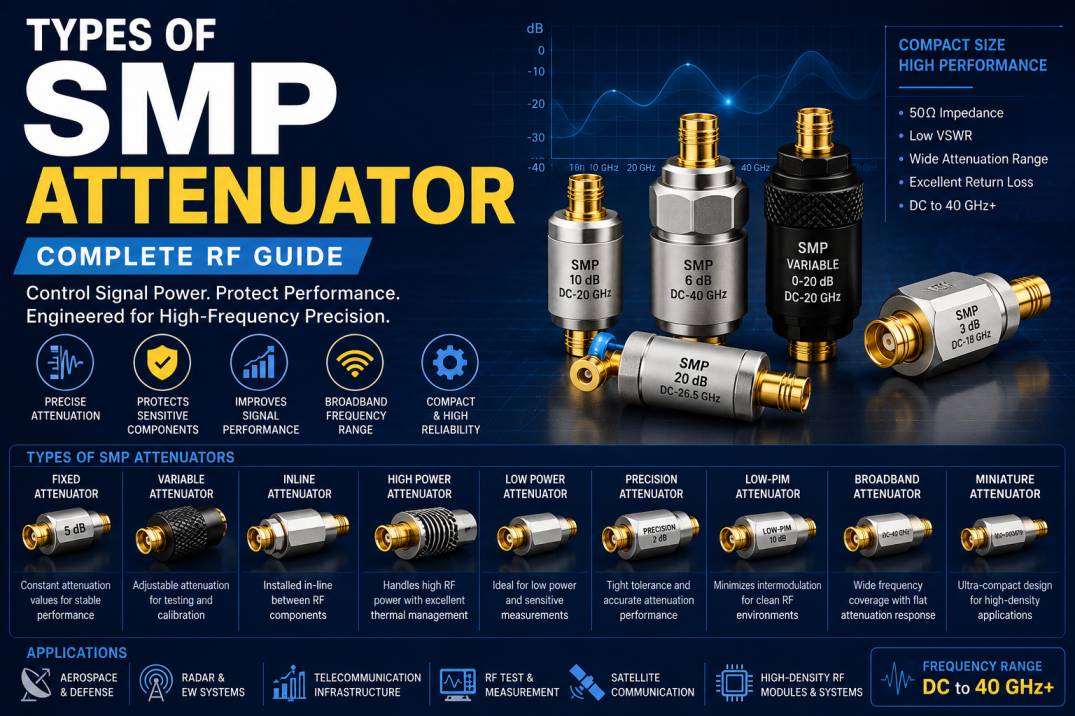
SMP attenuators are compact RF components designed to reduce signal power to a controlled level while maintaining impedance matching and signal integrity. They use the SMP connector interface, which is widely used in high-density and high-frequency RF systems where space, weight, and electrical performance are critical.
An SMP attenuator is commonly used in RF test equipment, aerospace systems, defense electronics, telecommunications, radar, wireless communication, instrumentation, and high-density interconnect applications.
Unlike a simple cable or connector, an attenuator intentionally introduces a specified amount of insertion loss into an RF signal path. This allows engineers to control signal amplitude, protect sensitive components, improve impedance matching, prevent receiver overload, and establish the desired power level for testing or system operation.
SMP attenuators are available in different attenuation values, frequency ranges, connector configurations, power ratings, mechanical structures, and performance classes. Selecting the right SMP attenuator therefore requires an understanding of attenuation, frequency, VSWR, return loss, power handling, connector gender, and application requirements.
This complete guide explains the major types of SMP attenuators, how they work, their specifications, applications, advantages, and important factors to consider when selecting an SMP RF attenuator.
What Is an SMP Attenuator?
An SMP attenuator is a passive RF component that reduces the power level of an RF or microwave signal while providing a controlled impedance interface.
SMP refers to a miniature push-on RF connector interface originally developed for compact, high-frequency applications. SMP connectors are available in different configurations and can support demanding RF applications where compact packaging and high-frequency performance are required.
An SMP attenuator combines this compact connector interface with an internal resistive or distributed attenuation network.
The primary functions of an SMP attenuator include:
- Reducing RF signal power
- Controlling signal amplitude
- Protecting sensitive RF components
- Improving impedance matching
- Preventing receiver overload
- Reducing excessive signal levels
- Supporting RF testing and calibration
- Maintaining controlled RF performance
How Does an SMP Attenuator Work?
An RF attenuator introduces a known amount of loss into a transmission path.
For example, if an RF signal enters an attenuator with a power level of 10 dBm and the attenuator provides 3 dB attenuation, the ideal output level is approximately 7 dBm, assuming negligible additional losses.
The attenuation relationship can be expressed as:
Attenuation (dB) = 10 log10(Pin / Pout)
Where:
- Pin = Input power
- Pout = Output power
A higher attenuation value produces a lower output signal level.
Common SMP attenuator values include:
- 1 dB
- 2 dB
- 3 dB
- 4 dB
- 5 dB
- 6 dB
- 10 dB
- 15 dB
- 20 dB
- 30 dB
The actual available attenuation values depend on the manufacturer’s product series and frequency range.
Why Are SMP Attenuators Important in RF Systems?
RF systems often require precise control of signal levels. Excessive RF power can saturate receivers, damage sensitive components, or create nonlinear behavior.
SMP attenuators provide a convenient method of reducing signal power without significantly changing the physical architecture of a compact RF system.
They are especially useful when:
- RF signals are too strong
- Receiver input power must be controlled
- Test equipment requires a defined signal level
- RF components need protection
- System gain needs to be balanced
- Multiple RF stages need level matching
- Signal reflections need to be controlled
Main Types of SMP Attenuators
SMP attenuators can be classified according to attenuation behavior, construction, connector configuration, power handling, and application.
The major types include:
- Fixed SMP Attenuator
- Variable SMP Attenuator
- Inline SMP Attenuator
- SMP Male Attenuator
- SMP Female Attenuator
- SMP Plug Attenuator
- SMP Jack Attenuator
- High-Power SMP Attenuator
- Low-Power SMP Attenuator
- Precision SMP Attenuator
- Low-PIM SMP Attenuator
- Broadband SMP Attenuator
- High-Frequency SMP Attenuator
- Miniature SMP Attenuator
- SMP Attenuator Termination
1. Fixed SMP Attenuator
A fixed SMP attenuator provides a predetermined attenuation value that does not change during normal operation.
For example, a 3 dB SMP attenuator continuously provides approximately 3 dB of attenuation within its specified operating range.
Common Fixed Attenuation Values
Typical values include:
- 1 dB
- 2 dB
- 3 dB
- 5 dB
- 6 dB
- 10 dB
- 15 dB
- 20 dB
- 30 dB
Advantages
- Simple design
- Reliable operation
- Compact construction
- Repeatable attenuation
- No external adjustment mechanism
- Suitable for permanent RF installations
Applications
Fixed SMP attenuators are commonly used in:
- RF test equipment
- Radar systems
- Aerospace electronics
- Defense systems
- Communication equipment
- RF modules
- Microwave assemblies
- Laboratory instrumentation
2. Variable SMP Attenuator
A variable SMP attenuator allows the attenuation level to be adjusted over a specified range.
Instead of providing only one fixed attenuation value, a variable attenuator may allow engineers to change the signal level according to testing or system requirements.
Applications
Variable SMP attenuators can be used in:
- RF laboratories
- Test benches
- Signal-generation systems
- Receiver testing
- Calibration equipment
- Communication system development
Advantages
- Adjustable signal level
- Flexible RF testing
- Useful for characterization
- Supports multiple attenuation conditions
However, variable attenuators may be more mechanically complex than fixed attenuators and can have different power and frequency limitations.
3. Inline SMP Attenuator
An inline SMP attenuator is installed directly within an RF transmission path.
It typically has SMP interfaces on both sides and is designed to provide controlled signal attenuation between connected RF components.
Applications
- RF cable assemblies
- Test equipment
- Microwave modules
- Antenna systems
- RF front ends
- Signal distribution systems
Benefits
The compact inline structure makes this type particularly useful where space is limited.
4. SMP Male Attenuator
An SMP male attenuator incorporates a male SMP interface on one side or within the selected configuration.
It is designed to mate with a compatible SMP female interface.
Applications
- Compact RF modules
- Test equipment
- Cable assemblies
- Board-level RF systems
- Aerospace electronics
Connector gender and interface configuration must always be checked before installation.
5. SMP Female Attenuator
An SMP female attenuator provides a compatible female SMP interface.
It is used where the mating RF component, cable, or module requires a corresponding SMP male interface.
Applications
- RF test systems
- Board-to-board RF connections
- Cable assemblies
- Microwave modules
- Communication equipment
6. SMP Plug Attenuator
A plug-style SMP attenuator is designed around the plug-side SMP interface.
Its compact construction makes it useful in high-density RF environments.
Typical Applications
- Microwave modules
- Aerospace systems
- RF instrumentation
- Defense electronics
- High-density interconnects
7. SMP Jack Attenuator
An SMP jack attenuator uses the corresponding jack interface.
It is commonly selected according to the mating interface required by the RF system.
When selecting an SMP attenuator, the connector interface should be checked alongside frequency, impedance, attenuation, and power specifications.
8. High-Power SMP Attenuator
High-power SMP attenuators are designed to dissipate greater amounts of RF energy than standard low-power versions.
Because attenuation converts part of the RF signal energy into heat, thermal management becomes increasingly important at higher power levels.
Important Specifications
High-power SMP attenuator selection should consider:
- Continuous power rating
- Peak power rating
- Frequency
- Ambient temperature
- Duty cycle
- Heat dissipation
- VSWR
- Connector rating
Applications
- Transmitters
- Radar
- RF amplifiers
- Defense systems
- Aerospace electronics
- High-power test systems
9. Low-Power SMP Attenuator
Low-power SMP attenuators are designed for applications where RF power levels are relatively low.
They are commonly used in:
- Signal measurement
- Receiver inputs
- RF instrumentation
- Laboratory testing
- Communication modules
- Prototype systems
Their compact size makes them especially useful in miniature RF assemblies.
10. Precision SMP Attenuator
Precision SMP attenuators are designed to provide tightly controlled attenuation and RF characteristics.
They are commonly used where repeatability and measurement accuracy are important.
Applications
- Vector Network Analyzers
- Spectrum analyzers
- Signal generators
- RF calibration systems
- Microwave measurement
- Research laboratories
Important performance characteristics can include attenuation accuracy, return loss, VSWR, insertion loss, phase response, and frequency stability.
11. Low-PIM SMP Attenuator
Low-PIM stands for low passive intermodulation.
Low-PIM RF components are designed to minimize unwanted intermodulation products that can occur when multiple RF signals pass through passive components.
Low-PIM attenuator technology is especially important in communication infrastructure where several RF carriers operate simultaneously.
Applications
- Cellular infrastructure
- Distributed antenna systems
- RF distribution
- Wireless communication
- Base station equipment
- High-density communication systems
Low-PIM performance depends on factors including material selection, surface finish, connector construction, mechanical integrity, and manufacturing quality.
12. Broadband SMP Attenuator
A broadband SMP attenuator is designed to provide controlled attenuation over a relatively wide frequency range.
Broadband attenuators are useful in systems where multiple frequencies need to pass through the same RF path.
Applications
- RF test systems
- Microwave instrumentation
- Broadband communication
- Aerospace systems
- Electronic warfare
- Research and development
The attenuation may not remain perfectly constant across the entire frequency range, so frequency-dependent performance should be checked in the manufacturer’s specifications.
13. High-Frequency SMP Attenuator
High-frequency SMP attenuators are designed for demanding RF and microwave applications.
At higher frequencies, small mechanical variations can have a significant effect on electrical performance.
Important design factors include:
- Connector geometry
- Dielectric properties
- Contact design
- Surface finish
- Impedance control
- VSWR
- Return loss
- Phase stability
Applications
- Microwave test systems
- Aerospace
- Defense
- Radar
- Satellite communication
- High-frequency instrumentation
14. Miniature SMP Attenuator
Miniature SMP attenuators are designed for applications where PCB area and mechanical space are limited.
SMP connectors themselves are significantly smaller than many traditional RF connector families, making them useful for dense RF packaging.
Applications
- Compact RF modules
- Avionics
- Satellite electronics
- Phased-array systems
- High-density RF assemblies
- Defense electronics
15. SMP Attenuator Termination
An attenuator termination combines signal attenuation with a termination function depending on the specific component design.
This type of device can be useful in RF test environments where signal power needs to be absorbed and controlled.
It should not be confused with a conventional RF termination, which is primarily designed to absorb RF power and provide a matched load without intentionally passing the signal through.
SMP Attenuator Types Comparison
| SMP Attenuator Type | Main Characteristic | Typical Application |
|---|---|---|
| Fixed | Constant attenuation | General RF systems |
| Variable | Adjustable attenuation | RF testing |
| Inline | Installed in RF path | Cable assemblies |
| Male | Male SMP interface | Compact modules |
| Female | Female SMP interface | RF equipment |
| Plug | Plug configuration | High-density RF |
| Jack | Jack configuration | RF interconnects |
| High-Power | Higher power handling | Transmitters |
| Low-Power | Low RF power | Receivers and testing |
| Precision | Accurate attenuation | Calibration |
| Low-PIM | Reduced passive intermodulation | Cellular systems |
| Broadband | Wide frequency operation | Multi-band systems |
| High-Frequency | Microwave performance | Aerospace and defense |
| Miniature | Compact form factor | High-density assemblies |
| Attenuator Termination | Attenuation and load function | RF testing |
Understanding SMP Attenuation Values
Attenuation is measured in decibels, or dB.
The attenuation value represents the reduction in RF power between the input and output.
For example:
- 1 dB provides a small reduction
- 3 dB reduces power by approximately half
- 6 dB reduces power to approximately one-quarter
- 10 dB reduces power to one-tenth
- 20 dB reduces power to one-hundredth
This relationship makes dB attenuation especially useful for RF system design.
SMP Attenuator Power Handling
Power handling is an important parameter when selecting an SMP attenuator.
An attenuator does not simply “lose” RF energy. The absorbed energy is converted primarily into heat within the attenuation network.
For example, if a high-power RF signal passes through a 10 dB attenuator, a significant portion of the input power is dissipated inside the attenuator.
Therefore, engineers must consider:
- Average RF power
- Peak RF power
- Pulse duration
- Duty cycle
- Frequency
- Ambient temperature
- Heat dissipation
Using an attenuator beyond its rated power can result in overheating, permanent damage, or degraded RF performance.
SMP Attenuator Frequency Range
Frequency range is another critical parameter.
SMP attenuators may be designed for:
- RF frequencies
- Microwave frequencies
- Broadband systems
- High-frequency test applications
The actual frequency range depends on the design and manufacturer.
At higher frequencies, connector geometry, dielectric properties, surface finish, and mechanical tolerances become increasingly important.
SMP Attenuator Impedance
Most SMP RF attenuators are designed around a 50-ohm impedance.
Maintaining a consistent 50-ohm transmission path helps minimize reflections and preserve RF signal integrity.
A complete RF chain may include:
RF Source → Cable → SMP Connector → SMP Attenuator → Cable → RF Device
Every interface should maintain appropriate impedance matching.
SMP Attenuator VSWR
VSWR, or Voltage Standing Wave Ratio, indicates how well the attenuator is impedance matched to the RF system.
A lower VSWR generally indicates better impedance matching.
An SMP attenuator used in a precision microwave application should be evaluated for VSWR across the entire operating frequency range.
A component may have excellent VSWR at a lower frequency but exhibit different performance at the upper end of its frequency range.
SMP Attenuator Return Loss
Return loss describes the amount of signal reflected back toward the RF source due to impedance mismatch.
Higher return loss generally indicates lower reflected power and better impedance matching.
For high-frequency RF systems, both VSWR and return loss should be reviewed before selecting an SMP attenuator.
SMP Attenuator Insertion Loss
Insertion loss represents the reduction in signal level caused by a component inserted into an RF path.
For an attenuator, the specified attenuation is intentional signal reduction.
However, the complete device may have additional frequency-dependent losses and variations.
When comparing precision attenuators, engineers should distinguish between nominal attenuation and actual attenuation accuracy.
SMP Attenuator Phase Performance
In high-frequency systems, attenuation is not the only important parameter.
The attenuator can also affect the phase of an RF signal.
Phase performance becomes especially important in:
- Phased-array antennas
- Radar
- Electronic warfare
- Satellite communication
- Vector network analysis
- High-speed RF systems
For these applications, phase stability and repeatability may be important selection criteria.
SMP Attenuator Applications
SMP attenuators are used in many RF and microwave applications.
Aerospace
Compact SMP attenuators are suitable for aerospace electronics where low weight, small size, and reliable RF performance are important.
Defense
Defense systems use RF attenuators in communication equipment, radar, electronic warfare systems, RF front ends, and test equipment.
Telecommunications
SMP attenuators can be used in compact RF modules, radio equipment, signal distribution systems, and communication infrastructure.
RF Test and Measurement
Test engineers use attenuators to control signal levels and protect measurement equipment.
Applications include:
- Signal generators
- Spectrum analyzers
- VNAs
- RF power meters
- Receiver testing
- Calibration systems
Radar Systems
Radar systems frequently require precise signal-level control.
SMP attenuators can be integrated into compact microwave assemblies used in radar transmit and receive chains.
Satellite Communication
Satellite systems have strict size, weight, and RF performance requirements. Compact SMP components can be useful within satellite RF assemblies.
Phased-Array Systems
Phased-array architectures use multiple RF channels and require compact, consistent RF components.
SMP attenuators can be integrated into high-density RF modules.
Electronic Warfare
Electronic warfare systems may require broadband and high-frequency RF components capable of operating across demanding frequency ranges.
SMP Attenuators in RF Cable Assemblies
SMP attenuators can be integrated directly into RF cable assemblies.
A cable assembly may contain:
- SMP connector
- Coaxial cable
- SMP attenuator
- SMPM connector
- SMA connector
- Other RF interfaces
Integrated attenuator cable assemblies can simplify system installation by combining signal transmission and attenuation into a single component.
SMP vs SMPM Attenuators
SMP and SMPM are closely related miniature RF connector families, but they are not identical.
SMP connectors are designed for compact high-frequency applications, while SMPM connectors are even smaller and intended for extremely high-density packaging.
The correct attenuator must match the connector interface used by the RF system.
General Comparison
| Feature | SMP | SMPM |
|---|---|---|
| Size | Miniature | Smaller |
| Density | High | Very high |
| Application | RF modules | High-density RF |
| Frequency | High-frequency capable | High-frequency capable |
| Typical Use | Aerospace, defense | Dense microwave systems |
Exact electrical performance depends on the individual component design.
SMP Attenuator Selection Guide
Choosing an SMP attenuator requires evaluating the complete RF system.
1. Determine Attenuation Value
Select the required attenuation in dB.
2. Check Frequency Range
Ensure the attenuator covers the complete operating frequency range.
3. Verify Impedance
Most RF applications require 50-ohm impedance.
4. Check Power Rating
Confirm both continuous and peak power requirements.
5. Check Connector Configuration
Verify SMP plug, jack, male, female, or other required interface.
6. Evaluate VSWR
Check VSWR across the operating frequency range.
7. Check Return Loss
Higher return loss generally indicates better impedance matching.
8. Consider Physical Dimensions
High-density RF systems may require miniature components with strict dimensional requirements.
9. Consider Environmental Requirements
Aerospace and defense systems may require components qualified for vibration, temperature extremes, humidity, shock, and other environmental conditions.
10. Consider Phase Stability
For phase-sensitive systems, attenuation consistency and phase characteristics may be critical.
Common Mistakes When Selecting an SMP Attenuator
Choosing Only by Attenuation
A 10 dB attenuator is not automatically suitable simply because the required attenuation is 10 dB.
Frequency, power, VSWR, connector configuration, and physical dimensions must also match.
Ignoring Power Dissipation
The attenuator must be capable of safely dissipating the absorbed RF power.
Using the Wrong Connector
SMP and SMPM interfaces should not be treated as interchangeable.
Ignoring Frequency
An attenuator optimized for a lower frequency range may not provide the required performance at higher microwave frequencies.
Ignoring Environmental Requirements
Commercial and ruggedized components can have significantly different environmental capabilities.
Using Excessive Attenuation
Too much attenuation can reduce the signal below the required receiver or measurement level.
Advantages of SMP Attenuators
SMP attenuators offer several benefits for compact RF systems.
Compact Size
Their miniature connector architecture is suitable for high-density RF packaging.
High-Frequency Capability
SMP components can be engineered for demanding RF and microwave applications.
Easy Installation
Push-on SMP interfaces can provide convenient mating in suitable applications.
Signal-Level Control
Attenuators provide predictable reduction of RF power.
System Protection
They can protect sensitive RF inputs from excessive signal levels when appropriately specified.
High-Density Integration
Their small form factor makes them suitable for systems with limited available space.
Limitations of SMP Attenuators
Despite their advantages, SMP attenuators have limitations.
- Power handling is limited by design
- Performance varies with frequency
- Connector compatibility must be verified
- High-frequency designs require precise manufacturing
- Thermal management may be necessary for high-power applications
- Very high attenuation may not be appropriate for every RF path
Quality Considerations for SMP Attenuators
For demanding RF applications, manufacturing quality is critical.
Important quality factors include:
- Precision machining
- Controlled impedance
- High-quality RF materials
- Reliable contact design
- Stable attenuation network
- Consistent connector geometry
- Surface finish
- Dimensional accuracy
- Proper RF testing
- Environmental qualification where required
For aerospace, defense, and high-frequency test applications, traceability and qualification documentation may also be important.
SMP Attenuator Testing
Professional SMP attenuators can be evaluated using RF test equipment such as:
- Vector Network Analyzers
- Signal generators
- Spectrum analyzers
- RF power meters
- Calibration equipment
Common parameters tested include:
- Insertion loss
- Attenuation accuracy
- Return loss
- VSWR
- Frequency response
- Power handling
- Phase characteristics
Testing across the complete specified frequency range provides a more accurate representation of real-world performance.
Future Trends in SMP Attenuator Technology
The demand for smaller and higher-frequency RF systems continues to drive development of miniature RF components.
Important trends include:
- Higher-frequency SMP attenuators
- Smaller RF packages
- Higher-density interconnects
- Improved attenuation accuracy
- Broadband attenuation
- Better thermal management
- Low-PIM designs
- Improved phase stability
- Advanced RF materials
- Customized cable-and-attenuator assemblies
Aerospace, defense, satellite communication, radar, 5G infrastructure, and advanced RF test systems are likely to continue driving demand for compact high-performance attenuators.
Conclusion
SMP attenuators are compact passive RF components used to control signal power in high-density RF and microwave systems. They are available in fixed, variable, inline, precision, high-power, low-power, broadband, high-frequency, low-PIM, miniature, and other configurations.
The SMP interface makes these attenuators particularly useful in applications where space is limited and high-frequency RF performance is required.
When selecting an SMP attenuator, engineers should consider attenuation value, frequency range, impedance, power rating, VSWR, return loss, connector configuration, physical dimensions, phase performance, environmental requirements, and application-specific specifications.
A properly selected SMP attenuator can improve RF system reliability, protect sensitive components, control signal levels, and support accurate testing and measurement.
Frequently Asked Questions
1. What is an SMP attenuator?
An SMP attenuator is a passive RF component that reduces signal power by a specified amount while providing a controlled RF interface using an SMP connector.
2. What are the main types of SMP attenuators?
The main types include fixed, variable, inline, precision, high-power, low-power, broadband, high-frequency, low-PIM, miniature, plug, jack, and termination-style SMP attenuators.
3. What is a fixed SMP attenuator?
A fixed SMP attenuator provides a predetermined attenuation value, such as 3 dB, 6 dB, 10 dB, or 20 dB, that remains substantially constant within its specified operating conditions.
4. What is a variable SMP attenuator?
A variable SMP attenuator allows the user or system to adjust the amount of RF attenuation over a specified range.
5. What is the difference between an SMP attenuator and an SMP termination?
An SMP attenuator reduces the signal passing through an RF path, while an SMP termination is primarily designed to absorb RF power and provide a matched load.
6. What attenuation values are available for SMP attenuators?
Common values include 1 dB, 2 dB, 3 dB, 5 dB, 6 dB, 10 dB, 15 dB, 20 dB, and 30 dB, although exact values depend on the manufacturer and product series.
7. What impedance is used for SMP attenuators?
Most SMP RF attenuators are designed for a nominal 50-ohm impedance.
8. Are SMP attenuators suitable for high-frequency applications?
Yes. SMP attenuators can be designed for high-frequency RF and microwave applications, but the exact usable frequency range must be verified from the manufacturer’s specifications.
9. What is a high-power SMP attenuator?
A high-power SMP attenuator is designed to safely dissipate higher levels of RF energy while maintaining its specified electrical performance.
10. What is a low-PIM SMP attenuator?
A low-PIM SMP attenuator is designed to minimize passive intermodulation products and is useful in multi-carrier wireless communication systems.
11. What is the difference between SMP and SMPM attenuators?
SMP and SMPM are different miniature RF connector interfaces. SMPM is smaller and designed for even higher-density RF packaging. The interfaces should be selected according to the equipment design.
12. What is VSWR in an SMP attenuator?
VSWR, or Voltage Standing Wave Ratio, indicates how effectively the attenuator is impedance matched to the RF transmission system.
13. Why is return loss important in SMP attenuators?
Return loss indicates the amount of RF signal reflected due to impedance mismatch. It is especially important in high-frequency and precision RF applications.
14. Can SMP attenuators be used in aerospace and defense systems?
Yes. Their compact size and high-frequency capability make SMP attenuators suitable for many aerospace and defense RF applications when the component meets the required electrical and environmental specifications.
15. How do I select the correct SMP attenuator?
Consider attenuation value, frequency range, impedance, power rating, connector configuration, VSWR, return loss, physical size, phase requirements, environmental conditions, and application requirements.
16. Can an SMP attenuator be integrated into an RF cable assembly?
Yes. SMP attenuators can be integrated into custom RF cable assemblies to provide controlled signal attenuation within the cable path.
17. Does an SMP attenuator reduce RF power?
Yes. An attenuator intentionally reduces RF signal power by converting part of the signal energy into heat within its attenuation network.
18. Are SMP attenuators available for low-power RF testing?
Yes. Low-power SMP attenuators are commonly used in RF laboratories, receiver testing, signal measurement, instrumentation, and development systems.
19. What applications use SMP attenuators?
Applications include aerospace, defense, radar, telecommunications, satellite communication, RF testing, electronic warfare, phased-array systems, microwave modules, and high-density RF assemblies.
20. Why are SMP attenuators useful in high-density RF systems?
SMP attenuators combine controlled RF attenuation with a compact connector architecture, making them useful where PCB space, system weight, and interconnect density are important.