RF attenuators are essential components in modern communication systems. They are designed to reduce the power level of radio frequency (RF) signals without significantly affecting the waveform or introducing distortion. Whether used in 5G networks, satellite communication, defense electronics, test laboratories, or broadcasting, RF attenuators help maintain signal integrity and protect sensitive RF equipment.
As communication systems continue operating at higher frequencies with greater power levels, RF attenuators have become increasingly important for ensuring stable and reliable performance.
What Is an RF Attenuator?
An RF attenuator is a passive electronic device that decreases the amplitude or power of an RF signal while maintaining impedance matching within the transmission line.
Unlike amplifiers that increase signal strength, RF attenuators intentionally weaken signals to an appropriate level for receivers, measuring instruments, or other RF components.
RF attenuators are available with standard impedance values of 50 Ohm and 75 Ohm and support frequencies ranging from DC to over 110 GHz depending on the connector type and application.
How Does an RF Attenuator Work?
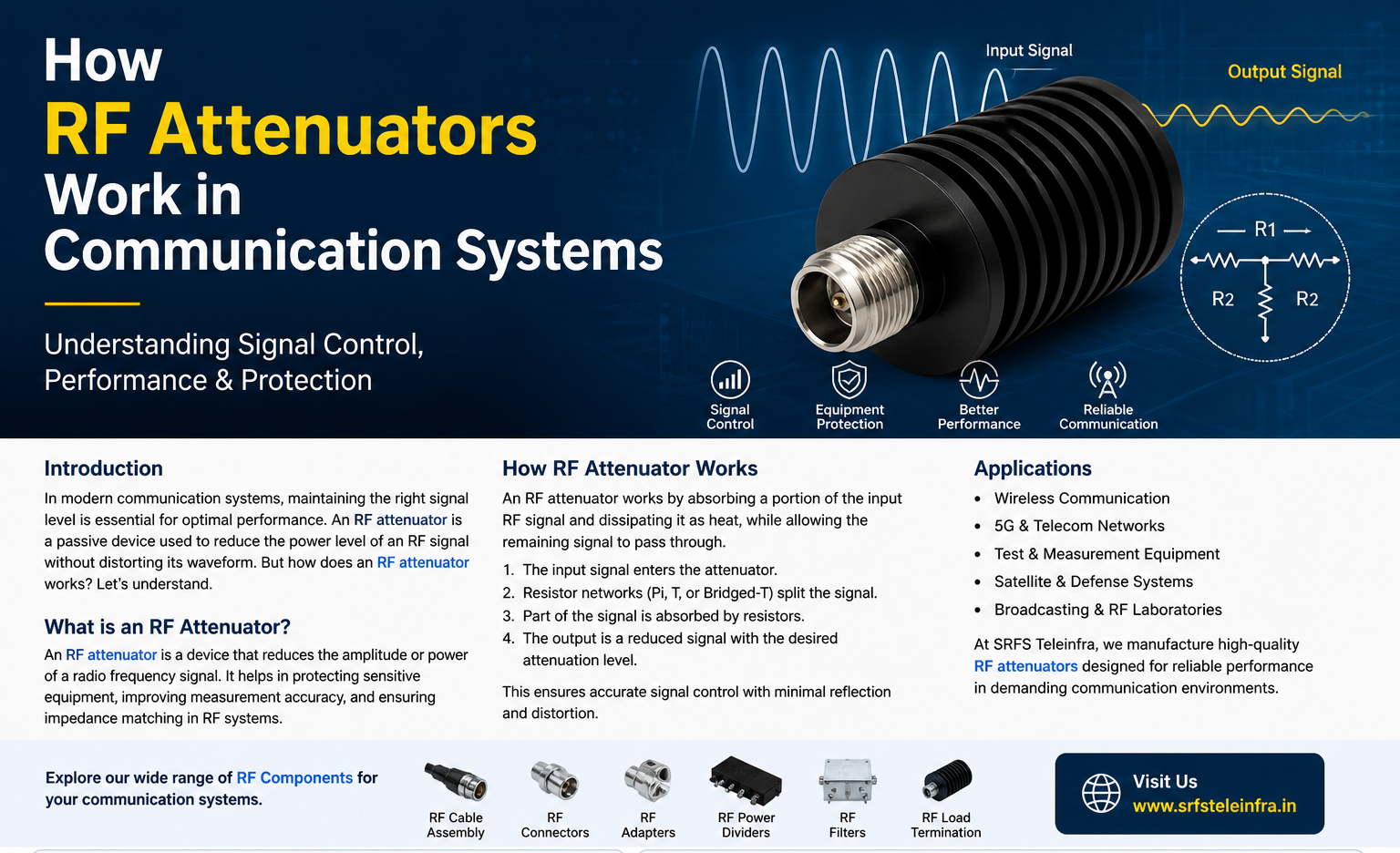
An RF attenuator works by converting a portion of the RF signal energy into heat through precision resistor networks.
The incoming RF signal enters the attenuator, where specially designed resistive circuits reduce its voltage and power while preserving the signal’s frequency characteristics.
The reduced signal exits the attenuator with:
- Lower signal power
- Minimal waveform distortion
- Low VSWR
- Excellent impedance matching
- Stable phase characteristics
Because RF attenuators maintain impedance, reflections are minimized, allowing communication systems to operate efficiently.
Basic Working Principle
The working process includes:
- RF signal enters the attenuator.
- Precision resistors absorb part of the RF energy.
- Signal power is reduced by a specified attenuation value.
- Remaining signal passes to the next RF component.
- Excess electrical energy is safely dissipated as heat.
The attenuation value remains constant over the specified frequency range for fixed attenuators.
Why RF Attenuators Are Important in Communication Systems
Modern communication systems require precise signal levels. Excessive RF power can cause:
- Receiver overload
- Signal distortion
- Equipment damage
- Increased noise
- Reduced measurement accuracy
RF attenuators solve these problems by maintaining optimal signal levels throughout the RF chain.
Main Functions of RF Attenuators
Signal Level Control
RF attenuators reduce excessively strong signals before they reach sensitive receivers.
Equipment Protection
They protect:
- Spectrum analyzers
- Vector Network Analyzers (VNAs)
- RF receivers
- Signal generators
- Power meters
- RF modules
from excessive input power.
Impedance Matching
Proper impedance matching reduces reflected signals and improves power transfer between RF components.
Measurement Accuracy
During RF testing and calibration, attenuators help instruments operate within their specified measurement range.
Noise Reduction
Controlled signal levels reduce unwanted distortion and improve the signal-to-noise ratio in communication systems.
Types of RF Attenuators
Fixed RF Attenuator
A fixed attenuator provides a constant attenuation value such as:
- 3 dB
- 6 dB
- 10 dB
- 20 dB
- 30 dB
- 40 dB
These are commonly used in production RF systems.
Variable RF Attenuator
Variable attenuators allow engineers to adjust attenuation manually or electronically for testing and laboratory applications.
Programmable RF Attenuator
Digital attenuators provide precise attenuation control through software or microcontrollers.
They are widely used in automated RF test systems.
Step Attenuator
Step attenuators provide multiple selectable attenuation levels with high repeatability.
Internal Construction of RF Attenuators
A high-quality RF attenuator typically consists of:
- Precision thin-film resistors
- High-frequency substrate
- Precision connectors
- Metal housing
- Heat dissipation structure
- Gold-plated contacts
- Low-loss internal transmission path
Premium attenuators are designed to maintain consistent electrical performance across wide frequency ranges.
Common RF Connector Types
RF attenuators are available with numerous connector interfaces including:
- SMA
- N Type
- 2.92 mm
- 2.4 mm
- 1.85 mm
- SMP
- SMPM
- TNC
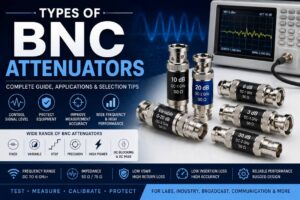
- BNC
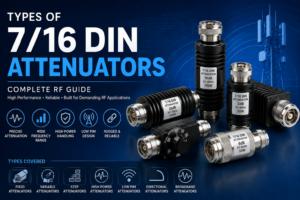
- 7/16 DIN
- QMA
- MCX
- MMCX
Connector selection depends on frequency, power rating, and application.
Applications of RF Attenuators in Communication Systems
5G Networks
In 5G infrastructure, RF attenuators help optimize signal power between antennas, radios, and test equipment.
Mobile Communication
Base stations use attenuators to control transmitted and received signal levels for reliable network performance.
Satellite Communication
Satellite ground stations use RF attenuators for signal conditioning and equipment protection.
Defense Communication
Military radar, electronic warfare, and secure communication systems require precision attenuation for accurate operation.
Aerospace Systems
Aircraft communication and navigation systems rely on RF attenuators for stable RF signal distribution.
Broadcasting
Television and radio transmitters use attenuators to maintain proper signal levels throughout RF distribution networks.
RF Testing Laboratories
Engineers use attenuators during:
- Calibration
- RF measurements
- Product validation
- EMC testing
- Receiver sensitivity testing
Wireless Research
Research laboratories employ RF attenuators while developing next-generation wireless technologies.
Advantages of RF Attenuators
RF attenuators offer numerous benefits:
- Excellent signal stability
- Accurate attenuation values
- Low insertion mismatch
- Low VSWR
- Wide frequency coverage
- High power handling capability
- Excellent repeatability
- Improved measurement accuracy
- Equipment protection
- Long operational life
- Maintenance-free operation
Factors to Consider When Selecting an RF Attenuator
When choosing an RF attenuator, consider:
Frequency Range
Ensure the attenuator supports your operating frequency.
Attenuation Value
Select the required attenuation level based on system design.
Power Rating
The attenuator should safely handle the maximum RF power.
Connector Type
Choose connectors compatible with existing RF equipment.
VSWR
Lower VSWR improves impedance matching and minimizes reflections.
Operating Temperature
Industrial and defense applications may require extended temperature ranges.
Mechanical Durability
High-quality connectors ensure long-term reliability.
RF Attenuator Specifications
Typical specifications include:
| Specification | Typical Value |
|---|---|
| Impedance | 50 Ohm / 75 Ohm |
| Frequency Range | DC to 110 GHz |
| Attenuation | 1 dB to 60 dB |
| Power Rating | 0.5 W to 500 W+ |
| VSWR | ≤1.20 typical |
| Connector Types | SMA, N, 2.92 mm, 2.4 mm, SMP, SMPM |
| Operating Temperature | -55°C to +125°C |
Specifications vary according to model and manufacturer.
RF Attenuators in 5G and Future Communication Systems
Emerging communication technologies require increasingly accurate RF signal control.
Applications include:
- Massive MIMO
- Beamforming systems
- mmWave communication
- Open RAN
- Private LTE
- 6G research
- High-frequency radar
- Quantum communication experiments
As operating frequencies continue to increase, precision RF attenuators will remain a critical component of advanced wireless systems.
Maintenance Tips
Although RF attenuators require minimal maintenance, good practices include:
- Keep RF connectors clean.
- Avoid exceeding the maximum power rating.
- Prevent connector damage during installation.
- Use calibrated torque wrenches.
- Store in dry environments.
- Periodically inspect connectors for wear.
Why Choose High-Quality RF Attenuators?
Premium RF attenuators provide:
- Stable attenuation across the frequency range
- Low insertion loss variation
- Excellent return loss
- Superior reliability
- High manufacturing precision
- Better thermal stability
- Long service life
- Consistent performance in demanding environments
Choosing a high-quality RF attenuator improves the overall reliability and accuracy of communication systems.
Conclusion
RF attenuators are indispensable components in modern communication systems. By reducing RF signal power while maintaining impedance matching, they protect sensitive equipment, improve measurement accuracy, reduce reflections, and ensure reliable signal transmission. From 5G infrastructure and satellite communication to defense electronics and RF testing laboratories, RF attenuators play a vital role in maintaining high-performance wireless networks. Selecting the right attenuator based on frequency, power rating, attenuation value, and connector type ensures optimal performance, longer equipment life, and superior communication reliability.
Frequently Asked Questions (FAQs)
What is an RF attenuator?
An RF attenuator is a passive device that reduces the power level of an RF signal while maintaining impedance matching and signal quality.
Why are RF attenuators used in communication systems?
They control signal strength, protect sensitive RF equipment, improve measurement accuracy, and reduce signal reflections.
How does an RF attenuator reduce signal power?
It uses precision resistor networks to convert part of the RF signal energy into heat while allowing the remaining signal to pass with minimal distortion.
What are the different types of RF attenuators?
The main types include fixed attenuators, variable attenuators, programmable attenuators, and step attenuators.
Where are RF attenuators commonly used?
They are widely used in 5G networks, satellite communication, defense systems, aerospace, RF laboratories, broadcasting, radar, and wireless infrastructure.
What attenuation values are commonly available?
Common attenuation values include 1 dB, 3 dB, 6 dB, 10 dB, 20 dB, 30 dB, and 40 dB, with custom values also available.
What connector types are available for RF attenuators?
Common connector types include SMA, N Type, 2.92 mm, 2.4 mm, 1.85 mm, SMP, SMPM, TNC, BNC, MCX, and MMCX.
What factors should be considered when selecting an RF attenuator?
Key factors include frequency range, attenuation value, power rating, impedance, connector type, VSWR, and operating temperature.
Do RF attenuators affect signal quality?
High-quality RF attenuators maintain excellent signal integrity with minimal distortion and low reflection across their operating frequency range.
Can RF attenuators be used in high-frequency applications?
Yes. Precision RF attenuators are designed for microwave and millimeter-wave applications, with some models supporting frequencies up to 110 GHz.