RF (Radio Frequency) connectors play an important role in modern communication systems by providing reliable connections between coaxial cables, antennas, RF equipment, and microwave devices. Among the widely used RF connector interfaces, the SMA Male Connector is a popular choice for applications requiring stable electrical performance, compact dimensions, and reliable mechanical connectivity.
SMA Male Connectors are commonly used in RF communication equipment, wireless networking systems, antenna assemblies, test and measurement instruments, microwave devices, and telecommunications infrastructure.
SMA stands for SubMiniature Version A. It is a threaded coaxial connector interface designed to provide a secure connection between RF components and coaxial cables. The SMA connector series is generally designed for a characteristic impedance of 50 Ohms.
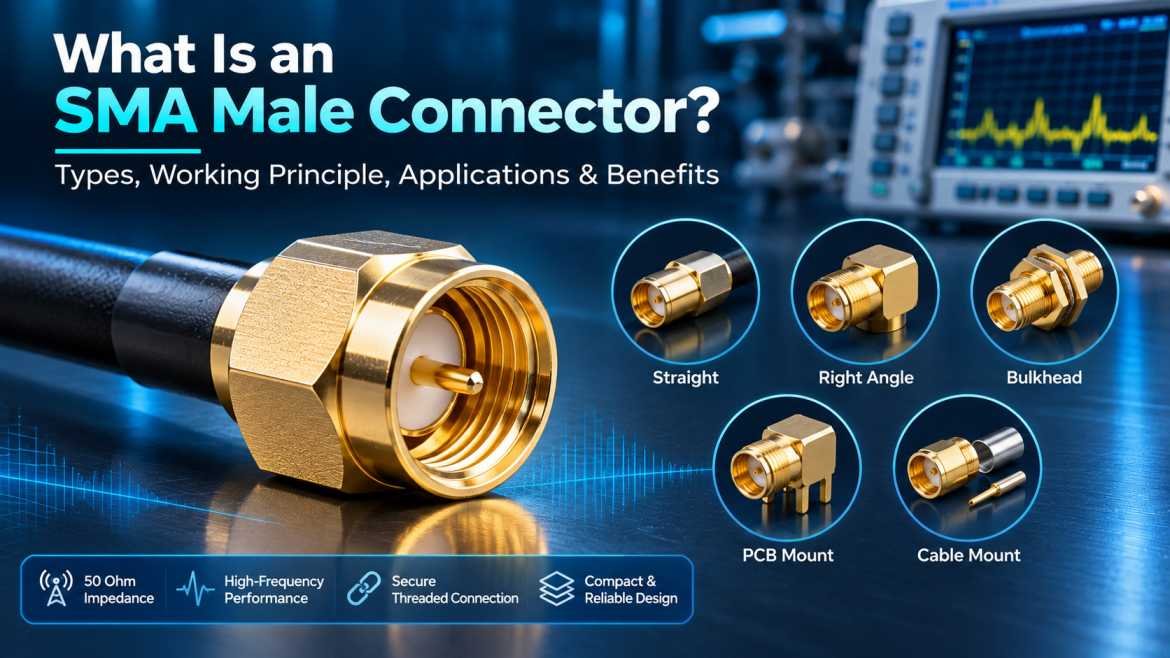
The SMA Male Connector is available in different configurations, including straight, right-angle, cable-mount, bulkhead, and PCB-mount versions. These configurations allow engineers and manufacturers to select the appropriate connector according to installation requirements and electrical performance specifications.
Understanding the design, working principle, types, specifications, and applications of SMA Male Connectors is essential for selecting the right RF connectivity solution.
What Is an SMA Male Connector?
An SMA Male Connector is a 50 Ohm coaxial RF connector designed to establish a secure electrical and mechanical connection between coaxial cables and compatible RF devices.
It is part of the SMA connector family and features a center contact pin surrounded by an insulating dielectric and an outer conductive body.
The male connector typically incorporates a threaded coupling nut that connects with the external threaded interface of a compatible SMA female connector. This threaded mechanism provides a secure connection and helps maintain consistent electrical contact.
SMA Male Connectors are designed to operate at radio frequencies and microwave frequencies. Their actual operating frequency depends on the connector design, materials, manufacturing precision, and cable configuration.
They are commonly used in applications where signal integrity, impedance matching, and mechanical reliability are important.
Construction of an SMA Male Connector
An SMA Male Connector consists of several precision-engineered components that work together to provide reliable RF signal transmission.
1. Center Contact Pin
The center contact pin is the primary signal-carrying element of the SMA Male Connector. It establishes electrical contact with the center socket of the mating SMA female connector.
It is generally manufactured from conductive materials such as brass or beryllium copper and may feature gold or other suitable plating.
2. Outer Conductor
The outer conductor provides the electrical ground connection and shielding required for coaxial signal transmission.
It is typically manufactured from brass or stainless steel, depending on the connector design and application.
3. Dielectric Insulator
The dielectric insulator separates the center conductor from the outer conductor while maintaining the required electrical characteristics.
PTFE (Polytetrafluoroethylene) is commonly used because of its dielectric properties and suitability for RF applications.
4. Threaded Coupling Mechanism
The threaded coupling mechanism allows the SMA Male Connector to connect securely with a compatible SMA Female Connector.
It provides mechanical stability and helps maintain consistent contact between the mating connector interfaces.
5. Connector Body
The connector body houses the internal components and provides mechanical protection.
It is manufactured with precision to maintain the required dimensional accuracy and electrical performance.
6. Cable Attachment Section
In cable-mount SMA Male Connectors, the rear section is designed to connect with the coaxial cable.
Depending on the connector design, cable termination may involve soldering, crimping, or other approved attachment methods.
How Does an SMA Male Connector Work?
An SMA Male Connector works by establishing a coaxial electrical connection between two compatible RF components.
Its operation is based on the transmission of electromagnetic signals through the center conductor while the outer conductor provides the ground return path and electromagnetic shielding.
The working process involves the following steps:
- Connector Alignment: The SMA Male Connector is aligned with the compatible SMA Female Connector.
- Threaded Connection: The coupling nut is tightened onto the external threads of the female connector.
- Electrical Contact: The male center pin engages with the female center socket to establish the signal connection.
- Ground Connection: The outer conductive surfaces establish the ground and shielding connection.
- RF Signal Transmission: The electromagnetic signal travels through the coaxial transmission path while maintaining the designed characteristic impedance.
A properly installed SMA connection helps minimize signal reflections, maintain signal integrity, and provide reliable RF performance.
For optimal performance, the connector should be tightened using the recommended torque specified by the manufacturer.
Types of SMA Male Connectors
SMA Male Connectors are available in several mechanical configurations to support different cable assemblies, equipment interfaces, and installation requirements.
1. SMA Male Straight Connector
An SMA Male Straight Connector features a straight cable-entry design and is commonly used in coaxial cable assemblies.
It provides a direct connection between RF cables and compatible SMA female interfaces.
Key Features:
- Straight connector configuration.
- Compact and reliable design.
- Suitable for cable assembly applications.
- Available for different coaxial cable types.
- Commonly used in RF and microwave systems.
2. SMA Male Right Angle Connector
An SMA Male Right Angle Connector features a 90-degree configuration that allows cable connections in restricted spaces.
It is useful in applications where straight connectors may create cable routing difficulties or require excessive installation space.
Key Features:
- 90-degree connector configuration.
- Suitable for compact equipment.
- Helps manage cable routing.
- Available in different cable termination styles.
- Commonly used in RF equipment and antenna assemblies.
3. SMA Male Bulkhead Connector
An SMA Male Bulkhead Connector is designed for installation through an equipment panel or enclosure.
It typically includes a mounting nut and threaded body to secure the connector mechanically.
Key Features:
- Panel-mount installation.
- Secure mechanical mounting.
- Suitable for equipment enclosures.
- Available in different termination configurations.
- Used in RF panels and communication equipment.
4. SMA Male Cable Mount Connector
An SMA Male Cable Mount Connector is designed to be attached directly to coaxial RF cables.
Depending on the design, it may support solder, crimp, or other specified cable termination methods.
Key Features:
- Designed for coaxial cable assemblies.
- Available for different cable diameters.
- Reliable electrical connection.
- Suitable for RF interconnections.
- Available in straight and right-angle versions.
5. SMA Male PCB Mount Connector
An SMA Male PCB Mount Connector is designed for direct installation on printed circuit boards.
It provides an RF interface between the PCB transmission line and an external coaxial cable assembly.
Key Features:
- PCB mounting configuration.
- Designed for RF circuit integration.
- Available in through-hole and other mounting styles.
- Suitable for RF modules and electronic equipment.
- Compact mechanical construction.
Common SMA Male Connector Configurations
SMA Male Connectors are available in different connector and cable combinations to meet specific RF connectivity requirements.
Common configurations include:
- SMA Male Straight for RG316 Cable
- SMA Male Straight for RG174 Cable
- SMA Male Straight for RG58 Cable
- SMA Male Right Angle for RG316 Cable
- SMA Male Bulkhead Connector
- SMA Male PCB Mount Connector
- SMA Male to SMA Male RF Cable Assembly
- SMA Male to N-Type Female Cable Assembly
- SMA Male to BNC Male Cable Assembly
- SMA Male to TNC Male Cable Assembly
The correct configuration depends on cable dimensions, mounting requirements, mating interface, and electrical specifications.
Technical Specifications of SMA Male Connector
When selecting an SMA Male Connector, it is important to understand its electrical and mechanical specifications.
The specifications may vary depending on the manufacturer, connector configuration, operating frequency, and cable compatibility.
| Specification | Description |
|---|---|
| Product Type | SMA Male Connector |
| Connector Series | SMA |
| Connector Gender | Male |
| Characteristic Impedance | 50 Ohms |
| Coupling Mechanism | Threaded |
| Center Contact | Male Pin |
| Mating Interface | Compatible SMA Female |
| Frequency Range | Depends on connector design; commonly available up to 18 GHz |
| Body Material | Brass / Stainless Steel |
| Center Contact Material | Brass / Beryllium Copper |
| Plating | Gold / Nickel / Other specified plating |
| Insulator Material | PTFE or suitable dielectric |
| Connector Configuration | Straight / Right Angle |
| Mounting Type | Cable Mount / Bulkhead / PCB Mount |
| Cable Termination | Solder / Crimp / Other specified method |
| Application | RF, Microwave and Communication Systems |
Note: The frequency range, VSWR, insertion loss, and power-handling specifications must be verified using the individual manufacturer’s datasheet. Not all SMA connectors support the same frequency range.
Electrical Characteristics of SMA Male Connectors
The electrical characteristics of an SMA Male Connector are important for maintaining reliable RF signal transmission.
1. Characteristic Impedance
Most standard SMA connectors are designed for a characteristic impedance of 50 Ohms.
Maintaining impedance compatibility between connectors, cables, and RF equipment helps reduce signal reflections.
2. Operating Frequency
SMA Male Connectors are widely used in RF and microwave applications.
Standard designs commonly support frequencies up to 18 GHz, while precision connector versions can support higher frequencies depending on their construction and specifications.
3. VSWR (Voltage Standing Wave Ratio)
VSWR indicates the degree of impedance matching within an RF transmission system.
A lower VSWR generally indicates better impedance matching and reduced signal reflection.
4. Insertion Loss
Insertion loss represents the amount of signal power lost when an RF signal passes through a connector or connection assembly.
A properly designed SMA Male Connector helps minimize unwanted signal loss.
5. Return Loss
Return loss measures the amount of signal power reflected back toward the source because of impedance mismatches.
Higher return loss generally indicates better impedance matching.
Applications of SMA Male Connectors
SMA Male Connectors are widely used in industries that require dependable RF and microwave connectivity.
1. Telecommunications
SMA Male Connectors are used in telecommunications equipment to establish RF connections between cables, antennas, wireless modules, and communication devices.
They support RF signal transmission in different communication systems.
2. Antenna Systems
SMA Male Connectors are commonly used in antenna assemblies to connect coaxial cables with RF antennas.
They are found in GPS antennas, Wi-Fi antennas, cellular antennas, and other wireless communication equipment.
3. RF and Microwave Testing
Test and measurement equipment uses SMA Male Connectors to establish RF connections between instruments and devices under test.
They are commonly used with spectrum analyzers, signal generators, network analyzers, and other RF measurement equipment.
4. Wireless Communication Systems
SMA Male Connectors are used in wireless modules, communication devices, and RF transceiver systems.
They help provide compact and secure RF connectivity.
5. Aerospace and Defence
Aerospace and defence applications require reliable RF connections for communication, navigation, monitoring, and electronic systems.
SMA connectors are used in suitable equipment where their electrical and mechanical specifications meet the application requirements.
6. IoT and Embedded Electronics
SMA Male Connectors are used in IoT devices, wireless communication modules, embedded systems, and electronic development boards.
They provide an external RF interface for antennas and coaxial cable assemblies.
7. Laboratory and Research Equipment
Research laboratories use SMA Male Connectors in RF experiments, microwave measurements, testing setups, and electronic development projects.
Benefits of Using SMA Male Connectors
SMA Male Connectors provide several advantages for RF and microwave applications.
1. Reliable Mechanical Connection
The threaded coupling mechanism provides a secure connection and helps prevent accidental disconnection.
2. 50 Ohm Impedance Compatibility
Standard SMA connectors are designed for 50 Ohm RF systems, making them suitable for a wide range of RF and microwave applications.
3. Compact Design
Their small form factor makes SMA Male Connectors suitable for compact electronic equipment and space-constrained installations.
4. Wide Frequency Applications
SMA connectors are available in different performance grades for applications ranging from low-frequency RF to microwave and higher-frequency systems.
5. Multiple Configurations
Straight, right-angle, bulkhead, cable-mount, and PCB-mount configurations provide flexibility for different installation requirements.
6. Reusable Connection
The threaded interface allows connectors to be disconnected and reconnected when required, provided they are handled and maintained correctly.
7. Versatile Cable Compatibility
SMA Male Connectors are available for several coaxial cable types, including RG174, RG316, and other RF cables.
Difference Between SMA Male and SMA Female Connectors
SMA Male and SMA Female Connectors are complementary interfaces used to establish coaxial RF connections.
Understanding their physical differences is important when selecting compatible RF components.
| Parameter | SMA Male Connector | SMA Female Connector |
|---|---|---|
| Connector Gender | Male | Female |
| Center Contact | Pin | Socket |
| Coupling Interface | Internally threaded coupling nut | Externally threaded interface |
| Mating Connection | Connects with SMA Female | Connects with SMA Male |
| Common Application | Cable assemblies and RF connections | Equipment ports and cable assemblies |
| Impedance | 50 Ohms | 50 Ohms |
| Configuration | Straight, right angle, bulkhead, etc. | Straight, right angle, bulkhead, etc. |
Both connector types must have compatible SMA interfaces and matching electrical specifications to ensure proper performance.
SMA Male Connector vs BNC Connector
SMA and BNC are two commonly used coaxial RF connector series, but they have different mechanical designs and applications.
| Parameter | SMA Connector | BNC Connector |
|---|---|---|
| Coupling Mechanism | Threaded | Bayonet |
| Typical Impedance | 50 Ohms | 50 Ohms or 75 Ohms |
| Physical Size | Compact | Relatively larger |
| Frequency Capability | Generally higher | Generally lower |
| Connection | Secure threaded coupling | Quick connect/disconnect |
| Applications | RF and microwave systems | Test equipment, video and RF systems |
The appropriate connector depends on the operating frequency, impedance, mechanical requirements, and application.
Factors to Consider When Selecting an SMA Male Connector
Selecting the correct SMA Male Connector is important for maintaining RF system performance and ensuring mechanical compatibility.
Consider the following factors before purchasing:
1. Operating Frequency
Check the frequency range required by your application. Select an SMA Male Connector designed to operate within the specified frequency band.
2. Characteristic Impedance
Ensure that the connector has a 50 Ohm impedance rating if it is being used in a standard 50 Ohm RF system.
3. Cable Compatibility
Verify the coaxial cable type and outer diameter before selecting a cable-mount connector.
Different connectors are designed for different cable constructions.
4. Connector Configuration
Choose between straight, right-angle, bulkhead, and PCB-mount configurations according to installation requirements.
5. Material and Plating
Consider the connector body material, center contact material, and plating according to environmental conditions and electrical requirements.
6. VSWR and Return Loss
Check the VSWR and return loss specifications to ensure the connector meets the performance requirements of your RF system.
7. Power Handling Capacity
Verify the maximum power rating at the intended operating frequency and environmental conditions.
8. Mating Compatibility
Ensure that the connector follows the required SMA interface dimensions and is compatible with the intended mating connector.
9. Installation Requirements
Check whether the application requires solder, crimp, panel mounting, or PCB mounting.
10. Manufacturer Quality
Choose precision-manufactured connectors with documented electrical and mechanical specifications.
Best Practices for SMA Male Connector Installation
Proper installation and handling help maintain the electrical performance and service life of SMA Male Connectors.
- Inspect the connector interface before installation.
- Keep the center contact pin clean and free from damage.
- Avoid cross-threading during connection.
- Use the recommended torque wrench and tightening torque.
- Do not overtighten the coupling nut.
- Avoid excessive bending or pulling of connected coaxial cables.
- Protect unused connectors with suitable dust caps.
- Avoid connecting damaged or incompatible interfaces.
- Follow the manufacturer’s installation instructions.
- Perform appropriate RF testing after installation when required.
These practices help reduce connection failures, mechanical damage, and unwanted signal reflections.
Why Are SMA Male Connectors Important in RF and Microwave Systems?
Modern RF and microwave systems require reliable connections to transfer high-frequency signals between different components.
SMA Male Connectors provide a standardized threaded coaxial interface that supports compact, secure, and repeatable RF connections.
Their versatility makes them suitable for antenna systems, wireless communication equipment, microwave test instruments, RF cable assemblies, and electronic devices.
As wireless communication, IoT, telecommunications, and microwave technologies continue to develop, SMA Male Connectors remain important components in RF connectivity solutions.
Conclusion
The SMA Male Connector is an essential 50 Ohm coaxial RF component used to establish secure electrical connections between coaxial cables and compatible RF devices.
Its threaded coupling mechanism, compact design, reliable electrical interface, and availability in multiple configurations make it suitable for a wide range of RF and microwave applications.
From telecommunications and antenna systems to aerospace equipment, wireless modules, and precision test instruments, SMA Male Connectors support reliable high-frequency signal transmission.
Selecting the right SMA Male Connector requires careful consideration of operating frequency, impedance, cable compatibility, connector configuration, VSWR, return loss, and power-handling capacity.
For RF manufacturers, telecom infrastructure providers, system integrators, and electronic equipment designers, choosing the appropriate SMA Male Connector is important for maintaining dependable RF connectivity and system performance.
Frequently Asked Questions (FAQs)
1. What is an SMA Male Connector?
An SMA Male Connector is a 50 Ohm coaxial RF connector featuring a center contact pin and threaded coupling mechanism. It is used to connect coaxial cables with compatible SMA Female interfaces.
2. What does SMA stand for?
SMA stands for SubMiniature Version A. It is a threaded coaxial connector series widely used in RF and microwave applications.
3. What is the impedance of an SMA Male Connector?
Standard SMA Male Connectors are designed for a characteristic impedance of 50 Ohms.
4. What is the frequency range of an SMA Male Connector?
The frequency range depends on the connector design and manufacturing precision. Standard SMA connectors commonly support frequencies up to 18 GHz, while specialized precision versions may support higher frequencies.
5. What is the difference between SMA Male and SMA Female Connectors?
An SMA Male Connector features a center pin and an internally threaded coupling nut, while an SMA Female Connector features a center socket and an externally threaded mating interface.
6. What are the different types of SMA Male Connectors?
Common types include straight SMA Male Connectors, right-angle SMA Male Connectors, bulkhead SMA Male Connectors, cable-mount connectors, and PCB-mount connectors.
7. Which cables are compatible with SMA Male Connectors?
Depending on the connector design, SMA Male Connectors are available for coaxial cables such as RG174, RG316, RG58, and other compatible RF cable types.
8. Where are SMA Male Connectors commonly used?
They are commonly used in telecommunications, antenna assemblies, RF test equipment, wireless communication systems, aerospace electronics, IoT devices, and microwave applications.
9. Are SMA Male Connectors suitable for microwave applications?
Yes. SMA Male Connectors are widely used in microwave systems within their specified operating frequency and performance limits.
10. How do I select the right SMA Male Connector?
Consider the operating frequency, 50 Ohm impedance, cable type, connector configuration, mating interface, VSWR, return loss, and power-handling requirements.
SEO Keywords
Primary Keyword:
- SMA Male Connector
Secondary Keywords:
- SMA Connector
- SMA Male RF Connector
- 50 Ohm SMA Connector
- SMA Coaxial Connector
- SMA Male RF Coaxial Connector
- SMA Male Cable Connector
- SMA Male Straight Connector
- SMA Male Right Angle Connector
- SMA Male Bulkhead Connector
- SMA Male PCB Mount Connector
Long-Tail Keywords:
- What is an SMA Male Connector?
- SMA Male Connector specifications
- SMA Male Connector working principle
- Types of SMA Male Connectors
- SMA Male Connector applications
- SMA Male Connector frequency range
- SMA Male Connector for RG316 cable
- SMA Male vs SMA Female Connector
- 50 Ohm RF SMA Male Connector
- How to select an SMA Male Connector
Recommended Internal Linking Opportunities:
For better SEO and website navigation, link this article to relevant SRFS Teleinfra product pages and categories wherever available:
- SMA Female Connectors
- SMA Cable Assemblies
- SMA Adapters
- SMA Attenuators
- RF Coaxial Connectors
- RF Cable Assemblies
- Microwave Connectors
- RF and Microwave Components
These internal links can help improve topical relevance, strengthen product-category relationships, and support organic search visibility.