Fiber optic communication has become an essential part of modern telecommunications, data centers, networking infrastructure, and high-speed internet connectivity. As the demand for faster data transmission and reliable network performance continues to grow, fiber optic components play an important role in connecting different network devices and equipment.
A Fiber Patch Cord is one of the most commonly used components in fiber optic communication systems. It provides a flexible connection between optical networking devices, switches, routers, servers, patch panels, and other fiber optic equipment.
Fiber Patch Cords are designed to transmit data using light signals through optical fibers. Unlike traditional copper cables, they offer high bandwidth, low signal attenuation, immunity to electromagnetic interference, and reliable performance over long distances.
They are widely used in telecommunications networks, enterprise networking, broadband infrastructure, FTTH installations, data centers, and industrial communication systems.
Understanding the construction, types, connector configurations, and applications of Fiber Patch Cords is important for selecting the right solution for efficient and reliable fiber optic connectivity.
What Is a Fiber Patch Cord?
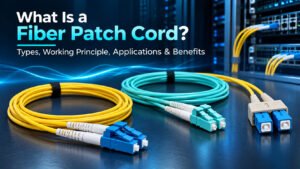
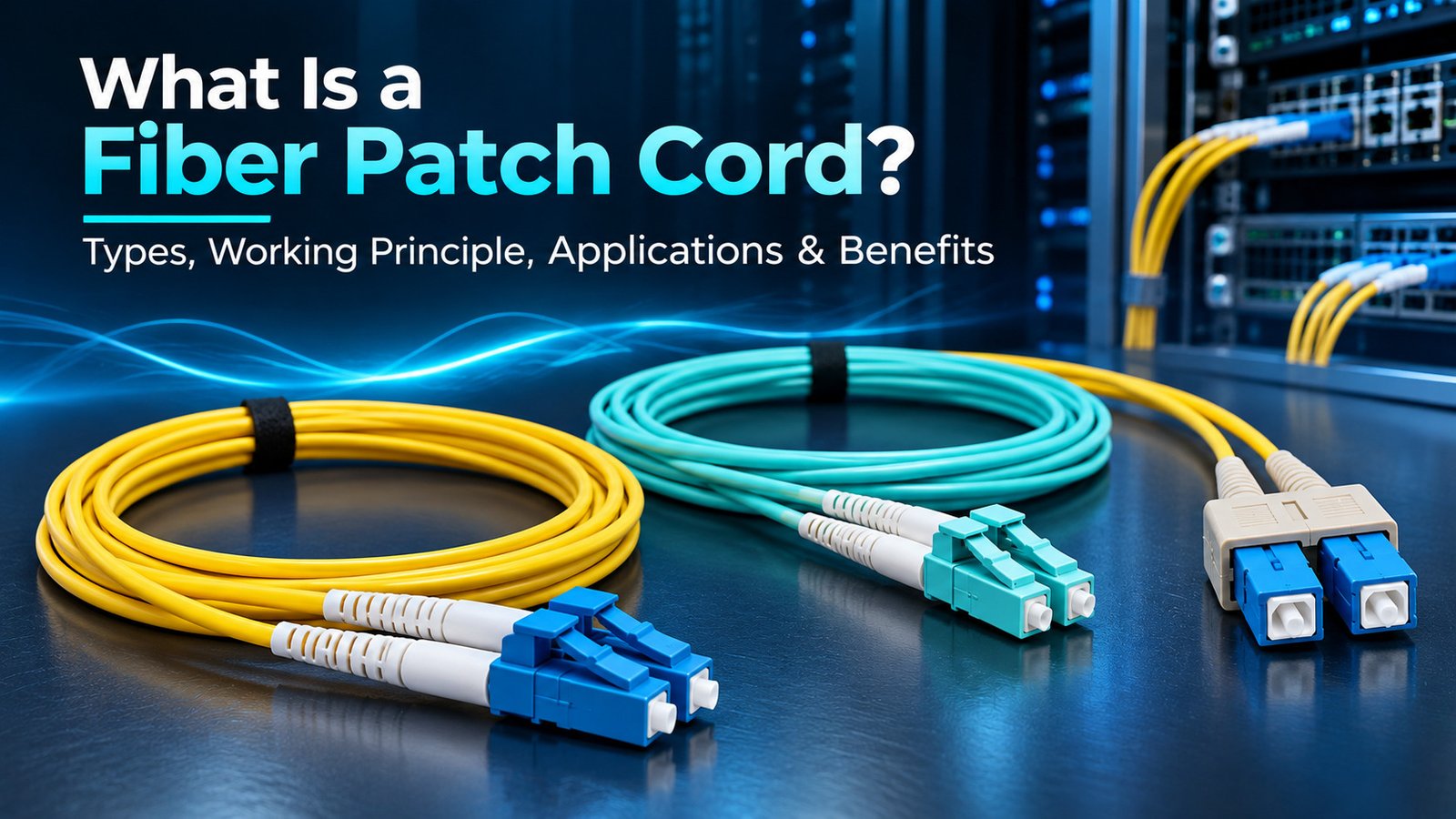
A Fiber Patch Cord, also known as a Fiber Optic Patch Cable or Fiber Jumper, is a short fiber optic cable assembly with optical connectors terminated at both ends.
It is used to establish connections between two fiber optic devices or between networking equipment and fiber distribution panels.
A typical Fiber Patch Cord consists of one or more optical fibers protected by an outer cable jacket and fitted with compatible connectors such as SC, LC, FC, or ST.
The connectors allow the cable to be connected and disconnected easily without requiring permanent splicing.
Fiber Patch Cords transmit information through light signals rather than electrical signals. This makes them suitable for high-speed data transmission and communication systems where signal quality and transmission reliability are important.
Depending on the application, Fiber Patch Cords are available in single-mode and multimode configurations, different connector combinations, various cable lengths, and different polishing types.
How Does a Fiber Patch Cord Work?
A Fiber Patch Cord works by transmitting optical signals from one device to another through a glass or plastic optical fiber.
The basic working principle is based on the transmission of light through the optical fiber core using the principle of total internal reflection.
When an optical transmitter converts electrical information into light signals, the light travels through the fiber optic cable and reaches the receiving device, where it is converted back into electrical information.
The operation involves the following steps:
- Optical Signal Generation: An optical transmitter, such as a laser diode or LED, generates light signals containing digital information.
- Signal Transmission: The light signals enter the optical fiber core and travel through the cable.
- Light Guidance: The fiber core and surrounding cladding guide the light through total internal reflection.
- Optical Connection: Fiber Patch Cord connectors provide an interface between the cable and networking equipment.
- Signal Reception: The receiving optical device detects the light signals and converts them into electrical data.
The quality of the Fiber Patch Cord, connector alignment, end-face cleanliness, and polishing condition directly influence optical transmission performance.
Main Components of a Fiber Patch Cord
A Fiber Patch Cord consists of several components that work together to ensure reliable optical connectivity.
1. Optical Fiber Core
The core is the central part of the optical fiber through which light signals travel. It is generally manufactured using high-quality glass or, in some applications, plastic materials.
The core diameter depends on whether the cable is designed for single-mode or multimode transmission.
2. Cladding
The cladding surrounds the optical fiber core and has a lower refractive index than the core.
It helps guide light through total internal reflection, allowing optical signals to travel efficiently through the fiber.
3. Protective Coating
The protective coating surrounds the glass fiber and protects it against moisture, scratches, and minor mechanical damage.
4. Strength Members
Strength members provide mechanical support and help protect the optical fiber from excessive pulling forces during installation and handling.
Common materials include aramid yarn and other suitable reinforcing materials.
5. Outer Jacket
The outer jacket protects the internal cable components from environmental exposure, abrasion, and mechanical damage.
Depending on the installation environment, Fiber Patch Cords may use PVC, LSZH, or other jacket materials.
6. Optical Connectors
Optical connectors are installed at both ends of the Fiber Patch Cord to provide connectivity with networking devices and fiber optic equipment.
Common connector types include LC, SC, FC, and ST.
Types of Fiber Patch Cords
Fiber Patch Cords are available in different configurations depending on transmission requirements, network architecture, connector compatibility, and installation conditions.
1. Single Mode Fiber Patch Cord
A Single Mode Fiber Patch Cord is designed to transmit optical signals over a small-diameter fiber core, typically 9/125 µm.
It allows light to travel primarily through a single propagation mode, making it suitable for long-distance and high-bandwidth communication applications.
Single Mode Fiber Patch Cords are commonly used in telecommunications networks, long-distance data transmission, FTTH infrastructure, and service provider networks.
Key Features:
- Typically uses 9/125 µm optical fiber.
- Suitable for long-distance transmission.
- Supports high-bandwidth communication.
- Low modal dispersion.
- Commonly used with single-mode optical transceivers.
2. Multimode Fiber Patch Cord
A Multimode Fiber Patch Cord is designed to transmit optical signals through multiple propagation modes.
It generally has a larger core diameter than single-mode fiber, with common configurations including 50/125 µm and 62.5/125 µm.
Multimode Fiber Patch Cords are widely used in data centers, enterprise networks, server rooms, and short-distance communication systems.
Key Features:
- Available in 50/125 µm and 62.5/125 µm configurations.
- Suitable for short-distance communication.
- Commonly used in enterprise networking.
- Supports high-speed data transmission over supported distances.
- Compatible with appropriate multimode optical transceivers.
3. Simplex Fiber Patch Cord
A Simplex Fiber Patch Cord contains a single optical fiber and is designed for transmitting optical signals in one direction.
It is commonly used in applications where only one optical fiber is required for a particular connection.
4. Duplex Fiber Patch Cord
A Duplex Fiber Patch Cord contains two optical fibers within a single cable assembly.
It is commonly used for bidirectional communication, with one fiber carrying transmitted signals and the other carrying received signals.
Duplex Fiber Patch Cords are widely used in networking switches, servers, optical transceivers, and data center infrastructure.
5. Armored Fiber Patch Cord
An Armored Fiber Patch Cord includes additional mechanical protection to protect the internal optical fibers from external damage.
It is suitable for industrial environments, equipment installations, and locations where additional mechanical protection is required.
6. Uniboot Fiber Patch Cord
A Uniboot Fiber Patch Cord combines two optical fibers into a compact cable structure with a specially designed connector housing.
It helps reduce cable congestion and improve cable management in high-density data centers and networking cabinets.
Common Fiber Patch Cord Connector Types
Fiber Patch Cords are available with different connector types to ensure compatibility with optical networking equipment.
The most commonly used fiber optic connectors include:
1. LC Connector
LC stands for Lucent Connector. It is a small-form-factor optical connector widely used in modern networking equipment.
LC connectors are popular in high-density data centers, optical switches, routers, and transceiver modules.
Key Characteristics:
- Compact design.
- Small-form-factor connector.
- Commonly uses a push-pull or latch mechanism.
- Available in single-mode and multimode configurations.
2. SC Connector
SC stands for Subscriber Connector or Standard Connector. It is a widely used fiber optic connector featuring a push-pull coupling mechanism.
SC connectors are commonly used in telecommunications networks, FTTH installations, and fiber distribution systems.
Key Characteristics:
- Square-shaped connector housing.
- Push-pull coupling mechanism.
- Reliable connection performance.
- Available in simplex and duplex configurations.
3. FC Connector
FC stands for Ferrule Connector. It uses a threaded coupling mechanism to provide a secure connection.
FC connectors are commonly used in test equipment, measurement systems, and applications requiring a stable mechanical connection.
Key Characteristics:
- Threaded coupling mechanism.
- Secure connector attachment.
- Available in single-mode and multimode versions.
- Suitable for precision optical applications.
4. ST Connector
ST stands for Straight Tip. It features a bayonet-style coupling mechanism and is commonly used in older networking installations and certain industrial communication systems.
Key Characteristics:
- Round connector design.
- Bayonet coupling mechanism.
- Easy installation and removal.
- Available in single-mode and multimode configurations.
Fiber Patch Cord Polishing Types
The polishing type of a Fiber Patch Cord connector affects the physical contact between the connector end faces and the resulting optical return loss.
Common polishing configurations include:
1. PC (Physical Contact)
PC connectors have a slightly convex polished end face that helps achieve physical contact between mating fiber connectors.
2. UPC (Ultra Physical Contact)
UPC connectors use a more refined polishing process to improve the surface finish and reduce optical back reflections compared with conventional PC connectors.
They are commonly used in telecommunications and data communication applications.
3. APC (Angled Physical Contact)
APC connectors feature an angled end-face polish, typically 8 degrees, which directs reflected light away from the optical source.
They provide lower optical return loss and are commonly used in applications such as FTTH, CATV, and certain optical transmission systems.
Important: APC and UPC connectors should not be directly mated together because their different end-face geometries can cause poor optical contact and potential connector damage.
Fiber Patch Cord Colour Identification
Fiber Patch Cords are available in different jacket colours to help identify fiber types and applications.
| Fibre Type | Common Cable Colour | Application |
|---|---|---|
| Single Mode OS1/OS2 | Yellow | Telecommunications and long-distance networks |
| Multimode OM1 | Orange | Legacy multimode networks |
| Multimode OM2 | Orange | Enterprise and short-distance networks |
| Multimode OM3 | Aqua | High-speed data center networks |
| Multimode OM4 | Aqua or Erika Violet | High-bandwidth data center networks |
| Multimode OM5 | Lime Green | Wideband multimode applications |
Note: Cable colour conventions may vary by manufacturer and regional standards. Always verify the cable markings and specifications rather than relying only on jacket colour.
Key Technical Specifications of Fiber Patch Cord
When selecting a Fiber Patch Cord, it is important to understand its technical specifications to ensure compatibility with the optical network.
| Specification | Description |
|---|---|
| Product Type | Fiber Optic Patch Cord |
| Fiber Type | Single Mode / Multimode |
| Fiber Core Size | 9/125 µm, 50/125 µm, 62.5/125 µm |
| Connector Type | LC, SC, FC, ST |
| Connector Configuration | LC-LC, SC-SC, LC-SC, FC-FC, etc. |
| Polishing Type | PC, UPC, APC |
| Cable Configuration | Simplex / Duplex |
| Cable Length | As per application requirement |
| Cable Jacket | PVC / LSZH / Other suitable materials |
| Insertion Loss | Depends on connector and manufacturing quality |
| Return Loss | Depends on fiber type and connector polishing |
| Operating Wavelength | Depends on fiber type and application |
| Operating Temperature | As per manufacturer’s specification |
| Application | Telecom, Data Centers, FTTH, LAN and Optical Networks |
Note: Actual specifications vary according to the fiber grade, connector type, cable construction, and manufacturer.
Applications of Fiber Patch Cord
Fiber Patch Cords are used in various industries and communication networks where reliable optical connectivity is required.
1. Telecommunications Networks
Fiber Patch Cords are widely used in telecommunications infrastructure to connect optical transmission equipment, distribution panels, switches, and network devices.
They support high-speed data communication and reliable connectivity in modern telecom networks.
2. Data Centers
Data centers require high-speed and high-density connectivity between servers, switches, routers, and storage systems.
Fiber Patch Cords provide reliable optical connections and help support efficient network infrastructure.
3. FTTH (Fiber to the Home)
Fiber Patch Cords are used in Fiber to the Home installations to connect optical network terminals, distribution boxes, and other fiber optic equipment.
They help deliver high-speed broadband services to residential and commercial users.
4. Enterprise Networking
Corporate offices, educational institutions, hospitals, and commercial buildings use Fiber Patch Cords to establish connections between networking equipment and fiber distribution systems.
5. Industrial Communication
Industrial facilities use fiber optic communication to transmit data between control systems, monitoring equipment, and automation devices.
Fiber Patch Cords are particularly useful in environments where immunity to electromagnetic interference is important.
6. Cable Television (CATV)
Fiber Patch Cords are used in optical transmission systems for cable television networks, connecting optical transmitters, receivers, and distribution equipment.
7. Testing and Measurement Equipment
Fiber Patch Cords are used in optical testing laboratories to connect optical power meters, light sources, optical time-domain reflectometers (OTDRs), and other measurement equipment.
They support optical testing, troubleshooting, and network maintenance.
Benefits of Using Fiber Patch Cords
Fiber Patch Cords provide several advantages in modern communication and networking infrastructure.
1. High-Speed Data Transmission
Fiber Patch Cords support high-speed optical communication and are suitable for applications requiring substantial bandwidth.
2. Low Signal Attenuation
Optical fiber offers low transmission loss over suitable distances, helping maintain signal quality in communication networks.
3. Immunity to Electromagnetic Interference
Unlike copper cables, optical fiber does not carry electrical signals. This makes Fiber Patch Cords immune to electromagnetic interference and radio frequency interference.
4. Compact and Lightweight Design
Fiber Patch Cords are generally lightweight and compact, making them suitable for high-density networking environments.
5. Easy Installation and Maintenance
Pre-terminated connectors allow Fiber Patch Cords to be installed and replaced without requiring permanent fiber splicing.
6. Reliable Network Connectivity
High-quality Fiber Patch Cords provide stable optical connections when properly installed, cleaned, and maintained.
7. Flexible Connectivity Options
They are available in multiple connector types, fiber configurations, lengths, and polishing options to meet different networking requirements.
Difference Between Single Mode and Multimode Fiber Patch Cord
Single Mode and Multimode Fiber Patch Cords are designed for different optical transmission requirements.
| Parameter | Single Mode Fiber Patch Cord | Multimode Fiber Patch Cord |
|---|---|---|
| Core Diameter | Typically 9 µm | 50 µm or 62.5 µm |
| Cladding Diameter | 125 µm | 125 µm |
| Light Transmission | Primarily single propagation mode | Multiple propagation modes |
| Transmission Distance | Suitable for long distances | Generally used for shorter distances |
| Bandwidth | Supports high bandwidth over long distances | Supports high bandwidth over application-specific distances |
| Light Source | Laser-based sources | VCSEL or LED, depending on system |
| Common Applications | Telecom, FTTH, long-distance links | Data centers, LAN, enterprise networks |
| Common Jacket Colour | Yellow | Orange, Aqua, or other standard colours |
Difference Between Fiber Patch Cord and Fiber Pigtail
Fiber Patch Cords and Fiber Pigtails are both used in fiber optic communication systems, but their construction and applications are different.
| Parameter | Fiber Patch Cord | Fiber Pigtail |
|---|---|---|
| Connector | Connectors at both ends | Connector at one end only |
| Other End | Pre-terminated connector | Bare optical fiber |
| Installation | Direct equipment connection | Generally requires fusion splicing |
| Application | Connecting optical devices and panels | Terminating optical fibers inside splice trays |
| Maintenance | Easy replacement | Requires splicing for replacement |
| Usage | Network patching and connectivity | Fiber cable termination |
Factors to Consider When Selecting a Fiber Patch Cord
Choosing the correct Fiber Patch Cord is important for maintaining optical network performance and minimizing signal loss.
Consider the following factors before purchasing:
1. Fiber Type
Determine whether your application requires single-mode or multimode fiber. The selected patch cord must match the optical equipment and installed network.
2. Connector Type
Check the connector interface required by your equipment. Common options include LC, SC, FC, and ST.
3. Connector Polishing
Select PC, UPC, or APC polishing according to the optical interface requirements. Ensure that the mating connectors have compatible polishing types.
4. Cable Length
Choose an appropriate cable length to avoid unnecessary cable congestion, excessive bending, and installation difficulties.
5. Simplex or Duplex Configuration
Select simplex for a single-fiber connection and duplex when separate transmit and receive fibers are required.
6. Insertion Loss
Check the insertion loss specifications to ensure minimal optical signal loss at the connector interfaces.
7. Return Loss
Return loss is an important parameter for applications sensitive to reflected optical signals. APC connectors are often selected where low back reflection is required.
8. Cable Jacket Material
Choose PVC, LSZH, or another suitable jacket material depending on the installation environment and fire-safety requirements.
9. Operating Environment
Consider temperature, humidity, mechanical stress, and installation conditions before selecting a Fiber Patch Cord.
10. Quality and Manufacturing Standards
Select products manufactured and tested according to applicable optical fiber and connector performance standards.
Best Practices for Fiber Patch Cord Installation and Maintenance
Proper handling and maintenance help maintain the performance and service life of Fiber Patch Cords.
- Always clean connector end faces before installation.
- Use appropriate fiber optic cleaning tools.
- Avoid touching exposed connector end faces.
- Never look directly into an active optical fiber connector.
- Maintain the minimum bending radius specified by the manufacturer.
- Avoid excessive pulling or twisting during installation.
- Use protective dust caps when connectors are not in use.
- Inspect connector end faces using a suitable fiber inspection microscope.
- Avoid connecting incompatible APC and UPC connectors.
- Store unused Fiber Patch Cords in a clean and dry environment.
Following these practices helps reduce contamination, insertion loss, and potential connector damage.
Why Are Fiber Patch Cords Important in Modern Networking?
Modern networking infrastructure requires reliable, high-speed, and scalable data transmission. Fiber Patch Cords provide the physical optical connections that allow different network devices to communicate efficiently.
As telecommunications networks, 5G infrastructure, cloud computing, data centers, and broadband services continue to expand, the demand for reliable fiber optic connectivity is increasing.
Fiber Patch Cords help simplify network installation, support high-density connectivity, and provide flexible connections between optical devices.
Their ability to support different fiber types, connector interfaces, and cable configurations makes them essential components in modern optical communication systems.
Conclusion
A Fiber Patch Cord is an essential fiber optic cable assembly used to establish optical connections between networking devices, switches, routers, servers, patch panels, and communication equipment.
Available in single-mode, multimode, simplex, duplex, armored, and uniboot configurations, Fiber Patch Cords support a wide range of telecommunications and networking applications.
Their high-speed transmission capabilities, low signal attenuation, immunity to electromagnetic interference, and flexible connector options make them suitable for data centers, FTTH networks, enterprise networking, industrial communication, and telecommunications infrastructure.
Selecting the right Fiber Patch Cord requires careful consideration of fiber type, connector configuration, polishing type, cable length, insertion loss, and operating environment.
For telecom operators, network integrators, system designers, and infrastructure providers, choosing the appropriate Fiber Patch Cord is important for maintaining reliable and efficient optical network connectivity.
Frequently Asked Questions (FAQs)
1. What is a Fiber Patch Cord used for?
A Fiber Patch Cord is used to connect two fiber optic devices or networking components. It is commonly used in data centers, telecommunications networks, FTTH installations, and enterprise networking systems.
2. What are the different types of Fiber Patch Cords?
Common types include single-mode, multimode, simplex, duplex, armored, and uniboot Fiber Patch Cords. Each type is designed for specific connectivity and transmission requirements.
3. What is the difference between single-mode and multimode Fiber Patch Cords?
Single-mode Fiber Patch Cords use a smaller optical fiber core and are suitable for long-distance transmission. Multimode Fiber Patch Cords use a larger core and are generally used for shorter-distance communication.
4. Which connectors are commonly used in Fiber Patch Cords?
Common fiber optic connectors include LC, SC, FC, and ST. The correct connector depends on the networking equipment and application requirements.
5. What is the difference between UPC and APC Fiber Patch Cords?
UPC connectors have a highly polished end face, whereas APC connectors feature an angled end-face polish, typically 8 degrees, to reduce optical back reflections.
6. Can Fiber Patch Cords be used for long-distance communication?
Yes. Single-mode Fiber Patch Cords are commonly used in optical systems designed for long-distance communication. The actual transmission distance depends on the complete optical link design and equipment specifications.
7. What is the difference between a Fiber Patch Cord and a Fiber Pigtail?
A Fiber Patch Cord has connectors at both ends, whereas a Fiber Pigtail has a connector at one end and exposed optical fiber at the other end for splicing.
8. How do I choose the correct Fiber Patch Cord?
Consider fiber type, connector type, polishing configuration, cable length, simplex or duplex construction, insertion loss, return loss, and compatibility with the optical equipment.