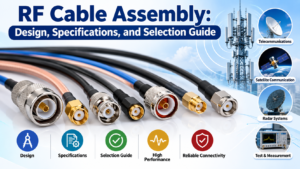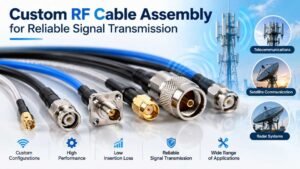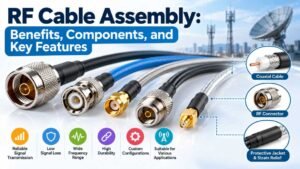
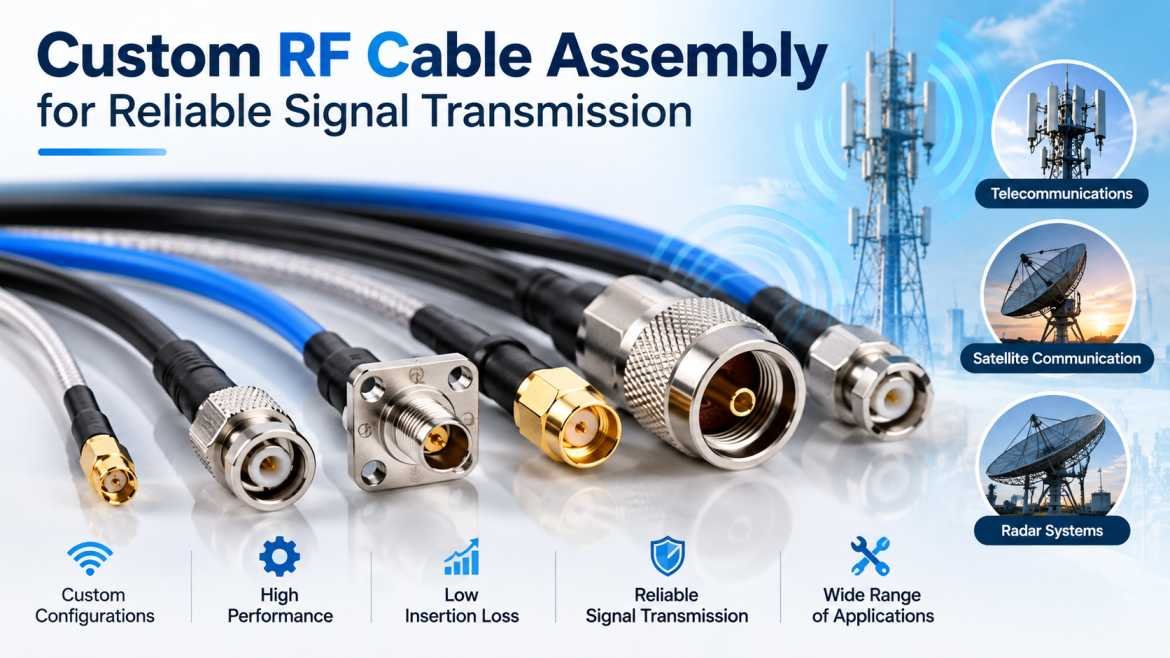
An RF Cable Assembly is an essential component used to transmit radio frequency signals between electronic devices, antennas, communication systems, and testing equipment. RF stands for Radio Frequency, which refers to electromagnetic signals used for wireless communication, radar systems, satellite communication, and various high-frequency electronic applications. These cable assemblies are designed to maintain signal integrity, minimize signal loss, and provide reliable connectivity in demanding operating environments.
RF cable assemblies typically consist of a coaxial cable, connectors, shielding, and protective components. Depending on the application, they may be manufactured with different cable materials, connector configurations, impedance ratings, and frequency capabilities. Selecting the appropriate RF cable assembly helps improve transmission efficiency, reduce electromagnetic interference, and ensure stable performance across communication and industrial systems.
Today, RF cable assemblies are widely used in telecommunications, aerospace, defense, medical electronics, automotive systems, industrial automation, and research laboratories. Understanding the different types of RF cable assemblies and their industrial applications helps engineers, system integrators, and purchasing professionals select the right solution for their technical requirements.
What Is an RF Cable Assembly?
An RF cable assembly is a pre-terminated cable solution designed to carry high-frequency electrical signals between two or more electronic components. It combines a suitable RF coaxial cable with compatible connectors to create a dependable connection for transmitting radio frequency energy.
Unlike ordinary electrical cables, RF cable assemblies are specifically engineered to control impedance, reduce signal reflections, and maintain consistent electrical performance at high frequencies. Their coaxial construction generally includes a central conductor, dielectric insulation, an outer conductive shield, and an external protective jacket.
The connectors installed at each end determine how the assembly interfaces with other equipment. Common connector types include SMA, BNC, N-Type, TNC, SMB, SMC, SMP, and SMPM connectors. Each connector offers different advantages in terms of frequency range, size, mechanical durability, and installation requirements.
RF cable assemblies can be manufactured in standard or custom configurations according to cable length, connector type, operating frequency, impedance, environmental conditions, and performance specifications.
Major Types of RF Cable Assembly
1. Coaxial RF Cable Assembly
Coaxial RF cable assemblies are among the most widely used solutions for transmitting radio frequency signals. Their concentric conductor design provides controlled impedance and effective shielding against external interference.
These assemblies are available in different cable sizes, flexibility levels, shielding constructions, and electrical specifications. They are commonly designed for 50-ohm applications, while 75-ohm versions are used in certain video and broadcast systems.
Industrial applications:
- Telecommunications infrastructure and wireless communication equipment
- Radio transmitters and receivers
- RF test and measurement instruments
- Broadcast and video transmission systems
- Industrial monitoring and electronic equipment
Coaxial RF cable assemblies are suitable for applications that require reliable signal transmission and predictable electrical performance.
2. SMA RF Cable Assembly
SMA cable assemblies use SubMiniature Version A connectors, which feature a threaded coupling mechanism for secure connections. SMA connectors are widely used in compact RF systems because they offer reliable mechanical engagement and support high-frequency applications when properly specified.
These assemblies are available with flexible, semi-rigid, and other compatible coaxial cable constructions. Their performance depends on the connector design, cable type, assembly quality, and operating conditions.
Industrial applications:
- Wireless communication modules
- Wi-Fi and cellular equipment
- RF amplifiers and attenuators
- Antenna connections
- Laboratory testing and measurement systems
SMA RF cable assemblies are particularly useful in applications where compact dimensions and dependable high-frequency connectivity are important.
3. N-Type RF Cable Assembly
N-Type RF cable assemblies are designed for robust RF connections and are commonly used in outdoor communication systems. Their threaded coupling mechanism provides secure mating, while suitable connector and cable configurations support reliable performance in demanding environments.
These assemblies are available in various cable lengths and connector configurations. Weather-resistant designs can be selected for outdoor installations where exposure to environmental conditions is a concern.
Industrial applications:
- Base station antenna systems
- Wireless networking infrastructure
- RF power measurement equipment
- Radio communication systems
- Outdoor antenna installations
N-Type assemblies are a practical option for applications that require durable connectors and dependable RF connectivity.
4. BNC RF Cable Assembly
BNC cable assemblies use a bayonet-style coupling mechanism that allows quick connection and disconnection. They are commonly found in test equipment, instrumentation, and video systems.
BNC assemblies are available in different impedance configurations, including 50-ohm and 75-ohm versions. Choosing the correct configuration is important to ensure compatibility with the connected equipment.
Industrial applications:
- Oscilloscopes and signal generators
- Electronic testing laboratories
- Video monitoring equipment
- Broadcast systems
- General-purpose instrumentation
BNC RF cable assemblies are valued for their convenient installation and suitability for equipment that requires frequent connections.
5. TNC RF Cable Assembly
TNC cable assemblies use threaded connectors similar in appearance to BNC connectors. The threaded interface provides a more secure connection than a bayonet coupling in applications where vibration or mechanical stability is a concern.
Depending on the connector and cable design, TNC assemblies can be used across various RF communication frequencies.
Industrial applications:
- Wireless communication equipment
- Navigation and positioning systems
- Outdoor radio equipment
- Industrial telemetry
- Mobile communication devices
TNC assemblies are suitable for systems requiring secure connector engagement and consistent electrical connectivity.
6. SMP and SMPM RF Cable Assembly
SMP and SMPM cable assemblies are compact RF interconnect solutions designed for high-density electronic systems. Their small form factors make them useful when circuit boards, modules, and electronic components have limited installation space.
SMP connectors can support blind-mate connections in suitable designs, while SMPM connectors provide a smaller interface for applications requiring miniaturization. Actual frequency performance depends on the specific connector series and cable assembly configuration.
Industrial applications:
- Aerospace and defense electronics
- High-speed RF modules
- Radar and communication equipment
- Compact microwave systems
- Automated test fixtures
SMP and SMPM assemblies are especially useful in applications where space efficiency and high-frequency performance are critical.
7. Semi-Rigid RF Cable Assembly
Semi-rigid RF cable assemblies use cables with a solid metallic outer conductor. This construction provides effective shielding and can offer excellent electrical stability when the assembly is properly designed and installed.
Unlike highly flexible cables, semi-rigid cables are generally formed into a specific shape during installation. They are therefore well suited to fixed internal connections within electronic equipment.
Industrial applications:
- Microwave communication systems
- Precision RF instrumentation
- Aerospace electronic equipment
- High-frequency laboratory setups
- Specialized radar systems
Semi-rigid RF cable assemblies are preferred when shielding effectiveness, repeatable routing, and stable electrical characteristics are important.
8. Flexible RF Cable Assembly
Flexible RF cable assemblies are designed for installations that require easier routing, movement, or frequent handling. They use flexible coaxial cable constructions that can accommodate practical installation requirements while maintaining specified RF performance.
Cable flexibility, minimum bend radius, insertion loss, and shielding effectiveness vary by cable design.
Industrial applications:
- Portable testing equipment
- Wireless communication devices
- Antenna connections
- Electronic service equipment
- Industrial monitoring systems
Flexible RF cable assemblies offer versatility for systems where installation access and cable routing are important considerations.
Industrial Applications of RF Cable Assembly
1. Telecommunications and Wireless Communication
Telecommunications is one of the major application areas for RF cable assemblies. Cellular networks, wireless base stations, radio equipment, and antenna systems rely on RF interconnects to transfer signals between different components.
RF cable assemblies connect antennas, transceivers, amplifiers, filters, and testing equipment. Low insertion loss, appropriate impedance matching, and effective shielding are important for maintaining communication quality.
As wireless infrastructure expands, dependable RF cable assemblies remain important for network installation, maintenance, and performance testing.
2. Aerospace and Defense
Aerospace and defense systems require reliable RF connections for demanding operating conditions. Radar equipment, satellite communication systems, navigation devices, and airborne communication platforms use RF cable assemblies to transfer high-frequency signals.
These applications may require lightweight construction, vibration resistance, temperature tolerance, and strict electrical performance specifications. Connector retention and cable routing must also be considered when designing assemblies for mission-critical equipment.
Specialized RF cable assemblies help support communication, sensing, navigation, and electronic testing functions in aerospace and defense applications.
3. Medical Electronics
RF cable assemblies are used in selected medical electronics and diagnostic systems that rely on radio frequency or microwave signals. Applications may include RF-based diagnostic equipment, medical imaging subsystems, research instruments, and certain therapeutic devices.
In these environments, cable assemblies must meet the electrical, mechanical, cleanliness, and regulatory requirements appropriate to the equipment. Compatibility with the intended system is essential, particularly where patient safety and measurement accuracy are involved.
4. Automotive and Transportation
Modern vehicles incorporate wireless communication, satellite navigation, radar sensing, and connectivity technologies. RF cable assemblies support connections between antennas, communication modules, test equipment, and other RF components.
Automotive applications may require resistance to vibration, temperature changes, moisture, and electromagnetic interference. Suitable cable and connector choices help maintain dependable connectivity throughout the vehicle’s operating life.
RF cable assemblies are also useful in automotive development laboratories for testing communication performance and evaluating electronic systems.
5. Industrial Automation and Manufacturing
Industrial automation systems use RF cable assemblies in wireless monitoring equipment, machine communication systems, sensors, and specialized electronic instruments.
Manufacturing environments may expose cables to vibration, electrical noise, temperature fluctuations, and repeated equipment movement. Choosing a suitable cable jacket, connector type, shielding design, and strain-relief arrangement helps improve reliability.
RF cable assemblies also connect signal generators, spectrum analyzers, and other instruments used to test electronic products during manufacturing.
6. Research, Development, and Test Laboratories
Research laboratories depend on accurate and repeatable RF connections when evaluating electronic circuits, antennas, amplifiers, and microwave devices.
RF cable assemblies connect instruments such as vector network analyzers, spectrum analyzers, signal generators, and power meters. For precision measurements, engineers must consider insertion loss, return loss, phase stability, connector repeatability, and calibration requirements.
Well-specified assemblies help reduce measurement uncertainty and improve the consistency of laboratory testing.
Key Factors to Consider When Selecting an RF Cable Assembly
Selecting the right RF cable assembly requires evaluating the electrical, mechanical, and environmental requirements of the application.
Operating frequency: Choose an assembly with a specified frequency range that covers the system’s operating requirements.
Characteristic impedance: Ensure compatibility with the equipment, commonly 50 ohms for RF communication and test systems or 75 ohms for applicable video systems.
Insertion loss: Evaluate signal attenuation across the required frequency range and cable length.
Return loss and VSWR: Consider impedance matching and signal reflections, particularly in sensitive high-frequency systems.
Connector type: Select compatible connectors based on interface requirements, size, coupling mechanism, and electrical specifications.
Cable length and flexibility: Determine the appropriate length, routing requirements, and minimum bend radius.
Environmental conditions: Evaluate temperature, moisture, vibration, chemical exposure, and other operating conditions.
Shielding and durability: Consider shielding effectiveness, connector retention, strain relief, and jacket materials.
Testing and quality control: Depending on the application, verify continuity, insertion loss, return loss, VSWR, and other relevant specifications.
Careful selection helps ensure that the RF cable assembly meets the performance requirements of the complete system.
Benefits of Using High-Quality RF Cable Assemblies
High-quality RF cable assemblies provide several advantages across industrial applications. They support consistent signal transmission, reduce unwanted interference, and help maintain reliable connections between electronic components.
Properly designed assemblies can also simplify installation, improve equipment integration, and reduce maintenance requirements. Custom cable lengths and connector configurations can minimize unnecessary adapters and support more organized equipment layouts.
For high-frequency systems, suitable cable construction and connector termination are particularly important because small variations in impedance, shielding, or connector condition can affect overall performance.
Conclusion
RF cable assemblies play an important role in modern communication, testing, and industrial electronic systems. From coaxial and SMA assemblies to N-Type, BNC, TNC, SMP, SMPM, semi-rigid, and flexible designs, each type offers specific advantages for different operating requirements.
Their industrial applications span telecommunications, aerospace, defense, medical electronics, automotive technology, manufacturing, and research laboratories. Selecting the appropriate RF cable assembly requires careful consideration of operating frequency, impedance, insertion loss, connector compatibility, cable flexibility, and environmental conditions.
By choosing assemblies that meet the technical requirements of the application, engineers and system integrators can improve signal integrity, support reliable equipment operation, and achieve consistent performance in demanding RF environments.
Frequently Asked Questions (FAQs)
1. What is an RF cable assembly?
An RF cable assembly is a coaxial cable fitted with compatible RF connectors to transmit radio frequency signals between antennas, communication equipment, electronic devices, and test instruments.
2. What are the common types of RF cable assemblies?
Common types include coaxial, SMA, N-Type, BNC, TNC, SMP, SMPM, semi-rigid, and flexible RF cable assemblies. Each type is designed for particular electrical, mechanical, and installation requirements.
3. What are the main industrial applications of RF cable assemblies?
RF cable assemblies are used in telecommunications, wireless networking, aerospace, defense, medical electronics, automotive systems, industrial automation, and RF testing laboratories.
4. How do I choose the right RF cable assembly?
Consider operating frequency, impedance, insertion loss, return loss, connector type, cable length, flexibility, environmental conditions, and equipment compatibility.
5. What is the difference between SMA and N-Type RF cable assemblies?
SMA connectors are compact and commonly used in high-frequency electronic equipment, while N-Type connectors are larger and widely used in communication infrastructure and antenna systems. The appropriate choice depends on frequency, power, space, and environmental requirements.
6. Why is impedance important in an RF cable assembly?
Impedance matching helps minimize signal reflections and supports efficient signal transfer. A mismatch between the cable assembly and connected equipment can increase reflected power and affect system performance.
7. Can RF cable assemblies be customized?
Yes. RF cable assemblies can be customized by cable type, length, connector combination, impedance, shielding, and environmental requirements to suit specific applications.
8. Why is shielding important in RF cable assemblies?
Shielding helps reduce electromagnetic interference and limits unwanted signal coupling. Effective shielding is especially important in environments with multiple electronic devices or sensitive RF signals.