
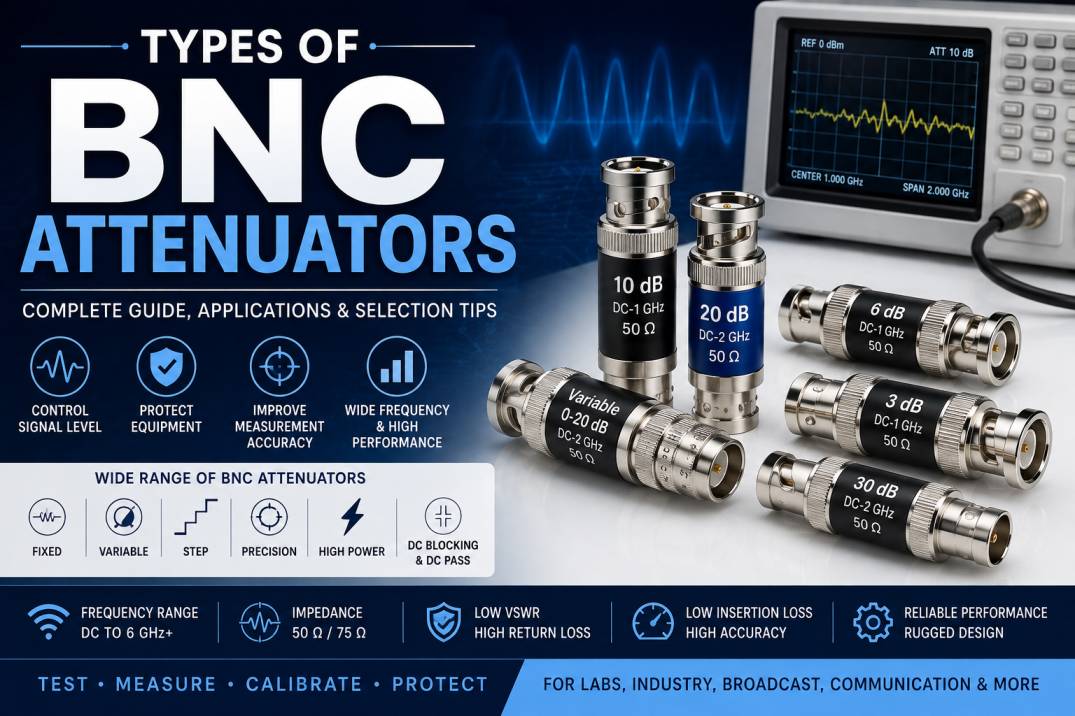
BNC attenuators are important RF components used to reduce signal power in coaxial transmission systems while maintaining a controlled impedance and reliable signal integrity. The BNC connector, known for its quick bayonet coupling mechanism, is widely used in test and measurement equipment, RF instrumentation, telecommunications, broadcasting, laboratory systems, surveillance equipment, and industrial electronics.
A BNC attenuator combines the mechanical convenience of a BNC connector with a resistive or RF attenuation network designed to reduce signal amplitude by a specified amount. Common attenuation values include 1 dB, 3 dB, 6 dB, 10 dB, 20 dB, and 30 dB, although custom and variable configurations are also available.
The correct BNC attenuator depends on several parameters, including attenuation value, frequency range, impedance, power rating, VSWR, return loss, connector gender, bidirectional operation, and environmental requirements.
With RF systems increasingly being used for higher-frequency testing, wireless communications, defense electronics, industrial automation, and signal monitoring, selecting the right BNC attenuator has become increasingly important for maintaining accurate and stable RF performance.
What Is a BNC Attenuator?
A BNC attenuator is a passive RF device used to reduce the amplitude or power level of an RF signal passing through a BNC interface.
The term BNC refers to Bayonet Neill-Concelman, a coaxial connector design that uses a bayonet-style locking mechanism. A BNC attenuator incorporates BNC connectors with an internal attenuation circuit.
For example, if a 0 dBm signal passes through a 10 dB attenuator, the theoretical output level becomes:
0 dBm − 10 dB = −10 dBm
The attenuator reduces the signal without requiring an active power source.
BNC attenuators are commonly designed around 50-ohm or 75-ohm impedance, depending on the application.
Why Are BNC Attenuators Used?
RF signals can sometimes be too strong for the input of a measurement instrument or receiver. Excessive signal levels can cause compression, distortion, overload, or even damage to sensitive equipment.
A BNC attenuator can be used to:
- Reduce excessive RF signal power
- Protect sensitive receiver inputs
- Improve impedance matching
- Control signal levels during testing
- Prevent amplifier or detector overload
- Improve measurement accuracy
- Adjust signal levels between RF equipment
- Reduce unwanted reflections
- Create known reference signal levels
- Support RF system calibration
How Does a BNC Attenuator Work?
A conventional fixed attenuator uses a network of resistive elements arranged to provide a predetermined amount of signal attenuation while maintaining the required impedance.
When an RF signal enters the BNC attenuator, part of the signal power is dissipated as heat within the resistive network.
The amount of attenuation is expressed in decibels.
The relationship between input and output power is:
Attenuation (dB) = 10 log10(Pin/Pout)
For voltage measurements under the same impedance:
Attenuation (dB) = 20 log10(Vin/Vout)
For example:
| Attenuation | Approximate Output Power |
|---|---|
| 1 dB | 79.4% |
| 3 dB | 50.1% |
| 6 dB | 25.1% |
| 10 dB | 10% |
| 20 dB | 1% |
| 30 dB | 0.1% |
These values represent the output power relative to the input power under matched conditions.
Main Types of BNC Attenuators
BNC attenuators are available in several configurations based on attenuation control, power handling, accuracy, frequency range, and application.
The major types include:
- Fixed BNC Attenuators
- Variable BNC Attenuators
- Step BNC Attenuators
- Precision BNC Attenuators
- High-Power BNC Attenuators
- Low-Power BNC Attenuators
- Broadband BNC Attenuators
- DC-Pass BNC Attenuators
- DC-Blocking BNC Attenuators
- Bidirectional BNC Attenuators
- In-Line BNC Attenuators
- BNC Male-to-Female Attenuators
- BNC Female-to-Female Attenuators
- BNC Male-to-Male Attenuators
- Programmable BNC Attenuators
1. Fixed BNC Attenuators
A fixed BNC attenuator provides a predetermined attenuation value that cannot be changed during operation.
Common values include:
- 1 dB
- 2 dB
- 3 dB
- 5 dB
- 6 dB
- 10 dB
- 15 dB
- 20 dB
- 30 dB
Fixed attenuators are among the most widely used BNC attenuator types because they are simple, reliable, compact, and easy to integrate into RF test systems.
Applications
Fixed BNC attenuators are used in:
- Oscilloscopes
- Signal generators
- Spectrum analyzers
- RF receivers
- RF transmitters
- Laboratory test systems
- Communication equipment
- Calibration systems
Advantages
- Simple operation
- High reliability
- Stable attenuation
- Compact construction
- No external power required
- Easy installation
2. Variable BNC Attenuators
Variable BNC attenuators allow the attenuation level to be adjusted across a specified range.
Instead of providing only one fixed attenuation value, a variable attenuator can provide multiple attenuation settings.
For example, a variable BNC attenuator may provide an adjustable range from 0 to 20 dB.
Applications
Variable BNC attenuators are useful for:
- RF signal optimization
- Laboratory experiments
- Receiver sensitivity testing
- Signal-level adjustment
- RF system development
- Test equipment calibration
Advantages
- Adjustable signal level
- Flexible laboratory use
- Multiple attenuation settings
- Useful for RF development and troubleshooting
3. Step BNC Attenuators
Step attenuators provide discrete attenuation levels that can be selected using a switch, rotary mechanism, or electronic control.
For example, a step attenuator may offer:
0, 2, 4, 6, 8, 10, 20 dB
This allows engineers to quickly change signal levels without replacing the attenuator.
Applications
- RF test benches
- Signal generators
- Receiver testing
- Calibration equipment
- Automated test systems
- Communication laboratories
4. Precision BNC Attenuators
Precision BNC attenuators are manufactured for applications where attenuation accuracy, impedance matching, and repeatability are critical.
They typically use precision resistive networks and controlled manufacturing processes to achieve stable RF characteristics.
Important Parameters
- Attenuation accuracy
- Return loss
- VSWR
- Frequency response
- Temperature coefficient
- Power handling
- Connector quality
Applications
Precision BNC attenuators are commonly used in:
- RF calibration
- Test and measurement
- Research laboratories
- Metrology
- Instrument verification
- Communication testing
5. High-Power BNC Attenuators
High-power BNC attenuators are designed to handle higher RF power levels than standard low-power models.
The internal attenuation network must dissipate the absorbed RF power as heat, so thermal design is particularly important.
Important Specifications
- Average power rating
- Peak power rating
- Frequency range
- Duty cycle
- Operating temperature
- Thermal management
- VSWR
High-power BNC attenuators can be used for RF transmitters, communication systems, laboratory test equipment, and other applications where signal levels are relatively high.
6. Low-Power BNC Attenuators
Low-power BNC attenuators are intended for low-level RF signals and measurement applications.
They are frequently used with laboratory instrumentation where signal levels are relatively low.
Applications
- Oscilloscope testing
- Signal monitoring
- Receiver testing
- RF laboratory equipment
- Educational laboratories
- Instrument interfaces
Their compact construction and simple passive design make them useful for everyday RF testing.
7. Broadband BNC Attenuators
Broadband BNC attenuators are designed to provide relatively consistent attenuation across a wide frequency range.
Broadband performance depends on the internal resistive network, connector geometry, transmission-line design, parasitic effects, and manufacturing precision.
Applications
- Wideband RF testing
- Communication systems
- Laboratory instrumentation
- Signal generators
- Spectrum analysis
- General-purpose RF measurement
When selecting a broadband BNC attenuator, engineers should evaluate attenuation flatness, VSWR, return loss, and maximum operating frequency rather than looking only at the nominal attenuation value.
8. DC-Pass BNC Attenuators
A DC-pass BNC attenuator allows a DC voltage component to pass through the attenuator along with the RF signal, provided the specific design supports the required DC voltage and current.
This type of attenuator is useful when both RF and DC components must be transmitted through the same coaxial path.
Applications
- Biasing circuits
- RF amplifiers
- Active devices
- Sensor systems
- Laboratory test setups
The maximum DC voltage and current rating must always be checked before use.
9. DC-Blocking BNC Attenuators
A DC-blocking BNC attenuator prevents DC voltage from passing through the signal path while allowing RF signals to pass.
This can protect connected instruments from unwanted DC components.
Applications
- RF measurement systems
- Receiver inputs
- Test equipment protection
- RF signal monitoring
- Amplifier testing
DC-blocking attenuators can be particularly useful when the RF source and measurement instrument have different DC requirements.
10. Bidirectional BNC Attenuators
A bidirectional BNC attenuator is designed to provide similar attenuation characteristics when the RF signal travels in either direction.
This is useful in test setups where the signal direction may change.
Applications
- RF test systems
- Communication links
- Laboratory measurements
- Signal routing
- Calibration setups
The actual bidirectional performance should be verified from the manufacturer’s RF specifications.
11. In-Line BNC Attenuators
In-line BNC attenuators are designed to be inserted directly into an existing coaxial RF path.
They provide a convenient way to reduce signal level without changing the existing cable assembly.
Applications
- Cable test systems
- Signal generators
- Oscilloscopes
- RF receivers
- Laboratory setups
- Broadcast equipment
Their compact form makes them convenient for temporary or permanent installations.
12. BNC Male-to-Female Attenuators
A BNC male-to-female attenuator has one male BNC connector and one female BNC connector.
This configuration is useful when an attenuator must be installed directly between compatible RF equipment and cable assemblies.
Advantages
- Easy installation
- Compact form
- Direct equipment connection
- Reduced need for additional adapters
13. BNC Female-to-Female Attenuators
Female-to-female BNC attenuators are useful when two male BNC connectors need to be connected while introducing a defined amount of attenuation.
They can be useful in laboratory setups and RF cable configurations.
14. BNC Male-to-Male Attenuators
Male-to-male BNC attenuators provide attenuation between two female BNC interfaces.
Their application depends on the equipment and cable configuration.
Connector gender should always be checked before ordering an attenuator to avoid requiring additional adapters.
15. Programmable BNC Attenuators
Programmable attenuators allow attenuation levels to be controlled electronically.
They can be integrated into automated RF test systems and computer-controlled measurement setups.
Applications
- Automated test equipment
- Production testing
- RF characterization
- Communication testing
- Laboratory automation
- Semiconductor testing
Programmable attenuators can improve test repeatability and reduce manual intervention.
BNC Attenuator Classification by Attenuation Value
BNC attenuators can also be classified according to their attenuation.
| Attenuation | Typical Application |
|---|---|
| 1 dB | Fine signal adjustment |
| 2 dB | Low-level correction |
| 3 dB | Power reduction and matching |
| 5 dB | Signal-level adjustment |
| 6 dB | Controlled power reduction |
| 10 dB | General RF testing |
| 15 dB | Intermediate signal reduction |
| 20 dB | Receiver protection |
| 30 dB | High signal reduction |
| 40 dB+ | Specialized test applications |
The appropriate attenuation depends on the input signal level and the maximum allowable level of the connected equipment.
BNC Attenuator Impedance
Impedance is one of the most important specifications when selecting an attenuator.
BNC attenuators are commonly available in:
- 50 ohms
- 75 ohms
50-Ohm BNC Attenuators
50-ohm BNC attenuators are commonly used in RF and microwave test environments, communications, instrumentation, and laboratory systems.
75-Ohm BNC Attenuators
75-ohm BNC attenuators are commonly associated with video, broadcast, CATV, and other 75-ohm systems.
Using the wrong impedance can cause signal reflections and measurement errors.
BNC Attenuator Frequency Range
Frequency range determines the RF spectrum over which the attenuator meets its specified performance.
Depending on the design, BNC attenuators may be used from low-frequency or DC-related applications into the RF range.
Common specifications may include:
- DC to 1 GHz
- DC to 2 GHz
- DC to 3 GHz
- DC to 4 GHz
- Higher-frequency specialized designs
The actual operating frequency must always be verified against the manufacturer’s datasheet.
BNC Attenuator Power Rating
Power rating indicates how much RF power the attenuator can safely dissipate under specified operating conditions.
For example, a component may be rated for:
- 0.25 W
- 0.5 W
- 1 W
- 2 W
- 5 W
- 10 W
- Higher specialized power levels
Power handling may vary with frequency, ambient temperature, mounting configuration, and duty cycle.
Why Power Rating Matters
If the input power exceeds the attenuator’s rated power, excessive heating may cause:
- Resistance changes
- Attenuation errors
- Connector damage
- Performance degradation
- Permanent component failure
VSWR and Return Loss of BNC Attenuators
VSWR and return loss indicate how well an attenuator maintains impedance matching.
A low VSWR generally indicates that less RF energy is reflected toward the source.
Return loss is another important parameter for evaluating RF matching.
For precision measurement applications, engineers should compare both VSWR and return-loss specifications across the required frequency range.
Insertion Loss vs Attenuation
Attenuation and insertion loss are related but should not be treated as exactly the same specification.
A 10 dB attenuator is designed to provide approximately 10 dB of signal reduction. Additional frequency-dependent insertion effects can occur due to the internal design and connectors.
In precision applications, engineers should review:
- Nominal attenuation
- Attenuation accuracy
- Frequency flatness
- Return loss
- VSWR
- Connector loss
BNC Attenuator Applications
BNC attenuators are used across a wide range of industries.
RF Test and Measurement
They are used with:
- Signal generators
- Spectrum analyzers
- Network analyzers
- Oscilloscopes
- Power meters
- RF receivers
Telecommunications
BNC attenuators can be used for signal-level control, equipment testing, and RF subsystem evaluation.
Broadcasting
75-ohm BNC attenuators are widely relevant to video and broadcast test environments.
Defense and Aerospace
RF attenuation components can be used in communication, radar, electronic warfare test equipment, and instrumentation.
Industrial Electronics
BNC attenuators can help manage RF signal levels in industrial measurement and control systems.
Laboratories
They are widely used for experimental RF setups where engineers need repeatable and controlled signal levels.
BNC Attenuators in RF Testing
During RF testing, the input level of an instrument must remain within its specified operating range.
For example, suppose a signal generator produces +10 dBm while a receiver can safely accept only 0 dBm.
A suitable attenuation value can reduce the signal to an appropriate level.
A 10 dB attenuator would theoretically produce:
+10 dBm − 10 dB = 0 dBm
This simple approach can protect equipment and improve measurement control.
Advantages of BNC Attenuators
BNC attenuators offer several practical advantages:
- Easy connection
- Quick bayonet locking
- Compact construction
- Passive operation
- Reliable RF performance
- Multiple attenuation values
- Available in different impedance configurations
- Suitable for laboratory environments
- Easy integration with BNC test equipment
Limitations of BNC Attenuators
Despite their advantages, BNC attenuators have limitations.
Frequency Limitations
BNC connectors are not suitable for every high-frequency application. For very high-frequency systems, connectors such as SMA, 2.92 mm, 2.4 mm, or 1.85 mm may be more appropriate.
Power Limitations
Compact BNC attenuators may have relatively low power ratings.
Connector Wear
Repeated connection and disconnection can eventually cause mechanical wear.
Impedance Compatibility
50-ohm and 75-ohm systems should not be mixed without considering the resulting impedance mismatch.
How to Select the Right BNC Attenuator
Selecting a BNC attenuator requires evaluating the entire RF system.
1. Determine the Required Attenuation
Calculate how much signal reduction is needed.
2. Check Impedance
Confirm whether the system requires 50 ohms or 75 ohms.
3. Check Frequency
Ensure the attenuator supports the complete operating frequency range.
4. Check Input Power
Select a model with adequate power handling.
5. Select Connector Gender
Determine whether male, female, or another BNC configuration is required.
6. Check VSWR
For precision applications, choose an attenuator with suitable VSWR performance.
7. Check Attenuation Accuracy
Precision testing requires tight attenuation tolerance.
8. Consider DC Requirements
Determine whether the system requires DC pass or DC blocking.
9. Consider Environmental Conditions
For outdoor, industrial, aerospace, or defense applications, evaluate temperature, vibration, humidity, and environmental requirements.
10. Consider Calibration Requirements
For measurement applications, select attenuators with documented and traceable RF performance where required.
BNC Attenuator vs BNC Termination
A BNC attenuator and a BNC termination perform different functions.
A termination is primarily used to terminate an RF transmission line with the required impedance and absorb the incident signal.
An attenuator intentionally reduces the signal level while maintaining a controlled impedance.
For example:
50-ohm BNC termination: primarily terminates a 50-ohm RF port.
10 dB BNC attenuator: reduces the signal power by approximately 10 dB while providing a matched interface.
BNC Attenuator vs BNC Adapter
A BNC adapter primarily changes or connects interfaces.
An attenuator, on the other hand, intentionally reduces RF signal power.
Some products combine adapter-style mechanical configurations with attenuation networks, but the electrical function remains different from a standard BNC adapter.
BNC Attenuator vs RF Amplifier
A BNC attenuator is passive and reduces signal level.
An RF amplifier is an active component that increases signal power or voltage and generally requires electrical power.
These components perform opposite functions in an RF signal chain.
Common Mistakes When Using BNC Attenuators
Using the Wrong Impedance
A 50-ohm attenuator should not be automatically used in a 75-ohm system.
Exceeding Power Rating
Always check maximum continuous and peak power requirements.
Ignoring Frequency
An attenuator rated for a particular frequency range should not be assumed to perform correctly above its specified maximum frequency.
Using Too Many Adapters
Every additional connector or adapter can introduce additional loss and mismatch.
Ignoring Temperature
Power dissipation generates heat, which can affect attenuation accuracy and reliability.
Selecting Attenuation Without Checking Instrument Limits
The attenuator should reduce the signal to a safe and useful level for the connected instrument.
BNC Attenuators for Modern RF Systems
Although newer RF systems increasingly use higher-frequency connectors, BNC attenuators remain valuable in applications involving test equipment, laboratory instruments, video systems, communications, and general-purpose RF systems.
The continuing need for controlled signal levels makes RF attenuators an essential part of test and measurement infrastructure.
For applications operating at substantially higher frequencies, engineers may select other connector families specifically designed for microwave and millimeter-wave performance.
Future Trends in BNC Attenuators
Important trends in RF attenuation technology include:
- Improved attenuation accuracy
- Wider operating bandwidth
- Better thermal management
- Higher power handling
- Compact mechanical designs
- Improved connector durability
- Automated and programmable attenuation
- Better calibration traceability
- Customized RF attenuation solutions
As RF test systems become more sophisticated, attenuation components are increasingly expected to provide stable, repeatable, and well-characterized performance.
Conclusion
BNC attenuators are essential passive RF components for controlling signal levels in coaxial systems. They are available in many configurations, including fixed, variable, step, precision, high-power, broadband, DC-pass, DC-blocking, bidirectional, programmable, and in-line designs.
The best BNC attenuator depends on the application’s attenuation requirement, impedance, frequency range, power level, VSWR, connector configuration, environmental conditions, and accuracy requirements.
For general RF testing, fixed BNC attenuators provide a simple and reliable solution. Variable and step attenuators are more suitable when signal levels need to be adjusted. Precision attenuators are preferred for calibration and measurement applications, while high-power models are designed for systems requiring greater power dissipation.
By carefully matching the attenuator to the RF system, engineers can protect sensitive equipment, improve signal-level control, minimize reflections, and achieve more reliable measurements.
Frequently Asked Questions About BNC Attenuators
1. What is a BNC attenuator?
A BNC attenuator is a passive RF component that reduces the power level of an RF signal while maintaining a controlled impedance through a BNC interface.
2. What are the main types of BNC attenuators?
The main types include fixed, variable, step, precision, high-power, broadband, DC-pass, DC-blocking, bidirectional, programmable, and in-line BNC attenuators.
3. What is a fixed BNC attenuator?
A fixed BNC attenuator provides a predetermined attenuation value such as 3 dB, 6 dB, 10 dB, or 20 dB and cannot be adjusted during normal operation.
4. What is a variable BNC attenuator?
A variable BNC attenuator allows the user to adjust the amount of RF signal attenuation across a specified range.
5. What does a 10 dB BNC attenuator do?
A 10 dB attenuator reduces RF power to approximately one-tenth of its input value under matched conditions.
6. Are BNC attenuators available in 50 ohms and 75 ohms?
Yes. BNC attenuators are available for both 50-ohm and 75-ohm systems. The correct impedance should match the RF system.
7. What is the difference between a BNC attenuator and a BNC termination?
A BNC termination primarily provides a matched load at the end of a transmission line, while a BNC attenuator reduces signal power while maintaining a matched RF interface.
8. Can BNC attenuators be used for high-frequency RF signals?
Yes, but the maximum usable frequency depends on the specific attenuator and BNC design. The manufacturer’s frequency specification should always be checked.
9. Can a BNC attenuator protect a receiver?
Yes. An appropriately rated attenuator can reduce the RF signal level entering a receiver or test instrument and help prevent input overload.
10. What is the importance of VSWR in a BNC attenuator?
VSWR indicates how effectively the attenuator maintains impedance matching. Lower VSWR generally means less signal reflection and better RF performance.
11. What is a DC-blocking BNC attenuator?
A DC-blocking BNC attenuator is designed to attenuate the RF signal while preventing DC voltage from passing through the signal path.
12. What is a DC-pass BNC attenuator?
A DC-pass BNC attenuator allows DC to pass along with the RF signal, subject to the voltage and current limits specified by the manufacturer.
13. What attenuation values are commonly available?
Common values include 1 dB, 3 dB, 6 dB, 10 dB, 20 dB, and 30 dB. Other values can be available for specialized applications.
14. What is a high-power BNC attenuator?
A high-power BNC attenuator is designed to dissipate higher levels of RF power while maintaining specified electrical performance.
15. How do I choose a BNC attenuator?
Consider attenuation, impedance, frequency range, power rating, VSWR, connector gender, DC requirements, accuracy, environmental conditions, and application requirements before selecting a BNC attenuator.
16. Can BNC attenuators be used in test and measurement equipment?
Yes. They are widely used with RF signal generators, oscilloscopes, spectrum analyzers, receivers, power meters, and other laboratory instruments.
17. Is a higher attenuation value always better?
No. The attenuation value should match the required signal reduction. Excessive attenuation can reduce the signal below the desired measurement or operating level.
18. Are BNC attenuators bidirectional?
Many passive attenuators can be used in either direction, but bidirectional performance should be confirmed from the manufacturer’s specifications.
19. What industries use BNC attenuators?
BNC attenuators are used in telecommunications, broadcasting, RF testing, defense, aerospace, industrial electronics, research laboratories, instrumentation, and education.
20. Why should I use a precision BNC attenuator?
Precision BNC attenuators are suitable when accurate and repeatable signal-level reduction is important, particularly in RF calibration, measurement, research, and test applications.