An RF Directional Coupler is an important passive RF component used to sample, split, monitor, or control radio frequency signals in communication systems. RF directional couplers are widely used in telecommunications, broadcasting, wireless networking, satellite communication, microwave systems, RF testing laboratories, military communication, and antenna systems.
These devices are designed to transfer a controlled amount of RF power from one transmission line to another while maintaining signal flow in a specific direction. RF directional couplers help monitor signal levels, protect communication equipment, improve impedance matching, and optimize RF system performance.
Modern telecom and wireless communication systems rely heavily on RF directional couplers in 4G LTE networks, 5G infrastructure, distributed antenna systems, RF amplifiers, repeaters, and microwave communication systems. Their ability to support high-frequency communication with low insertion loss and excellent isolation makes them essential components in advanced RF systems.
Today, RF directional couplers are critical components in modern communication infrastructure because they help manage RF signals efficiently while maintaining stable communication performance.
What is an RF Directional Coupler?
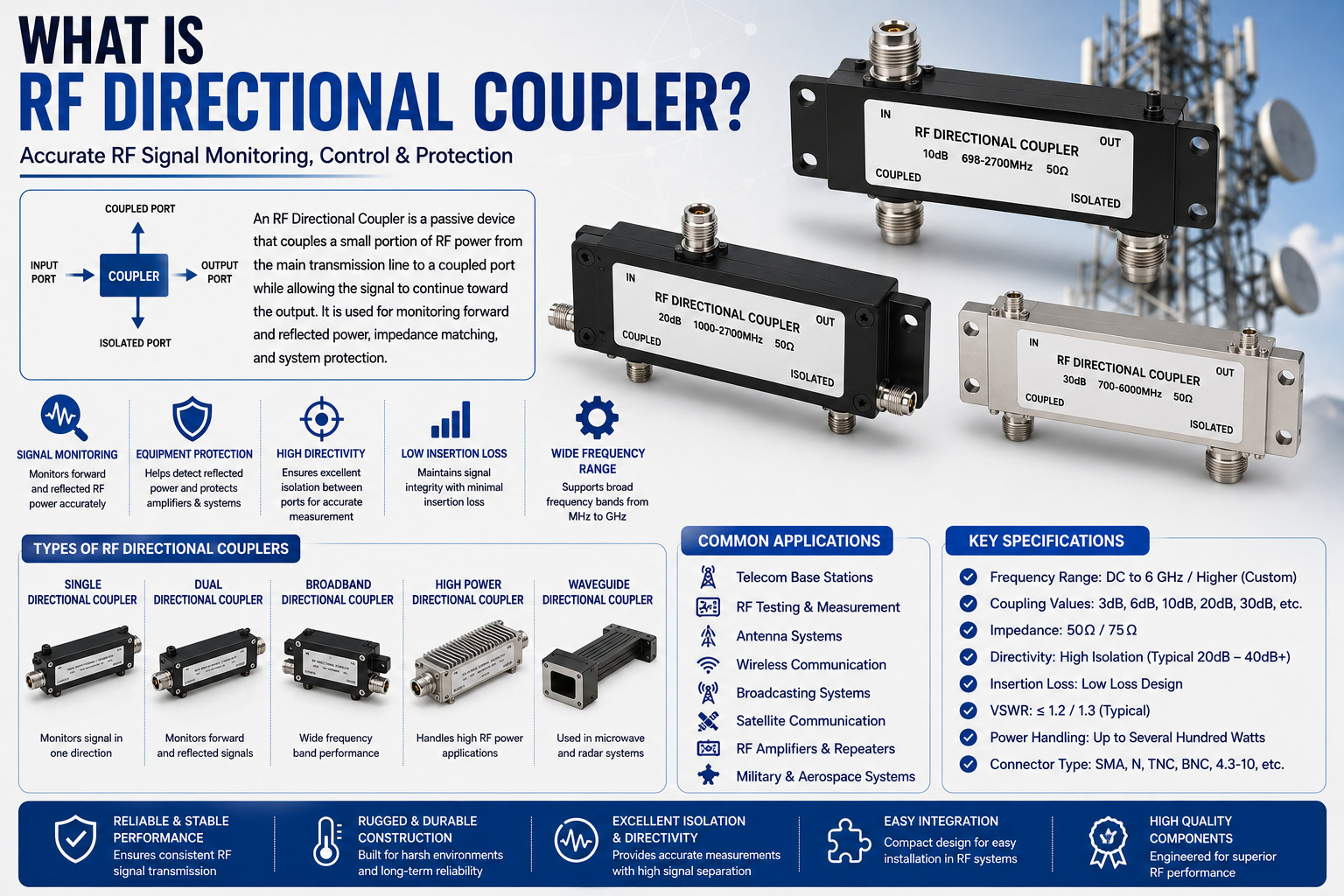
An RF directional coupler is a passive RF device designed to sample or split a specific portion of RF power from a transmission line while allowing the main signal to continue toward the output.
The coupler transfers a controlled amount of RF energy through a coupled port without significantly affecting the primary signal path.
RF directional couplers are commonly used in:
- Telecom systems
- RF testing equipment
- Wireless communication networks
- Antenna systems
- Microwave communication
- Broadcasting systems
- Satellite communication
These devices are commonly designed with:
- 50 ohm impedance
- 75 ohm impedance
RF directional couplers help monitor and manage RF signals in high-frequency communication systems.
Importance of RF Directional Couplers
Modern RF systems require accurate signal monitoring and efficient RF power management. RF directional couplers are important because they allow engineers to measure and distribute RF signals without interrupting communication systems.
RF directional couplers help:
- Monitor RF signal power
- Improve impedance matching
- Protect RF equipment
- Support signal testing
- Reduce signal reflection
- Improve communication efficiency
Because of these advantages, directional couplers are widely used in telecom and RF communication infrastructure.
How Does an RF Directional Coupler Work?
An RF directional coupler works by transferring a small portion of RF energy from the main transmission line to a secondary output port while maintaining signal directionality.
The device contains internal transmission line structures designed to separate forward and reflected signals.
The working process includes:
- RF signal input
- Controlled signal coupling
- Signal monitoring
- Forward signal transmission
- Isolation between ports
High-quality RF directional couplers provide low insertion loss, high directivity, and stable RF performance.
Components of an RF Directional Coupler
An RF directional coupler contains several important components designed for signal sampling and RF management.
Input Port
The input port receives the RF signal from the communication source.
Output Port
The output port transfers the primary RF signal toward the communication system.
Coupled Port
The coupled port samples a controlled amount of RF power.
Isolated Port
The isolated port minimizes unwanted signal leakage and reflection.
Internal RF Transmission Structure
The internal RF circuit controls signal coupling and directionality.
Shielded Housing
The metal body protects against EMI and RF interference.
Types of RF Directional Couplers
RF directional couplers are available in multiple configurations depending on communication requirements.
Single Directional Coupler
Samples RF signals traveling in one direction.
Applications
- RF monitoring
- Telecom systems
- Signal testing
Dual Directional Coupler
Monitors both forward and reflected RF signals.
Uses
- VSWR measurement
- RF amplifier systems
- Antenna testing
Broadband RF Directional Coupler
Designed for wide frequency range communication systems.
High Power RF Coupler
Supports high RF power transmission systems.
Applications
- Broadcasting systems
- Telecom towers
- Microwave communication
Stripline Directional Coupler
Uses stripline technology for compact RF communication systems.
Waveguide Directional Coupler
Used in microwave and radar communication applications.
Specifications of RF Directional Couplers
The specifications of RF directional couplers determine communication performance and compatibility.
Frequency Range
RF directional couplers support frequencies from MHz to GHz and microwave ranges.
Common ranges include:
- 698 MHz to 4000 MHz
- 5G communication bands
- Microwave frequencies
Coupling Value
Coupling determines how much RF power is sampled.
Common coupling values include:
- 3 dB
- 6 dB
- 10 dB
- 20 dB
- 30 dB
Impedance
Most RF directional couplers use:
- 50 ohm impedance
- 75 ohm impedance
Directivity
Directivity measures isolation between forward and reflected signals.
Higher directivity improves signal accuracy.
Insertion Loss
Low insertion loss improves communication efficiency.
VSWR
Low VSWR indicates proper impedance matching and reduced reflection.
Connector Types
Common connector interfaces include:
- N Type
- SMA
- DIN
- BNC
- TNC
- 4.3-10
Power Handling Capacity
RF directional couplers support various RF power levels depending on system requirements.
Applications of RF Directional Couplers
RF directional couplers are widely used across multiple RF and communication industries.
Telecommunications Industry
Telecom systems use directional couplers for signal monitoring and power management.
Applications
- Mobile towers
- Base stations
- DAS systems
- 5G communication networks
RF Testing Laboratories
Testing systems use directional couplers for RF measurement and analysis.
Equipment
- Spectrum analyzers
- Signal generators
- Network analyzers
Broadcasting Systems
Broadcast communication systems use couplers for RF signal control and monitoring.
Antenna Systems
Directional couplers help monitor antenna signal performance and reflected power.
Satellite Communication
Satellite systems use directional couplers for microwave signal management.
Military and Aerospace
Defense communication systems require precision RF monitoring components.
Benefits
- Stable RF performance
- Accurate signal measurement
- High-frequency support
Advantages of RF Directional Couplers
RF directional couplers provide several important communication and RF management benefits.
Accurate Signal Monitoring
They allow precise RF signal sampling without interrupting communication.
Improved Equipment Protection
Directional couplers help monitor reflected power and protect RF systems.
Low Signal Loss
High-quality couplers maintain communication efficiency.
Wide Frequency Support
Directional couplers support modern telecom and microwave systems.
Better RF Testing
They improve accuracy in RF measurement and calibration systems.
Stable Communication Performance
Precision RF designs maintain reliable signal transmission.
Technical Features of RF Directional Couplers
Modern RF directional couplers include several advanced RF features.
High Directivity
Improves signal separation and measurement accuracy.
Excellent Isolation
Reduces interference between RF ports.
Precision Coupling
Maintains accurate RF power sampling.
Durable Construction
Industrial-grade materials improve long-term reliability.
Difference Between RF Directional Coupler and RF Power Splitter
Both RF devices manage signal distribution but perform different functions.
RF Directional Coupler
- Samples a portion of RF power
- Maintains signal directionality
- Used for RF monitoring and testing
RF Power Splitter
- Divides RF signals equally
- Used for signal distribution
- Supports multiple communication outputs
Directional couplers are mainly used for signal monitoring, while power splitters are used for signal distribution.
Common Problems with RF Directional Couplers
Improper installation or poor-quality devices may affect RF performance.
Signal Reflection
Impedance mismatch may increase reflected RF power.
Insertion Loss
Low-quality couplers may reduce communication efficiency.
Connector Damage
Improper installation may damage RF interfaces.
Poor Directivity
Insufficient isolation may affect signal monitoring accuracy.
Tips for Choosing the Right RF Directional Coupler
Selecting the correct RF directional coupler improves communication reliability and system performance.
Verify Frequency Compatibility
Choose couplers suitable for operating frequency bands.
Check Coupling Requirements
Select proper coupling values based on application needs.
Verify Connector Compatibility
Ensure compatibility with RF cables and communication devices.
Select Low VSWR Devices
Low VSWR improves communication efficiency.
Evaluate Directivity Performance
Higher directivity improves RF monitoring accuracy.
Future of RF Directional Couplers
Modern telecom systems continue to demand advanced RF monitoring and signal management technologies.
Recent developments include:
- Wideband directional couplers
- 5G communication systems
- High-frequency microwave couplers
- Compact RF monitoring devices
- Advanced wireless networking infrastructure
As wireless communication and telecom infrastructure continue to expand, RF directional couplers will remain essential components in RF communication and testing systems.
Conclusion
An RF Directional Coupler is a critical passive RF component used to sample, monitor, and manage radio frequency signals in communication systems. These devices provide accurate RF signal monitoring, improve equipment protection, reduce signal reflection, and support stable communication performance across telecom, wireless networking, broadcasting, satellite communication, and RF testing systems.
From telecom towers and antenna systems to RF laboratories and microwave communication networks, RF directional couplers provide reliable RF monitoring and signal management solutions for modern communication infrastructure.
Understanding RF directional coupler types, specifications, applications, advantages, and working principles helps communication professionals select the right RF monitoring solution for stable and high-performance RF communication systems.