
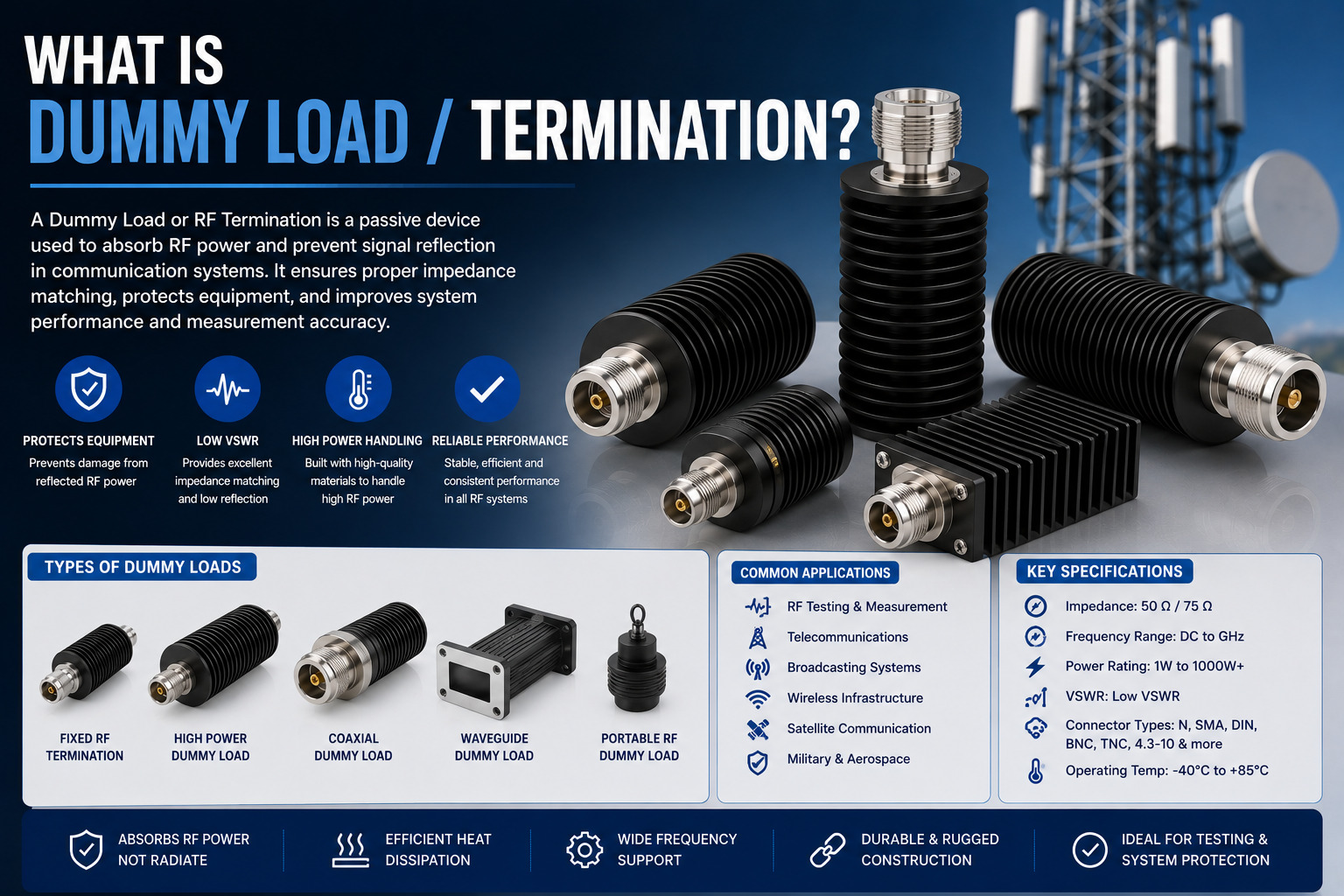
A Dummy Load, also known as RF Termination, is an essential RF component used to absorb radio frequency power in communication systems without radiating signals. Dummy loads are widely used in telecommunications, broadcasting, wireless networking, RF testing, microwave communication, military systems, satellite communication, and laboratory applications.
These devices are designed to provide a matched impedance to RF systems, ensuring proper signal absorption and preventing signal reflection. Dummy loads help protect RF transmitters, amplifiers, antennas, and communication equipment from damage caused by reflected power or improper impedance matching.
Modern RF communication systems rely heavily on dummy loads for accurate testing, system calibration, network optimization, and safe operation of high-frequency equipment. They are commonly used in telecom infrastructure, base stations, RF laboratories, signal generators, antenna systems, and wireless communication networks.
Today, dummy loads and RF terminations are considered critical components in modern communication infrastructure because they help maintain stable RF performance and improve system reliability.
What is Dummy Load / Termination?
A Dummy Load or RF Termination is a passive RF device designed to absorb radio frequency energy and convert it into heat instead of radiating it as electromagnetic signals.
It is commonly connected to unused RF ports, communication outputs, or testing systems to maintain proper impedance matching and prevent signal reflection.
Dummy loads are commonly used in:
- RF communication systems
- Telecom infrastructure
- Broadcasting systems
- RF testing laboratories
- Wireless communication
- Microwave systems
- Antenna testing
These devices are specially designed with precise impedance values such as:
- 50 ohm
- 75 ohm
Proper impedance matching helps maintain signal stability and protects RF equipment.
Importance of Dummy Loads in RF Systems
Modern communication systems require proper impedance control for stable operation and signal integrity. Dummy loads are important because they absorb unwanted RF energy and prevent damage caused by reflected signals.
Dummy loads help:
- Protect RF transmitters
- Prevent signal reflection
- Maintain impedance matching
- Improve testing accuracy
- Stabilize communication systems
- Reduce RF interference
Because of these advantages, dummy loads are widely used in RF communication and testing environments.
How Does a Dummy Load Work?
A dummy load works by absorbing incoming RF energy and dissipating it as heat through internal resistive elements.
The device provides a matched impedance to the RF system, ensuring minimal signal reflection and stable communication performance.
The working process includes:
- RF signal input
- Signal absorption
- Heat dissipation
- Impedance stabilization
High-quality dummy loads provide low VSWR and accurate RF termination for communication systems.
Components of a Dummy Load / Termination
A dummy load contains several important components designed for RF signal absorption and heat management.
Resistive Element
The resistive network absorbs RF energy and converts it into heat.
RF Connector Interface
The connector provides input connection for RF communication equipment.
Heat Sink Structure
Heat sinks help dissipate thermal energy generated during RF absorption.
Shielded Housing
The outer body protects against EMI and environmental conditions.
Dielectric Insulation
The dielectric material maintains impedance stability and electrical isolation.
Types of Dummy Load / Termination
Dummy loads are available in different configurations depending on RF applications and power requirements.
Fixed RF Termination
Fixed terminations provide constant impedance for RF systems.
Applications
- Telecom systems
- RF testing
- Wireless communication
High Power Dummy Load
Designed to handle large RF power levels safely.
Uses
- Broadcasting systems
- RF transmitters
- Base stations
Coaxial Dummy Load
Coaxial dummy loads are used in RF cable and antenna systems.
Waveguide Dummy Load
Waveguide loads are used in microwave and radar communication systems.
Portable RF Dummy Load
Compact dummy loads are used for field testing and portable RF equipment.
Specifications of Dummy Load / Termination
The specifications of dummy loads determine RF performance and compatibility.
Frequency Range
Dummy loads support frequency ranges from MHz to microwave GHz bands.
Impedance
Most RF terminations are designed with:
- 50 ohm impedance
- 75 ohm impedance
Power Rating
Power handling capacity determines how much RF energy the load can absorb.
Common power ratings include:
- 1 Watt
- 10 Watt
- 50 Watt
- 100 Watt
- 500 Watt and above
VSWR
Low VSWR indicates excellent impedance matching and reduced reflection.
Connector Types
Dummy loads support multiple RF connector interfaces such as:
- N Type
- SMA
- DIN
- BNC
- TNC
- 4.3-10
Operating Temperature
Industrial dummy loads support harsh environmental conditions.
Insertion Loss
High-quality RF terminations provide efficient signal absorption with minimal reflection.
Applications of Dummy Load / Termination
Dummy loads are widely used across numerous RF and communication industries.
RF Testing Laboratories
Testing equipment uses dummy loads for signal calibration and measurement.
Equipment
- Signal generators
- Network analyzers
- Spectrum analyzers
Telecommunications Industry
Telecom systems use dummy loads for RF network optimization and testing.
Broadcasting Systems
Broadcast transmitters use dummy loads for testing and maintenance.
Wireless Communication Systems
Wireless infrastructure uses RF terminations for stable signal management.
Satellite Communication
Satellite systems use dummy loads for microwave signal testing.
Military and Aerospace
Defense communication systems require precision RF terminations.
Benefits
- Stable RF performance
- Reliable impedance matching
- High-frequency support
Advantages of Dummy Load / Termination
Dummy loads provide several important RF communication benefits.
Protects RF Equipment
They prevent damage caused by reflected RF power.
Improves Signal Stability
Proper impedance matching improves communication quality.
Accurate RF Testing
Dummy loads provide reliable signal absorption for testing environments.
Reduces Signal Reflection
Low VSWR improves communication efficiency.
Supports High-Frequency Systems
Dummy loads work efficiently in microwave and RF applications.
Reliable Heat Dissipation
High-power designs safely absorb RF energy.
Technical Features of Dummy Loads
Modern dummy loads include several advanced RF features.
Precision Impedance Matching
Maintains stable RF communication performance.
Low VSWR
Minimizes reflected RF energy.
High Power Handling
Supports high-power communication systems.
Durable Construction
Industrial-grade materials improve operational lifespan.
Difference Between Dummy Load and RF Attenuator
Both devices are used in RF systems but perform different functions.
Dummy Load
- Absorbs RF energy completely
- Prevents signal radiation
- Used for RF termination and testing
RF Attenuator
- Reduces RF signal power
- Allows signal transmission
- Used for signal level control
Dummy loads terminate RF signals, while attenuators reduce signal strength.
Common Problems with Dummy Loads
Improper usage or low-quality devices may affect RF performance.
Overheating
Excessive RF power may generate high temperatures.
Impedance Mismatch
Incorrect impedance may increase signal reflection.
Connector Damage
Improper installation can damage RF interfaces.
Reduced RF Efficiency
Poor-quality loads may affect communication stability.
Tips for Choosing the Right Dummy Load / Termination
Selecting the correct dummy load improves communication reliability and RF system safety.
Verify Frequency Compatibility
Choose loads suitable for required operating frequencies.
Check Power Rating
Ensure the dummy load supports required RF power levels.
Verify Connector Compatibility
Ensure compatibility with RF cables and communication equipment.
Choose Low VSWR Devices
Low VSWR improves RF efficiency and signal absorption.
Select Durable Materials
High-quality materials improve operational reliability and heat resistance.
Future of Dummy Load / Termination
Modern RF communication systems continue to demand advanced signal management solutions.
Recent developments include:
- High-frequency RF terminations
- 5G telecom testing systems
- Compact microwave dummy loads
- Advanced heat dissipation technology
- High-power RF communication infrastructure
As wireless networking, telecom systems, and microwave communication continue to grow, dummy loads will remain essential components in RF communication and testing systems.
Conclusion
A Dummy Load or RF Termination is a critical RF component used to absorb radio frequency energy and maintain stable impedance matching in communication systems. These devices help protect RF equipment, improve testing accuracy, reduce signal reflection, and support stable communication performance across telecom, broadcasting, satellite communication, and wireless networking systems.
From telecom towers and RF laboratories to microwave systems and broadcasting infrastructure, dummy loads provide reliable RF termination solutions for modern communication environments.
Understanding dummy load types, specifications, applications, advantages, and working principles helps communication professionals select the right RF termination solution for stable and efficient RF communication systems.