
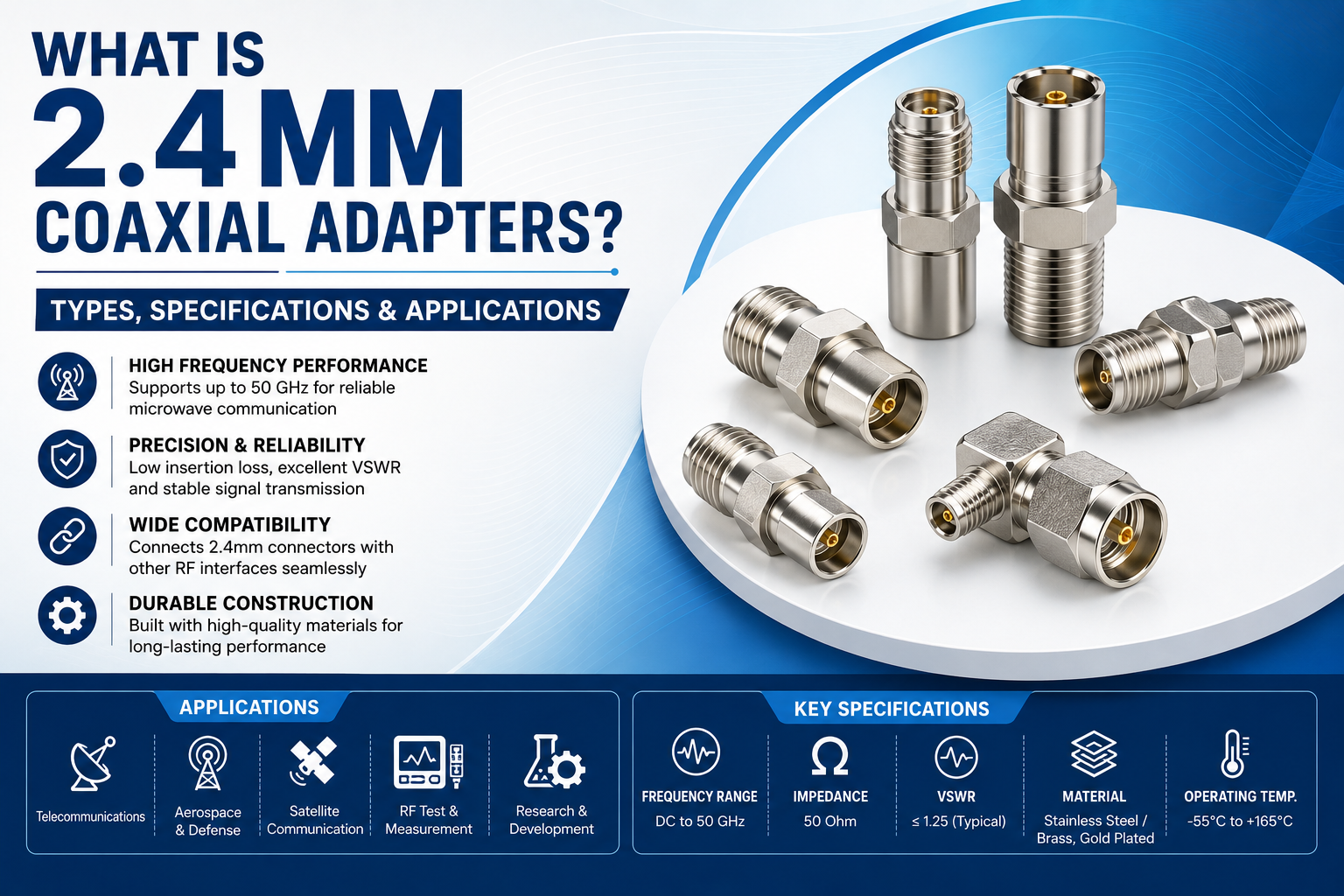
2.4mm coaxial adapters are high-frequency RF components used to connect precision microwave connectors and communication equipment in advanced radio frequency systems. These adapters are specially designed for extremely high-frequency applications where stable signal transmission, low insertion loss, and precise impedance matching are critical.
2.4mm coaxial adapters are widely used in microwave communication, aerospace systems, defense applications, telecom infrastructure, satellite communication, RF testing, and laboratory measurement equipment. They are designed to support frequencies up to 50 GHz, making them ideal for modern high-speed communication technologies and precision RF environments.
These adapters are commonly used for connecting cables, antennas, instruments, and RF modules with compatible 2.4mm interfaces or other precision connector types. Their rugged construction and precision engineering ensure excellent microwave performance with minimal signal reflection and interference.
As high-frequency communication technologies continue to evolve, 2.4mm coaxial adapters remain essential components in advanced RF and microwave systems.
What is a 2.4mm Coaxial Adapter?
A 2.4mm coaxial adapter is a precision RF adapter used to connect two microwave connectors or RF interfaces operating at extremely high frequencies. It is designed with a 50-ohm impedance structure to maintain accurate signal transmission in microwave applications.
These adapters are commonly used to:
- Connect RF cables
- Join microwave connectors
- Interface testing equipment
- Support high-frequency communication systems
- Convert RF connector interfaces
2.4mm coaxial adapters are specially engineered for precision microwave environments where low signal loss and stable electrical performance are essential.
These adapters are commonly compatible with:
- 2.4mm connectors
- SMA connectors
- K connectors
- Precision RF interfaces
Their compact design and high-frequency capability make them suitable for advanced communication systems and RF testing laboratories.
Importance of 2.4mm Coaxial Adapters
Modern RF systems require extremely accurate signal transmission at microwave frequencies. 2.4mm coaxial adapters are important because they help maintain signal integrity while supporting high-frequency communication applications.
These adapters help:
- Minimize signal loss
- Maintain impedance matching
- Support microwave frequencies
- Reduce signal reflection
- Improve testing accuracy
Because of these advantages, they are widely used in telecom, aerospace, military, and RF research applications.
How Does a 2.4mm Coaxial Adapter Work?
A 2.4mm coaxial adapter works by creating a stable electrical connection between two RF interfaces while maintaining proper impedance and shielding characteristics.
The adapter transfers microwave signals through an internal conductive pathway surrounded by precision dielectric insulation and metal shielding.
The working process includes:
- RF signal transmission
- Impedance matching
- Signal shielding
- Microwave signal continuity
High-quality 2.4mm adapters ensure low insertion loss and accurate signal performance even at extremely high frequencies.
Components of a 2.4mm Coaxial Adapter
A 2.4mm coaxial adapter contains several precision-engineered components.
Center Conductor
The center conductor transfers the RF or microwave signal between connected devices.
Dielectric Insulator
The dielectric material separates the center conductor from the outer body while maintaining impedance stability.
Outer Shielding Body
The metal housing provides shielding protection against EMI and RF interference.
Precision Connector Interface
The connector interface ensures secure mechanical and electrical connections.
Coupling Mechanism
The threaded coupling design provides stable high-frequency connectivity.
Types of 2.4mm Coaxial Adapters
2.4mm coaxial adapters are available in multiple configurations depending on communication and testing requirements.
2.4mm Male to Male Adapter
Used to connect two female microwave interfaces.
Applications
- RF testing equipment
- Microwave communication systems
- Laboratory instruments
2.4mm Female to Female Adapter
Connects two male RF connectors.
Uses
- Cable assemblies
- Microwave modules
- Precision testing systems
2.4mm Male to Female Adapter
Allows connection between opposite-gender RF interfaces.
Right Angle 2.4mm Adapter
Designed for compact installations and restricted cable routing environments.
Benefits
- Space-saving installation
- Better cable management
- Reduced cable stress
Between-Series 2.4mm Adapter
Used to connect 2.4mm connectors with other RF connector types.
Examples
- 2.4mm to SMA adapter
- 2.4mm to K connector adapter
Specifications of 2.4mm Coaxial Adapters
The specifications of 2.4mm coaxial adapters determine their RF performance and compatibility.
Frequency Range
One of the most important specifications is frequency capability.
2.4mm coaxial adapters generally support frequencies up to:
- 50 GHz
This makes them suitable for advanced microwave applications.
Impedance
Most 2.4mm adapters are designed with:
- 50 ohm impedance
Proper impedance matching minimizes signal reflection and transmission loss.
VSWR
VSWR stands for Voltage Standing Wave Ratio.
Low VSWR values indicate better impedance matching and improved RF performance.
Insertion Loss
Insertion loss measures signal loss through the adapter.
High-quality 2.4mm adapters provide very low insertion loss for efficient microwave transmission.
Material
These adapters are commonly manufactured using:
- Stainless steel
- Brass
- Gold-plated contacts
- Precision alloy materials
Durability
Precision adapters are designed for repeated mating cycles and long operational life.
Operating Temperature
Industrial-grade adapters can operate under harsh environmental conditions.
Applications of 2.4mm Coaxial Adapters
2.4mm coaxial adapters are used in numerous advanced RF and microwave systems.
RF Testing and Measurement
Testing laboratories use these adapters for precision microwave measurements.
Equipment
- Network analyzers
- Spectrum analyzers
- Signal generators
- Oscilloscopes
Telecommunications Industry
Telecom infrastructure uses high-frequency adapters for advanced communication systems.
Applications
- Microwave communication
- Base stations
- 5G systems
- RF modules
Aerospace and Defense
Military and aerospace systems require precision microwave connectivity.
Benefits
- Stable signal transmission
- High-frequency support
- Rugged construction
Satellite Communication
Satellite systems use microwave adapters for high-frequency signal transmission.
Research and Development Laboratories
Research facilities use precision RF adapters for microwave experiments and testing.
Radar Systems
Radar communication systems use high-frequency coaxial adapters for accurate RF performance.
Advantages of 2.4mm Coaxial Adapters
2.4mm coaxial adapters offer several important RF communication benefits.
Extremely High-Frequency Support
They support microwave frequencies up to 50 GHz.
Low Signal Loss
Precision construction minimizes insertion loss.
Excellent Signal Integrity
These adapters maintain accurate microwave signal transmission.
Precision Impedance Matching
Proper impedance reduces signal reflection and distortion.
Strong Mechanical Stability
Threaded coupling provides secure connectivity.
Long Operational Life
Durable materials support repeated use in professional environments.
Difference Between 2.4mm and SMA Adapters
Although both are RF adapters, they support different performance levels.
2.4mm Adapter
- Supports frequencies up to 50 GHz
- Precision microwave applications
- Higher RF performance
SMA Adapter
- Typically supports lower frequencies
- Used in standard RF communication systems
- More common in general wireless applications
2.4mm adapters are preferred for advanced microwave and precision RF systems.
Common Problems with 2.4mm Coaxial Adapters
Improper handling or installation may affect performance.
Signal Reflection
Poor impedance matching may increase reflection loss.
Connector Damage
Over-tightening can damage precision interfaces.
Contamination
Dust and particles may affect microwave performance.
Signal Loss
Low-quality adapters may increase attenuation.
Tips for Choosing the Right 2.4mm Coaxial Adapter
Selecting the correct adapter improves microwave communication performance.
Verify Frequency Requirements
Ensure the adapter supports required operating frequencies.
Check Connector Compatibility
Choose compatible RF interfaces and connector types.
Consider Precision Requirements
Testing applications require high-accuracy adapters.
Select Durable Materials
Quality materials improve operational reliability.
Choose Low VSWR Adapters
Lower VSWR improves RF signal efficiency.
Future of 2.4mm Coaxial Adapters
Modern communication systems continue to demand higher frequencies and better signal performance.
Recent advancements include:
- Precision microwave adapters
- 5G communication connectivity
- Advanced radar systems
- High-frequency testing solutions
- Low-loss RF components
As microwave communication and high-speed networking continue to grow, 2.4mm coaxial adapters will remain essential components in advanced RF infrastructure.
Conclusion
2.4mm coaxial adapters are precision RF components designed for extremely high-frequency microwave communication and testing applications. Their ability to support frequencies up to 50 GHz, maintain low insertion loss, and provide accurate impedance matching makes them ideal for telecom, aerospace, defense, satellite communication, and laboratory testing systems.
From RF analyzers and microwave communication equipment to radar systems and advanced telecom infrastructure, 2.4mm coaxial adapters provide reliable and high-performance connectivity across modern communication environments.
Understanding their specifications, applications, advantages, and configurations helps engineers and communication professionals select the right adapter for precision microwave and RF systems.