Wi-Fi antennas are essential components of modern wireless communication systems. They determine how radio frequency signals are transmitted and received between wireless devices such as routers, access points, gateways, laptops, smartphones, IoT devices, and industrial equipment.
The performance of a Wi-Fi network depends on several factors, including antenna type, antenna gain, radiation pattern, polarization, frequency range, impedance, installation position, and surrounding environment.
Modern Wi-Fi systems operate primarily across the 2.4 GHz, 5 GHz, and 6 GHz frequency bands. With the growth of Wi-Fi 6, Wi-Fi 6E, and Wi-Fi 7, antenna technology has also evolved to support MIMO, beamforming, multi-band operation, higher data rates, and improved wireless capacity.
Selecting the correct Wi-Fi antenna can improve coverage, signal quality, connection stability, range, and overall network performance.
What Is a Wi-Fi Antenna?
A Wi-Fi antenna is an RF component designed to transmit and receive electromagnetic waves used by Wi-Fi wireless communication systems.
During transmission, the antenna converts electrical RF energy into electromagnetic waves. During reception, it captures electromagnetic energy from the surrounding environment and converts it back into an electrical signal that can be processed by the wireless device.
A Wi-Fi antenna can influence:
- Wireless coverage
- Signal strength
- Communication range
- Data throughput
- Signal-to-noise ratio
- Network reliability
- Interference performance
- Spatial stream performance
The antenna itself does not create additional transmitter power. Instead, its radiation pattern and gain determine how efficiently available RF energy is distributed.
Why Wi-Fi Antenna Selection Is Important
Choosing a Wi-Fi antenna only on the basis of antenna gain can lead to poor network performance. Different applications require different radiation patterns.
For example, an omnidirectional antenna may be suitable for a central access point that needs to communicate with devices throughout a room. A directional antenna may be more appropriate for connecting two buildings over a long distance.
Important selection parameters include:
- Operating frequency
- Antenna gain
- Radiation pattern
- Polarization
- Impedance
- VSWR
- Connector type
- Cable loss
- Physical dimensions
- Environmental protection
- Installation method
Main Types of Wi-Fi Antennas
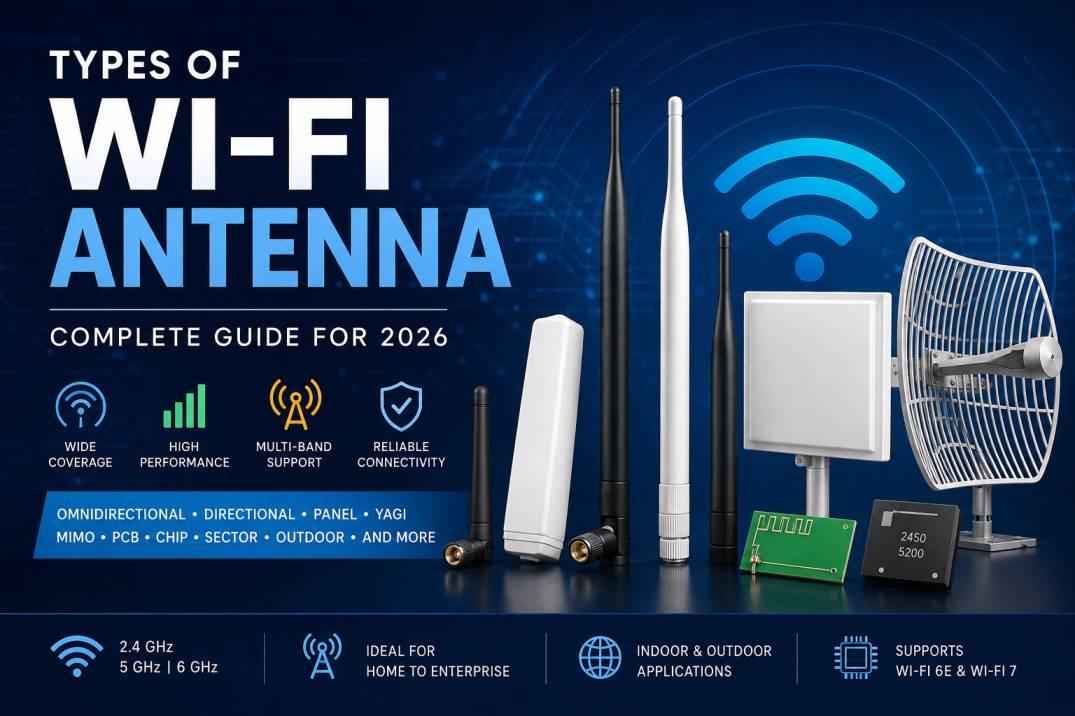
The major types of Wi-Fi antennas include:
- Omnidirectional Wi-Fi Antenna
- Directional Wi-Fi Antenna
- Panel Wi-Fi Antenna
- Yagi Wi-Fi Antenna
- Parabolic Wi-Fi Antenna
- Sector Wi-Fi Antenna
- MIMO Wi-Fi Antenna
- PCB Wi-Fi Antenna
- Ceramic Chip Antenna
- Rubber Duck Wi-Fi Antenna
- Ceiling-Mount Wi-Fi Antenna
- Outdoor Wi-Fi Antenna
- High-Gain Wi-Fi Antenna
- Dual-Band Wi-Fi Antenna
- Tri-Band Wi-Fi Antenna
1. Omnidirectional Wi-Fi Antenna
An omnidirectional Wi-Fi antenna radiates RF energy around the antenna in a broad horizontal pattern. It is commonly used when wireless devices are distributed around an access point.
Omnidirectional antennas are frequently found in Wi-Fi routers, wireless access points, IoT gateways, and indoor wireless systems.
Features of Omnidirectional Wi-Fi Antennas
- Wide horizontal coverage
- 360-degree nominal horizontal radiation pattern
- Simple installation
- Available in multiple gain options
- Suitable for multi-user environments
- Available for indoor and outdoor applications
Applications
Omnidirectional Wi-Fi antennas are commonly used in:
- Homes
- Offices
- Hotels
- Schools
- Retail stores
- Warehouses
- Public Wi-Fi hotspots
- Industrial wireless networks
Advantages
The main advantage is broad area coverage. A centrally installed omnidirectional antenna can provide connectivity to devices located in different directions.
2. Directional Wi-Fi Antenna
A directional Wi-Fi antenna concentrates RF energy toward a particular direction rather than distributing it equally around the antenna.
Directional antennas are particularly useful when a wireless signal needs to travel over a long distance or when coverage needs to be restricted to a specific area.
Applications
- Point-to-point wireless links
- Building-to-building communication
- Outdoor Wi-Fi networks
- Wireless bridges
- Rural broadband
- Industrial communication
- Remote monitoring
Advantages
- Higher gain
- Longer potential range
- Focused coverage
- Better control of RF energy
- Reduced unwanted radiation outside the intended coverage area
3. Panel Wi-Fi Antenna
Panel antennas are flat directional antennas designed to provide controlled RF coverage.
They are commonly installed on walls, poles, ceilings, access points, and outdoor structures.
Panel antennas are available in different gain and beamwidth configurations, making them suitable for both indoor and outdoor wireless networks.
Typical Applications
- Enterprise Wi-Fi
- Warehouses
- Shopping centers
- Educational campuses
- Industrial facilities
- Outdoor wireless networks
- Public hotspots
Advantages
- Compact construction
- Directional radiation
- Moderate to high gain
- Easy mounting
- Controlled coverage area
4. Yagi Wi-Fi Antenna
A Yagi antenna is a directional antenna consisting of multiple conductive elements arranged along a supporting boom.
Its structure allows RF energy to be concentrated in a specific direction.
Yagi antennas are commonly used for long-distance wireless communication where a narrow directional pattern is desirable.
Applications
- Point-to-point Wi-Fi
- Rural wireless communication
- Remote locations
- Agricultural IoT
- Industrial monitoring
- Wireless bridges
Advantages
- High directional gain
- Good front-to-back ratio
- Relatively lightweight
- Suitable for outdoor applications
- Long communication range under suitable conditions
5. Parabolic Wi-Fi Antenna
A parabolic antenna uses a reflector to focus electromagnetic energy into a narrow beam.
Parabolic antennas can provide very high gain and are primarily used for long-distance point-to-point wireless communication.
Applications
- ISP wireless backhaul
- Long-distance Wi-Fi links
- Building-to-building communication
- Remote infrastructure
- Outdoor broadband
- Specialized industrial networks
Advantages
- Very high gain
- Extremely narrow beam
- Long-distance capability
- Excellent directional control
Important Consideration
Because the beamwidth is narrow, accurate alignment is critical. Trees, buildings, terrain, and other physical obstacles can significantly affect long-distance wireless links.
6. Sector Wi-Fi Antenna
Sector antennas provide coverage over a defined angular area instead of 360 degrees.
Common sector coverage configurations include approximately 60, 90, or 120 degrees, depending on the antenna design.
Multiple sector antennas can be installed together to provide broader coverage.
Applications
- Outdoor Wi-Fi
- Campus networks
- Public hotspots
- Stadiums
- Smart city infrastructure
- Industrial campuses
- Wireless broadband networks
Advantages
- Controlled coverage
- High user capacity
- Directional RF management
- Suitable for large outdoor deployments
- Can help manage interference through sectorization
7. MIMO Wi-Fi Antenna
MIMO stands for Multiple Input Multiple Output.
MIMO uses multiple antennas and multiple spatial signal paths to increase wireless capacity and improve communication reliability.
MIMO technology is an important part of modern Wi-Fi standards, including Wi-Fi 5, Wi-Fi 6, Wi-Fi 6E, and Wi-Fi 7.
Benefits of MIMO Antennas
- Higher throughput
- Improved reliability
- Multiple spatial streams
- Better performance in multipath environments
- Support for advanced wireless technologies
- Improved network capacity
MIMO Configurations
Common configurations include:
- 2×2 MIMO
- 3×3 MIMO
- 4×4 MIMO
- 8×8 MIMO
The appropriate configuration depends on the wireless chipset, access point architecture, client devices, and application requirements.
8. PCB Wi-Fi Antenna
A PCB antenna is integrated directly into the printed circuit board of an electronic device.
PCB antennas are popular because they can be manufactured as part of the device PCB and do not necessarily require a separate external antenna structure.
Applications
- IoT devices
- Smart home products
- Wireless sensors
- Industrial controllers
- Smart meters
- Embedded systems
- Consumer electronics
Advantages
- Compact
- Lightweight
- Cost-effective for mass production
- Easy integration
- No separate external antenna required in many designs
PCB antenna performance depends heavily on PCB layout, ground-plane design, enclosure material, component placement, and surrounding structures.
9. Ceramic Chip Wi-Fi Antenna
Ceramic chip antennas are miniature antennas designed for compact wireless devices.
They are mounted directly onto a PCB and are useful when space is limited.
Applications
- Wearable devices
- Smart sensors
- IoT equipment
- Smart locks
- Portable electronics
- Wireless modules
- Compact industrial devices
Advantages
- Very small footprint
- Easy PCB mounting
- Suitable for compact devices
- Consistent manufacturing
- Available for multiple wireless frequency bands
10. Rubber Duck Wi-Fi Antenna
The rubber duck antenna is a compact external antenna commonly used with wireless routers, access points, gateways, and communication equipment.
It is generally an omnidirectional antenna and may be detachable depending on the equipment design.
Features
- Compact construction
- Easy installation
- Omnidirectional radiation
- Multiple connector options
- Available in different frequency ranges
Applications
- Wi-Fi routers
- Wireless gateways
- Access points
- Industrial routers
- Embedded wireless equipment
11. Ceiling-Mount Wi-Fi Antenna
Ceiling-mounted antennas are commonly used in enterprise wireless networks.
Their installation position helps provide broad indoor coverage throughout offices, hotels, schools, hospitals, shopping centers, and other large buildings.
Advantages
- Centralized coverage
- Clean installation
- Suitable for enterprise access points
- Better coverage planning
- Supports high-density environments
12. Outdoor Wi-Fi Antenna
Outdoor Wi-Fi antennas are designed for use in environments exposed to weather and temperature variations.
Depending on the application, outdoor antennas may feature weather-resistant housings, UV-resistant materials, sealed connectors, and appropriate mounting systems.
Applications
- Outdoor Wi-Fi hotspots
- Industrial sites
- Smart city networks
- Agriculture
- Construction sites
- Campus networks
- Wireless broadband
13. High-Gain Wi-Fi Antenna
High-gain antennas concentrate RF energy into a more focused radiation pattern.
High-gain antennas are useful when extended communication distance or controlled coverage is required.
However, higher gain does not automatically mean better coverage in every installation.
An antenna with excessive gain may create a narrow vertical beam that does not provide the desired coverage in some environments.
14. Dual-Band Wi-Fi Antenna
Dual-band antennas are designed to support two Wi-Fi frequency bands, typically:
- 2.4 GHz
- 5 GHz
Dual-band antennas are widely used in Wi-Fi 5 and Wi-Fi 6 equipment.
Advantages
- Supports multiple Wi-Fi bands
- Flexible deployment
- Suitable for modern routers
- Improved network capacity
- Supports different client requirements
15. Tri-Band Wi-Fi Antenna
Tri-band Wi-Fi antennas support three frequency ranges, typically:
- 2.4 GHz
- 5 GHz
- 6 GHz
They are increasingly important for Wi-Fi 6E and Wi-Fi 7 equipment.
Tri-band antenna systems allow compatible wireless equipment to utilize additional spectrum while supporting multiple wireless clients.
Wi-Fi Antenna Types Comparison
| Antenna Type | Radiation Pattern | Typical Application |
|---|---|---|
| Omnidirectional | 360° horizontal | Homes and offices |
| Directional | Focused | Long-distance links |
| Panel | Directional | Enterprise and outdoor |
| Yagi | Narrow directional | Point-to-point |
| Parabolic | Very narrow | Long-distance backhaul |
| Sector | Sector coverage | Outdoor networks |
| MIMO | Multiple spatial paths | Wi-Fi 6/7 |
| PCB | Device-dependent | IoT |
| Chip | Device-dependent | Compact electronics |
| Rubber Duck | Omnidirectional | Routers and gateways |
| Ceiling Mount | Broad indoor | Enterprise |
| Outdoor | Omni or directional | Outdoor networks |
Wi-Fi Antenna Frequency Bands
Wi-Fi antenna selection must always consider the frequency range.
2.4 GHz
The 2.4 GHz band generally provides better propagation through obstacles than higher Wi-Fi bands but has less available spectrum and can experience more congestion.
It is commonly used for:
- IoT
- Smart home devices
- General wireless connectivity
- Legacy Wi-Fi equipment
5 GHz
The 5 GHz band provides access to more channels and is widely used for higher-performance Wi-Fi connectivity.
It is commonly used for:
- Enterprise Wi-Fi
- High-speed wireless access
- Video streaming
- Gaming
- Business networks
6 GHz
The 6 GHz band is important for Wi-Fi 6E and Wi-Fi 7 deployments.
It provides additional spectrum that can support high-capacity wireless networks when compatible devices and regulatory conditions permit.
Understanding Wi-Fi Antenna Gain
Antenna gain is commonly expressed in dBi.
dBi describes antenna gain relative to an ideal isotropic radiator.
Examples of general antenna gain categories include:
| Gain Category | Typical Design |
|---|---|
| 1–3 dBi | Compact internal antenna |
| 3–6 dBi | Standard indoor antenna |
| 6–10 dBi | Extended coverage |
| 10–18 dBi | Directional applications |
| 18+ dBi | Long-distance directional |
Actual performance depends on frequency, installation height, radiation pattern, polarization, cable loss, environment, and system design.
Wi-Fi Antenna Radiation Pattern
The radiation pattern shows how an antenna distributes RF energy.
Two important patterns are:
Horizontal Radiation Pattern
This shows antenna coverage around the antenna when viewed from above.
Vertical Radiation Pattern
This shows how RF energy is distributed above and below the antenna.
Radiation pattern is extremely important when designing a Wi-Fi network because an antenna with high gain may have a narrower vertical beam.
Wi-Fi Antenna Polarization
Polarization describes the orientation of the electromagnetic field.
Common polarization configurations include:
- Vertical polarization
- Horizontal polarization
- Dual polarization
- Cross polarization
Matching the polarization between transmitting and receiving antennas helps maintain efficient RF communication.
MIMO systems may use multiple antenna elements with different polarization orientations to improve spatial performance.
Wi-Fi Antenna Impedance
Most Wi-Fi RF systems are designed around a 50-ohm impedance.
Maintaining impedance matching between the wireless chipset, transmission line, connector, cable, and antenna helps minimize signal reflections.
Poor impedance matching can result in:
- Increased VSWR
- Return loss
- Reduced transmitted power
- Reduced receiver sensitivity
- Lower overall RF efficiency
VSWR in Wi-Fi Antennas
VSWR stands for Voltage Standing Wave Ratio.
It is an important parameter used to evaluate how well an antenna is matched to the RF system.
A lower VSWR generally indicates better impedance matching.
A well-designed Wi-Fi antenna should maintain an acceptable VSWR across its intended operating frequency range.
Wi-Fi Antenna Connectors
Wi-Fi antennas are available with different RF connector configurations.
Common connectors include:
- SMA
- RP-SMA
- N-Type
- TNC
- MMCX
- U.FL
- IPEX
- MHF connectors
Connector selection depends on the wireless device, cable assembly, mechanical requirements, and operating frequency.
Wi-Fi Antenna Cable Assembly
The antenna cable is another important part of the wireless RF system.
Even if the antenna has excellent gain, excessive cable loss can reduce the signal reaching the antenna.
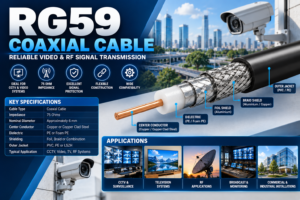
Common Wi-Fi antenna cable types include:
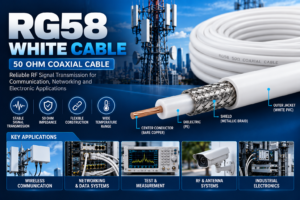
- RG174
- RG316
- RG58
- Low-loss coaxial cables
- Micro coaxial cables
- Custom RF cable assemblies
For compact wireless devices, U.FL, IPEX, and similar miniature connectors are frequently used.
Wi-Fi Antenna Applications
Wi-Fi antennas are used across numerous industries.
Telecommunications
Wi-Fi antennas are used in wireless access points, gateways, routers, and broadband equipment.
Industrial Automation
Industrial wireless networks use antennas for machine communication, monitoring, control systems, and industrial IoT.
Smart Cities
Wi-Fi antennas support public connectivity, surveillance infrastructure, smart parking, environmental monitoring, and connected infrastructure.
Transportation
Wireless networks in railway stations, airports, warehouses, and transportation infrastructure depend on appropriately designed antenna systems.
Healthcare
Hospitals and healthcare facilities use wireless connectivity for mobile devices, monitoring equipment, asset tracking, and IoT systems.
Education
Schools and universities deploy large numbers of wireless access points and antenna systems to provide high-density Wi-Fi coverage.
Retail
Retail environments use Wi-Fi for point-of-sale systems, inventory management, customer connectivity, and IoT applications.
Wi-Fi Antennas for IoT
IoT devices often require compact antennas that provide reliable connectivity while consuming minimal physical space.
PCB and chip antennas are particularly useful for IoT devices because they can be integrated directly into the device.
Important considerations include:
- Device dimensions
- Enclosure material
- Ground-plane size
- Frequency band
- Antenna efficiency
- Power consumption
- Installation orientation
Wi-Fi Antennas for Outdoor Networks
Outdoor networks require careful antenna selection because environmental conditions and physical obstacles can significantly affect wireless propagation.
Important factors include:
- Weather resistance
- UV resistance
- Temperature range
- Mounting method
- Wind loading
- Connector protection
- Cable routing
- Grounding and lightning protection
Directional antennas are frequently used when outdoor Wi-Fi communication must cover a specific area or connect two distant locations.
Wi-Fi Antennas for Wi-Fi 6 and Wi-Fi 7
Modern Wi-Fi generations require more sophisticated antenna architectures than earlier wireless systems.
Wi-Fi 6 introduced technologies such as OFDMA and enhanced MU-MIMO capabilities, while Wi-Fi 6E expanded operation into the 6 GHz band.
Wi-Fi 7 further improves wireless performance through technologies including 320 MHz channels, 4096-QAM, Multi-Link Operation, and enhanced multi-user capabilities.
These developments increase the importance of:
- Multi-band antennas
- MIMO arrays
- Beamforming
- Low-loss RF paths
- High-isolation antenna elements
- Advanced antenna tuning
Beamforming and Wi-Fi Antennas
Beamforming allows a wireless system to direct RF energy more effectively toward a client device.
Instead of treating every direction equally, the system uses multiple antenna elements and signal processing to optimize transmission.
Benefits can include:
- Improved signal quality
- Better coverage
- Increased throughput
- Reduced interference
- Improved wireless reliability
Beamforming is particularly important in high-performance Wi-Fi 6 and Wi-Fi 7 access points.
How to Choose the Right Wi-Fi Antenna
The correct antenna should be selected according to the complete wireless system rather than based on gain alone.
Step 1: Identify the Frequency
Determine whether the system operates at:
- 2.4 GHz
- 5 GHz
- 6 GHz
- Dual-band
- Tri-band
Step 2: Determine Required Coverage
For broad coverage, consider an omnidirectional antenna.
For focused coverage, consider a panel, Yagi, sector, or parabolic antenna.
Step 3: Determine Required Gain
Choose gain according to the required coverage pattern and communication distance.
Step 4: Check Polarization
Ensure the antenna polarization is compatible with the wireless system.
Step 5: Check Impedance
Most Wi-Fi RF systems use 50-ohm impedance.
Step 6: Select the Connector
Verify whether the equipment requires SMA, RP-SMA, N-Type, U.FL, IPEX, MMCX, or another connector.
Step 7: Consider the Environment
Indoor and outdoor antennas have different mechanical and environmental requirements.
Step 8: Consider MIMO Requirements
For modern Wi-Fi systems, verify the number of antenna ports and spatial streams supported by the wireless chipset or access point.
Common Wi-Fi Antenna Selection Mistakes
Choosing the Highest Gain Available
Higher gain is not always better. An antenna with excessive gain can produce an unsuitable radiation pattern.
Ignoring Frequency Range
An antenna designed for 2.4 GHz should not automatically be assumed to perform efficiently at 5 GHz or 6 GHz.
Using Excessively Long Cable
Long coaxial cables can introduce significant RF loss, particularly at higher frequencies.
Ignoring Polarization
Incorrect polarization can reduce received signal strength.
Installing Directional Antennas Without Alignment
Directional antennas require appropriate alignment between communicating devices.
Ignoring the Enclosure
Plastic, metal, glass, batteries, PCBs, and other nearby materials can affect antenna performance.
Future Trends in Wi-Fi Antenna Technology
Wi-Fi antenna technology is evolving alongside next-generation wireless standards.
Major trends include:
- Wi-Fi 7 tri-band antenna systems
- Higher-order MIMO
- Advanced beamforming
- Compact embedded antennas
- Multi-band antenna integration
- High-efficiency PCB antennas
- Low-profile antenna designs
- Smart antenna systems
- Antenna arrays for high-density networks
- Integrated RF front-end and antenna solutions
The growth of IoT, smart cities, industrial automation, edge computing, AR/VR, and high-density enterprise networks will continue increasing demand for advanced Wi-Fi antenna technologies.
Conclusion
Wi-Fi antennas play a critical role in determining wireless network coverage, range, reliability, and performance. Different antenna types are designed for different applications.
Omnidirectional antennas are ideal for broad-area coverage, while directional antennas are suitable for focused and long-distance communication. Panel and sector antennas are useful for controlled coverage, Yagi and parabolic antennas are suited to long-distance links, and PCB and chip antennas are preferred for compact IoT and embedded devices.
Modern Wi-Fi 6E and Wi-Fi 7 networks are increasing the demand for multi-band, MIMO, beamforming, and high-efficiency antenna systems.
Choosing the right Wi-Fi antenna requires careful consideration of frequency, gain, radiation pattern, polarization, impedance, connector type, installation environment, and network architecture.
Frequently Asked Questions
1. What are the main types of Wi-Fi antennas?
The main types include omnidirectional, directional, panel, Yagi, parabolic, sector, MIMO, PCB, chip, rubber duck, ceiling-mounted, outdoor, dual-band, and tri-band Wi-Fi antennas.
2. Which Wi-Fi antenna provides the longest range?
High-gain directional antennas such as parabolic dish antennas can provide very long communication distances when properly aligned and used in suitable line-of-sight conditions.
3. What is the difference between omnidirectional and directional Wi-Fi antennas?
An omnidirectional antenna provides broad horizontal coverage, while a directional antenna concentrates RF energy toward a particular direction.
4. What is MIMO in Wi-Fi antennas?
MIMO stands for Multiple Input Multiple Output. It uses multiple antennas to transmit and receive multiple spatial streams, improving wireless throughput and reliability.
5. What Wi-Fi antenna is best for a home router?
A dual-band omnidirectional antenna is generally suitable for home routers because it can provide broad indoor coverage across supported Wi-Fi bands.
6. What antenna is best for long-distance Wi-Fi?
Yagi, panel, and parabolic directional antennas can be suitable for long-distance Wi-Fi depending on the required gain, beamwidth, distance, and installation environment.
7. What does dBi mean in a Wi-Fi antenna?
dBi represents antenna gain relative to an isotropic radiator. Higher gain generally means RF energy is concentrated more strongly in particular directions.
8. Are Wi-Fi antennas directional?
Some Wi-Fi antennas are directional while others are omnidirectional. The correct type depends on the required coverage pattern.
9. What frequency bands do Wi-Fi antennas support?
Wi-Fi antennas may support 2.4 GHz, 5 GHz, 6 GHz, or multiple bands depending on their design.
10. What is a dual-band Wi-Fi antenna?
A dual-band Wi-Fi antenna is designed to operate across two Wi-Fi frequency bands, typically 2.4 GHz and 5 GHz.
11. What is a tri-band Wi-Fi antenna?
A tri-band Wi-Fi antenna supports three frequency ranges, typically 2.4 GHz, 5 GHz, and 6 GHz, making it suitable for many Wi-Fi 6E and Wi-Fi 7 applications.
12. Can a high-gain Wi-Fi antenna increase range?
A high-gain antenna can increase effective coverage in a particular direction by concentrating RF energy, but actual range depends on the complete wireless system, environment, transmit power, receiver sensitivity, frequency, and antenna installation.
13. Which antenna is suitable for IoT devices?
PCB and ceramic chip antennas are commonly used in compact IoT devices because they can be integrated directly into the device.
14. What connector is commonly used with Wi-Fi antennas?
SMA, RP-SMA, U.FL, IPEX, MMCX, and N-Type are among the connectors commonly encountered in Wi-Fi equipment, depending on the application.
15. Why is antenna gain important in Wi-Fi?
Antenna gain indicates how effectively an antenna concentrates RF energy. It helps determine the coverage pattern and potential communication range of the wireless system.