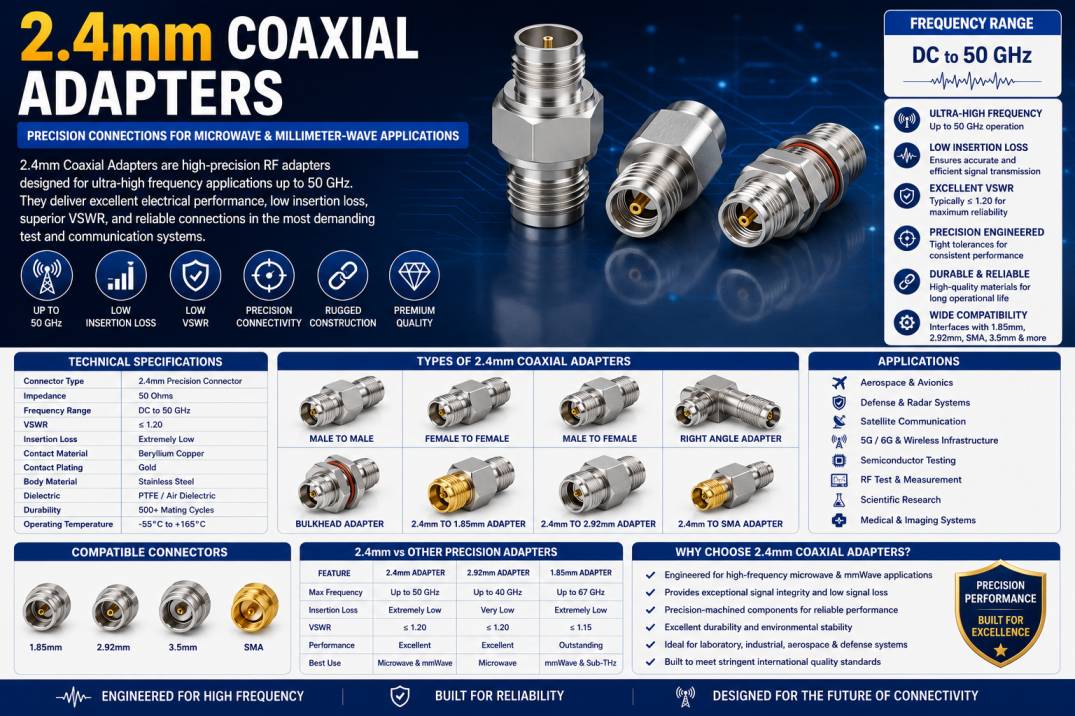
As RF and microwave communication technologies continue to evolve, engineers require precision interconnection components capable of supporting extremely high frequencies with minimal signal loss. 2.4mm Coaxial Adapters are among the most advanced RF adapters available, specifically designed for microwave and millimeter-wave applications requiring outstanding electrical performance, mechanical accuracy, and long-term reliability.
These adapters are widely used in aerospace, defense, satellite communication, radar systems, semiconductor testing, wireless infrastructure, scientific research, medical electronics, and advanced laboratory measurement equipment. Their ability to support frequencies up to 50 GHz makes them an ideal solution for high-performance RF systems where signal integrity is critical.
Unlike standard RF adapters, 2.4mm Coaxial Adapters are manufactured with precision-machined components and tight dimensional tolerances to minimize insertion loss, maintain excellent return loss, and provide consistent impedance throughout the signal path.
This comprehensive guide explains everything about 2.4mm Coaxial Adapters, including their construction, working principles, types, specifications, applications, advantages, maintenance, and selection criteria.
What Are 2.4mm Coaxial Adapters?
A 2.4mm Coaxial Adapter is a precision RF interconnect component used to connect microwave cables, antennas, amplifiers, network analyzers, spectrum analyzers, and other RF devices equipped with 2.4mm connectors or compatible interfaces.
These adapters are designed with a 50 Ohm characteristic impedance, ensuring accurate signal transmission while minimizing reflections and insertion loss across high-frequency microwave systems.
Their exceptional electrical performance makes them an industry standard in advanced communication, testing, and aerospace applications.
How Do 2.4mm Coaxial Adapters Work?
A 2.4mm Coaxial Adapter creates a precision electrical connection between two RF interfaces while maintaining continuous impedance from one device to another.
The center contacts transfer the RF signal, while the outer conductors provide electromagnetic shielding that prevents external interference and signal leakage.
Precision dielectric insulation maintains constant spacing between conductors, ensuring stable electrical performance throughout the operating frequency range.
This design minimizes insertion loss, return loss, phase distortion, and VSWR while maximizing signal integrity.
Construction of a 2.4mm Coaxial Adapter
Center Contact
The center conductor transfers high-frequency RF signals.
Common materials include:
- Beryllium Copper
- Gold-Plated Copper Alloy
- Phosphor Bronze
Gold plating improves conductivity and corrosion resistance.
Dielectric Insulator
The dielectric separates the conductors while maintaining impedance.
Typical dielectric materials include:
- PTFE
- Air dielectric
- High-performance engineering polymers
These materials provide excellent electrical stability at microwave frequencies.
Connector Body
The connector body provides mechanical strength and RF shielding.
Common materials include:
- Stainless Steel
- Passivated Stainless Steel
- Precision Machined Brass
Coupling Nut
The threaded coupling mechanism ensures secure mechanical engagement and reliable electrical contact.
Key Features of 2.4mm Coaxial Adapters
- Supports frequencies up to 50 GHz
- Precision microwave performance
- Very low insertion loss
- Excellent return loss
- Low VSWR
- Precision 50 Ohm impedance
- Gold-plated contacts
- Stainless steel construction
- Superior mechanical accuracy
- High repeatability
- Corrosion resistance
- Long operational life
Technical Specifications
| Specification | Typical Value |
| Connector Type | 2.4mm Precision Connector |
| Characteristic Impedance | 50 Ohms |
| Frequency Range | DC to 50 GHz |
| VSWR | ≤ 1.20 |
| Insertion Loss | Extremely Low |
| Contact Material | Beryllium Copper |
| Contact Plating | Gold |
| Body Material | Stainless Steel |
| Coupling Type | Threaded |
| Durability | 500+ Mating Cycles |
Types of 2.4mm Coaxial Adapters
Male to Male Adapter
Connects two female RF connectors.
Female to Female Adapter
Connects two male RF connectors.
Male to Female Adapter
Used for connector gender conversion.
Right Angle Adapter
Designed for installations with limited mounting space.
Bulkhead Adapter
Ideal for panel-mounted RF equipment.
Between-Series Adapter
Connects 2.4mm interfaces with other precision RF connectors including:
- 1.85mm
- 2.92mm
- 3.5mm
- SMA (Precision)
Common Adapter Configurations
Popular configurations include:
- 2.4mm Male to Male
- 2.4mm Female to Female
- 2.4mm Male to Female
- 2.4mm to 1.85mm
- 2.4mm to 2.92mm
- 2.4mm to SMA
- Right Angle Adapter
- Bulkhead Adapter
Applications of 2.4mm Coaxial Adapters
Aerospace
Aircraft communication systems
Navigation equipment
Satellite payload testing
Avionics
Defense
Military communication
Radar systems
Electronic warfare
Missile guidance
Satellite Communication
Ground stations
Satellite transceivers
VSAT systems
Space communication
Semiconductor Testing
Integrated circuit testing
Wafer probing
High-speed chip characterization
5G and Future 6G Development
Millimeter-wave testing
Base station development
Antenna measurement
RF module validation
RF Test Laboratories
Vector network analyzers
Spectrum analyzers
Signal generators
Calibration systems
Medical Equipment
Microwave imaging
Diagnostic equipment
RF measurement systems
Scientific Research
University laboratories
Government research centers
Microwave engineering
Advantages of 2.4mm Coaxial Adapters
- Supports frequencies up to 50 GHz
- Outstanding signal integrity
- Extremely low insertion loss
- Excellent return loss
- Superior impedance stability
- High mechanical precision
- Corrosion-resistant materials
- Long operational life
- Reliable microwave performance
- Excellent repeatability
- Compatible with precision RF systems
- Suitable for advanced testing environments
Limitations of 2.4mm Coaxial Adapters
- Higher cost than conventional RF adapters
- Precision connectors require careful handling
- Improper installation may damage mating surfaces
- Requires torque-controlled assembly
- Sensitive to contamination
How to Choose the Right 2.4mm Coaxial Adapter
Selecting the appropriate adapter depends on several engineering requirements.
- Operating frequency
- Connector configuration
- Connector compatibility
- Impedance
- VSWR requirements
- Insertion loss
- Mechanical durability
- Environmental conditions
- Installation method
- Manufacturer quality certifications
2.4mm Adapter vs 2.92mm Adapter
| Feature | 2.4mm Adapter | 2.92mm Adapter |
| Maximum Frequency | Up to 50 GHz | Up to 40 GHz |
| Characteristic Impedance | 50 Ohms | 50 Ohms |
| Precision | Higher | Very High |
| Microwave Performance | Excellent | Excellent |
| Millimeter-Wave Applications | Better | Good |
| Mechanical Accuracy | Superior | High |
| Cost | Higher | Moderate |
| Laboratory Testing | Advanced | Standard Precision |
Industries Using 2.4mm Coaxial Adapters
2.4mm Coaxial Adapters are widely used in:
- Telecommunications
- Aerospace
- Defense
- Satellite Communication
- Semiconductor Manufacturing
- Scientific Research
- Medical Electronics
- RF Testing Laboratories
- Microwave Engineering
- Advanced Wireless Development
Maintenance Tips
To maintain optimal performance:
- Keep connector interfaces clean.
- Use protective dust caps.
- Apply recommended connector torque.
- Avoid contamination.
- Store adapters in dry environments.
- Inspect contacts regularly.
- Replace damaged adapters immediately.
Future Trends of 2.4mm Coaxial Adapters
As communication systems continue advancing toward 5G Advanced, 6G, autonomous vehicles, satellite internet, quantum communication, and terahertz research, demand for ultra-precision RF interconnect solutions will continue to increase. Manufacturers are developing next-generation 2.4mm Coaxial Adapters with lower insertion loss, enhanced durability, improved corrosion resistance, superior plating technologies, and greater compatibility with millimeter-wave frequencies beyond 50 GHz. These innovations will support future communication, defense, aerospace, semiconductor, and scientific research applications.
Conclusion
2.4mm Coaxial Adapters are precision RF interconnection components engineered for high-frequency microwave applications requiring exceptional electrical performance and mechanical accuracy. Their ability to support frequencies up to 50 GHz while maintaining low insertion loss, excellent impedance stability, and superior signal integrity makes them indispensable in aerospace, defense, telecommunications, satellite communication, semiconductor testing, scientific research, and laboratory measurement systems. Choosing the right adapter based on connector configuration, frequency range, impedance, and application requirements ensures maximum system reliability and long-term performance.
Frequently Asked Questions (FAQs)
1. What is a 2.4mm Coaxial Adapter?
A 2.4mm Coaxial Adapter is a precision RF adapter designed to connect microwave and high-frequency components while maintaining excellent signal integrity up to 50 GHz.
2. What frequency does a 2.4mm Adapter support?
Most 2.4mm Coaxial Adapters support frequencies from DC to 50 GHz, depending on the manufacturer and model.
3. What impedance do 2.4mm Coaxial Adapters use?
Standard 2.4mm Coaxial Adapters are designed with a 50 Ohm characteristic impedance.
4. Where are 2.4mm Coaxial Adapters used?
They are used in aerospace, defense, satellite communication, semiconductor testing, RF laboratories, microwave engineering, medical electronics, and advanced wireless communication systems.
5. Can 2.4mm Adapters connect to other RF connector types?
Yes. Between-series adapters are available for connecting 2.4mm connectors with compatible interfaces such as 1.85mm, 2.92mm, 3.5mm, and precision SMA connectors.
6. What are the advantages of 2.4mm Coaxial Adapters?
They offer high-frequency capability up to 50 GHz, extremely low insertion loss, excellent VSWR, superior return loss, high precision, and long service life.
7. What materials are used in 2.4mm Coaxial Adapters?
Most adapters feature stainless steel bodies, gold-plated beryllium copper contacts, and PTFE or air dielectric insulation.
8. What is the difference between a 2.4mm and a 2.92mm Adapter?
A 2.4mm Adapter supports higher frequencies up to 50 GHz, while a 2.92mm Adapter typically supports frequencies up to 40 GHz.
9. How do I choose the right 2.4mm Coaxial Adapter?
Choose an adapter based on connector configuration, operating frequency, impedance, insertion loss, VSWR, durability, and application requirements.
10. How should 2.4mm Coaxial Adapters be maintained?
Keep connectors clean, use protective caps, apply the correct torque during installation, inspect contacts regularly, and store adapters in a clean, dry environment to ensure long-term precision performance.