In today’s rapidly evolving RF (Radio Frequency) and microwave communication industry, reliable signal transmission depends heavily on the quality of connectors used in the network. Among the many RF connector types available, the QMA Connector has become a preferred solution for applications requiring quick installation, compact size, excellent electrical performance, and secure connections.
The QMA connector is a quick-lock version of the well-known SMA connector. It combines the outstanding electrical characteristics of SMA connectors with a snap-on locking mechanism that eliminates the need for threaded coupling. This innovative design allows engineers to connect and disconnect RF equipment much faster while maintaining excellent signal integrity.
QMA connectors are widely used in 5G infrastructure, wireless communication, military equipment, satellite systems, automotive radar, industrial automation, IoT devices, aerospace, medical electronics, and laboratory testing. Their compact design, low insertion loss, and high-frequency capability make them ideal for modern communication systems where space, performance, and installation speed are critical.
This comprehensive guide explains everything you need to know about QMA connectors, including their construction, working principle, specifications, types, advantages, applications, selection criteria, and maintenance practices.
What Is a QMA Connector?
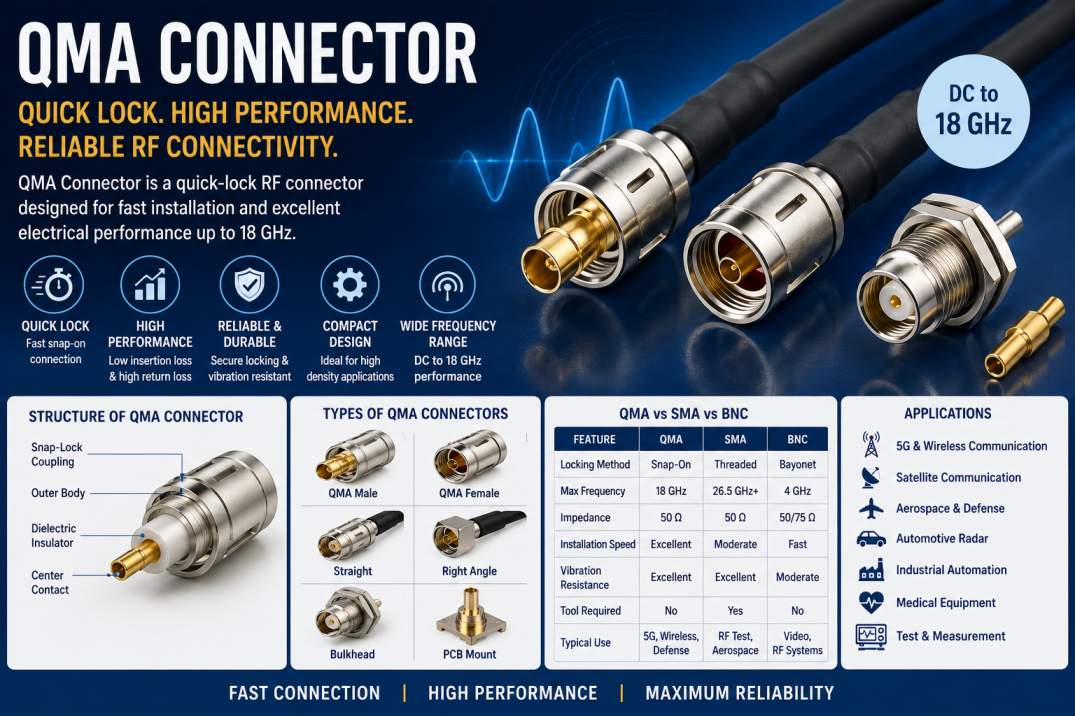
A QMA Connector is a quick-lock coaxial RF connector designed for high-frequency signal transmission. It is mechanically compatible with the SMA interface but replaces the threaded coupling mechanism with a snap-on locking system.
The connector provides secure RF connections without requiring torque tools, making installation significantly faster than conventional threaded connectors.
QMA connectors are typically designed for 50 Ohm impedance systems and support frequencies up to 18 GHz, although premium versions may operate at even higher frequencies depending on the manufacturer.
How Does a QMA Connector Work?
Unlike traditional SMA connectors that require threaded coupling, the QMA connector uses a spring-loaded snap-lock mechanism.
When the male connector is pushed onto the female connector, the internal locking mechanism automatically engages, creating a secure mechanical and electrical connection.
To disconnect the connector, the locking sleeve is simply pulled back, allowing quick removal without damaging the connector.
This push-pull operation significantly reduces installation time while maintaining excellent RF performance.
Construction of a QMA Connector
A QMA connector consists of several precision-engineered components.
Center Contact
Carries the RF signal between connected devices.
Usually manufactured from gold-plated brass or beryllium copper.
Dielectric Insulator
Separates the center conductor from the outer conductor.
Commonly manufactured from PTFE for excellent electrical insulation.
Outer Body
Provides mechanical strength and grounding.
Usually made from stainless steel or brass with nickel plating.
Snap-Lock Coupling Mechanism
The defining feature of the QMA connector.
Allows quick installation without threaded engagement.
Spring Lock
Ensures reliable retention even under vibration.
Key Features of QMA Connectors
Quick snap-on locking
Fast installation
Excellent RF performance
Low insertion loss
High return loss
Compact size
50 Ohm impedance
Supports frequencies up to 18 GHz
Reliable mechanical locking
Excellent vibration resistance
Reusable design
Tool-free installation
Long service life
Technical Specifications
| Specification | Typical Value |
|---|---|
| Connector Type | QMA |
| Impedance | 50 Ω |
| Frequency Range | DC to 18 GHz |
| Coupling Style | Snap-On |
| VSWR | ≤1.20 |
| Return Loss | >26 dB |
| Contact Resistance | Low |
| Insulation Resistance | ≥5000 MΩ |
| Operating Temperature | -65°C to +165°C |
| Contact Plating | Gold |
| Body Material | Brass / Stainless Steel |
| Dielectric Material | PTFE |
Types of QMA Connectors
QMA Male Connector
Contains the center pin and snap-lock coupling.
Used on RF cable assemblies.
QMA Female Connector
Contains the receptacle interface.
Usually mounted on RF equipment.
Straight QMA Connector
Ideal for direct cable routing.
Offers minimal insertion loss.
Right Angle QMA Connector
Designed for compact installations.
Reduces cable bending stress.
Bulkhead QMA Connector
Allows installation through equipment panels.
Widely used in RF enclosures.
PCB Mount QMA Connector
Designed for printed circuit boards.
Used in wireless communication modules.
Comparison Table: QMA vs SMA vs BNC Connectors
| Feature | QMA | SMA | BNC |
|---|---|---|---|
| Locking Method | Snap-On | Threaded | Bayonet |
| Installation Speed | Excellent | Moderate | Fast |
| Maximum Frequency | 18 GHz | 26.5 GHz+ | 4 GHz |
| Impedance | 50 Ω | 50 Ω | 50/75 Ω |
| Vibration Resistance | Excellent | Excellent | Moderate |
| Tool Required | No | Yes | No |
| Typical Applications | 5G, Defense | RF Labs | Video & RF |
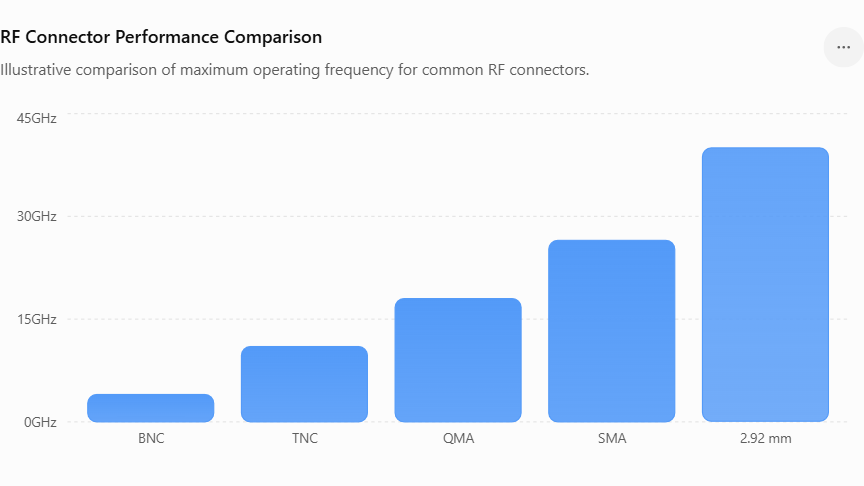
Performance Comparison Chart
The following chart compares common RF connector types across key performance metrics (illustrative values for comparison).
Advantages of QMA Connectors
Fast installation without threading
Excellent signal integrity
Low insertion loss
Reduced installation time
Compact design
Excellent shielding effectiveness
Reliable performance under vibration
High durability
Reusable connection
Suitable for dense equipment layouts
Maintenance-friendly
Ideal for automated production environments
Limitations
Maximum frequency is lower than premium SMA connectors.
Slightly higher cost than conventional connectors.
Requires compatible QMA interfaces.
Not suitable for extremely high-power RF applications.
Applications of QMA Connectors
5G Base Stations
QMA connectors simplify installation in dense antenna systems.
Wireless Communication
Used in cellular networks, Wi-Fi systems, and RF repeaters.
Aerospace
Aircraft communication equipment uses QMA connectors because of their vibration resistance.
Military and Defense
Widely used in tactical communication systems, radar equipment, and electronic warfare systems.
Medical Equipment
MRI systems and RF imaging equipment rely on precision RF connectors.
Industrial Automation
Factory automation and wireless control systems use QMA connectors for reliable communication.
Automotive Radar
ADAS and autonomous vehicle radar systems require compact RF connectors.
Satellite Communication
Ground stations and satellite terminals benefit from quick installation and reliable RF performance.
Test and Measurement Equipment
RF laboratories use QMA connectors for calibration systems, analyzers, and signal generators.
Why Choose QMA Connectors?
QMA connectors provide the perfect balance between installation speed and electrical performance. Their quick-lock mechanism reduces assembly time, improves maintenance efficiency, and minimizes the risk of incorrect torque during installation. For modern RF systems where equipment density continues to increase, QMA connectors offer an excellent solution for reliable, repeatable, and space-saving connectivity.
How to Choose the Right QMA Connector
When selecting a QMA connector, consider the following factors:
- Operating frequency
- Impedance (typically 50 Ω)
- Connector gender (male or female)
- Cable compatibility
- Mounting style
- Environmental conditions
- Return loss requirements
- VSWR specifications
- Mechanical durability
- Manufacturer quality certifications
Installation Best Practices
Always inspect connectors before installation.
Keep connector interfaces clean.
Avoid excessive bending near the connector.
Protect unused connectors with dust caps.
Use compatible RF cable assemblies.
Inspect locking mechanisms periodically.
Replace damaged connectors immediately.
Future Trends
As RF systems continue evolving toward 5G Advanced, 6G, IoT, satellite internet, and millimeter-wave communication, demand for quick-lock RF connectors will continue to increase. Future QMA connectors are expected to feature improved shielding, higher operating frequencies, enhanced corrosion resistance, and lighter materials while maintaining their signature tool-free installation.
Conclusion
The QMA Connector is a modern RF connector designed to simplify installation while delivering excellent electrical performance. Its quick snap-on locking mechanism, compact design, low insertion loss, and reliable mechanical stability make it an ideal choice for high-frequency communication systems. Whether used in telecommunications, aerospace, military, medical equipment, industrial automation, or laboratory testing, QMA connectors offer engineers a durable, efficient, and easy-to-install solution. As communication technologies continue advancing, QMA connectors will remain an essential component in building faster, more reliable, and space-efficient RF networks.
Frequently Asked Questions (FAQs)
1. What is a QMA Connector?
A QMA Connector is a quick-lock RF coaxial connector that provides fast installation and reliable signal transmission without threaded coupling.
2. What is the difference between QMA and SMA connectors?
The main difference is the locking mechanism. QMA connectors use a snap-on coupling, while SMA connectors use threaded coupling.
3. What is the impedance of a QMA Connector?
Most QMA connectors are designed for 50 Ohm RF systems.
4. What frequency can a QMA Connector support?
Standard QMA connectors typically support frequencies from DC up to 18 GHz, depending on design and manufacturer.
5. Where are QMA Connectors used?
They are widely used in 5G infrastructure, wireless communication, aerospace, military systems, satellite communication, industrial automation, automotive radar, and RF testing.
6. What are the advantages of a QMA Connector?
QMA connectors offer quick installation, low insertion loss, excellent shielding, reliable vibration resistance, compact size, and tool-free operation.
7. Are QMA Connectors compatible with SMA Connectors?
They share similar RF interfaces but use different coupling mechanisms. Mechanical compatibility depends on the specific connector design and adapter availability.
8. What materials are used in QMA Connectors?
Typical materials include gold-plated brass or beryllium copper contacts, PTFE dielectric insulation, and brass or stainless-steel bodies.
9. Can QMA Connectors be used outdoors?
Yes. Outdoor-rated QMA connectors with weather-resistant sealing are available for harsh environmental conditions.
10. How do I choose the right QMA Connector?
Select a QMA connector based on frequency range, impedance, cable type, connector gender, mounting style, environmental requirements, and electrical performance specifications.
RF Connector Performance Comparison
Illustrative comparison of maximum operating frequency for common RF connectors.
| connector | frequency |
|---|---|
| BNC | 4 |
| TNC | 11 |
| QMA | 18 |
| SMA | 26.5 |
| 2.92 mm | 40 |