In the world of Radio Frequency (RF), telecommunications, broadcasting, aerospace, defense, radar systems, and high-power communication networks, connector selection plays a critical role in ensuring reliable signal transmission and long-term system performance. While many RF connectors are designed primarily for compact size or high-frequency operation, some applications require connectors capable of handling significantly higher power levels and voltages.
One such solution is the HN Connector.
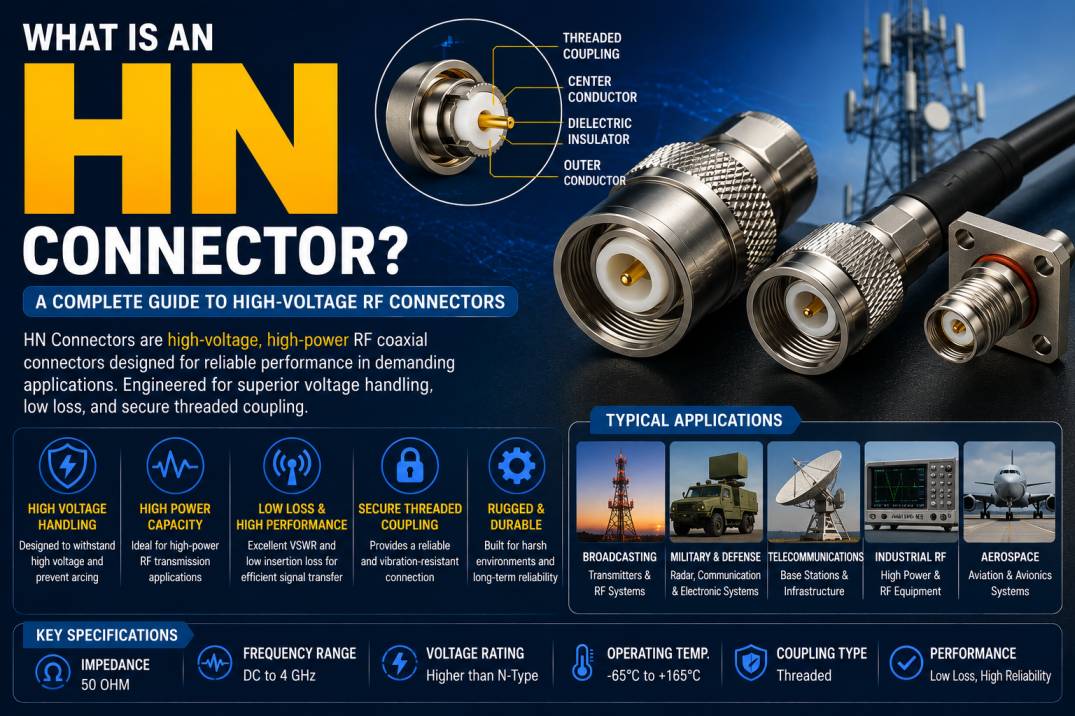
The HN Connector is a threaded RF coaxial connector specifically designed for high-voltage and high-power RF applications. Known for its robust construction, excellent impedance control, superior voltage handling capabilities, and reliable performance in demanding environments, the HN connector has become a preferred choice for many industrial, military, broadcasting, and telecommunications systems.
Unlike smaller connectors such as SMA or TNC, HN connectors are engineered to safely handle higher RF power levels while maintaining low insertion loss and excellent signal integrity.
In this comprehensive guide, we will explore what an HN connector is, how it works, its construction, specifications, types, applications, advantages, and how to choose the right HN connector for your RF infrastructure.
What Is an HN Connector?
An HN Connector is a threaded RF coaxial connector designed to provide reliable electrical performance in high-voltage and high-power RF systems.
The connector was developed as an enhanced version of the N-Type connector, offering improved voltage handling capabilities while maintaining similar mechanical characteristics.
HN connectors are commonly used in applications requiring:
- High RF power transmission
- High operating voltage
- Low signal loss
- Secure threaded connections
- Rugged environmental performance
These connectors are widely found in:
- Broadcasting transmitters
- Military communication systems
- Radar installations
- High-power RF amplifiers
- Industrial RF systems
- Telecommunications infrastructure
Because of their ability to withstand significantly higher voltages than standard RF connectors, HN connectors remain an important component in specialized RF applications.
History of the HN Connector
As RF systems evolved, engineers encountered situations where standard N-Type connectors could not safely handle increasing voltage levels.
While N-Type connectors offered excellent RF performance, high-power applications required additional voltage isolation and larger spacing between conductive elements.
To address these challenges, the HN connector was developed with:
- Improved dielectric design
- Higher voltage ratings
- Enhanced insulation properties
- Increased reliability under high-power conditions
This made HN connectors particularly valuable in military, broadcasting, and industrial RF systems.
How Does an HN Connector Work?
An HN connector functions similarly to other coaxial RF connectors but incorporates enhanced insulation and mechanical design to support higher voltages.
Signal Transmission
The center conductor carries RF energy between connected devices.
Shielding Continuity
The outer conductor provides grounding and electromagnetic shielding.
High-Voltage Isolation
Special dielectric materials separate conductive components to prevent arcing and electrical breakdown.
Secure Threaded Coupling
The threaded interface ensures stable electrical and mechanical connections.
This design enables safe and efficient RF signal transmission in high-power systems.
Construction of an HN Connector
HN connectors are built using precision-engineered components designed for durability and electrical performance.
Center Contact
The center conductor carries RF signals.
Typically manufactured from:
- Brass
- Beryllium copper
- Gold-plated alloys
Benefits include:
- High conductivity
- Low resistance
- Reliable performance
Dielectric Insulator
The dielectric is one of the most important parts of an HN connector.
Common materials include:
- PTFE (Teflon)
- High-performance engineering plastics
Functions include:
- Voltage isolation
- Impedance control
- Signal stability
Outer Body
The connector body provides:
- Mechanical protection
- Shielding continuity
- Structural support
Common materials:
- Nickel-plated brass
- Stainless steel
- Corrosion-resistant alloys
Threaded Coupling Mechanism
The threaded interface ensures secure connections.
Advantages include:
- Vibration resistance
- Long-term reliability
- Stable RF performance
Key Features of HN Connectors
High Voltage Capability
The defining feature of HN connectors is their ability to handle significantly higher voltages than many standard RF connectors.
Benefits:
- Enhanced safety
- Reduced risk of arcing
- Reliable high-power operation
Excellent RF Performance
HN connectors provide:
- Low insertion loss
- Low VSWR
- High return loss
These characteristics ensure efficient signal transmission.
Threaded Coupling Design
The threaded mechanism provides:
- Secure connections
- Improved durability
- Vibration resistance
High Power Handling
Suitable for applications involving substantial RF power transmission.
Rugged Construction
Designed for demanding industrial and outdoor environments.
Electrical Specifications of HN Connectors
Specifications vary by manufacturer, but typical values include:
| Parameter | Typical Value |
|---|---|
| Impedance | 50 Ohm |
| Frequency Range | DC to 4 GHz |
| Voltage Rating | Higher than N-Type |
| Coupling Method | Threaded |
| Operating Temperature | -65°C to +165°C |
| VSWR | Low |
These characteristics make HN connectors ideal for high-power RF systems.
Types of HN Connectors
HN Male Connector
Features:
- External threads
- Center pin
Common applications:
- RF cable assemblies
- Broadcasting systems
- High-power transmitters
HN Female Connector
Features:
- Internal threads
- Female contact interface
Found on:
- RF equipment
- Amplifiers
- Antenna systems
Bulkhead HN Connector
Designed for panel mounting.
Applications include:
- RF cabinets
- Communication shelters
- Equipment enclosures
Right-Angle HN Connector
Provides easier cable routing in confined spaces.
Benefits:
- Reduced cable strain
- Improved installation flexibility
Cable Mount HN Connector
Used for terminating coaxial cables in RF systems.
Advantages of HN Connectors
Superior Voltage Handling
One of the primary reasons for choosing HN connectors.
Reliable High-Power Performance
Supports demanding RF transmission systems.
Excellent Mechanical Stability
Threaded coupling prevents accidental disconnections.
Long Operational Life
Built for durability and repeated use.
Environmental Resistance
Suitable for outdoor and industrial installations.
Applications of HN Connectors
Broadcasting Systems
HN connectors are widely used in radio and television broadcasting infrastructure.
Applications include:
- FM transmitters
- TV transmitters
- RF transmission lines
Telecommunications
Used in:
- Base station equipment
- RF amplifiers
- Communication networks
Military Communication Systems
Critical applications include:
- Tactical communication equipment
- Radar systems
- Defense communication infrastructure
Aerospace Systems
Used in specialized high-power RF systems.
Industrial RF Equipment
Applications include:
- RF heating systems
- Industrial transmitters
- High-power monitoring systems
Test and Measurement Equipment
Found in:
- RF test setups
- Calibration systems
- Laboratory equipment
HN Connector vs N-Type Connector
| Feature | HN Connector | N-Type Connector |
|---|---|---|
| Voltage Handling | Higher | Standard |
| Power Handling | Higher | Moderate |
| Threaded Coupling | Yes | Yes |
| Frequency Range | Up to 4 GHz | Up to 11 GHz+ |
| Mechanical Size | Larger | Smaller |
| Broadcasting Applications | Excellent | Good |
HN connectors are preferred when voltage and power handling are more important than maximum frequency capability.
HN Connector vs TNC Connector
| Feature | HN Connector | TNC Connector |
|---|---|---|
| Voltage Rating | High | Moderate |
| Power Handling | High | Moderate |
| Frequency Range | Lower | Higher |
| Physical Size | Larger | Smaller |
| Industrial Applications | Excellent | Good |
How to Choose the Right HN Connector
Determine Power Requirements
Evaluate RF power levels before selecting a connector.
Verify Voltage Specifications
Ensure the connector supports the operating voltage.
Select Compatible Cable Types
Common cable options include:
- RG213
- LMR400
- High-power coaxial cables
Consider Environmental Conditions
Outdoor installations may require:
- Corrosion resistance
- Waterproofing
- Rugged construction
Check Frequency Requirements
Confirm the connector meets system frequency specifications.
Installation Best Practices
Use Proper Torque
Follow manufacturer-recommended torque values.
Keep Interfaces Clean
Contamination can affect electrical performance.
Inspect Regularly
Check for:
- Wear
- Corrosion
- Connector damage
Protect Outdoor Connections
Use weatherproof sealing when necessary.
Verify RF Performance
Perform testing after installation.
Future Trends in HN Connector Technology
Growth of High-Power RF Systems
Increasing RF power demands continue supporting HN connector usage.
Broadcasting Infrastructure Upgrades
Modern transmission networks require reliable high-voltage connectivity.
Defense Modernization Programs
Advanced military communication systems continue utilizing rugged RF connectors.
Industrial RF Expansion
Growing industrial automation and RF applications increase demand for high-power interconnect solutions.
Key Takeaways
- HN stands for High-Voltage N-Type Connector.
- Designed for high-power RF applications.
- Provides superior voltage handling capabilities.
- Uses a threaded coupling mechanism.
- Commonly used in broadcasting and military systems.
- Offers excellent reliability and durability.
- Supports demanding industrial RF environments.
- Delivers stable RF performance with low signal loss.
Conclusion
The HN Connector is a specialized RF coaxial connector engineered for applications that require exceptional voltage handling, high power capacity, and reliable long-term performance. By combining robust mechanical construction, excellent electrical characteristics, and secure threaded coupling, HN connectors provide dependable operation in some of the most demanding RF environments.
From broadcasting transmitters and military communication systems to industrial RF equipment and telecommunications infrastructure, HN connectors continue to serve as a trusted solution for high-power RF connectivity.
As communication networks, broadcasting systems, and industrial RF technologies continue evolving, HN connectors will remain a valuable component wherever high-voltage and high-power RF performance is required.
FAQ About HN Connectors
What does HN stand for?
HN generally refers to a high-voltage version of the N-Type RF connector designed for higher power and voltage applications.
What is the main advantage of an HN connector?
Its ability to safely handle higher voltages and RF power levels than standard N-Type connectors.
Where are HN connectors commonly used?
Broadcasting transmitters, military systems, industrial RF equipment, and telecommunications infrastructure.
Are HN connectors threaded?
Yes, HN connectors use a threaded coupling mechanism for secure connections.
What impedance do HN connectors use?
Most HN connectors are designed with a 50-ohm impedance.