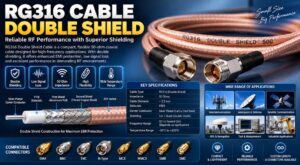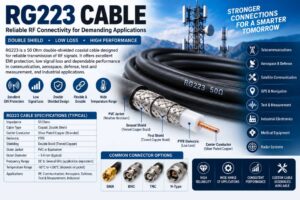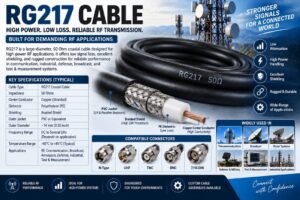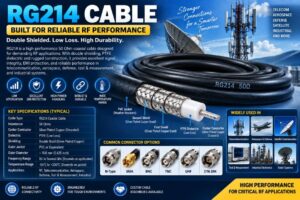
When working with RF (Radio Frequency) systems, many people use the terms RF cable assembly and coaxial cable interchangeably. However, these two components are not the same. While a coaxial cable is the core transmission medium that carries RF signals, an RF cable assembly is a complete solution consisting of a coaxial cable fitted with connectors and often tested for electrical performance.
Understanding the differences between these two products is essential for engineers, telecom professionals, system integrators, defense organizations, satellite communication companies, and anyone designing high-frequency communication systems. Selecting the wrong product can lead to increased signal loss, poor impedance matching, reduced system performance, and higher maintenance costs.
In this comprehensive guide, we explain the differences between RF cable assemblies and coaxial cables, their construction, applications, advantages, and how to select the right option for your project.
What is a Coaxial Cable?
A coaxial cable is an electrical cable specifically designed to carry high-frequency signals while minimizing electromagnetic interference. Its unique layered construction provides excellent shielding and stable electrical characteristics, making it suitable for RF, microwave, broadcast, telecommunications, and test equipment.
A standard coaxial cable consists of four primary layers:
Center Conductor
The center conductor carries the RF signal. It is typically made from copper, silver-plated copper, or copper-clad steel depending on the application.
Dielectric Insulator
The dielectric surrounds the center conductor and maintains the correct spacing between the conductor and the outer shield. Materials such as PTFE, polyethylene, and foam polyethylene are commonly used.
Outer Shield
The shield protects the transmitted signal from external electromagnetic interference while preventing signal leakage. It may consist of braided copper, aluminum foil, or multiple shielding layers.
Outer Jacket
The outer jacket protects the cable from environmental conditions, moisture, chemicals, abrasion, and UV exposure.
What is an RF Cable Assembly?
An RF cable assembly is a complete interconnection solution consisting of a coaxial cable with RF connectors professionally installed on both ends. These assemblies are designed, assembled, inspected, and tested to meet specific electrical and mechanical performance requirements.
Unlike raw coaxial cable, RF cable assemblies are ready for immediate installation and ensure reliable signal transmission.
An RF cable assembly may include:
- Coaxial cable
- Precision RF connectors
- Heat shrink protection
- Strain relief
- Weather sealing
- Protective boots
- Electrical testing
- Phase matching
- Custom labeling
The assembly is manufactured according to the application’s frequency range, power handling, connector type, cable flexibility, environmental conditions, and impedance requirements.
RF Cable Assembly vs Coaxial Cable
Although closely related, there are significant differences between the two.
| Feature | RF Cable Assembly | Coaxial Cable |
|---|---|---|
| Definition | Complete cable with connectors | Raw RF transmission cable |
| Ready to Install | Yes | No |
| Connectors Included | Yes | No |
| Electrical Testing | Usually Tested | Not Tested |
| Custom Length | Yes | Cable Roll |
| Signal Performance | Optimized | Depends on Assembly |
| Manufacturing | Precision Assembly | Cable Production |
| Typical Applications | RF Systems | Assembly Manufacturing |
| Cost | Higher | Lower |
| Installation Time | Faster | Requires Connector Installation |
Construction Differences
Coaxial Cable Construction
A coaxial cable is manufactured as continuous cable reels. It contains no connectors and requires additional processing before installation.
The cable manufacturer focuses on electrical characteristics such as impedance, attenuation, shielding effectiveness, velocity factor, and operating frequency.
RF Cable Assembly Construction
The cable assembly process includes:
Cable selection
Connector selection
Cable cutting
Precision stripping
Connector attachment
Crimping or soldering
Mechanical inspection
VSWR testing
Insertion loss testing
Continuity testing
Return loss testing
Final quality inspection
Packaging
Every cable assembly undergoes extensive quality control before shipment.
Why RF Cable Assemblies Perform Better
A professionally manufactured RF cable assembly offers several advantages over manually terminated coaxial cables.
Precision Connector Installation
Factory-installed connectors provide accurate impedance matching and minimize reflections.
Lower Signal Loss
Professionally assembled cables reduce insertion loss compared to improperly installed connectors.
Better Return Loss
High-quality assemblies achieve superior return loss by maintaining consistent impedance throughout the cable.
Reliable Mechanical Strength
Proper crimping techniques increase pull strength and improve connector durability.
Consistent Performance
Each cable assembly is tested to ensure repeatable electrical performance.
Common RF Connector Types Used in Cable Assemblies
Modern RF cable assemblies can be fitted with various connector types depending on the application.
Popular connector types include:
SMA
N Type
BNC
TNC
MCX
MMCX
SMP
SMPM
2.92mm
2.4mm
1.85mm
QMA
QN
7/16 DIN
4.3-10
UHF
F Type
The connector selection depends on operating frequency, power handling, environmental conditions, and equipment compatibility.
Types of RF Cable Assemblies
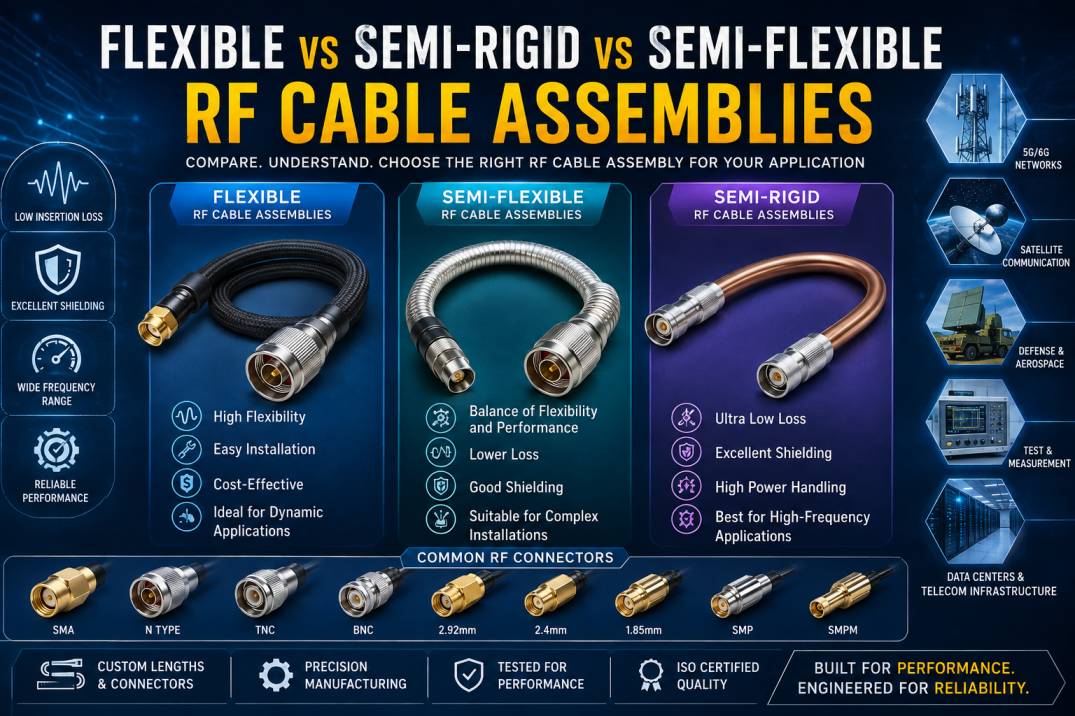
Flexible RF Cable Assemblies
Designed for frequent bending and easy routing in confined spaces.
Semi-Flexible Cable Assemblies
Offer better shielding with moderate flexibility.
Semi-Rigid Cable Assemblies
Provide excellent phase stability and low insertion loss.
Low Loss Cable Assemblies
Designed to minimize attenuation over long distances.
Phase Stable Cable Assemblies
Maintain consistent electrical length across varying temperatures.
High Frequency Cable Assemblies
Support microwave and millimeter-wave frequencies up to 110 GHz.
Armored Cable Assemblies
Provide additional protection against mechanical damage.
Waterproof Cable Assemblies
Designed for outdoor telecommunications and military applications.
Applications of Coaxial Cables
Raw coaxial cables are widely used for manufacturing RF cable assemblies and custom installations.
Common applications include:
Television distribution
Internet broadband
Cable networks
Laboratory testing
Signal transmission
Antenna feed lines
Industrial communication
Video surveillance
Consumer electronics
Telecommunications
Applications of RF Cable Assemblies
RF cable assemblies are used wherever reliable RF interconnections are required.
Industries include:
5G networks
Satellite communication
Defense
Military communication
Radar systems
Electronic warfare
Medical imaging
Wireless infrastructure
Broadcast systems
Aerospace
Industrial automation
Research laboratories
Automotive testing
Semiconductor manufacturing
Test and measurement equipment
Frequency Range Comparison
The operating frequency depends largely on cable type and connector selection.
Typical frequency capabilities include:
Standard coaxial cable:
DC to several GHz
High-performance RF cable assembly:
DC to 110 GHz
Millimeter-wave cable assembly:
Up to 110 GHz with precision connectors
Signal Loss Comparison
Signal attenuation is influenced by:
Cable length
Frequency
Cable quality
Connector quality
Installation accuracy
Improperly installed connectors can increase insertion loss significantly, whereas professionally manufactured RF cable assemblies maintain optimal performance.
Installation Comparison
Installing raw coaxial cable requires:
Measuring
Cutting
Stripping
Connector installation
Crimping
Testing
Troubleshooting
Installing an RF cable assembly simply involves connecting both ends, reducing installation time and minimizing errors.
Which One Should You Choose?
Choose a coaxial cable if:
You manufacture cable assemblies
You need bulk cable
Custom termination will be performed later
You have professional installation equipment
Choose an RF cable assembly if:
You require plug-and-play installation
Performance is critical
You need factory-tested reliability
You require custom connector combinations
Your system operates at high frequencies
You need phase matching
You want reduced installation time
Factors to Consider Before Buying
Before selecting either product, evaluate:
Operating frequency
Power level
Cable flexibility
Connector compatibility
Impedance
Cable length
Environmental conditions
Temperature range
Mechanical durability
Shielding effectiveness
Insertion loss
Return loss
VSWR requirements
Indoor or outdoor use
Budget
Future maintenance requirements
Common Mistakes to Avoid
Using incorrect impedance cables
Selecting the wrong connector type
Ignoring frequency limitations
Using poor-quality connectors
Installing connectors improperly
Exceeding minimum bend radius
Skipping electrical testing
Ignoring shielding requirements
Using consumer-grade cables in industrial environments
Choosing based only on price
Advantages of RF Cable Assemblies
Factory tested
Ready for installation
Excellent VSWR
Lower insertion loss
High reliability
Long service life
Reduced downtime
Improved system performance
Customizable lengths
Available with numerous connector combinations
Excellent mechanical durability
Supports high-frequency applications
Advantages of Coaxial Cables
Lower initial cost
Available in long lengths
Easy to customize
Suitable for bulk installations
Wide range of cable sizes
Compatible with many connector types
Used across multiple industries
Future Trends in RF Cable Assemblies
As wireless communication technologies continue to evolve, RF cable assemblies are becoming more advanced. Modern designs focus on ultra-low insertion loss, higher operating frequencies, compact connector systems, lightweight materials, and improved durability for harsh environments. The growth of 5G-Advanced, early 6G research, AI-driven data centers, satellite internet constellations, autonomous vehicles, aerospace systems, and quantum computing is driving demand for precision RF cable assemblies capable of delivering exceptional performance at microwave and millimeter-wave frequencies. Manufacturers are also investing in automated testing, phase-matched assemblies, ruggedized outdoor solutions, and environmentally resistant materials to meet the requirements of next-generation communication infrastructure.
Why Choose SRFS Teleinfra for RF Cable Assemblies?
SRFS Teleinfra manufactures high-quality RF cable assemblies engineered for superior electrical performance, low insertion loss, excellent return loss, and long-term reliability. Our product range includes flexible, semi-rigid, semi-flexible, phase-stable, low-loss, high-frequency, and custom RF cable assemblies with connector options such as SMA, N Type, BNC, TNC, SMP, SMPM, 2.92mm, 2.4mm, and 1.85mm. Every assembly undergoes strict quality inspection and electrical testing to ensure consistent performance for telecom, aerospace, defense, satellite communication, research laboratories, and industrial applications.
Conclusion
Although they are closely related, coaxial cables and RF cable assemblies serve different purposes. A coaxial cable is the transmission medium, while an RF cable assembly is a complete, factory-terminated solution designed for dependable, high-performance signal transfer. For applications where reliability, low signal loss, precision, and ease of installation are essential, RF cable assemblies provide a clear advantage. Understanding these differences helps engineers and buyers select the most suitable solution for their communication systems, ensuring efficient performance and long-term durability.
Frequently Asked Questions (FAQs)
1. What is the main difference between an RF cable assembly and a coaxial cable?
A coaxial cable is the raw transmission cable, while an RF cable assembly is a finished product that includes the coaxial cable, installed RF connectors, and performance testing.
2. Can I use a coaxial cable without connectors?
No. A coaxial cable must be terminated with compatible RF connectors before it can be connected to RF equipment.
3. Which is better for high-frequency applications?
Professionally manufactured RF cable assemblies are better because they provide optimized impedance matching, lower insertion loss, and verified electrical performance.
4. What impedance is most common for RF cable assemblies?
Most RF cable assemblies are designed with a 50 Ohm impedance for telecommunications, defense, aerospace, and RF test applications. Some video and broadcast systems use 75 Ohm assemblies.
5. What connector types are commonly used with RF cable assemblies?
Common connector types include SMA, N Type, BNC, TNC, SMP, SMPM, MMCX, MCX, QMA, 2.92mm, 2.4mm, and 1.85mm connectors.
6. Are RF cable assemblies tested before delivery?
Yes. High-quality manufacturers test assemblies for continuity, VSWR, insertion loss, return loss, and mechanical integrity before shipment.
7. Can RF cable assemblies be customized?
Yes. They can be customized for cable type, length, connector combinations, shielding, frequency range, labeling, and environmental protection.
8. Which industries use RF cable assemblies?
RF cable assemblies are widely used in telecommunications, 5G infrastructure, aerospace, defense, satellite communications, medical equipment, automotive testing, research laboratories, broadcasting, and industrial automation.
9. How long do RF cable assemblies last?
Their lifespan depends on the operating environment, cable quality, connector quality, and handling practices. Properly manufactured assemblies can provide many years of reliable service.
10. How do I choose the right RF cable assembly?
Consider the operating frequency, impedance, cable length, connector type, flexibility, environmental conditions, power handling, and electrical performance requirements to select the most suitable RF cable assembly.