Radio Frequency (RF) engineering plays a crucial role in modern communication systems, enabling wireless technologies that power mobile networks, satellite communication, aerospace systems, radar, IoT devices, defense applications, broadcasting, and emerging 5G and 6G infrastructure. At the heart of every RF system lies a collection of specialized RF components that ensure efficient signal transmission, minimal losses, impedance matching, and reliable high-frequency performance.
Whether you are a beginner entering the field of RF engineering or an experienced professional designing microwave systems, understanding the function and application of RF components is essential. Selecting the right component not only improves system performance but also reduces insertion loss, minimizes reflections, and increases reliability.
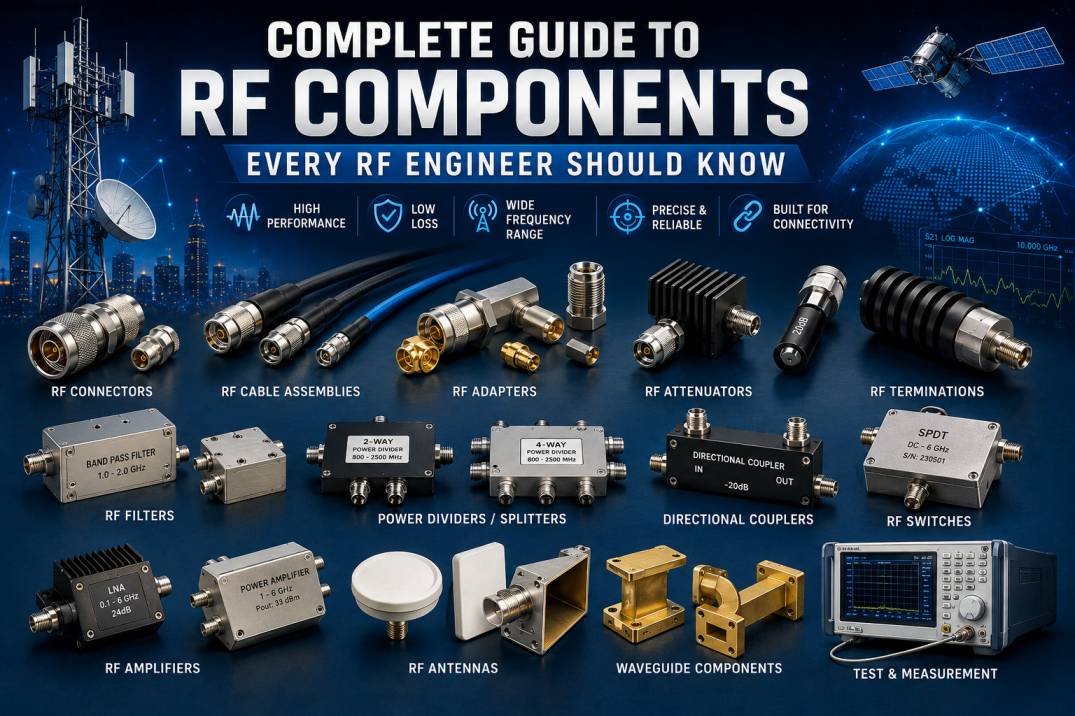
This comprehensive guide explores the most important RF components every RF engineer should know, their functions, applications, and key selection criteria.
What Are RF Components?
RF components are specialized electronic devices designed to transmit, receive, control, measure, or modify radio frequency signals. These components typically operate from a few megahertz (MHz) up to millimeter-wave frequencies exceeding 110 GHz.
Unlike standard electronic components, RF components are engineered to maintain signal integrity at extremely high frequencies while minimizing power loss and impedance mismatch.
They are widely used in:
- Cellular communication
- Satellite communication
- Aerospace systems
- Defense and military equipment
- Wireless networking
- Test and measurement
- Broadcasting
- Medical electronics
- Industrial automation
- Automotive radar
Why RF Components Are Important
Every RF system depends on precision-engineered components working together to achieve reliable signal transmission.
Proper RF components help:
- Reduce insertion loss
- Improve return loss
- Maintain impedance matching
- Minimize signal reflections
- Increase power handling
- Improve frequency response
- Enhance overall system reliability
Poor-quality RF components can significantly degrade communication performance, resulting in reduced efficiency and increased maintenance costs.
Essential RF Components Every RF Engineer Should Know
RF Connectors
RF connectors provide secure electrical and mechanical connections between RF cables, devices, antennas, and test equipment while maintaining consistent impedance.
Popular RF connector types include:
- SMA Connectors
- N Type Connectors
- TNC Connectors
- BNC Connectors
- 2.92mm (K) Connectors
- 2.4mm Connectors
- 1.85mm Connectors
- SMP Connectors
- SMPM Connectors
- MMCX Connectors
- MCX Connectors
- U.FL / IPEX Connectors
- QMA Connectors
Applications include:
- Base stations
- Test equipment
- Microwave systems
- Aerospace
- Radar
- 5G infrastructure
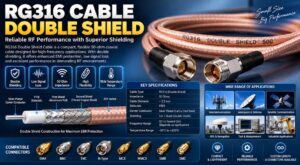
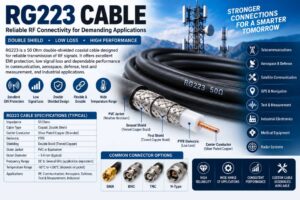
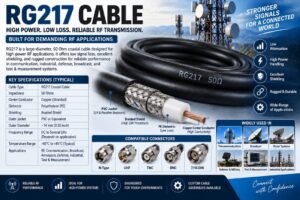
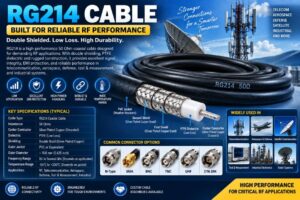
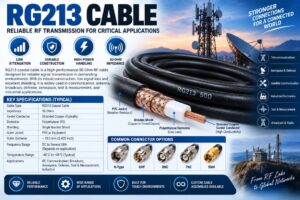
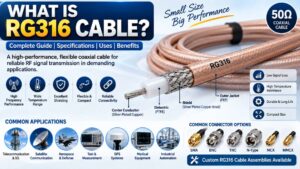
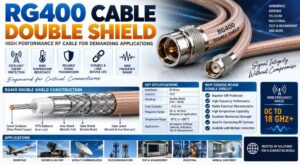
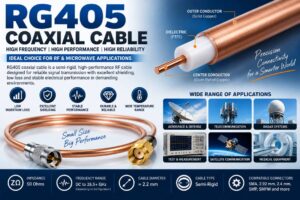
RF Cable Assemblies
RF cable assemblies transmit high-frequency signals between RF devices with minimal signal degradation.
Common cable types include:
- Flexible RF Cable Assemblies
- Semi-Rigid Cable Assemblies
- Semi-Flexible Cable Assemblies
- Low Loss Cable Assemblies
- Phase Stable Cable Assemblies
- Test Cable Assemblies
- High Power Cable Assemblies
Important parameters include:
- Frequency range
- Insertion loss
- VSWR
- Shielding effectiveness
- Flexibility
- Phase stability
RF Adapters
RF adapters connect different connector interfaces without changing the electrical characteristics of the system.
Examples include:
- SMA to N Adapter
- N to BNC Adapter
- 2.92mm to SMA Adapter
- SMP to SMPM Adapter
- MMCX to SMA Adapter
Adapters are essential during testing, prototyping, and system integration.
RF Attenuators
RF attenuators reduce signal power without significantly affecting waveform quality.
Types include:
- Fixed Attenuators
- Variable Attenuators
- Programmable Attenuators
- High Power Attenuators
- Directional Attenuators
- Coaxial Attenuators
Applications:
- RF testing
- Signal calibration
- Power control
- Measurement systems
- Instrument protection
RF Terminations
RF terminations absorb unused RF energy and eliminate unwanted reflections.
Typical specifications include:
- 50 Ohm impedance
- 75 Ohm impedance
- High power capability
- Low VSWR
- Wide frequency range
Common applications include:
- Vector Network Analyzers
- Signal generators
- RF amplifiers
- Test benches
- Microwave systems
RF Filters
RF filters remove unwanted frequencies while allowing desired signals to pass.
Common filter types:
- Low Pass Filter
- High Pass Filter
- Band Pass Filter
- Band Stop Filter
- Notch Filter
- Cavity Filter
Applications include:
- Cellular base stations
- Satellite systems
- Radar
- Broadcasting
- Wireless communication
Power Dividers and Splitters
Power dividers distribute RF signals equally among multiple output ports.
Popular configurations:
- 2-Way
- 3-Way
- 4-Way
- 8-Way
- Wilkinson Power Divider
Applications:
- Antenna systems
- RF testing
- Distributed communication
- Signal routing
Directional Couplers
Directional couplers sample RF signals while allowing the majority of power to continue through the main transmission path.
Types include:
- Single Directional Coupler
- Dual Directional Coupler
- Bi-Directional Coupler
Applications:
- Power monitoring
- VSWR measurement
- Amplifier testing
- RF laboratories
RF Switches
RF switches route RF signals between different signal paths.
Common technologies:
- Electromechanical
- Solid State
- PIN Diode
- MEMS RF Switches
Applications:
- Automated testing
- Antenna selection
- Signal routing
- Communication systems
RF Amplifiers
RF amplifiers increase signal strength without significantly degrading signal quality.
Types include:
- Low Noise Amplifier (LNA)
- Power Amplifier (PA)
- Driver Amplifier
- Broadband Amplifier
Applications:
- Cellular communication
- Satellite systems
- Radar
- RF laboratories
RF Antennas
Antennas convert electrical energy into electromagnetic waves and vice versa.
Common antenna types include:
- Omni-directional Antenna
- Directional Antenna
- Yagi Antenna
- Horn Antenna
- LPDA Antenna
- Patch Antenna
- RFID Antenna
- MIMO Antenna
Applications:
- Wireless communication
- Satellite systems
- IoT
- Defense
- Aerospace
Waveguide Components
Waveguide components efficiently carry microwave signals with very low transmission loss at extremely high frequencies.
Popular components include:
- Waveguide Adapters
- Waveguide Bends
- Waveguide Couplers
- Waveguide Loads
- Waveguide Transitions
- Waveguide Filters
Applications:
- Radar
- Satellite communication
- Aerospace
- High-frequency microwave systems
RF Measurement Equipment Every RF Engineer Uses
In addition to RF components, engineers rely on specialized instruments for testing and validation.
Essential RF test equipment includes:
- Vector Network Analyzer (VNA)
- Spectrum Analyzer
- Signal Generator
- Power Meter
- Oscilloscope
- RF Load
- Frequency Counter
- Noise Figure Analyzer
These instruments ensure that RF components meet performance specifications before deployment.
Key Parameters When Selecting RF Components
Choosing the correct RF component requires evaluating several technical specifications.
Frequency Range
Ensure the component supports the operating frequency of your application.
Impedance
Most RF systems use:
- 50 Ohm
- 75 Ohm
Using mismatched impedance causes reflections and power loss.
VSWR
A lower Voltage Standing Wave Ratio (VSWR) indicates better impedance matching and reduced reflected power.
Insertion Loss
Lower insertion loss improves signal transmission efficiency.
Return Loss
Higher return loss indicates better signal integrity and fewer reflections.
Power Handling
Components should safely withstand the expected RF power level.
Environmental Conditions
Consider:
- Temperature
- Humidity
- Vibration
- Outdoor exposure
- Corrosion resistance
Connector Compatibility
Ensure connectors match your cable assemblies and equipment interfaces.
Applications of RF Components
RF components are used across numerous industries.
Telecommunications
- 4G LTE
- 5G
- Future 6G
- Small Cells
- DAS Systems
Aerospace
- Aircraft communication
- Navigation
- Satellite payloads
Defense
- Electronic warfare
- Radar
- Secure communication
- Missile guidance
Medical
- MRI equipment
- Medical imaging
- Wireless monitoring
Industrial Automation
- Smart factories
- Industrial IoT
- Wireless sensors
Automotive
- ADAS
- Vehicle radar
- V2X communication
Broadcasting
- Television
- FM Radio
- Digital broadcasting
Common Mistakes RF Engineers Should Avoid
Even experienced RF engineers can encounter performance issues due to improper component selection.
Common mistakes include:
- Choosing the wrong impedance
- Ignoring frequency limitations
- Using poor-quality cable assemblies
- Selecting incompatible connectors
- Overlooking insertion loss
- Ignoring environmental ratings
- Improper torque during connector installation
- Using incorrect power ratings
Avoiding these mistakes improves system reliability and reduces maintenance costs.
Future of RF Components
As wireless communication continues to evolve, RF components are becoming more advanced to support higher frequencies and greater bandwidth.
Emerging trends include:
- Millimeter-wave components
- Terahertz communication devices
- AI-assisted RF design
- Miniaturized RF modules
- High-density interconnects
- Low-loss materials
- High-performance test solutions
- Components for 6G networks
These innovations will enable faster, more efficient communication systems for future technologies.
Conclusion
Understanding RF components is fundamental for every RF engineer. From connectors and cable assemblies to filters, attenuators, antennas, and waveguide components, each element plays a vital role in ensuring reliable, high-performance wireless communication. By selecting the right components based on frequency, impedance, insertion loss, power handling, and application requirements, engineers can design robust RF systems that meet the demands of modern telecommunications, aerospace, defense, industrial automation, and next-generation 5G and 6G networks.
Investing in high-quality RF components not only improves signal integrity and system efficiency but also reduces long-term maintenance and operational costs, making them an essential part of every successful RF design.
Frequently Asked Questions (FAQs)
What are RF components?
RF components are specialized devices used to transmit, receive, control, and measure radio frequency signals in wireless communication systems.
Which RF component is most important?
There is no single most important component. RF connectors, cable assemblies, filters, attenuators, antennas, and adapters all play critical roles depending on the application.
Why is impedance matching important in RF systems?
Proper impedance matching minimizes signal reflections, reduces power loss, improves return loss, and maximizes system performance.
What is the standard impedance used in RF communication?
Most RF communication systems use 50 Ohm impedance, while television and cable distribution systems commonly use 75 Ohm.
What industries use RF components?
RF components are widely used in telecommunications, aerospace, defense, broadcasting, automotive, medical devices, industrial automation, satellite communication, and wireless networking.
How do RF engineers choose the right RF component?
RF engineers evaluate frequency range, impedance, VSWR, insertion loss, return loss, power handling, connector type, environmental conditions, and application requirements before selecting an RF component.