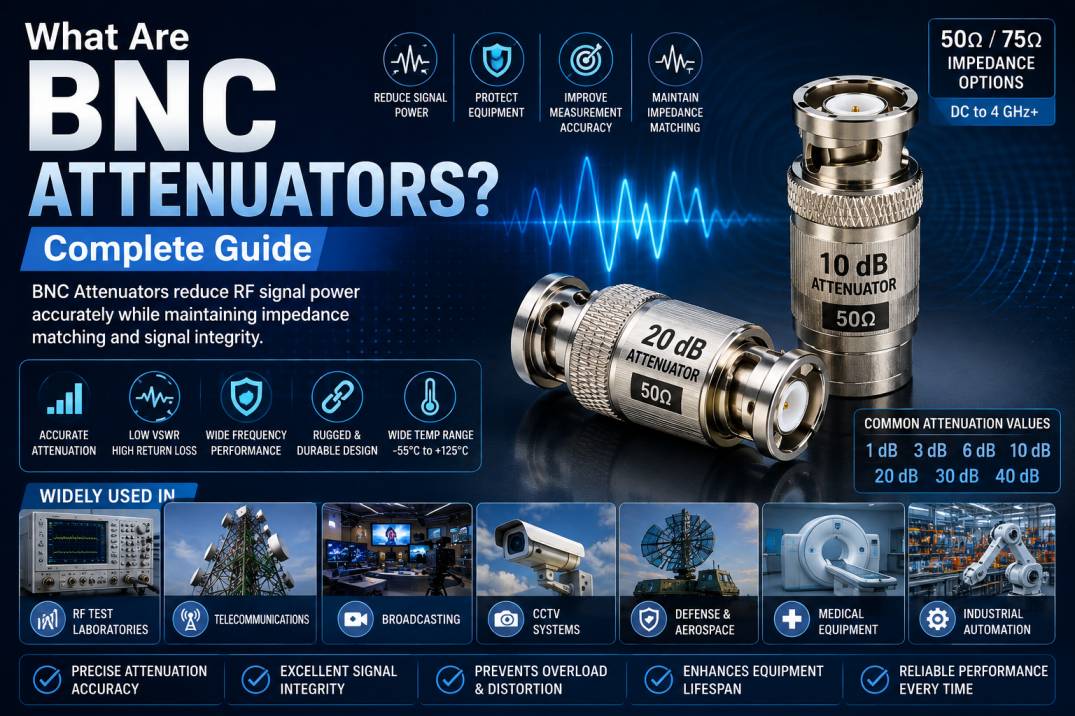
BNC Attenuators are passive RF components designed to reduce the power level of radio frequency (RF) signals without significantly affecting signal quality or waveform characteristics. They provide controlled signal attenuation while maintaining the characteristic impedance of the transmission line, ensuring accurate signal transmission and reliable system performance.
The term BNC stands for Bayonet Neill-Concelman, referring to the quick-connect bayonet locking mechanism widely used in RF and video systems. BNC attenuators are commonly used in RF laboratories, communication systems, test equipment, broadcasting, CCTV networks, medical electronics, aerospace, and defense applications.
A BNC attenuator contains a precisely designed resistor network that decreases the amplitude of an RF signal by a predetermined amount measured in decibels (dB). Unlike amplifiers, which increase signal strength, attenuators intentionally reduce signal levels to protect sensitive equipment, improve measurement accuracy, and prevent signal overload.
Whether used in oscilloscopes, spectrum analyzers, signal generators, vector network analyzers, or communication systems, BNC attenuators play a vital role in maintaining stable RF performance.
What Is a BNC Attenuator?
A BNC attenuator is an impedance-matched RF device installed between two BNC-connected components to reduce signal power while preserving signal integrity.
It allows engineers and technicians to safely adjust signal levels without introducing distortion, reflections, or impedance mismatch.
Most BNC attenuators are available in:
- 50 Ohm BNC Attenuators
- 75 Ohm BNC Attenuators
The amount of attenuation is specified in decibels (dB), with common values including:
- 1 dB
- 2 dB
- 3 dB
- 6 dB
- 10 dB
- 20 dB
- 30 dB
- 40 dB
Why Are BNC Attenuators Important?
Many RF systems generate signals that exceed the input limits of connected equipment.
Without attenuation, excessive signal levels can lead to:
- Instrument overload
- Signal distortion
- Inaccurate measurements
- Receiver saturation
- Equipment damage
A BNC attenuator safely reduces signal strength while maintaining impedance matching.
How Does a BNC Attenuator Work?
A BNC attenuator uses a precision resistor network to dissipate part of the RF signal energy as heat.
Instead of blocking the signal, it allows the signal to pass through while reducing its amplitude.
Throughout the attenuation process, the attenuator maintains:
- Constant impedance
- Low VSWR
- Excellent return loss
- Stable frequency response
This ensures minimal signal distortion.
Construction of a BNC Attenuator
A high-quality BNC attenuator typically includes:
BNC Male and Female Connectors
Provide secure and reliable RF connections.
Precision Thin-Film Resistors
Deliver accurate attenuation values.
Brass or Stainless Steel Housing
Provides mechanical durability and EMI shielding.
Gold-Plated Contacts
Improve conductivity while reducing contact resistance.
PTFE Dielectric
Offers excellent electrical insulation and high-frequency performance.
Types of BNC Attenuators
Fixed BNC Attenuators
Provide a constant attenuation value.
Common ratings include:
- 3 dB
- 6 dB
- 10 dB
- 20 dB
- 30 dB
These are widely used in laboratory and production environments.
Variable BNC Attenuators
Allow adjustable attenuation levels depending on application requirements.
They are commonly used during RF testing and calibration.
High-Power BNC Attenuators
Designed to dissipate higher RF power without overheating.
Ideal for transmitter testing and industrial RF systems.
Precision BNC Attenuators
Manufactured with tight attenuation tolerances for calibration laboratories and high-accuracy measurements.
Key Features of BNC Attenuators
Modern BNC attenuators offer several performance advantages.
These include:
- Accurate attenuation values
- Excellent impedance matching
- Low VSWR
- High return loss
- Wide frequency coverage
- Compact design
- Precision resistor network
- Rugged construction
- Corrosion-resistant finish
- Long service life
- Stable electrical performance
- Reliable RF transmission
- Easy installation
Technical Specifications
Typical specifications include:
- Connector Type: BNC Male to Female
- Impedance: 50 Ohm or 75 Ohm
- Frequency Range: DC to 4 GHz (higher-frequency versions available)
- Attenuation Values: 1 dB to 40 dB
- VSWR: Typically below 1.20
- Power Rating: 1W, 2W, 5W or higher
- Body Material: Brass or Stainless Steel
- Contact Plating: Gold
- Insulator Material: PTFE
- Operating Temperature: -55°C to +125°C
Actual specifications depend on the manufacturer and application.
Advantages of Using BNC Attenuators
Protect Sensitive Equipment
Reduces excessive signal power before it reaches measurement instruments.
Improve Measurement Accuracy
Prevents overload and ensures precise RF testing.
Maintain Signal Integrity
Provides attenuation without affecting waveform quality.
Reduce Signal Reflections
Maintains impedance matching across the RF system.
Increase Equipment Life
Protects receivers and analyzers from excessive input power.
Stable RF Performance
Delivers consistent attenuation over a wide frequency range.
Easy Installation
Simple plug-and-play installation using standard BNC connectors.
Applications of BNC Attenuators
BNC attenuators are used across numerous industries.
RF Test Laboratories
Used with:
- Spectrum analyzers
- Oscilloscopes
- Signal generators
- Power meters
- Vector network analyzers
Telecommunications
Protect RF receivers and communication equipment.
Broadcasting
Control RF signal levels in television and radio systems.
CCTV Networks
Used in video transmission systems requiring controlled signal levels.
Aerospace
Installed in aircraft communication and testing equipment.
Defense
Used in military RF communication and radar systems.
Medical Electronics
Protect diagnostic and imaging equipment from excessive RF power.
Industrial Automation
Maintain signal stability in monitoring and control systems.
Common Attenuation Values
Different attenuation levels serve different applications.
1 dB
Fine signal adjustment.
3 dB
Reduces signal power by approximately half.
6 dB
Moderate signal reduction.
10 dB
Reduces signal power to one-tenth.
20 dB
High attenuation for sensitive equipment.
30–40 dB
Used in high-power testing and calibration systems.
How to Choose the Right BNC Attenuator
Selecting the correct BNC attenuator depends on several factors.
Select the Correct Impedance
Choose either:
- 50 Ohm
- 75 Ohm
Determine Required Attenuation
Select the appropriate dB value based on your application.
Verify Frequency Range
Ensure the attenuator supports your operating frequency.
Check Power Rating
Power handling must exceed your system requirements.
Connector Compatibility
Verify male and female connector configuration.
Environmental Conditions
Consider operating temperature and installation environment.
Common Mistakes to Avoid
Avoid these common errors.
- Using incorrect impedance
- Selecting insufficient power rating
- Ignoring frequency limitations
- Using excessive attenuation
- Installing damaged connectors
- Purchasing low-quality attenuators
- Mixing RF and video impedance standards
Maintenance Tips
Proper maintenance ensures long-term performance.
- Keep connectors clean
- Avoid excessive mechanical force
- Store in dry environments
- Inspect connectors regularly
- Replace worn components
- Protect connectors with dust caps
- Avoid contamination on contact surfaces
BNC Attenuators vs BNC Terminations
Although both components use BNC connectors, they perform different functions.
BNC Attenuators
- Reduce signal power
- Allow signal transmission
- Maintain impedance
- Used between connected devices
BNC Terminations
- Absorb RF energy
- Terminate unused ports
- Prevent signal reflections
- Installed at the end of transmission lines
Why Choose High-Quality BNC Attenuators?
Premium BNC attenuators provide:
Precision manufacturing ensures dependable performance in critical RF applications.
- Precise attenuation accuracy
- Low insertion loss
- Excellent return loss
- Stable frequency response
- Superior shielding
- Long operational life
- High mechanical durability
- Consistent RF performance
Conclusion
BNC attenuators are essential RF components used to reduce signal power while maintaining impedance matching and signal integrity. They protect sensitive equipment, improve measurement accuracy, minimize signal reflections, and ensure stable RF system performance. Whether used in telecommunications, broadcasting, aerospace, defense, laboratories, or industrial automation, selecting the correct BNC attenuator based on impedance, attenuation value, frequency range, and power rating helps maximize reliability and efficiency. High-quality BNC attenuators deliver precise attenuation, excellent electrical performance, and long-lasting durability for professional RF applications.
Frequently Asked Questions (FAQs)
1. What is a BNC attenuator?
A BNC attenuator is an RF component that reduces signal power while maintaining impedance and preserving signal quality.
2. Why are BNC attenuators used?
They are used to protect sensitive equipment, prevent signal overload, improve measurement accuracy, and maintain proper RF system performance.
3. What attenuation values are available?
Common values include 1 dB, 2 dB, 3 dB, 6 dB, 10 dB, 20 dB, 30 dB, and 40 dB.
4. What is the difference between a BNC attenuator and a BNC termination?
A BNC attenuator reduces signal strength while allowing transmission, whereas a BNC termination absorbs RF energy at the end of a transmission line to eliminate reflections.
5. What impedance options are available?
Most BNC attenuators are available in 50 Ohm and 75 Ohm versions.
6. What frequency range do BNC attenuators support?
Standard models typically operate from DC to 4 GHz, while specialized versions support higher frequencies.
7. Can BNC attenuators handle high power?
Yes. High-power BNC attenuators are specifically designed for transmitter testing and industrial RF applications.
8. Where are BNC attenuators commonly used?
They are widely used in RF laboratories, telecommunications, broadcasting, CCTV, aerospace, defense, medical equipment, and industrial automation.
9. How do I choose the correct BNC attenuator?
Select the correct impedance, attenuation value, frequency range, connector type, and power rating based on your system requirements.
10. What are the advantages of precision BNC attenuators?
Precision BNC attenuators provide accurate attenuation, low VSWR, excellent return loss, reliable impedance matching, and consistent RF performance over a wide frequency range.