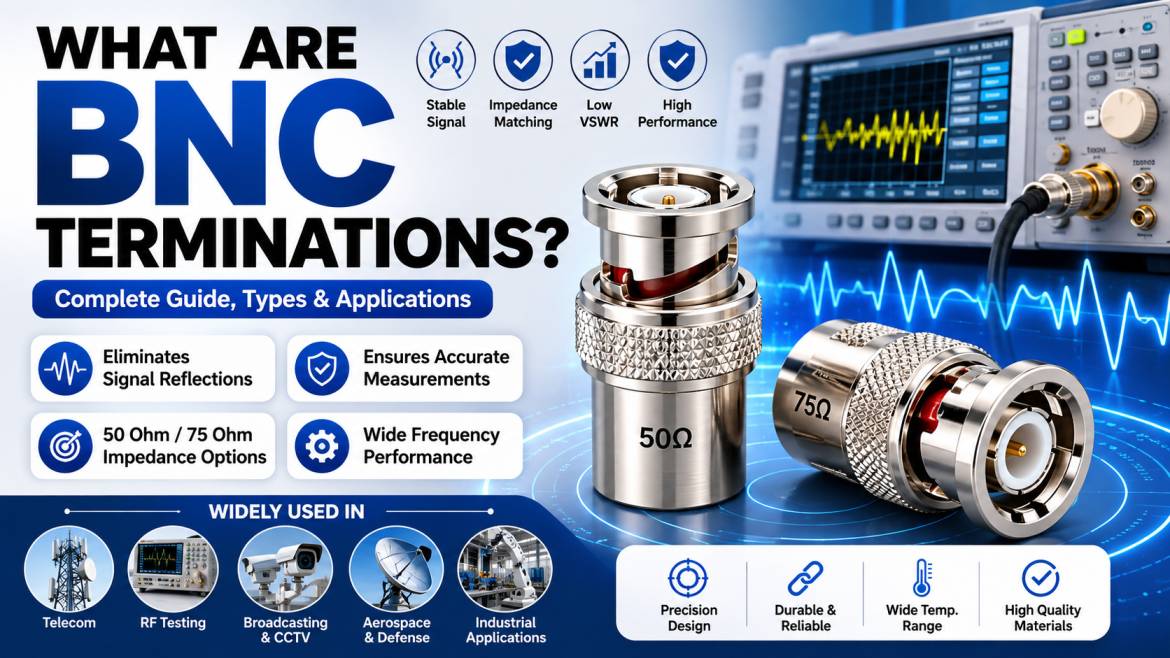
BNC Terminations are passive RF components designed to absorb unwanted radio frequency (RF) signals at the end of a transmission line. They prevent signal reflections caused by open ports or improperly terminated coaxial cables, ensuring maximum signal integrity and stable system performance.
The acronym BNC stands for Bayonet Neill-Concelman, referring to the connector’s quick-lock bayonet coupling mechanism. BNC connectors and terminations are widely used in RF communication systems, laboratory equipment, video transmission, broadcast networks, oscilloscopes, signal generators, and test instruments.
A BNC termination contains a precision resistor inside the connector housing that matches the characteristic impedance of the transmission line. When connected to an unused BNC port, it absorbs the incoming RF energy rather than allowing it to reflect back into the system.
Whether used in telecommunications, defense, broadcasting, medical electronics, or laboratory testing, BNC terminations play a critical role in maintaining accurate signal transmission.
What Is a BNC Termination?
A BNC termination is an impedance-matching device installed on unused BNC connector ports. It consists of a precision resistor enclosed inside a BNC connector body.
The resistor matches the system impedance, typically:
- 50 Ohm BNC Termination
- 75 Ohm BNC Termination
When RF signals reach the termination, they are converted into heat instead of reflecting back through the cable.
This simple device significantly improves measurement accuracy and minimizes standing waves.
Why Are BNC Terminations Important?
Without proper termination, RF signals reaching the end of a cable reflect back toward the source. These reflected signals interfere with incoming signals, causing errors and degraded performance.
Using a BNC termination helps:
- Prevent signal reflections
- Reduce return loss
- Improve VSWR
- Maintain impedance matching
- Increase measurement accuracy
- Protect RF equipment
- Improve network reliability
- Stabilize communication systems
How Does a BNC Termination Work?
Every coaxial cable has a characteristic impedance.
Common values include:
- 50 Ohm
- 75 Ohm
When the cable ends with the same impedance, the RF signal is fully absorbed.
If the impedance is different or left open:
- Signals bounce back
- Standing waves develop
- Measurements become inaccurate
- Signal power decreases
A BNC termination eliminates these problems by providing the correct load impedance.
Construction of a BNC Termination
A high-quality BNC termination typically consists of:
BNC Connector Body
Provides secure mechanical connection.
Precision Resistor
Maintains accurate impedance.
Metal Housing
Offers excellent shielding against EMI and RFI.
Gold-Plated Contacts
Reduce contact resistance and improve conductivity.
Nickel-Plated Brass Body
Provides corrosion resistance and durability.
PTFE Insulator
Ensures excellent dielectric performance over wide frequency ranges.
Types of BNC Terminations
50 Ohm BNC Termination
This is the most common RF termination used in:
- RF communication
- Wireless systems
- Laboratory instruments
- Signal generators
- Spectrum analyzers
- Network analyzers
- Antenna testing
75 Ohm BNC Termination
Used mainly in:
- CCTV systems
- Video broadcasting
- Television equipment
- Digital video interfaces
- Audio-video distribution
Choosing the correct impedance is essential for optimal system performance.
BNC Male and Female Terminations
BNC terminations are available in different connector genders.
BNC Male Termination
Used to terminate female BNC ports.
BNC Female Termination
Used to terminate male BNC connectors.
Selecting the correct connector type ensures a secure and reliable connection.
Key Features of BNC Terminations
Modern BNC terminations offer several performance advantages.
These include:
- Precision impedance matching
- Low VSWR
- High return loss
- Wide frequency coverage
- Excellent RF performance
- Compact design
- Rugged construction
- Corrosion resistance
- Long operational life
- Easy installation
- Reliable electrical contact
- EMI shielding
- Stable performance over temperature variations
Technical Specifications of BNC Terminations
Typical specifications include:
- Connector Interface: BNC Male or Female
- Characteristic Impedance: 50 Ohm or 75 Ohm
- Frequency Range: DC to 4 GHz (higher-frequency versions available)
- VSWR: Typically less than 1.20
- Return Loss: Excellent across operating frequencies
- Body Material: Brass
- Plating: Nickel or Gold
- Insulator Material: PTFE
- Operating Temperature: -55°C to +125°C
- RoHS Compliance: Available
Specifications vary depending on manufacturer and application.
Advantages of Using BNC Terminations
Proper termination provides several important benefits.
Improved Signal Integrity
Signal reflections are minimized, resulting in cleaner RF transmission.
Better Measurement Accuracy
Laboratory instruments produce reliable and repeatable measurements.
Reduced Signal Loss
Energy is absorbed efficiently without unwanted reflections.
Enhanced Equipment Protection
Unused RF ports remain electrically stable.
Lower VSWR
Proper impedance matching improves overall RF system efficiency.
Longer Equipment Life
Reducing reflected power helps protect sensitive RF components.
Reliable Performance
Consistent operation across different environmental conditions.
Applications of BNC Terminations
BNC terminations are widely used across many industries.
RF Test Laboratories
Used with:
- Spectrum analyzers
- Oscilloscopes
- Signal generators
- Power meters
- Network analyzers
Telecommunications
Installed in RF communication networks for impedance matching.
Broadcasting
Used in professional audio and video equipment.
CCTV Systems
Terminate unused video ports in surveillance systems.
Defense Systems
Applied in military communication and radar equipment.
Aerospace
Used in aircraft testing and RF measurement systems.
Medical Equipment
Found in imaging and diagnostic electronics.
Educational Laboratories
Used for electronics experiments and RF training.
Industrial Automation
Installed in communication and monitoring systems.
How to Choose the Right BNC Termination
Selecting the correct BNC termination depends on several factors.
Match the Impedance
Always use:
- 50 Ohm for RF systems
- 75 Ohm for video systems
Verify Frequency Range
Ensure the termination supports your operating frequency.
Check Power Rating
Higher-power systems require higher-rated terminations.
Select Correct Connector Gender
Choose male or female depending on the equipment interface.
Consider Build Quality
Look for precision machining, gold-plated contacts, and PTFE insulation.
Verify Environmental Rating
Industrial environments may require wider operating temperature ranges.
Common Mistakes to Avoid
Avoid these common errors when using BNC terminations.
- Using incorrect impedance
- Leaving RF ports open
- Installing damaged connectors
- Ignoring frequency specifications
- Using low-quality components
- Over-tightening connectors
- Mixing RF and video terminations
BNC Terminations vs Open Ports
Leaving an RF port open causes signal reflections and unstable system behavior.
Using a BNC termination:
- Maintains impedance
- Improves return loss
- Reduces standing waves
- Increases measurement accuracy
- Enhances communication quality
For professional RF systems, unused ports should always be terminated.
Maintenance Tips
Proper maintenance extends service life.
- Keep connectors clean
- Protect from dust and moisture
- Avoid excessive mechanical stress
- Inspect plating regularly
- Replace worn connectors
- Store in dry environments
- Use protective caps when not installed
Why Choose High-Quality BNC Terminations?
Premium BNC terminations deliver:
- Accurate impedance matching
- Stable RF performance
- Excellent shielding
- Low insertion loss
- Superior return loss
- Long-term reliability
- Precision manufacturing
- Consistent electrical characteristics
High-quality terminations are essential for critical RF measurements and communication systems.
Conclusion
BNC Terminations are essential components in RF and video systems that ensure proper impedance matching and eliminate signal reflections. By absorbing unwanted RF energy, they improve signal integrity, reduce VSWR, enhance return loss, and provide accurate measurements across a wide range of applications. Whether used in telecommunications, broadcasting, defense, aerospace, laboratories, or CCTV systems, selecting the correct 50 Ohm or 75 Ohm BNC termination significantly improves system performance and equipment reliability. Investing in precision-engineered BNC terminations ensures long-lasting performance, dependable connectivity, and optimal efficiency in every RF application.
Frequently Asked Questions (FAQs)
1. What is a BNC termination used for?
A BNC termination is used to terminate unused RF or video ports, absorb signal energy, prevent reflections, and maintain proper impedance matching.
2. What is the difference between a 50 Ohm and a 75 Ohm BNC termination?
A 50 Ohm termination is used for RF communication and test equipment, while a 75 Ohm termination is primarily used for video, broadcasting, and CCTV systems.
3. Why is impedance matching important?
Proper impedance matching prevents reflected signals, improves signal quality, reduces VSWR, and ensures accurate measurements.
4. What happens if I do not use a BNC termination?
Without termination, signal reflections occur, leading to standing waves, reduced performance, inaccurate measurements, and possible equipment instability.
5. Can a 50 Ohm BNC termination be used on a 75 Ohm system?
No. Using the wrong impedance causes signal mismatch, reflections, and degraded system performance.
6. What frequency range do BNC terminations support?
Most standard BNC terminations operate from DC up to 4 GHz, while specialized versions support higher frequencies depending on their design.
7. Are BNC terminations reusable?
Yes. High-quality BNC terminations are durable and can be reused multiple times if handled and maintained properly.
8. Where are BNC terminations commonly used?
They are widely used in RF laboratories, telecommunications, broadcasting, aerospace, defense, medical equipment, industrial automation, and CCTV systems.
9. How do I select the correct BNC termination?
Choose the correct impedance (50 Ohm or 75 Ohm), connector gender, frequency range, power rating, and ensure compatibility with your equipment.
10. Why should I choose precision BNC terminations?
Precision BNC terminations provide accurate impedance matching, lower VSWR, better return loss, improved signal integrity, and reliable long-term performance in demanding RF applications.