The SMB Connector is a compact radio frequency (RF) coaxial connector designed for reliable signal transmission in high-frequency electronic systems. Developed as part of the SubMiniature connector family, the SMB connector offers a secure snap-on coupling mechanism, compact size, and excellent electrical performance, making it ideal for applications where space is limited and quick connection is essential.
SMB connectors are widely used in telecommunications, GPS systems, wireless communication, automotive electronics, medical devices, industrial automation, military equipment, satellite communication, and RF test systems. They provide stable impedance, low signal loss, and consistent performance across a wide frequency range.
Compared to larger RF connectors such as Type N or TNC connectors, SMB connectors are significantly smaller while still delivering excellent signal integrity. Their push-on coupling design allows for fast installation and removal without the need for threaded coupling, making them popular in applications requiring frequent connections.
This guide explains everything about SMB connectors, including their construction, working principle, types, specifications, applications, advantages, disadvantages, and selection tips.
What Is an SMB Connector?
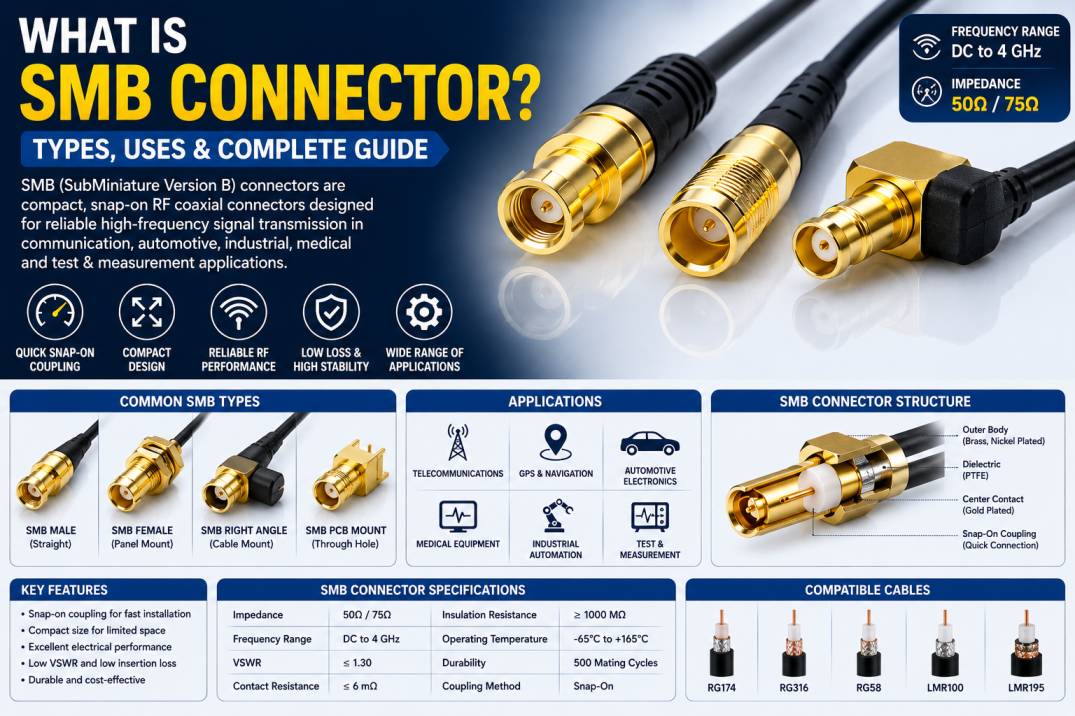
An SMB (SubMiniature Version B) Connector is a 50 Ohm or 75 Ohm coaxial RF connector designed for transmitting high-frequency electrical signals between RF devices. It belongs to the IEC 60169-10 standard and is recognized for its compact size, snap-on coupling mechanism, and reliable electrical performance.
Unlike threaded RF connectors such as SMA or Type N, SMB connectors use a push-on locking mechanism that enables quick mating and unmating while maintaining secure electrical contact.
SMB connectors are suitable for frequencies up to 4 GHz and are commonly used in communication equipment, GPS receivers, wireless antennas, automotive infotainment systems, and medical instruments.
How Does an SMB Connector Work?
An SMB connector transfers RF signals by creating a precise electrical connection between a male and female connector.
The center conductor carries the RF signal while the outer conductor provides grounding and shielding against electromagnetic interference (EMI).
When the connector is pushed into its mating socket, the snap-on locking mechanism securely holds both connectors together, ensuring low contact resistance and consistent impedance.
The coaxial design minimizes signal reflections, reduces insertion loss, and maintains stable signal transmission even at high frequencies.
Construction of an SMB Connector
An SMB connector consists of several precision-engineered components.
Center Contact
The center contact transmits the RF signal.
Common materials include:
- Brass
- Beryllium Copper
- Phosphor Bronze
Most premium connectors feature gold-plated contacts to improve conductivity and corrosion resistance.
Dielectric Insulator
The dielectric separates the center conductor from the outer conductor.
Common dielectric materials include:
- PTFE (Teflon)
- High-performance thermoplastics
PTFE offers excellent insulation and high-temperature resistance.
Outer Body
The connector body provides mechanical strength and shielding.
Typical materials include:
- Brass
- Stainless Steel
- Nickel-plated Brass
Snap-On Coupling
The SMB connector uses a push-on coupling system instead of threads.
Benefits include:
- Fast installation
- Easy removal
- Reliable connection
- Reduced installation time
Types of SMB Connectors
SMB connectors are available in several configurations.
SMB Male Connector
Features a center pin and connects to a female SMB jack.
SMB Female Connector
Contains a center socket designed to receive the male connector.
Straight SMB Connector
Ideal for direct cable routing.
Right-Angle SMB Connector
Used where installation space is limited.
PCB Mount SMB Connector
Designed for printed circuit board applications.
Panel Mount SMB Connector
Installed directly on equipment enclosures.
Cable Mount SMB Connector
Attached directly to coaxial cables.
SMB Connector Specifications
| Specification | Typical Value |
|---|---|
| Impedance | 50 Ohm / 75 Ohm |
| Frequency Range | DC to 4 GHz |
| VSWR | ≤ 1.30 |
| Contact Resistance | ≤ 6 mΩ |
| Insulation Resistance | ≥ 1000 MΩ |
| Operating Temperature | -65°C to +165°C |
| Durability | 500 Mating Cycles |
| Coupling Method | Snap-On |
Common SMB Connector Cable Types
SMB connectors are compatible with numerous RF coaxial cables.
| Cable Type | Typical Application |
|---|---|
| RG174 | GPS Systems |
| RG178 | Compact RF Devices |
| RG316 | Military Equipment |
| RG58 | Wireless Communication |
| LMR100 | RF Modules |
| LMR195 | Antenna Systems |
Key Features of SMB Connectors
- Compact size
- Push-on snap coupling
- Reliable RF performance
- Excellent impedance matching
- Low insertion loss
- High shielding effectiveness
- Quick installation
- Lightweight construction
- Durable mechanical design
- Cost-effective solution
Advantages of SMB Connectors
SMB connectors provide several important benefits.
- Fast push-on connection
- Compact footprint
- Reliable signal transmission
- Low return loss
- Good vibration resistance
- Excellent electrical performance
- Suitable for dense PCB layouts
- High corrosion resistance
- Easy maintenance
- Wide compatibility with RF cables
Limitations of SMB Connectors
Despite their advantages, SMB connectors have certain limitations.
- Lower frequency capability than SMA connectors
- Lower mechanical retention than threaded connectors
- Limited power handling
- Not ideal for harsh outdoor environments without protection
Applications of SMB Connectors
SMB connectors are widely used across numerous industries.
Telecommunications
- Cellular base stations
- RF communication equipment
- Signal repeaters
GPS Systems
- GPS antennas
- Navigation devices
- Fleet tracking systems
Wireless Communication
- Wi-Fi equipment
- RF modules
- Wireless sensors
Automotive Electronics
- Infotainment systems
- GPS navigation
- Vehicle antennas
- ADAS systems
Medical Equipment
- Diagnostic instruments
- Patient monitoring systems
- Portable medical devices
Industrial Automation
- Industrial controllers
- Robotics
- Wireless sensors
Aerospace and Defense
- Military communication
- Radar equipment
- Aircraft electronics
Test and Measurement
- Spectrum analyzers
- RF signal generators
- Oscilloscopes
- Network analyzers
SMB Connector vs SMA Connector
| Feature | SMB Connector | SMA Connector |
|---|---|---|
| Coupling | Snap-On | Threaded |
| Frequency | Up to 4 GHz | Up to 18 GHz or higher |
| Size | Compact | Compact |
| Installation | Quick | Slower |
| Mechanical Strength | Moderate | High |
| Best Applications | Fast Connections | High Frequency RF |
SMB Connector vs MMCX Connector
| Feature | SMB | MMCX |
|---|---|---|
| Size | Larger | Smaller |
| Frequency | Up to 4 GHz | Up to 6 GHz |
| Coupling | Snap-On | Snap-On |
| Durability | Higher | Moderate |
| Applications | Industrial RF | Mobile Devices |
How to Choose the Right SMB Connector
Selecting the correct SMB connector requires evaluating several technical factors.
- Impedance (50 Ohm or 75 Ohm)
- Operating frequency
- Cable compatibility
- Mounting style
- Connector orientation
- Environmental conditions
- Temperature rating
- Gold-plated contacts
- Manufacturer quality
- Required mating cycles
Future Trends of SMB Connectors
Although newer RF connectors continue to emerge, SMB connectors remain widely used because of their compact size and reliable push-on design. Future developments include higher-frequency SMB variants, improved corrosion resistance, enhanced shielding performance, smaller footprints for high-density electronic assemblies, and ruggedized versions for automotive, aerospace, and industrial applications. As wireless communication, IoT, and connected devices continue expanding, SMB connectors will remain an important solution for compact RF interconnections.
Conclusion
SMB connectors are reliable, compact, and cost-effective RF coaxial connectors designed for applications requiring fast installation, dependable electrical performance, and efficient signal transmission. Their snap-on coupling mechanism, excellent impedance matching, and compatibility with various coaxial cables make them ideal for telecommunications, GPS systems, automotive electronics, medical equipment, industrial automation, aerospace, and RF testing. Choosing the appropriate SMB connector based on impedance, frequency range, cable type, and environmental conditions ensures optimal performance and long-term reliability in modern RF systems.
Frequently Asked Questions (FAQs)
1. What is an SMB connector?
An SMB connector is a compact RF coaxial connector with a snap-on coupling mechanism used for transmitting high-frequency signals in communication and electronic systems.
2. What does SMB stand for?
SMB stands for SubMiniature Version B, a family of compact RF connectors designed for quick and reliable connections.
3. What is the frequency range of an SMB connector?
Standard SMB connectors typically operate from DC to 4 GHz, depending on the manufacturer and cable assembly.
4. What impedance options are available for SMB connectors?
SMB connectors are commonly available in 50 Ohm and 75 Ohm impedance versions.
5. What is the difference between SMB and SMA connectors?
SMB connectors use a snap-on coupling, while SMA connectors use a threaded coupling and generally support higher frequencies.
6. Where are SMB connectors used?
SMB connectors are used in GPS systems, wireless communication, automotive electronics, medical equipment, industrial automation, aerospace, and RF test instruments.
7. Which cables are compatible with SMB connectors?
SMB connectors are commonly used with RG174, RG178, RG316, RG58, LMR100, and LMR195 coaxial cables.
8. Are SMB connectors waterproof?
Standard SMB connectors are not waterproof. However, sealed and ruggedized versions are available for outdoor and harsh-environment applications.
9. How many mating cycles can an SMB connector withstand?
Most standard SMB connectors are rated for approximately 500 mating cycles, depending on the manufacturer and construction quality.
10. How do I choose the right SMB connector?
Choose an SMB connector based on impedance, frequency range, cable compatibility, mounting style, operating environment, temperature rating, and required durability to ensure reliable RF performance.