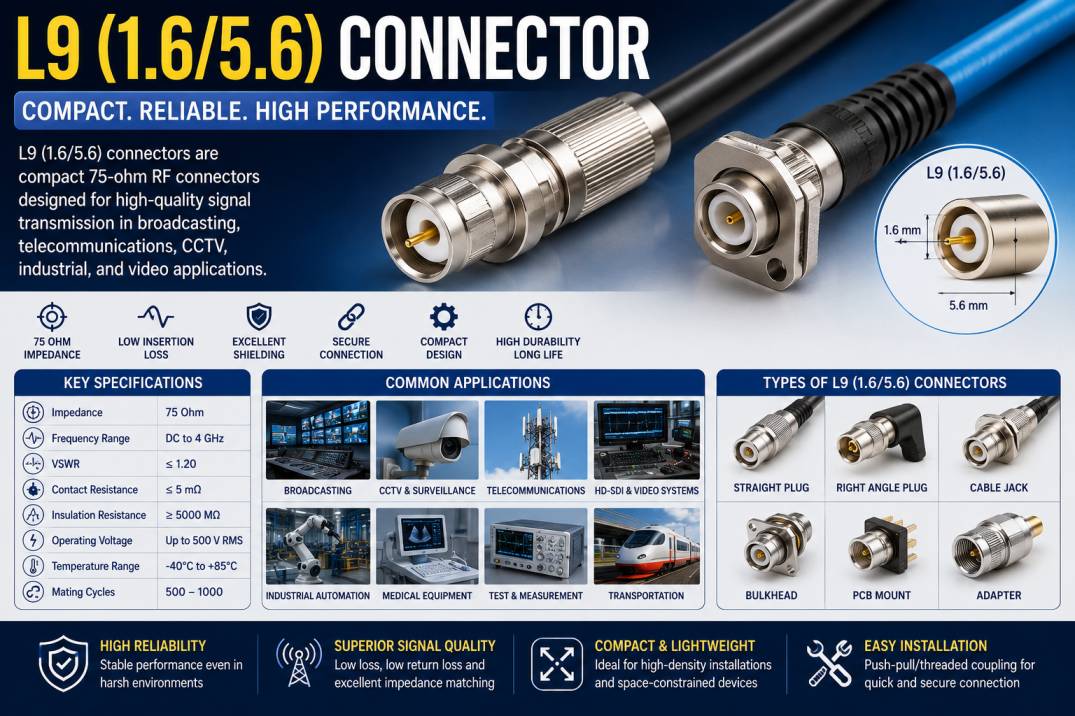
The L9 (1.6/5.6) Connector is a compact coaxial RF connector specifically designed for reliable signal transmission in telecommunications, broadcasting, video transmission, industrial communication, and RF applications. Known for its secure locking mechanism, compact size, and excellent electrical performance, the L9 connector has become a preferred choice for professional communication systems where stable signal transmission and minimal signal loss are essential.
Originally developed for 75-ohm communication systems, the L9 (1.6/5.6) connector is widely used in digital video broadcasting, CCTV systems, telecommunications infrastructure, serial digital interface (SDI) equipment, monitoring systems, and professional audio-video installations. Its compact dimensions allow installation in high-density equipment while maintaining excellent impedance matching and low return loss.
Compared to larger RF connectors such as BNC and N-Type, the L9 connector offers significant space savings without compromising electrical performance. Modern communication systems continue to rely on L9 connectors due to their durability, precision engineering, and compatibility with high-frequency applications.
This comprehensive guide explains everything about the L9 (1.6/5.6) connector, including its construction, working principle, specifications, applications, advantages, types, and selection considerations.
What Is an L9 (1.6/5.6) Connector?
An L9 (1.6/5.6) Connector is a miniature coaxial RF connector designed primarily for 75-ohm impedance applications requiring high-quality signal transmission. The designation “1.6/5.6” refers to the approximate dimensions of the connector’s inner conductor and outer conductor geometry.
The connector provides a secure push-pull or threaded locking mechanism depending on the design, ensuring reliable electrical contact even in environments exposed to vibration or repeated mating cycles.
L9 connectors are widely used for transmitting:
RF signals
Digital video
Analog video
Audio signals
Broadcast signals
Communication data
Monitoring signals
How Does an L9 (1.6/5.6) Connector Work?
An L9 connector transfers RF or video signals through a coaxial structure consisting of a center conductor surrounded by dielectric insulation and an outer shield.
When the male connector is inserted into the female connector, the center conductors make electrical contact while the outer shell simultaneously establishes shielding continuity.
The coaxial structure maintains constant impedance throughout the connection, minimizing:
Signal reflections
Insertion loss
Electromagnetic interference (EMI)
Return loss
The precision mechanical design ensures consistent electrical performance over thousands of connection cycles.
Construction of an L9 (1.6/5.6) Connector
Center Contact
The center pin carries the RF or video signal.
Common materials include:
Brass
Phosphor bronze
Beryllium copper
Gold-plated copper alloy
Gold plating improves conductivity and corrosion resistance.
Dielectric Insulator
The dielectric maintains proper spacing between conductors.
Typical materials include:
PTFE (Teflon)
PE
High-performance engineering plastics
Outer Conductor
The outer conductor provides shielding against electromagnetic interference while maintaining the connector’s characteristic impedance.
Common materials include:
Brass
Nickel-plated brass
Stainless steel
Connector Housing
The housing protects internal components while providing mechanical strength.
Available finishes include:
Nickel plating
Silver plating
Gold plating
Chrome plating
Key Specifications of L9 (1.6/5.6) Connectors
| Specification | Typical Value |
|---|---|
| Characteristic Impedance | 75 Ohms |
| Frequency Range | DC to 4 GHz (varies by design) |
| VSWR | ≤1.20 |
| Contact Resistance | ≤5 mΩ |
| Insulation Resistance | ≥5000 MΩ |
| Operating Voltage | Up to 500 V RMS |
| Operating Temperature | -40°C to +85°C |
| Mating Cycles | 500–1000 |
Types of L9 (1.6/5.6) Connectors
Several connector styles are available depending on installation requirements.
Straight Plug
Suitable for standard cable assemblies.
Right Angle Plug
Ideal for compact equipment with limited installation space.
Cable Jack
Installed directly onto RF cables.
Bulkhead Connector
Used for panel mounting applications.
PCB Mount Connector
Designed for printed circuit board installations.
Adapter Connectors
Available for converting between:
L9 to BNC
L9 to SMA
L9 to N-Type
L9 to F-Type
Common Cable Compatibility
L9 connectors are compatible with several coaxial cable types.
Common cable options include:
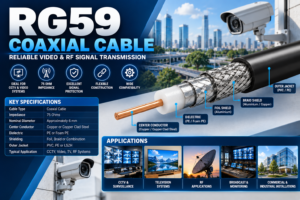
RG59
RG179
RG187
Belden 1505A
Belden 1694A
Low-loss video cables
Broadcast coaxial cables
Applications of L9 (1.6/5.6) Connectors
Broadcasting
Television broadcasting
Digital video transmission
HD-SDI systems
Broadcast studios
CCTV Systems
Surveillance cameras
Video monitoring
Security installations
Control rooms
Telecommunications
Communication equipment
Network infrastructure
Signal transmission
Communication cabinets
Industrial Automation
Machine vision
Industrial monitoring
Control systems
Factory automation
Medical Equipment
Diagnostic imaging
Medical video systems
Monitoring equipment
Test and Measurement
Oscilloscopes
Signal generators
Spectrum analyzers
RF laboratories
Transportation
Railway communication
Traffic monitoring
Airport communication
Marine electronics
Advantages of L9 (1.6/5.6) Connectors
Compact design
Excellent impedance matching
Low insertion loss
Reliable shielding performance
Easy installation
High durability
Excellent vibration resistance
Secure locking mechanism
High-quality signal transmission
Long service life
Corrosion-resistant contacts
Suitable for high-density installations
Limitations of L9 (1.6/5.6) Connectors
Lower power handling than larger RF connectors
Primarily designed for 75-ohm systems
Limited frequency range compared to SMA or 2.92 mm connectors
Requires compatible coaxial cable
L9 (1.6/5.6) Connector vs BNC Connector
| Feature | L9 (1.6/5.6) | BNC |
|---|---|---|
| Size | Smaller | Larger |
| Impedance | 75 Ohms | 50 & 75 Ohms |
| Locking | Push-Pull/Threaded | Bayonet |
| Frequency | Up to 4 GHz | Up to 6 GHz |
| Installation Density | High | Medium |
| Common Applications | Broadcast, CCTV | RF, Video, Test Equipment |
How to Choose the Right L9 Connector
Consider the following factors before selecting an L9 connector:
Cable type
Connector gender
Mounting style
Operating frequency
Voltage requirements
Environmental conditions
Cable diameter
Shielding requirements
Gold or nickel plating
Manufacturer quality certifications
Installation Best Practices
Inspect connector contacts before installation.
Use the correct cable stripping tools.
Ensure proper crimping or soldering.
Avoid excessive cable bending.
Maintain minimum bend radius.
Check impedance compatibility.
Protect connectors from moisture and contaminants.
Perform signal testing after installation.
Maintenance Tips
Clean contacts periodically.
Avoid excessive mating force.
Replace damaged connectors immediately.
Inspect locking mechanisms.
Protect unused connectors with dust caps.
Store connectors in dry environments.
Future Trends of L9 (1.6/5.6) Connectors
As communication networks continue to evolve toward higher bandwidths and more compact equipment, L9 (1.6/5.6) connectors remain valuable in professional broadcasting, surveillance, and telecommunications. Manufacturers are enhancing connector designs with improved shielding, gold-plated contacts, better corrosion resistance, and higher mating cycle durability. The growing adoption of HD video, smart surveillance, transportation infrastructure, and industrial automation is expected to sustain demand for these compact RF connectors.
Conclusion
The L9 (1.6/5.6) connector is a compact, reliable, and high-performance coaxial RF connector widely used in broadcasting, CCTV, telecommunications, industrial automation, and professional video systems. Its excellent impedance matching, secure mechanical connection, low insertion loss, and durable construction make it an ideal choice for applications requiring stable signal transmission and long-term reliability. Selecting the appropriate connector type, cable compatibility, and installation method ensures maximum performance and extended service life in demanding communication environments.
Frequently Asked Questions (FAQs)
1. What is an L9 (1.6/5.6) connector?
An L9 (1.6/5.6) connector is a compact 75-ohm coaxial RF connector used for video, RF, and communication signal transmission in professional applications.
2. What is the characteristic impedance of an L9 connector?
Most L9 (1.6/5.6) connectors are designed with a 75-ohm impedance, making them suitable for broadcast and video systems.
3. What are L9 connectors used for?
They are commonly used in television broadcasting, CCTV, telecommunications, industrial automation, surveillance systems, and professional video equipment.
4. What cables are compatible with L9 connectors?
L9 connectors are commonly used with RG59, RG179, RG187, Belden 1505A, Belden 1694A, and other 75-ohm coaxial cables.
5. What is the frequency range of an L9 connector?
Depending on the design, L9 connectors typically support frequencies from DC to approximately 4 GHz.
6. How is an L9 connector different from a BNC connector?
L9 connectors are smaller and optimized primarily for 75-ohm applications, while BNC connectors are available in both 50-ohm and 75-ohm versions and use a bayonet locking mechanism.
7. Are L9 connectors suitable for outdoor installations?
Yes. Many industrial-grade L9 connectors feature corrosion-resistant plating and weather-resistant designs suitable for outdoor applications when properly sealed.
8. What materials are used in L9 connector contacts?
Contacts are typically made from brass, phosphor bronze, or beryllium copper with gold or nickel plating for improved conductivity and corrosion resistance.
9. How many mating cycles can an L9 connector withstand?
High-quality L9 connectors are generally rated for 500 to 1,000 mating cycles, depending on the manufacturer.
10. How do I choose the right L9 (1.6/5.6) connector?
Choose the connector based on cable compatibility, impedance, mounting style, operating frequency, environmental conditions, connector finish, and application requirements.