Radio Frequency Identification (RFID) technology has revolutionized the way businesses identify, track, and manage assets, inventory, people, and products. At the heart of every RFID system is the RFID Antenna, a critical component responsible for transmitting and receiving radio frequency signals between the RFID reader and RFID tags. Without an antenna, an RFID system cannot communicate effectively with tags or achieve reliable data collection.
RFID Antennas are widely used across industries such as retail, logistics, manufacturing, healthcare, transportation, agriculture, warehousing, aviation, defense, and smart cities. Their ability to enable contactless identification, automate inventory management, improve asset visibility, and enhance operational efficiency makes them an indispensable part of modern automation systems.
Available in various frequencies, polarizations, gains, and mounting styles, RFID antennas are designed to meet the needs of different applications ranging from short-range access control to long-range warehouse tracking. Choosing the correct RFID antenna significantly impacts system performance, read accuracy, and overall efficiency.
This comprehensive guide explains everything you need to know about RFID Antennas, including their working principle, construction, types, specifications, applications, advantages, and selection criteria.
What Is an RFID Antenna?
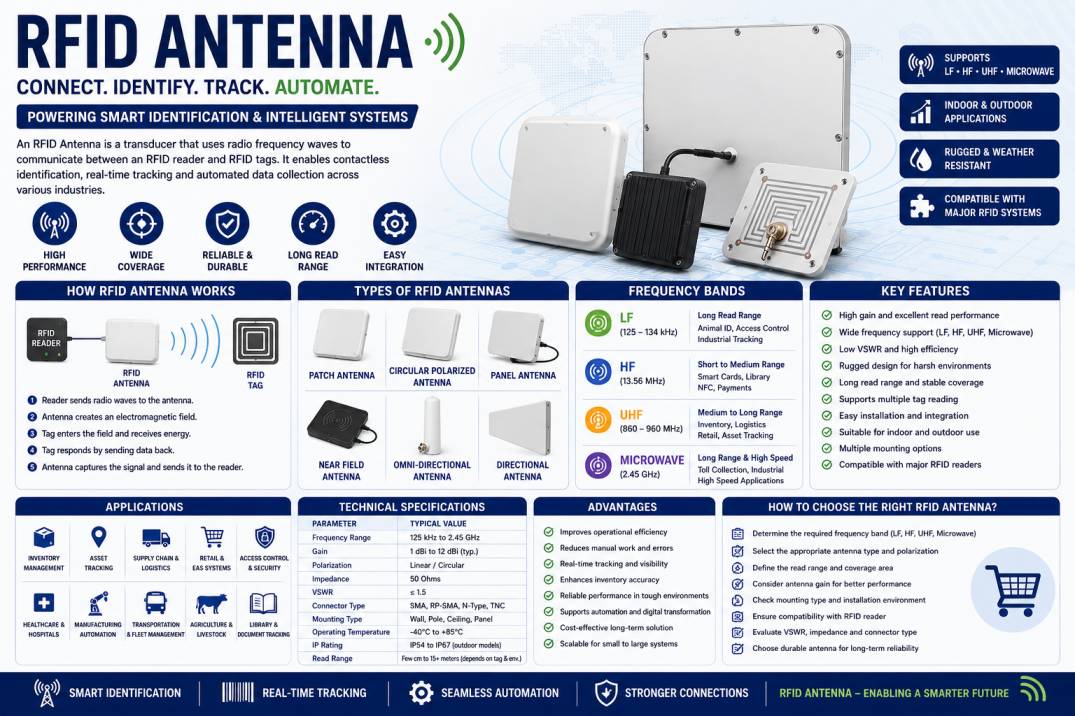
An RFID Antenna is a specialized radio frequency antenna designed to transmit and receive electromagnetic waves between an RFID reader and RFID tags. It converts electrical signals from the RFID reader into RF waves and receives reflected signals from RFID tags, enabling wireless communication and automatic identification.
The RFID antenna determines the reading range, coverage area, signal strength, and overall performance of an RFID system. Depending on the application, RFID antennas can be designed for near-field or far-field communication and can support low frequency (LF), high frequency (HF), ultra-high frequency (UHF), or microwave RFID systems.
Unlike conventional communication antennas, RFID antennas are optimized to provide consistent coverage, reliable tag detection, and accurate data transfer in various operating environments.
How Does an RFID Antenna Work?
An RFID antenna works by transmitting radio frequency energy generated by the RFID reader into the surrounding area.
When an RFID tag enters the antenna’s electromagnetic field, the tag receives energy from the transmitted signal. Passive RFID tags use this energy to activate their internal chip and send stored information back to the reader.
The antenna then receives the reflected signal from the tag and transfers the data to the RFID reader for processing.
The complete communication process includes:
- RFID reader generates RF signal.
- RFID antenna radiates electromagnetic waves.
- RFID tag enters the antenna field.
- Tag responds with stored identification data.
- RFID antenna receives the response.
- Reader decodes the information.
- Data is sent to the software system for monitoring and management.
Construction of an RFID Antenna
Radiating Element
The radiating element generates the electromagnetic field required for communication with RFID tags.
Depending on the antenna type, it may consist of:
- Patch element
- Dipole element
- Loop element
- Microstrip element
Ground Plane
The ground plane improves radiation efficiency and reduces unwanted signal reflections.
It also helps shape the antenna’s radiation pattern.
Dielectric Substrate
The substrate supports the radiating element and maintains electrical insulation.
Common materials include:
- FR4
- PTFE
- Ceramic
- Rogers PCB materials
Connector
The antenna connects to the RFID reader using RF connectors such as:
- SMA
- RP-SMA
- N-Type
- TNC
Protective Housing
Outdoor RFID antennas are enclosed in rugged housings made from:
- ABS Plastic
- Polycarbonate
- Aluminum
- Fiberglass
These housings provide protection against dust, moisture, UV radiation, and harsh weather.
Working Principle of RFID Antennas
The RFID antenna creates an electromagnetic field around its operating area.
When RFID tags enter this field:
- Passive tags harvest RF energy.
- Active tags transmit using their internal battery.
- The antenna receives the returned RF signal.
- The reader processes the received information.
- The system identifies the tagged object.
The efficiency of this communication depends on antenna gain, polarization, frequency, environmental conditions, and tag orientation.
Types of RFID Antennas
Patch RFID Antenna
Patch antennas provide directional coverage and are widely used in inventory management, warehouse automation, and industrial applications.
Circular Polarized RFID Antenna
These antennas transmit circularly polarized signals, allowing reliable tag reading regardless of tag orientation.
Common applications include:
- Retail
- Warehousing
- Logistics
- Conveyor systems
Linear Polarized RFID Antenna
Linear antennas offer longer reading distances when RFID tags maintain a fixed orientation.
Near Field RFID Antenna
Near-field antennas are designed for short-range applications such as:
- Access control
- Smart shelves
- Medical equipment
- Payment systems
Far Field RFID Antenna
Far-field antennas support long-distance identification in warehouses, logistics, and vehicle tracking.
Panel RFID Antenna
Panel antennas provide broad directional coverage and are commonly installed at warehouse gates and loading docks.
Omni-Directional RFID Antenna
Omni-directional antennas provide 360-degree coverage and are suitable for mobile RFID systems.
RFID Frequency Bands
RFID antennas operate across multiple frequency bands.
Low Frequency (LF)
Frequency:
125–134 kHz
Applications:
- Animal identification
- Access control
- Industrial tracking
High Frequency (HF)
Frequency:
13.56 MHz
Applications:
- Smart cards
- Library management
- Contactless payment
- NFC systems
Ultra High Frequency (UHF)
Frequency:
860–960 MHz
Applications:
- Warehouse management
- Retail
- Supply chain
- Asset tracking
Microwave RFID
Frequency:
2.45 GHz
Applications:
- High-speed identification
- Toll collection
- Specialized industrial systems
Technical Specifications
| Specification | Typical Value |
| Frequency Range | 125 kHz to 2.45 GHz |
| Polarization | Linear / Circular |
| Gain | 1 dBi to 12 dBi |
| Impedance | 50 Ohms |
| VSWR | ≤ 1.50 |
| Connector Type | SMA, N-Type, RP-SMA |
| Mounting Type | Wall, Pole, Ceiling, Panel |
| Operating Temperature | -40°C to +85°C |
| IP Rating | IP54 to IP67 |
| Read Range | Few centimeters to over 15 meters |
Key Features of RFID Antennas
- High reading accuracy
- Excellent signal coverage
- Reliable tag detection
- Low VSWR
- High durability
- Indoor and outdoor models
- Wide frequency support
- Compact design
- Easy installation
- High environmental resistance
- Long operational life
- Multiple mounting options
Applications of RFID Antennas
Inventory Management
Tracks inventory in warehouses and distribution centers.
Asset Tracking
Monitors valuable equipment and fixed assets.
Retail
Supports automated checkout and stock management.
Supply Chain
Improves logistics visibility and shipment tracking.
Healthcare
Tracks medical equipment, medicines, and patient records.
Manufacturing
Automates production monitoring and inventory control.
Transportation
Supports vehicle identification and fleet management.
Access Control
Provides secure employee and visitor authentication.
Agriculture
Tracks livestock and farming equipment.
Smart Cities
Supports intelligent transportation and public infrastructure management.
Advantages of RFID Antennas
- Contactless identification
- Fast data collection
- High reading accuracy
- Multiple tag reading capability
- Reduced manual labor
- Improved inventory visibility
- Increased operational efficiency
- Long reading distance
- Reliable performance
- Easy integration
- Low maintenance
- Supports automation
Limitations of RFID Antennas
- Metal surfaces may affect performance
- Liquids can reduce reading efficiency
- Higher installation cost than barcode systems
- Requires compatible RFID readers
- Read range depends on antenna design and frequency
How to Choose the Right RFID Antenna
When selecting an RFID antenna, consider the following:
- Operating frequency
- Required read range
- Polarization
- Gain
- Indoor or outdoor installation
- Mounting method
- Connector compatibility
- Environmental protection
- Number of tags to be read
- Application requirements
RFID Antenna vs Barcode Scanner
| Feature | RFID Antenna | Barcode Scanner |
| Reading Method | Wireless | Optical |
| Line of Sight | Not Required | Required |
| Multiple Tag Reading | Yes | No |
| Reading Speed | Very High | Moderate |
| Automation | Excellent | Limited |
| Read Range | Up to 15+ meters | Few centimeters |
| Data Storage | High | Limited |
Industries Using RFID Antennas
RFID Antennas are widely used in:
- Retail
- Warehousing
- Logistics
- Healthcare
- Manufacturing
- Transportation
- Automotive
- Agriculture
- Aviation
- Defense
- Smart Cities
- Industrial Automation
Maintenance Tips
To maximize RFID antenna performance:
- Keep the antenna surface clean.
- Inspect RF connectors regularly.
- Avoid installing near strong interference sources.
- Mount antennas correctly.
- Protect outdoor antennas from physical damage.
- Verify cable integrity periodically.
- Test read performance during maintenance.
Future Trends of RFID Antennas
The increasing adoption of Industry 4.0, smart manufacturing, AI-powered automation, IoT, autonomous warehouses, and smart cities is driving rapid innovation in RFID antenna technology. Modern RFID antennas are becoming smaller, lighter, and more efficient while supporting longer read ranges, higher gain, improved polarization, and better resistance to environmental interference. Future developments will include AI-assisted RFID tracking, integration with cloud platforms, advanced beam-steering antennas, and compatibility with next-generation industrial automation systems, enabling faster, more accurate, and highly scalable asset tracking solutions.
Conclusion
RFID Antennas are one of the most important components of modern RFID systems, enabling fast, reliable, and contactless communication between RFID readers and tags. Their ability to provide accurate identification, long read ranges, and efficient data collection makes them essential in industries such as retail, logistics, healthcare, manufacturing, transportation, and smart city infrastructure. By selecting the appropriate frequency band, antenna type, gain, polarization, and mounting configuration, organizations can maximize RFID system performance, improve operational efficiency, and achieve reliable asset visibility across a wide range of applications.
Frequently Asked Questions (FAQs)
1. What is an RFID Antenna?
An RFID Antenna is a radio frequency device that transmits and receives RF signals between an RFID reader and RFID tags for wireless identification and tracking.
2. What is the purpose of an RFID Antenna?
Its primary purpose is to create an electromagnetic field that enables RFID tags to communicate with the RFID reader for data transmission.
3. What are the different types of RFID Antennas?
Common types include Patch Antennas, Circular Polarized Antennas, Linear Polarized Antennas, Near Field Antennas, Far Field Antennas, Panel Antennas, and Omni-Directional Antennas.
4. What frequency bands do RFID Antennas support?
RFID antennas typically support LF (125–134 kHz), HF (13.56 MHz), UHF (860–960 MHz), and Microwave (2.45 GHz) frequency bands.
5. What is the difference between linear and circular polarized RFID antennas?
Linear polarized antennas provide longer read distances for fixed tag orientations, while circular polarized antennas can read tags reliably regardless of their orientation.
6. Where are RFID Antennas commonly used?
They are widely used in inventory management, retail, logistics, healthcare, manufacturing, transportation, access control, agriculture, and industrial automation.
7. What is the typical read range of an RFID Antenna?
Depending on the frequency band, gain, and tag type, RFID antennas can read tags from a few centimeters to more than 15 meters.
8. Can RFID Antennas be used outdoors?
Yes. Many RFID antennas are available with rugged, weatherproof enclosures and IP-rated protection for outdoor installations.
9. What are the advantages of RFID Antennas?
They provide contactless identification, high-speed data collection, multiple tag reading, improved inventory accuracy, long service life, and support for automated systems.
10. How do I choose the right RFID Antenna?
Choose an RFID antenna based on operating frequency, read range, antenna gain, polarization, installation environment, mounting type, connector compatibility, and the specific requirements of your RFID application.