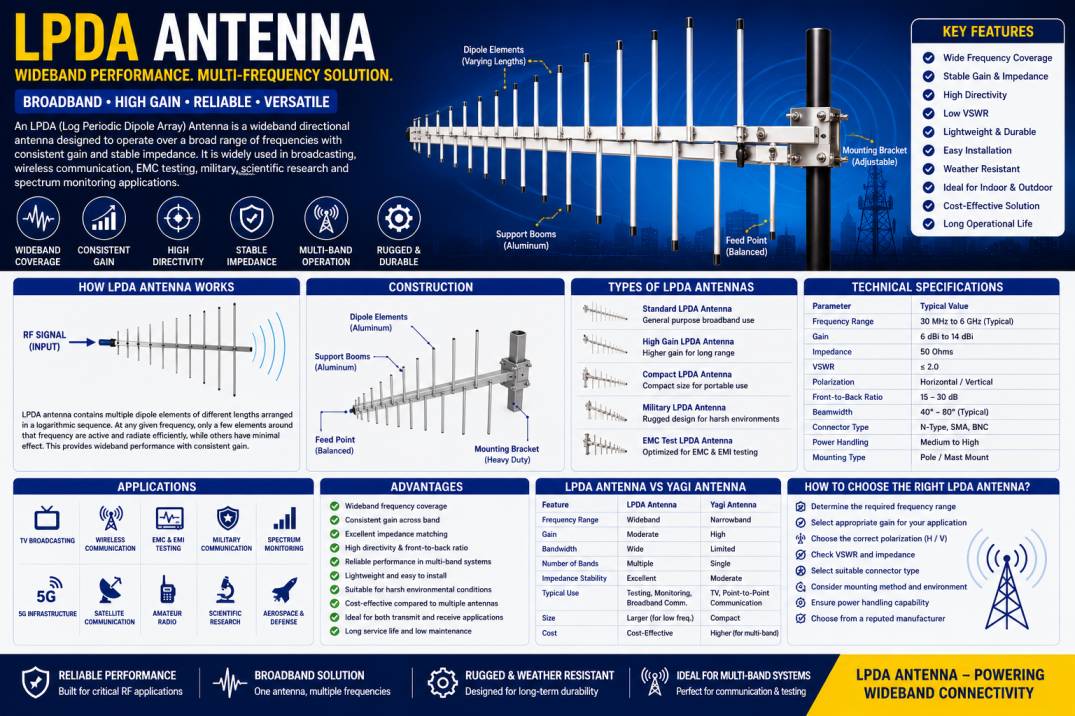
An LPDA Antenna, or Log Periodic Dipole Array Antenna, is a broadband directional antenna designed to operate efficiently across a wide range of frequencies. Unlike conventional antennas that are optimized for a narrow frequency band, an LPDA antenna provides consistent gain, stable radiation patterns, and reliable impedance over multiple frequency ranges, making it one of the most versatile antennas used in modern RF and microwave communication.
LPDA antennas are widely deployed in television broadcasting, military communication, electronic warfare, wireless communication, EMC testing, satellite systems, radio monitoring, scientific research, and 5G infrastructure. Their broadband characteristics allow a single antenna to replace multiple narrowband antennas, reducing installation costs while improving operational flexibility.
The unique arrangement of multiple dipole elements with varying lengths and spacing enables the LPDA antenna to maintain nearly constant electrical performance across its operating frequency range. This makes it particularly valuable in applications requiring wideband signal reception, frequency scanning, and spectrum monitoring.
This comprehensive guide explains everything you need to know about LPDA Antennas, including their construction, working principle, specifications, types, applications, advantages, and selection criteria.
What Is an LPDA Antenna?
An LPDA Antenna (Log Periodic Dipole Array Antenna) is a directional broadband antenna consisting of multiple dipole elements of different lengths mounted along two conductive booms. The dipoles are arranged according to logarithmic spacing, allowing the antenna to maintain consistent electrical performance over a wide frequency range.
Unlike Yagi antennas, which are designed for a single frequency band, LPDA antennas provide stable gain and impedance across multiple frequencies.
The antenna is widely used wherever continuous frequency coverage is required without changing antennas.
How Does an LPDA Antenna Work?
An LPDA antenna operates by activating different dipole elements depending on the transmitted or received frequency.
When a high-frequency signal is applied, the smaller dipole elements near the front of the antenna become active.
As the operating frequency decreases, progressively larger dipole elements farther along the boom become active.
Only a small group of elements around the operating frequency radiates efficiently at any given time, while the remaining elements have minimal influence.
This frequency-dependent operation enables broadband performance with nearly constant radiation characteristics.
Construction of an LPDA Antenna
Dipole Elements
The antenna contains multiple dipole elements with gradually changing lengths.
Each element is optimized for a specific frequency range.
Common materials include:
- Aluminum
- Copper
- Stainless Steel
Support Booms
Two conductive booms support the dipole elements and act as the balanced transmission line.
The booms provide mechanical strength while maintaining proper electrical connections.
Feed Point
The feed line connects to the booms and delivers RF energy to the active dipole elements.
Balanced feeding improves impedance stability and radiation efficiency.
Mounting Bracket
The mounting bracket allows secure installation on towers, poles, rooftops, or testing equipment.
Protective Hardware
Outdoor LPDA antennas include corrosion-resistant fasteners, weatherproof coatings, and UV-resistant materials for long service life.
Working Principle of an LPDA Antenna
The LPDA antenna operates according to the logarithmic periodic design principle.
The operating sequence is as follows:
- RF signal enters the feed point.
- Electrical energy travels through the booms.
- Dipole elements resonate according to frequency.
- Active elements radiate the RF signal.
- Inactive elements have minimal effect.
- The antenna produces a directional radiation pattern.
- Broadband communication is achieved with stable gain.
Technical Specifications
| Specification | Typical Value |
|---|---|
| Frequency Range | 30 MHz to 6 GHz (Depending on Model) |
| Gain | 6 dBi to 14 dBi |
| Impedance | 50 Ohms |
| VSWR | ≤ 2.0 |
| Polarization | Horizontal or Vertical |
| Front-to-Back Ratio | 15–30 dB |
| Beamwidth | 40°–80° |
| Connector Type | N-Type, SMA, BNC |
| Power Handling | Medium to High |
| Mounting Type | Pole or Mast Mount |
Key Features of LPDA Antennas
- Wide frequency coverage
- Broadband operation
- Stable gain
- Excellent directivity
- Constant impedance
- Low VSWR
- Lightweight construction
- Corrosion-resistant materials
- Easy installation
- Reliable outdoor performance
- High durability
- Long operational life
Types of LPDA Antennas
Standard LPDA Antenna
Designed for general broadband communication and testing applications.
High Gain LPDA Antenna
Provides increased directional gain for long-distance communication.
Compact LPDA Antenna
Designed for portable and space-constrained installations.
Military LPDA Antenna
Built for rugged environments with enhanced durability and wideband performance.
EMC Test LPDA Antenna
Used in electromagnetic compatibility (EMC) and EMI compliance testing laboratories.
Outdoor LPDA Antenna
Designed with weatherproof materials for long-term outdoor deployment.
Applications of LPDA Antennas
Television Broadcasting
Receives multiple television frequency bands using a single antenna.
Wireless Communication
Supports broadband communication across multiple RF frequencies.
Military Communication
Used in tactical communication, surveillance, and electronic warfare.
EMC Testing
Measures electromagnetic emissions and immunity during compliance testing.
Spectrum Monitoring
Monitors wide frequency bands for signal analysis.
Amateur Radio
Supports multi-band communication without changing antennas.
Scientific Research
Used in universities and research laboratories for RF experiments.
Aerospace
Supports aircraft communication testing and radar measurements.
5G Communication
Used for testing broadband wireless communication equipment.
Industrial Monitoring
Supports wireless monitoring and industrial communication systems.
Advantages of LPDA Antennas
- Wide operating frequency range
- Consistent gain across frequencies
- Excellent impedance stability
- Broadband performance
- High directivity
- Reliable signal reception
- Lightweight design
- Easy maintenance
- Cost-effective for multi-band systems
- Suitable for indoor and outdoor applications
- Long service life
- Reduced need for multiple antennas
Limitations of LPDA Antennas
- Lower gain than large Yagi antennas
- Larger physical size for lower frequencies
- Moderate front-to-back ratio
- Requires proper alignment for maximum performance
- More complex construction than simple dipole antennas
How to Choose the Right LPDA Antenna
When selecting an LPDA antenna, consider the following:
- Operating frequency range
- Required antenna gain
- Polarization
- Connector type
- Mounting method
- Beamwidth
- Environmental conditions
- Wind loading
- Power handling
- Installation location
LPDA Antenna vs Yagi Antenna
| Feature | LPDA Antenna | Yagi Antenna |
|---|---|---|
| Frequency Range | Broadband | Narrowband |
| Gain | Moderate | High |
| Bandwidth | Wide | Limited |
| Number of Frequency Bands | Multiple | Single |
| Impedance Stability | Excellent | Moderate |
| Typical Applications | Testing, Monitoring | Television, Fixed Communication |
Industries Using LPDA Antennas
LPDA antennas are widely used in:
- Telecommunications
- Broadcasting
- Defense
- Aerospace
- EMC Laboratories
- Scientific Research
- Industrial Automation
- Wireless Communication
- Government Agencies
- RF Testing Facilities
Maintenance Tips
To maximize antenna performance:
- Inspect mounting hardware regularly.
- Keep connector interfaces clean.
- Tighten loose fasteners.
- Protect connectors from moisture.
- Check cable integrity periodically.
- Remove dirt and debris from antenna elements.
- Verify antenna alignment during routine inspections.
Future Trends of LPDA Antennas
The rapid expansion of broadband communication, 5G, 6G research, spectrum monitoring, electronic warfare, and EMC compliance testing continues to increase demand for LPDA antennas. Manufacturers are developing lighter materials, higher-gain designs, improved weather resistance, and optimized broadband performance. Advanced simulation techniques and precision manufacturing are enabling LPDA antennas to deliver better impedance stability, wider bandwidth, and enhanced radiation characteristics for next-generation wireless communication and testing applications.
Conclusion
LPDA Antennas are among the most versatile broadband antennas available for RF and microwave communication systems. Their ability to maintain stable gain, consistent impedance, and reliable performance across a wide frequency range makes them an ideal solution for broadcasting, military communication, EMC testing, scientific research, spectrum monitoring, and modern wireless networks. By selecting the appropriate frequency range, gain, polarization, and installation method, users can achieve dependable broadband communication with excellent long-term performance.
Frequently Asked Questions (FAQs)
1. What is an LPDA Antenna?
An LPDA (Log Periodic Dipole Array) Antenna is a broadband directional antenna designed to operate efficiently across a wide range of frequencies while maintaining stable gain and impedance.
2. What is an LPDA Antenna used for?
LPDA antennas are used in television broadcasting, wireless communication, EMC testing, military communication, spectrum monitoring, scientific research, and 5G testing.
3. How does an LPDA Antenna work?
An LPDA antenna activates different dipole elements depending on the operating frequency, allowing it to maintain broadband performance across a wide frequency range.
4. What is the frequency range of an LPDA Antenna?
Depending on the design, LPDA antennas typically operate from 30 MHz to 6 GHz, with specialized models covering even wider frequency ranges.
5. What are the advantages of an LPDA Antenna?
LPDA antennas provide wide bandwidth, stable gain, excellent impedance matching, reliable directivity, broadband operation, and long service life.
6. What is the difference between an LPDA Antenna and a Yagi Antenna?
An LPDA antenna supports multiple frequency bands with broadband performance, while a Yagi antenna is optimized for a narrow frequency range with higher gain.
7. Which connector types are commonly used with LPDA Antennas?
Common connectors include N-Type, SMA, and BNC, depending on the antenna model and application.
8. Can LPDA Antennas be used outdoors?
Yes. Most LPDA antennas are designed with weather-resistant materials and corrosion protection for reliable outdoor operation.
9. Which industries commonly use LPDA Antennas?
LPDA antennas are widely used in telecommunications, broadcasting, aerospace, defense, EMC laboratories, scientific research, industrial automation, and RF testing facilities.
10. How do I choose the right LPDA Antenna?
Choose an LPDA antenna based on operating frequency range, antenna gain, polarization, connector type, beamwidth, environmental conditions, mounting method, and the specific requirements of your communication or testing application.