A Band Pass Filter (BPF) is one of the most important passive components used in radio frequency (RF), microwave, wireless communication, and electronic systems. It is specifically designed to allow signals within a desired frequency range to pass while rejecting frequencies below and above that range. This selective filtering capability makes Band Pass Filters essential for maintaining signal quality, reducing interference, and improving overall communication system performance.
Modern communication technologies such as 4G LTE, 5G NR, Wi-Fi, Bluetooth, satellite communication, radar, GPS, broadcasting, aerospace, military electronics, and IoT rely heavily on Band Pass Filters to isolate useful signals from unwanted noise and interference.
As wireless networks become increasingly crowded and operate at higher frequencies, precise filtering becomes more critical than ever. High-performance Band Pass Filters help prevent adjacent channel interference, reduce signal distortion, improve receiver sensitivity, and protect sensitive RF equipment.
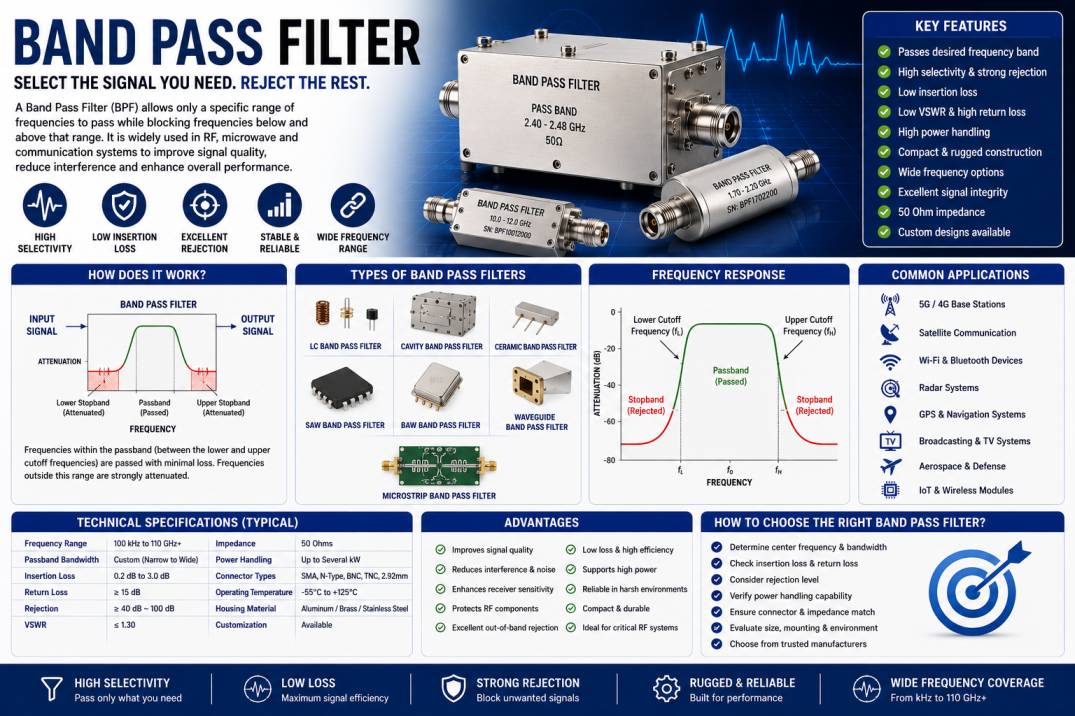
Band Pass Filters are available in numerous designs, including cavity filters, ceramic filters, SAW filters, BAW filters, waveguide filters, coaxial filters, LC filters, and microstrip filters. Each type is optimized for specific frequency ranges and applications.
This comprehensive guide explains everything about Band Pass Filters, including their working principle, construction, types, specifications, applications, advantages, and selection criteria.
What Is a Band Pass Filter?
A Band Pass Filter is an electronic or RF component that allows signals within a specific frequency band to pass while attenuating frequencies outside the selected range.
It combines the functions of a high-pass filter and a low-pass filter into a single device.
The high-pass section blocks frequencies below the lower cutoff frequency.
The low-pass section blocks frequencies above the upper cutoff frequency.
Only signals between these two cutoff frequencies are transmitted with minimal attenuation.
Band Pass Filters are available for frequencies ranging from a few kilohertz to hundreds of gigahertz depending on the application.
How Does a Band Pass Filter Work?
A Band Pass Filter operates by selectively passing a predefined frequency range while rejecting unwanted frequencies.
The filtering process includes:
- RF signal enters the filter.
- Low-frequency components below the lower cutoff are blocked.
- High-frequency components above the upper cutoff are blocked.
- Desired frequencies within the passband are transmitted.
- Output signal contains only the required frequency band.
This process significantly improves communication quality and minimizes interference from neighboring channels.
Construction of a Band Pass Filter
Input Connector
The input connector receives the RF signal from the source.
Common connector types include:
- SMA
- N-Type
- BNC
- TNC
- 2.92 mm
- 2.4 mm
Resonator
The resonator determines the operating frequency of the filter.
Common resonator technologies include:
- Cavity resonators
- Ceramic resonators
- LC resonators
- Dielectric resonators
- Microstrip resonators
Coupling Structure
The coupling structure controls bandwidth and insertion loss.
Different coupling methods are used depending on filter type and operating frequency.
Shielded Housing
The metal enclosure protects the filter from external electromagnetic interference and ensures mechanical stability.
Materials commonly used include:
- Aluminum
- Brass
- Stainless Steel
Output Connector
The filtered RF signal exits through the output connector.
Working Principle of a Band Pass Filter
The filter uses resonant circuits that respond only to a specific frequency range.
The operating sequence includes:
- Signal enters the filter.
- Desired frequencies resonate inside the filter structure.
- Out-of-band frequencies are attenuated.
- Only passband frequencies reach the output.
- Signal integrity is preserved with minimal distortion.
Types of Band Pass Filters
LC Band Pass Filter
Constructed using inductors and capacitors.
Commonly used in low-frequency and general electronic circuits.
Cavity Band Pass Filter
Uses metal cavity resonators.
Provides excellent selectivity and low insertion loss.
Ideal for:
- Base stations
- Satellite communication
- Radar
Ceramic Band Pass Filter
Uses ceramic resonators.
Offers compact size and stable performance.
Used in:
- Mobile phones
- GPS
- Wireless communication
SAW Band Pass Filter
Surface Acoustic Wave filters provide high precision for lower microwave frequencies.
Applications include:
- Mobile devices
- Television receivers
- GPS systems
BAW Band Pass Filter
Bulk Acoustic Wave filters support higher frequencies used in modern 5G smartphones and wireless communication systems.
Waveguide Band Pass Filter
Designed for microwave and millimeter-wave frequencies.
Used in:
- Aerospace
- Radar
- Satellite systems
Microstrip Band Pass Filter
Manufactured directly on printed circuit boards.
Common in compact RF modules and wireless devices.
Technical Specifications
| Specification | Typical Value |
|---|---|
| Frequency Range | 100 kHz to 110 GHz+ |
| Characteristic Impedance | 50 Ohms |
| Passband Bandwidth | Custom |
| Insertion Loss | Low |
| Return Loss | High |
| VSWR | ≤ 1.30 |
| Power Handling | Up to Several Kilowatts |
| Connector Types | SMA, N-Type, BNC, TNC |
| Operating Temperature | -55°C to +125°C |
| Housing Material | Aluminum / Brass / Stainless Steel |
Key Features of Band Pass Filters
- High frequency selectivity
- Low insertion loss
- Excellent rejection
- Stable performance
- High power handling
- Wide frequency coverage
- Low VSWR
- Excellent impedance matching
- Compact design
- Reliable operation
- Long service life
- High-quality signal transmission
Applications of Band Pass Filters
5G Communication
Filters unwanted frequencies in base stations and small cells.
Satellite Communication
Improves signal quality in uplink and downlink communication.
Radar Systems
Removes unwanted microwave interference.
Wireless Networks
Used in Wi-Fi, Bluetooth, and IoT communication.
GPS Systems
Filters satellite navigation signals.
Broadcasting
Supports television and radio transmission.
Aerospace
Used in aircraft communication and navigation equipment.
Military Communication
Supports secure RF communication and electronic warfare systems.
Medical Equipment
Used in MRI systems and RF diagnostic equipment.
Scientific Research
Supports precision microwave measurements in laboratories.
Advantages of Band Pass Filters
- Eliminates unwanted frequencies
- Improves signal quality
- Reduces interference
- Enhances receiver sensitivity
- Protects RF equipment
- Excellent frequency selectivity
- Low signal distortion
- High reliability
- Wide frequency compatibility
- Long operational life
- Supports high-power applications
- Easy integration into RF systems
Limitations of Band Pass Filters
- Frequency range is fixed in most designs
- Precision filters are more expensive
- Insertion loss cannot be completely eliminated
- Narrowband filters require accurate manufacturing
- Performance depends on proper impedance matching
How to Choose the Right Band Pass Filter
Before selecting a Band Pass Filter, consider:
- Operating frequency
- Required bandwidth
- Insertion loss
- Return loss
- VSWR
- Power handling
- Connector type
- Environmental conditions
- Mounting style
- Application requirements
Band Pass Filter vs Band Stop Filter
| Feature | Band Pass Filter | Band Stop Filter |
|---|---|---|
| Signal Passed | Selected Frequency Band | All Except Selected Band |
| Signal Blocked | Outside Passband | Inside Stopband |
| Primary Function | Signal Selection | Interference Rejection |
| Applications | Communication Systems | Noise Suppression |
| Frequency Response | Passes Desired Band | Rejects Specific Band |
Industries Using Band Pass Filters
Band Pass Filters are widely used in:
- Telecommunications
- Aerospace
- Defense
- Satellite Communication
- Broadcasting
- Medical Electronics
- Automotive Radar
- Industrial Automation
- Scientific Research
- Semiconductor Manufacturing
Maintenance Tips
To maximize filter performance:
- Keep RF connectors clean.
- Avoid excessive mechanical shock.
- Protect from moisture and dust.
- Use proper connector torque.
- Inspect insertion loss periodically.
- Verify VSWR during maintenance.
- Store in clean, dry conditions.
Future Trends of Band Pass Filters
The rapid deployment of 5G Advanced, 6G, satellite internet, autonomous vehicles, Wi-Fi 7, and millimeter-wave communication is driving innovation in Band Pass Filter technology. Future filters will feature lower insertion loss, higher rejection, wider bandwidth options, compact integrated designs, improved thermal stability, and advanced materials such as Bulk Acoustic Wave (BAW), Surface Acoustic Wave (SAW), and dielectric resonator technologies. AI-driven RF optimization and miniaturized filter architectures will further improve communication efficiency while supporting higher operating frequencies beyond 110 GHz.
Conclusion
Band Pass Filters are essential RF components that allow only the desired frequency band to pass while rejecting unwanted signals and interference. Their ability to improve signal quality, enhance receiver sensitivity, reduce noise, and protect communication equipment makes them indispensable in telecommunications, satellite communication, aerospace, defense, radar, broadcasting, medical electronics, and wireless networking. Selecting the correct Band Pass Filter based on frequency range, bandwidth, insertion loss, impedance, power handling, and application requirements ensures reliable RF system performance and long-term operational efficiency.
Frequently Asked Questions (FAQs)
1. What is a Band Pass Filter?
A Band Pass Filter is an RF or electronic filter that allows signals within a selected frequency range to pass while rejecting frequencies outside that range.
2. What is the purpose of a Band Pass Filter?
Its primary purpose is to improve signal quality by allowing only the desired frequencies to pass while eliminating unwanted interference and noise.
3. How does a Band Pass Filter work?
It combines high-pass and low-pass filtering principles to pass frequencies between the lower and upper cutoff frequencies while blocking signals outside the passband.
4. What are the different types of Band Pass Filters?
Common types include LC Filters, Cavity Filters, Ceramic Filters, SAW Filters, BAW Filters, Waveguide Filters, and Microstrip Filters.
5. What industries use Band Pass Filters?
Band Pass Filters are widely used in telecommunications, aerospace, defense, satellite communication, broadcasting, medical electronics, automotive radar, industrial automation, and scientific research.
6. What frequency range can a Band Pass Filter support?
Depending on the design, Band Pass Filters can operate from 100 kHz to more than 110 GHz.
7. What are the advantages of a Band Pass Filter?
They provide excellent frequency selectivity, low insertion loss, reduced interference, improved signal quality, equipment protection, and reliable RF performance.
8. What is the difference between a Band Pass Filter and a Band Stop Filter?
A Band Pass Filter allows a selected frequency range to pass while blocking all other frequencies, whereas a Band Stop Filter blocks only a specific frequency range and allows the remaining frequencies to pass.
9. Can Band Pass Filters handle high RF power?
Yes. High-power cavity and waveguide Band Pass Filters are available for applications requiring power handling from several watts to multiple kilowatts.
10. How do I choose the right Band Pass Filter?
Choose a Band Pass Filter based on operating frequency, bandwidth, insertion loss, return loss, VSWR, connector type, power handling, environmental conditions, and the specific requirements of your RF communication or microwave application.